When the Customer Is an AI: How Shopping Agents Change E-Commerce

Table of Contents
Agentic commerce is what happens when an AI agent does the shopping for a person, researching, comparing, choosing, and increasingly completing the purchase, without the human ever visiting your store. It's the step beyond AI answer engines: not just getting your store cited in an answer, but getting your product chosen and bought by software. The stores that win it won't be the ones with the prettiest pages. They'll be the ones an agent can read, trust, and transact with cleanly.
This is the forward edge of the Discoverability cluster. It's the most genuinely new shift in e-commerce right now, and the one most worth understanding early, precisely because most stores are still optimising entirely for human eyes.
What agentic commerce actually is
Strip the hype and it's simple. An AI agent is goal-directed software that can act, not just answer. Agentic commerce is when a person hands a shopping goal to such an agent, "find me the best office chair under €300 with good reviews and fast delivery, and order it", and the agent does the work: it researches options, compares them on the buyer's actual criteria, decides, and increasingly can complete the purchase. The human sets the intent. The agent does the shopping.
That's the part to sit with. For thirty years, e-commerce assumed a human would arrive at a store, look at it, and decide. Agentic commerce breaks that assumption. The deciding party may now be software that never looks at your store the way a person does, and may never load your homepage at all.
Why this is the next step after GEO and AEO
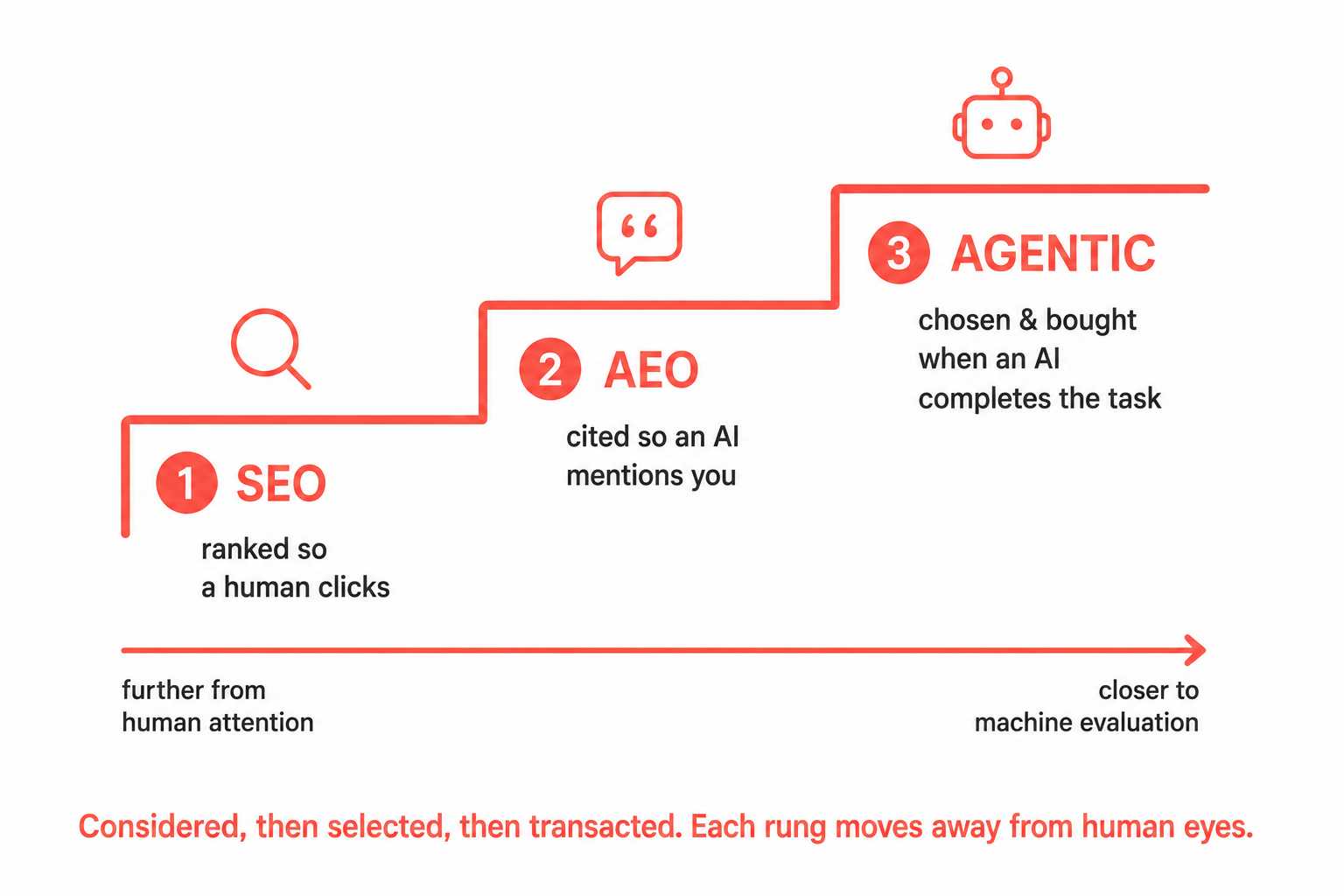
If you've followed the discoverability shift, this is the next rung on the same ladder. Search engine optimisation was about ranking so a human would click. Answer engine optimisation was about being cited so an AI would mention you in its answer. Agentic commerce goes one step further: it's about being chosen and bought when an AI completes a task, not just mentioned.
Being cited gets you considered. Being readable and transactable by an agent gets you selected. The progression is consideration, then selection, then transaction, and each rung moves further from human attention and closer to machine evaluation. The same instinct that made you structure content to be quotable by answer engines now extends to structuring your whole store to be choosable by shopping agents. It's the logical end of the road GEO and AEO put you on.
What changes when the buyer is software
This is the heart of it. When the thing evaluating your store is an agent, not a person, the rules quietly invert.
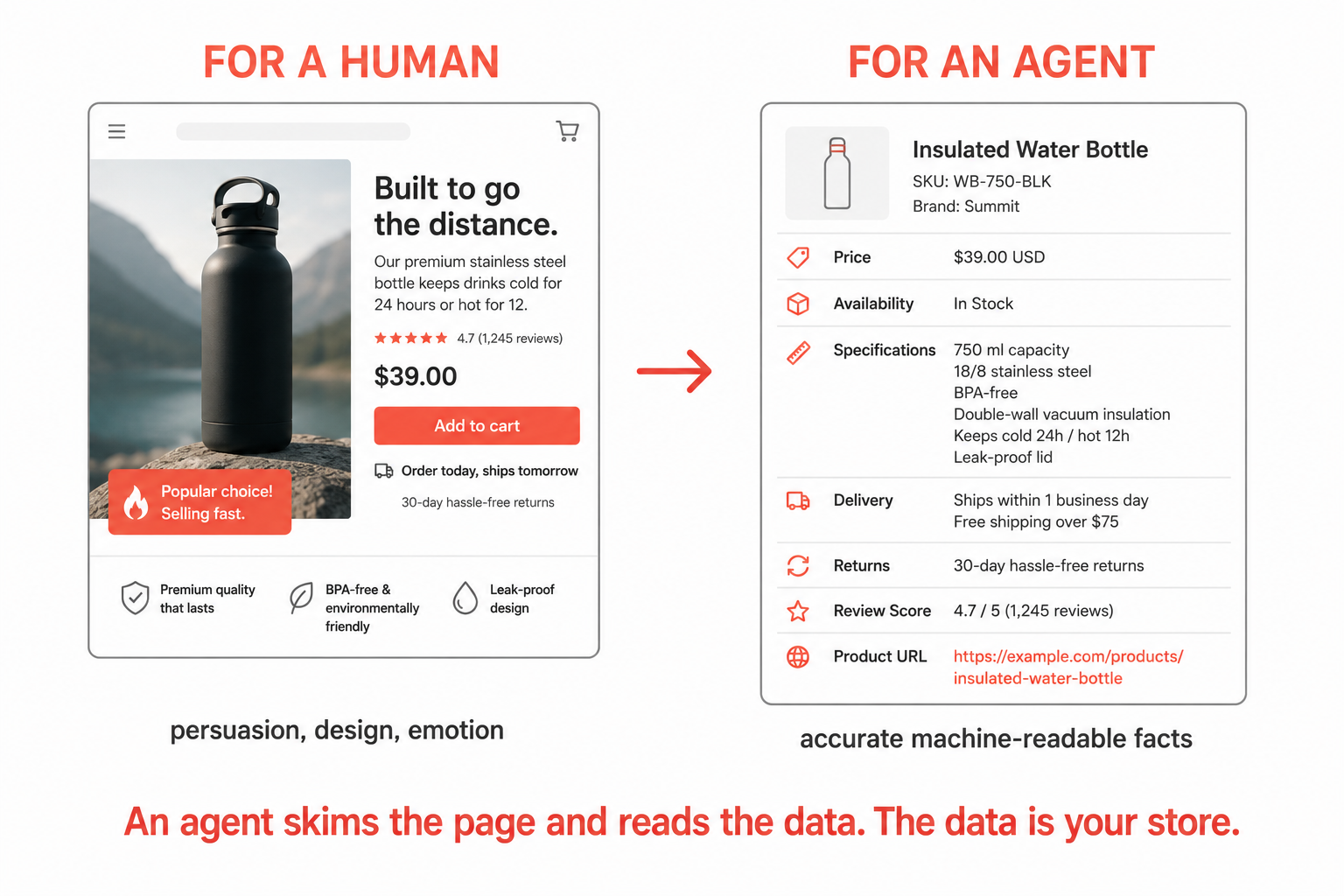
The page is no longer the product. Much of what a storefront does, the hero imagery, the persuasive copy, the emotional pull, the urgency, is built for human psychology. An agent skims past all of it. What an agent wants is the opposite: structured, accurate, machine-readable facts. Price. Availability. Specifications. Delivery time. Return terms. The beautiful page that sells to a human is largely invisible to the software deciding on the human's behalf.
Structured data stops being SEO hygiene and becomes the storefront. The clean, accurate, machine-readable product data you built for search and for feeds turns out to be exactly what an agent reads to decide. To an agent, your structured data is your store. If it's messy, incomplete, or wrong, you're not just ranking poorly, you're effectively invisible, because the agent has nothing reliable to evaluate.
Trust becomes data, not vibe. A human absorbs trust as a feeling, a tidy site, recognisable logos, a reassuring tone. An agent weighs trust as data points: review scores, return policy, delivery reliability, price competitiveness, all as structured inputs to a decision. The "trust" you earn with an agent is whatever it can read and verify, not whatever atmosphere you create.
The transaction itself may be agent-to-system. Beyond discovery, agents are increasingly able to act, to check out, not just recommend. That points toward stores being not only browsable by people but transactable by software through structured interfaces, the kind of machine-to-machine connection that protocols like MCP gesture at. Your store may need to be buyable by a program, not just a person.
The honest state of it (no hype)
Here's where I keep it grounded, because this field is loud. Agentic commerce is early, uneven, and moving genuinely fast. Agents that research products and build shortlists for people are already in everyday use. Agents that complete the whole purchase are emerging, and the standards and infrastructure that let them transact safely are being rolled out across major AI platforms and the major payment networks right now, and changing month to month as they do. Some approaches launched and were already replaced within a single year. This is a moving target, not a settled system.
So the sane response is not to rebuild your store for robots tomorrow. It's to notice that almost everything that prepares you for agents is work that already pays off today: clean structured product data, accurate and complete specifications, honest and machine-readable trust signals, reliable feeds. Preparing for agentic commerce is, mostly, just doing the data fundamentals properly, the same fundamentals that improve your search, your feeds, and your answer-engine citations right now. You don't need to bet on which protocol wins. You need data so clean that whatever wins can read you.
(It's worth noting this isn't only a consumer-side shift. The structured, repeatable, rules-based nature of B2B buying makes it a natural place for agent-assisted quoting and ordering too. The data discipline pays off on both sides.)
The strategic reframe
Step back and the shift is profound but simple. For a decade, e-commerce optimised for human attention, the click, the scroll, the emotional pull, the persuasive page. Agentic commerce optimises for machine selection, the accurate fact, the clean feed, the verifiable signal, the structured interface. The human storefront and the machine-readable one will coexist for a long time, because plenty of shopping stays human. But the smart move is to stop treating machine-readability as an afterthought bolted on for SEO, and start treating it as a second storefront, the one you're not looking at, that an increasing share of your customers' agents are.
The stores quietly winning the next few years will be the ones that serve both: a genuinely good experience for the humans who still shop directly, and clean, accurate, structured data for the agents shopping on the rest. Neglect the second and you'll lose sales you never see, to a competitor whose data was simply easier for an agent to read and trust.
The guardrail that doesn't change
One thing carries straight over from every other use of AI in commerce: don't fabricate or game your data to court agents. The temptation will be to stuff and inflate the machine-readable layer the way people once stuffed keywords. Resist it, because an agent that catches a wrong specification, an inflated review, or a delivery promise you don't keep simply drops you and moves on, and it does it silently and at scale. The discipline that protects human trust, never assert a fact you can't stand behind, protects agent trust just as completely. Accuracy isn't only ethics here. It's the strategy.
What this comes down to
The next customer through your store might not be a person at all. It might be an agent acting for one, reading your data, weighing your signals, and deciding in milliseconds whether you're the answer. You can't charm it. You can't sell it with a hero image or a clever headline. You can only be accurate, structured, and trustworthy enough to be chosen.
The stores being built for human eyes alone are quietly optimising for a shopper who is starting to send a proxy. You don't have to predict exactly how it plays out. You have to make your store legible to software, on the same data fundamentals that already make it better for everyone. Do that, and whatever the agents turn out to be, they can read you, trust you, and pick you.
A few common questions
What is agentic commerce? It's when an AI agent does the shopping on a person's behalf, researching, comparing, choosing, and increasingly completing the purchase, without the human visiting the store directly. The human sets the goal ("find and order the best X under this budget"); the agent does the work. It breaks the thirty-year assumption that a human arrives at a store, looks at it, and decides, because the deciding party may now be software that never loads your page the way a person would.
How is it different from SEO and answer-engine optimisation? It's the next rung on the same ladder. SEO was about ranking so a human clicks; AEO was about being cited so an AI mentions you; agentic commerce is about being chosen and bought when an AI completes a task. Being cited gets you considered; being readable and transactable by an agent gets you selected and purchased. Each step moves further from human attention and closer to machine evaluation.
What do I need to do to be ready for shopping agents? Mostly, do the data fundamentals properly, which already pay off today: clean, accurate, complete structured product data; real specifications; honest, machine-readable trust signals (reviews, return policy, delivery reliability); and reliable feeds. To an agent, your structured data is your store, if it's messy or wrong, you're effectively invisible. You don't need to bet on which emerging standard wins; you need data clean enough that whatever wins can read you. Don't rebuild for robots tomorrow, but stop treating machine-readability as an afterthought.
Should I fabricate or inflate data to win with agents? No, and it backfires faster than with humans. An agent that catches a wrong specification, an inflated review, or a broken delivery promise simply drops you and moves on, silently and at scale. The same discipline that protects human trust, never assert a fact you can't stand behind, protects agent trust completely. With agents, accuracy isn't just ethics; it's the strategy, because the machine checks.
You should also read:
The E-Commerce Manager's Guide to AWS Without an Engineering Degree
You do not need to understand all of AWS. You need to understand maybe six services and one mental model, and that is enough to make good decisions, ask the right questions, and stop nodding along blankly when your developers or a vendor start talking…
Continue reading...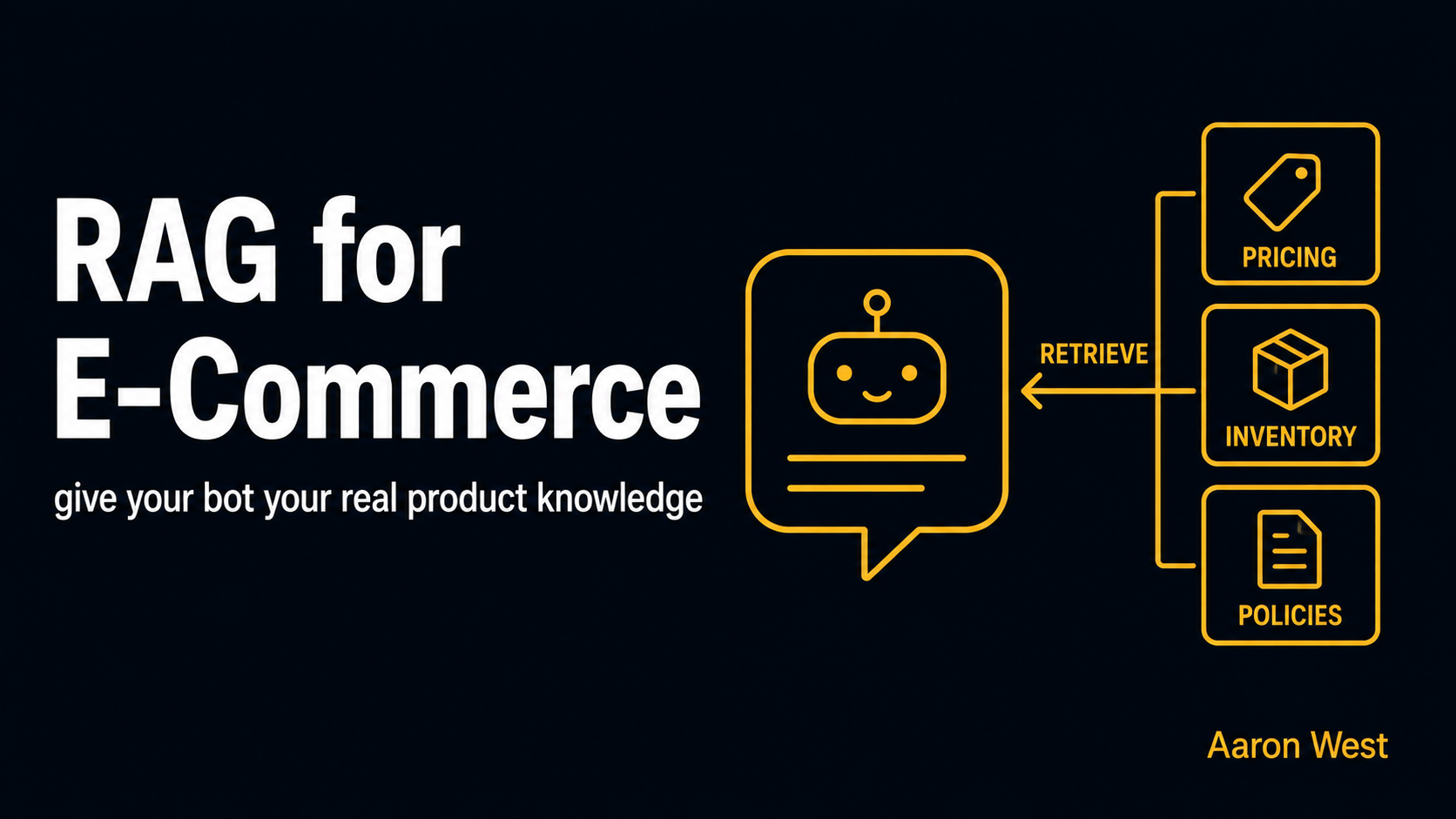
RAG Explained for E-Commerce: Giving a Bot Your Product Knowledge Without Retraining It
If you want an AI assistant that actually knows your store, your real products, your current prices, your live stock, your specific return policy, the technique you need is RAG, retrieval-augmented generation. It connects the AI to your live business data so it answers from…
Continue reading...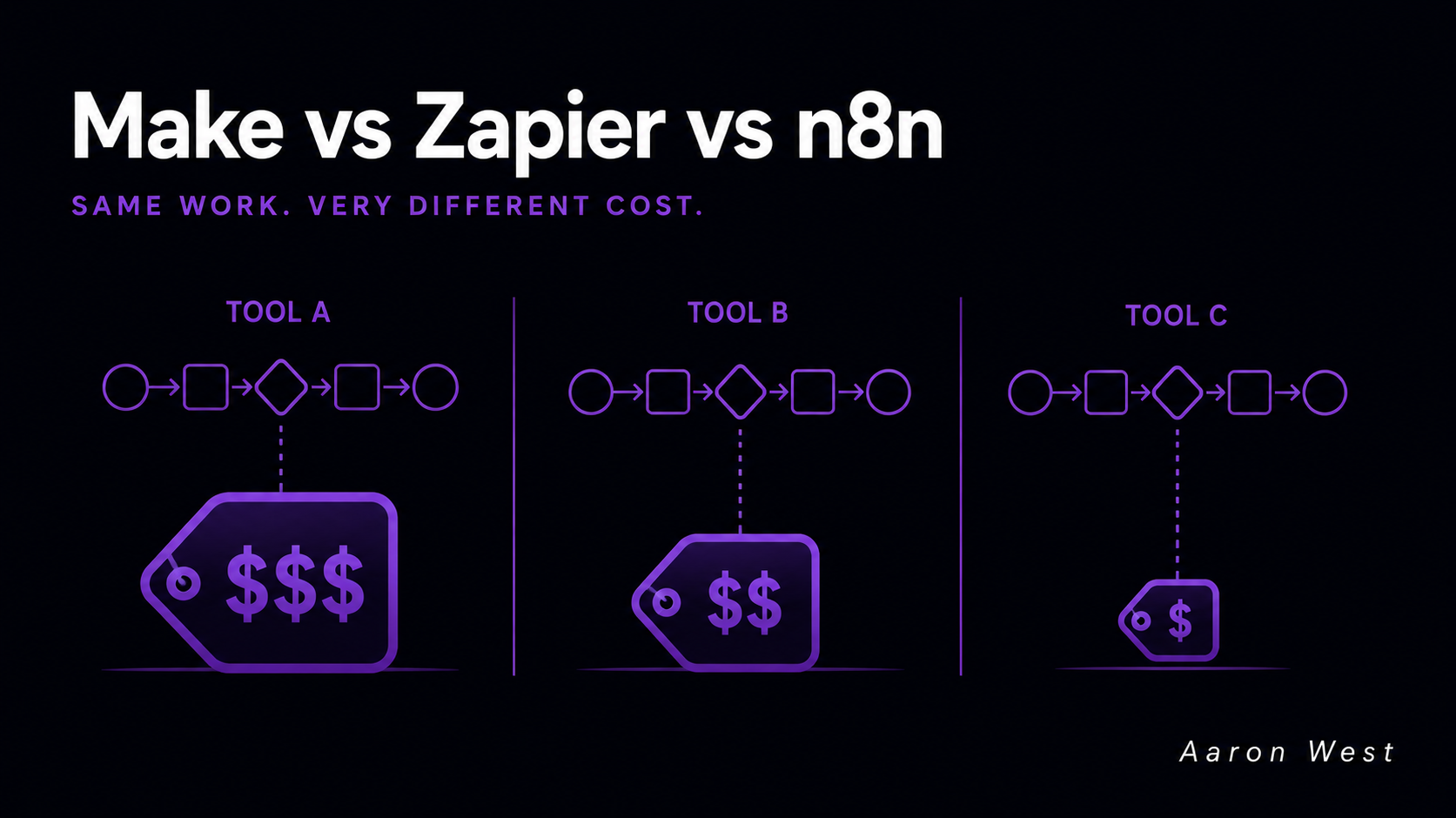
Make vs Zapier vs n8n: When Each One Is the Right Call
The honest answer to "which automation tool should I use?" is that it depends on three things: how technical your team is, how sensitive your data is, and how much volume you will run. But there is one detail underneath all of it that almost…
Continue reading...