What Is AEO (Answer Engine Optimization)?

Table of Contents
Answer Engine Optimization (AEO) is the practice of structuring your content so it gets selected as the direct answer to a specific question, whether that is a Google featured snippet, a voice-assistant reply, or the answer an AI engine reads out when someone asks it something factual. If SEO is about ranking in a list and GEO is about being cited inside a long AI-generated answer, AEO is the narrower discipline in between: being the clean, quotable answer to a direct question. The neat way to hold it: AEO is the snippet game; GEO is the synthesis game.
AEO is actually the oldest of the three AI-era ideas, even though the acronym is new. It grew out of optimising for Google's featured snippets and voice search, the early previews of a world where the engine answers instead of just linking, and it has simply expanded as AI answer boxes have spread. This is the short, practical explainer: what AEO is, how it differs from GEO and SEO, and how content gets picked as the answer. It pairs with what is GEO; read both and the whole discoverability picture clicks into place.
What an "answer engine" actually is
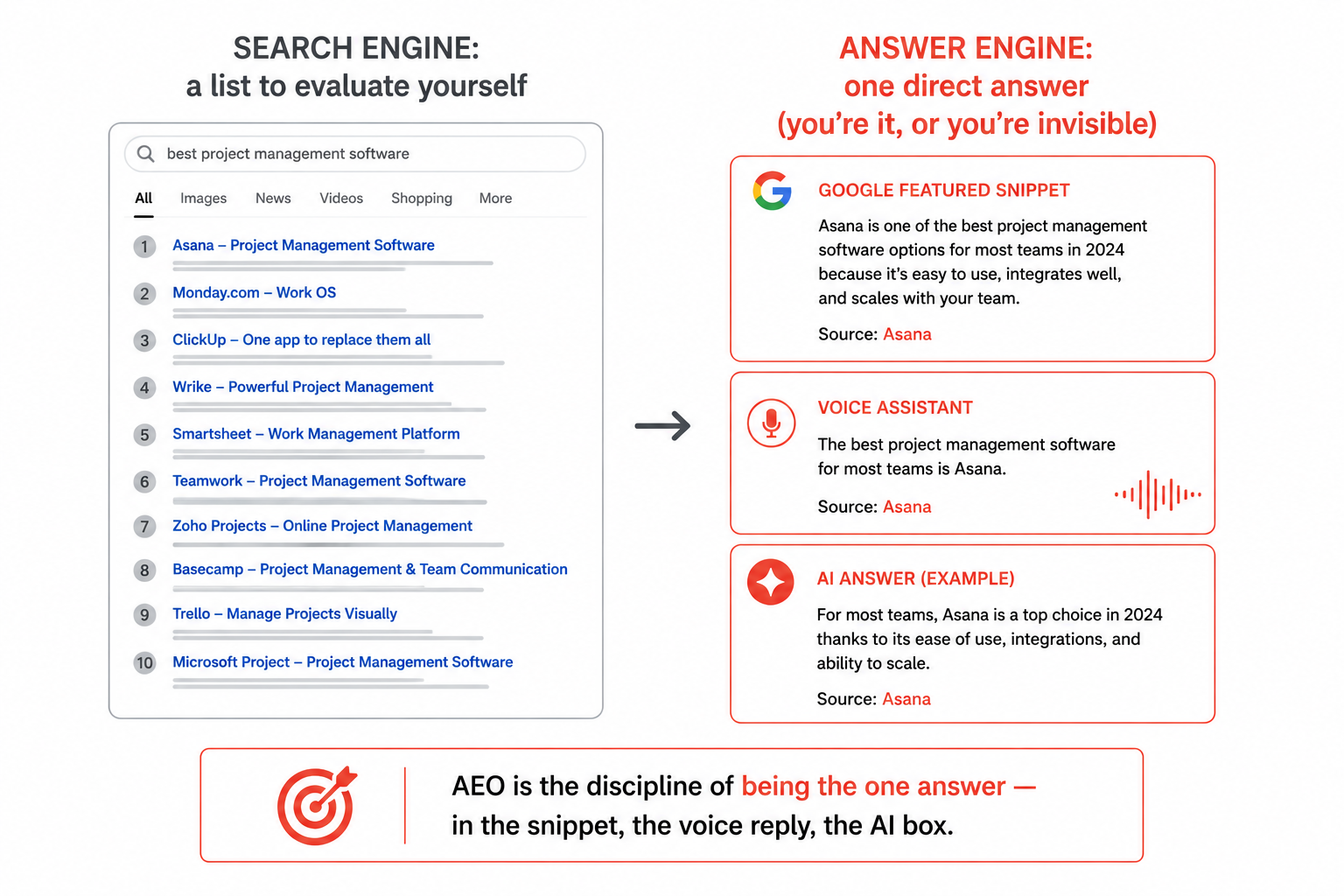
Start with the thing being optimised for. An answer engine is any system that responds to a question with a direct answer rather than a list of links to go and read. That covers more than people assume: Google's featured snippets and AI Overviews, voice assistants like Alexa and Siri reading a single result aloud, and the AI chat tools when they give a short, factual reply. The common thread is that the user gets an answer, not a set of options to evaluate themselves.
This is why AEO predates the generative-AI wave. Featured snippets, the boxed answer that appears at the top of some Google results, were the first mainstream "answer engine," and voice search made the stakes obvious: a voice assistant reads out one answer, so you are either it or you are invisible. There is no page two in a spoken answer. AEO is the discipline of being that one answer, and the skills it rewards, clarity, structure, directness, are exactly the ones the newer AI answer boxes reward too, which is why the idea scaled so naturally into 2026.
AEO vs GEO vs SEO: where AEO sits
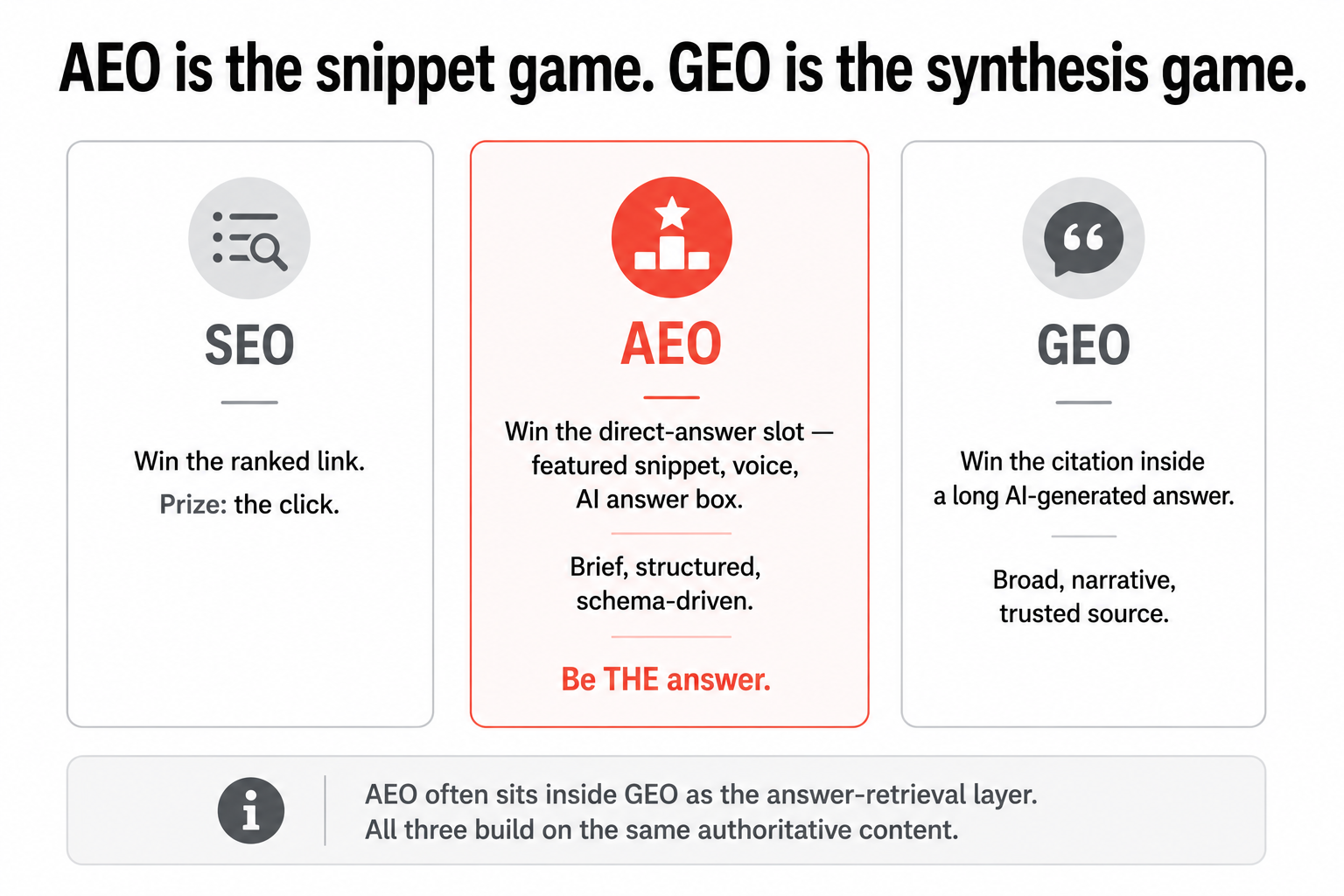
The three terms blur together, so here is the clean placement, consistent with how I framed it in the GEO piece. All three chase visibility; they target different surfaces.
SEO wins the ranked position in the list of links. The prize is the click.
AEO wins the direct-answer slot, the featured snippet, the voice reply, the concise AI answer box. It is the narrowest and most precise of the three: it is about being the single extracted answer to a specific question. It rewards brevity, clean structure, and clear factual statements, and it leans heavily on structured data (FAQ and How-To markup) that tells a machine exactly where your answer is.
GEO wins the citation inside a longer, synthesised AI response, the multi-paragraph answer ChatGPT or Perplexity builds from several sources. It is the broadest, and it is more about being a trusted, quotable source woven into a narrative than about owning one tidy answer box.
The honest relationship between AEO and GEO is that they overlap heavily and the line is fuzzy, many practitioners treat AEO as a component of GEO, the answer-retrieval layer within the broader citation game. That is fine. You do not need to police the boundary. What matters is the shared foundation: both, like SEO, reward genuinely authoritative, well-structured content, and all three stack on the same base rather than competing. AEO is simply the part aimed at being the crisp, direct answer.
How content gets picked as the answer
The practical question: what makes an engine choose your content as the answer? The signals are consistent and, helpfully, concrete.
Answer the question directly and immediately. The single biggest factor: state a clear, complete answer right where the question is asked, ideally in the first sentence or two of a section, before any build-up. Answer engines lift the passage that most cleanly and directly answers the query, so a buried answer cannot win the slot. (This is the same answer-first discipline I cover in how I structure an article to be quotable by AI.)
Match the question's phrasing. Use the actual questions people ask as your headings, and answer them. AEO is closely tied to natural, conversational queries, especially from voice, so content shaped as clear question-and-answer pairs gets picked far more readily than the same facts buried in prose.
Give machines structured signals. Structured data, FAQ schema and How-To markup in particular, explicitly tells an engine "here is a question, and here is its answer," which makes your content easy to lift cleanly. This matters more for AEO than for almost anything else, because the answer box is a precise, structured slot.
Be trustworthy and clear. The same authority signals that help everywhere, named expertise, credible sourcing, unambiguous writing, decide whether an engine trusts your answer enough to put its name on it. And a note for 2026: featured-snippet brevity was the early version, but the richer AI answer boxes increasingly reward content that is complete as well as extractable, covering the trade-offs and context of a question, not just the one-line definition. Be the clear answer, and be the thorough one.
So, to close the loop. AEO is optimising to be the direct answer, the featured snippet, the voice reply, the AI answer box, to a specific question. It is the oldest of the three AI-era disciplines (it began with featured snippets and voice), the narrowest and most precise, and it sits between SEO (rank the list) and GEO (be cited in the synthesis), often treated as the answer-retrieval layer inside GEO. You win it by answering directly and immediately, matching the real questions people ask, giving machines clean structured signals, and being trustworthy. AEO is the snippet game: in a world where the engine increasingly gives one answer, the whole goal is to be that answer.
A few common questions
What is AEO (Answer Engine Optimization)? AEO is the practice of structuring content so it's selected as the direct answer to a specific question, a Google featured snippet, a voice-assistant reply, or an AI answer box, rather than just ranking in a list. Where SEO wins the ranked link and GEO wins citations inside long AI answers, AEO wins the concise direct-answer slot.
What is the difference between AEO and GEO? AEO targets the direct-answer slots (featured snippets, voice replies, concise AI answer boxes), it's the "snippet game," narrow and precise, heavily reliant on structured data. GEO targets being cited inside longer, synthesised AI answers across ChatGPT, Perplexity, and Gemini, it's the "synthesis game," broader and more narrative. They overlap heavily; AEO is often considered the answer-retrieval layer within GEO.
Is AEO new? The acronym is new, but the discipline is the oldest of the three AI-era ideas. It grew out of optimising for Google's featured snippets and voice search, the original "answer engines", and expanded naturally as AI answer boxes spread. Featured-snippet optimisation was an early preview of what AEO now covers more broadly.
How do I get my content selected as the answer? Answer the question directly in the first sentence or two of a section; phrase headings as the real questions people ask; add structured data (FAQ and How-To schema) so machines know exactly where your answer is; and keep the content trustworthy and clear. Increasingly, also be complete, covering context and trade-offs, not just the one-line definition.
You should also read:
What Is GEO (Generative Engine Optimization)?
Generative Engine Optimization (GEO) is the practice of structuring your content so that AI systems like ChatGPT, Perplexity, Google's AI Overviews, and Gemini cite, quote, or recommend it when they answer a user's question. Where traditional SEO optimises to rank in a list of links…
Continue reading...
What Is Conversational AI, Really, and What It Still Can't Do
Conversational AI is the umbrella term for any technology that lets a machine understand, process, and respond to human language in something close to a natural conversation, by text or by voice. That is the whole definition. It is not one product or one technique.
Continue reading...
What Is RAG (Retrieval-Augmented Generation), and Why Everyone Is Using It
RAG, retrieval-augmented generation, is a way of making an AI model answer from a specific, trusted set of documents instead of relying only on what it absorbed during training. Before the model writes its answer, the system goes and fetches the most relevant material from…
Continue reading...