How I Structure an Article to Be Quotable by AI

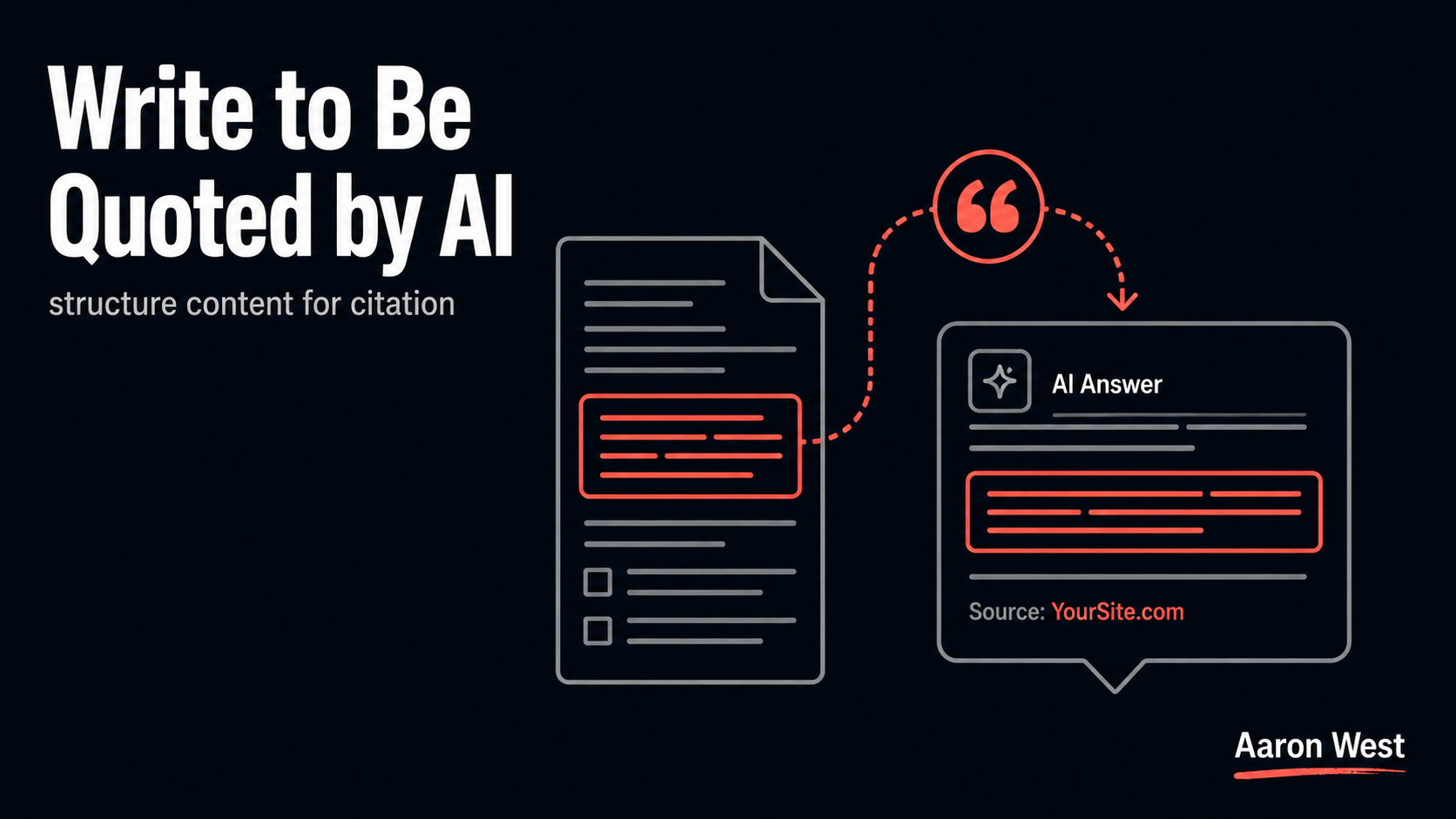
Table of Contents
To get cited by an AI answer engine, the single most important thing is to put a direct, self-contained answer right where the engine can lift it: in the first sentence or two of the piece and of each section, before any build-up. AI engines do not cite whole articles; they pull out small, self-contained passages and quote those, so the real unit of citation is the quotable chunk, not the page. Structure your writing as a series of clean, liftable answers and you get cited. Bury your best line in the middle of a wandering paragraph and you will not, no matter how good the article is.
This is the most repeatable tactic in all of GEO, and it is the one I apply to every piece on this blog, including this one, which is built to demonstrate each rule as it states it. None of it means writing for machines at the expense of humans; the same structure that helps an engine lift a clean answer also helps a busy reader skim and understand. So here is exactly how I structure an article to be quotable, and why each move works, from someone who does it on every post.
Why the unit of citation is the passage, not the page
Start with the mechanism, because every technique below follows from it. When an AI answer engine uses your content, it usually does so through retrieval (RAG): it searches, retrieves relevant material, and synthesises an answer from it. Crucially, it does not retrieve at the level of whole documents. It breaks content into smaller fragments, often called chunks, and evaluates each fragment on its own to decide what to pull into the answer.
That single fact rewires how you should write for citation. The engine is not asking "is this a good article?" It is asking, of each small passage, "does this chunk directly and cleanly answer the question, on its own, without needing the rest of the page?" An answer that needs three surrounding paragraphs for context cannot be lifted as a chunk, so it does not get cited, even if it is the best thing on the page. The job, then, is not to write one great document. It is to write a series of self-contained passages, each of which could be quoted alone and still make complete sense. Everything else is detail on how to do that.
Lead with the answer (answer-first formatting)
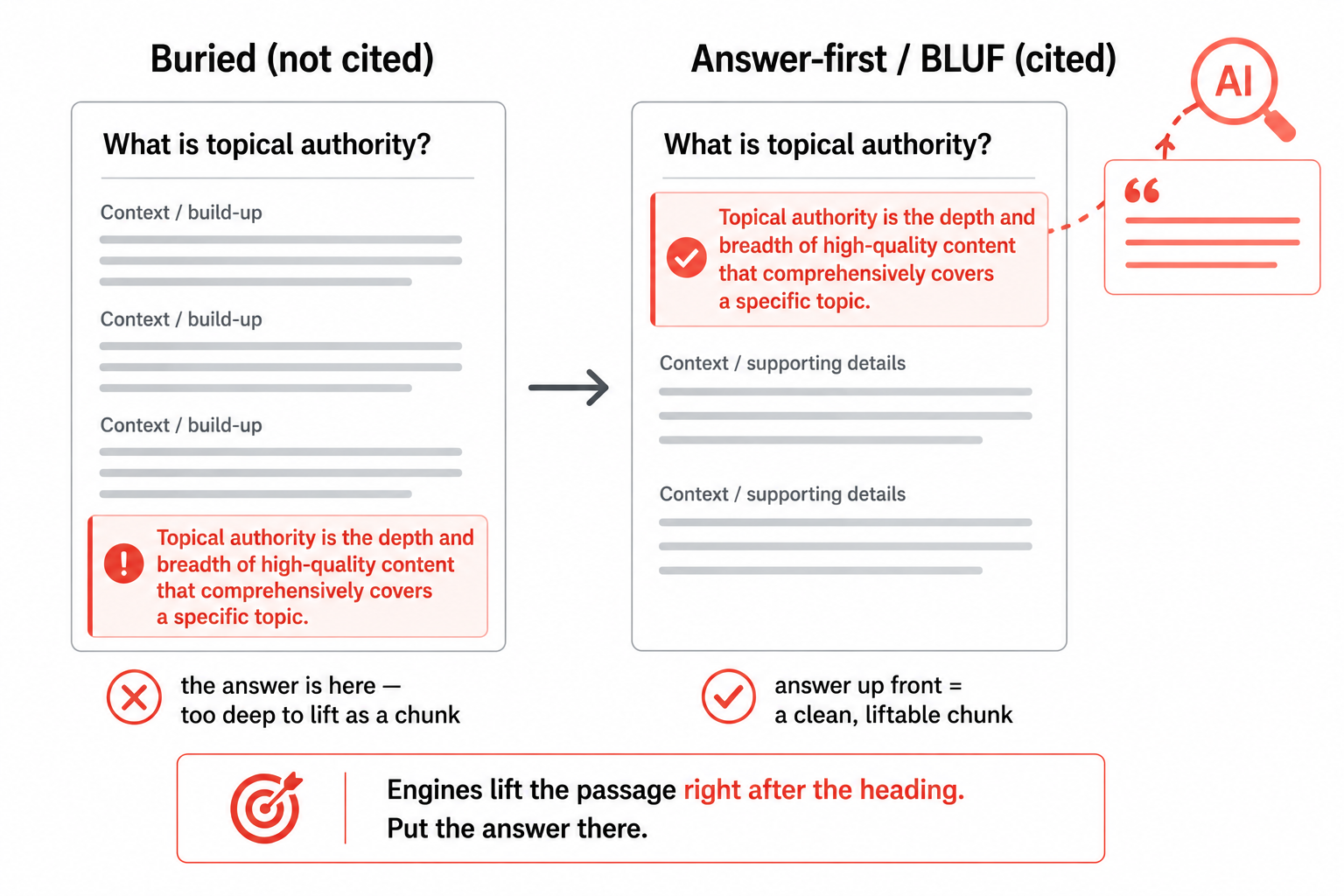
This is the highest-leverage change you can make, so it goes first: open the article, and every major section, with a direct answer to its core question, in roughly the first 40 to 60 words, before any context or warm-up. State the conclusion, then explain it. The technique is sometimes called BLUF, "bottom line up front", and it inverts the instinct most writers have to build toward a conclusion.
The reason is mechanical. Engines look for the most directly relevant passage to a query, and they disproportionately lift the opening sentences right after a heading. A buried answer is invisible to that process. Notice that the very first paragraph of this article is itself a direct, standalone answer to "how do I structure an article to be quotable by AI", that is not an accident, it is the technique demonstrating itself. The discipline is simple and slightly uncomfortable: say the thing first, then earn it. Give away the answer immediately, then spend the rest of the section justifying and deepening it. It feels backwards if you were trained to write a slow build, but it is exactly what both an answer engine and a time-pressed human want.
Write atomic, self-contained passages
Once you lead with the answer, the next rule is how you build everything else: keep paragraphs short and atomic, one idea each, roughly two to four sentences, and make each one make sense if read entirely on its own. This is the structural habit that produces liftable chunks throughout the piece, not just at the top.
Think of it as writing a series of standalone units rather than a flowing essay. A dense, beautifully-interconnected paragraph where each sentence depends on the last is great literature and terrible for citation, because no fragment of it survives being pulled out alone. An atomic paragraph that states one complete idea can be lifted cleanly and quoted with confidence. The same applies to "one concept per section", do not mix a definition and a how-to in the same block, give each its own clearly-headed home, so the engine knows exactly where the self-contained answer to each sub-question lives. A useful test as you write: could this paragraph be quoted, by itself, with nothing around it, and still be true and clear? If yes, it is a citation candidate. If it only works in context, it will not be cited.
A specific high-value version of this is the standalone fact or definition. A clean one-sentence definition, or a specific statistic stated as its own line, is exactly the kind of compact, self-contained unit an engine loves to quote. Scatter several of these through a piece, real numbers, crisp definitions, single-sentence claims that stand alone, and you give the engine clean things to lift. Vague generalities get skipped; specific, self-contained statements get quoted.
Use question-headings and matching structure
The third move is about signposting, so the engine can find the right chunk fast: phrase your headings as the actual questions people ask, and let the structure mirror how the content will be queried. A heading like "Why is the unit of citation the passage, not the page?" mirrors a real query far better than a vague "Citation Mechanics", and it signals to the engine that the section below is a candidate answer to that question.
This is why the headings throughout this article are written the way they are, each one is a question or a direct instruction a reader (or an engine) might be matching against. Pair that with formatting that genuinely fits the content: numbered steps for a process, a bulleted list for a set of criteria, a table for a comparison where each row is a compact, citable fact. These formats are not decoration; they create natural passage boundaries an engine can lift cleanly without clipping a sentence mid-thought, and they force you to make each item atomic. The caution is to format honestly, a list of things that is not really a list, or a table forced onto prose, adds noise rather than extractability. Match the format to the actual shape of the content, and the structure does double duty: clearer for humans, cleaner for machines.
Add the machine-readable and the irreplaceable layers
Two final layers sit on top of the structure, and they pull in opposite directions, which is the point. The first is purely for machines: add structured data, FAQ schema and Article schema, in your CMS where it is supported, so engines get explicit, machine-readable signals about your author, date, and the question-and-answer pairs on the page. It is plumbing the reader never sees, and it reduces the interpretation work an engine has to do to find your quotable blocks. A short, genuine FAQ section at the foot of a piece does the same job in the content itself, a cluster of clean question-and-answer units that are tailor-made to be lifted.
The second layer is the opposite, and it is the one that actually matters most: the irreplaceable human content a machine cannot synthesise. All the structure in the world only determines whether your content can be cited cleanly; it does not, by itself, make you worth citing over the next well-structured page. What makes you the source is genuine first-hand experience, a real opinion, the specific "here is what I saw when I built this" that exists nowhere in the model's training. As I argued in the GEO cornerstone, structure is necessary but not sufficient. And note the trap: this is exactly why flooding a site with well-formatted but hollow AI-generated pages backfires, perfect structure wrapped around nothing real gets detected and downweighted. The structure makes you liftable. The genuine experience makes you worth lifting. You need both.
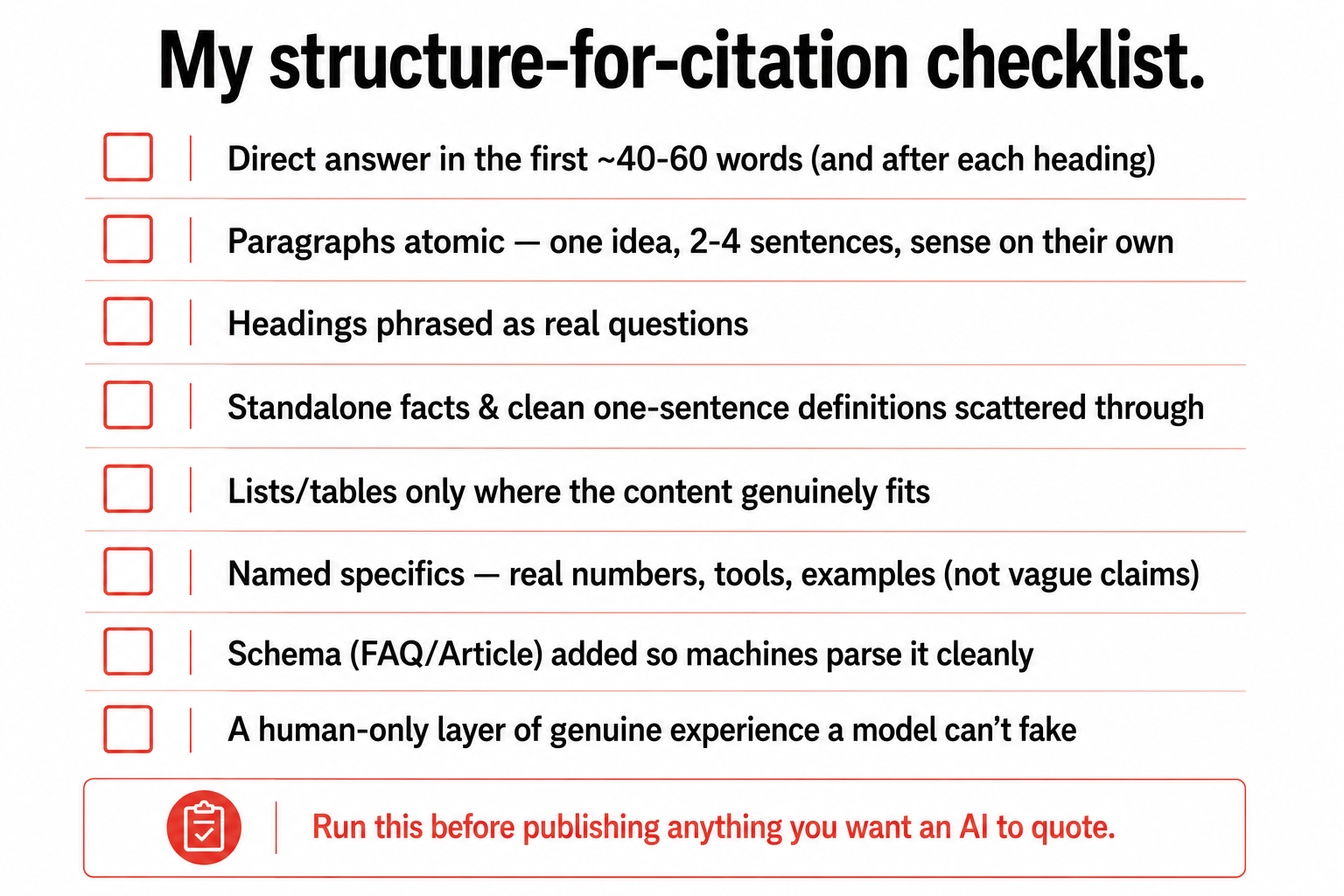
So that is how I structure an article to be quotable by AI, and how this very article is built. Understand that engines cite passages, not pages, then write accordingly: lead with the answer in the first 40 to 60 words, keep paragraphs atomic and self-contained, phrase headings as real questions, scatter standalone facts and clean definitions, format honestly where it fits, add schema for the machines, and, above all, put genuine experience inside the clean structure so there is something real to quote. Do the structure and you become liftable. Add the lived expertise and you become the source. The article you are reading is my own working example of every rule in it, which is the most honest way I know to make the case.
A few common questions
How do I make my content quotable by AI engines? Lead with a direct, self-contained answer in the first 40 to 60 words of the article and of each section, before any context. AI engines cite small, standalone passages rather than whole pages, so each paragraph should make sense on its own. Keep paragraphs atomic (one idea, two to four sentences), phrase headings as real questions, and include specific, standalone facts and definitions.
Why does AI cite some pages and not others that rank well? Because ranking and citation reward different things. AI answer engines retrieve and quote at the passage level using RAG, so they look for clean, self-contained chunks that directly answer a question. A page can rank on Google for human relevance yet never be cited, because its answers are buried in flowing prose that can't be lifted cleanly. Structure for extraction, not just for reading flow.
What is answer-first (BLUF) formatting? "Bottom line up front", stating the direct answer to a section's question in its first 40 to 60 words, before any build-up or context. Engines disproportionately lift the sentences right after a heading, so a buried answer rarely gets cited. Say the conclusion first, then justify and expand it.
Is structuring for AI citation enough to get cited? No. Structure makes your content liftable, but it doesn't make you worth citing over the next well-structured page. The decisive ingredient is genuine first-hand experience and opinion a model can't synthesise from generic sources. Well-formatted but hollow content (especially mass-produced AI content) gets detected and downweighted. You need clean structure and something real inside it.
You should also read:
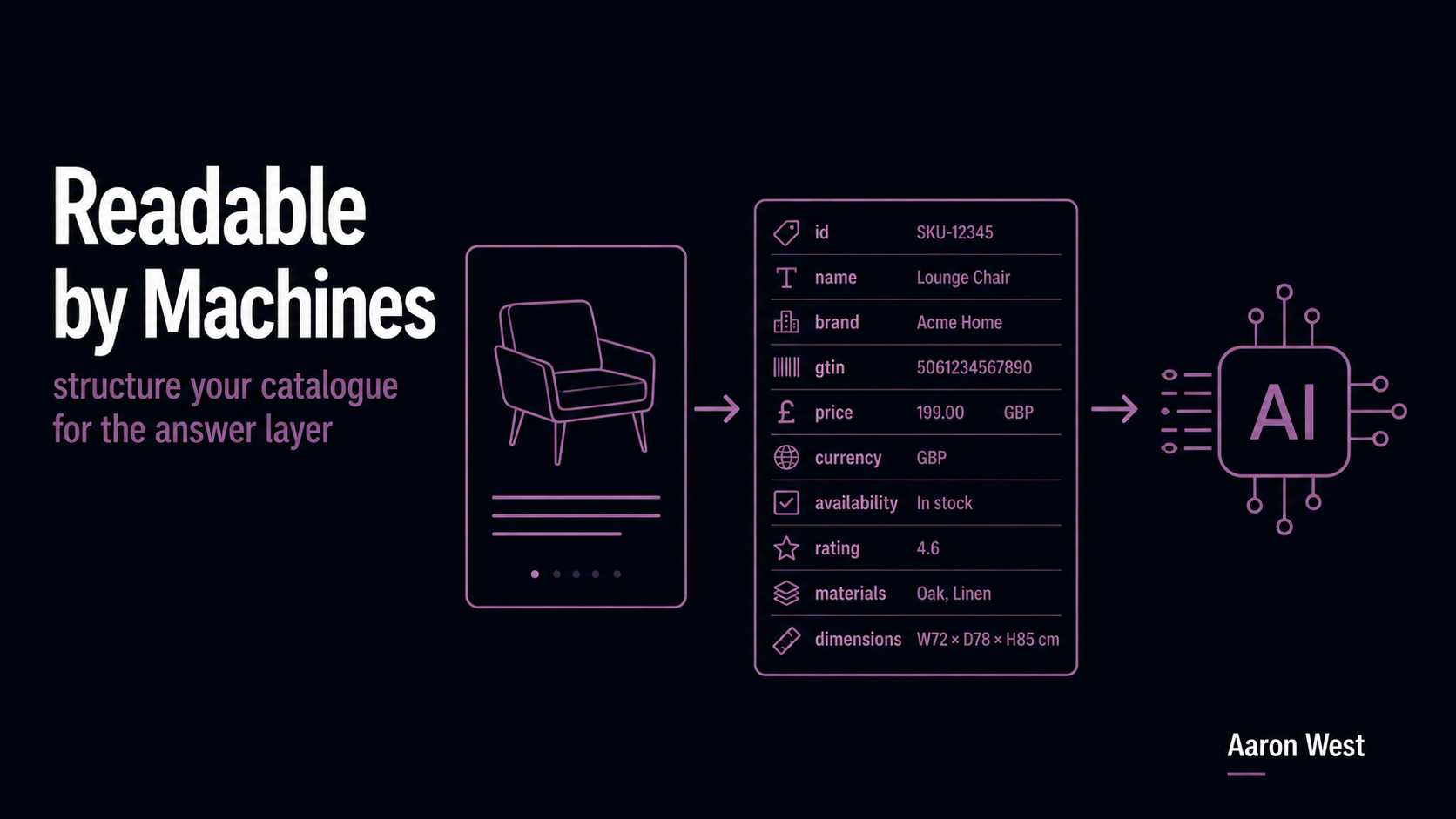
Structured Product Data: How to Make Your Catalog Readable by Machines and AI
You've structured your product data for your own site, and you've structured it for your channel feeds. There's a third reader you can't ignore: the open machine world, search engines' rich results and the AI answer and shopping engines that increasingly sit between customers and…
Continue reading...
Product Taxonomy: The Structure Everything Else Depends On
Product taxonomy is how you classify and organise your products, the categories, subcategories, and attributes that everything else is built on top of: search, filters, navigation, category pages, recommendations. It's the most unglamorous decision in merchandising and quietly the most consequential, because when the structure…
Continue reading...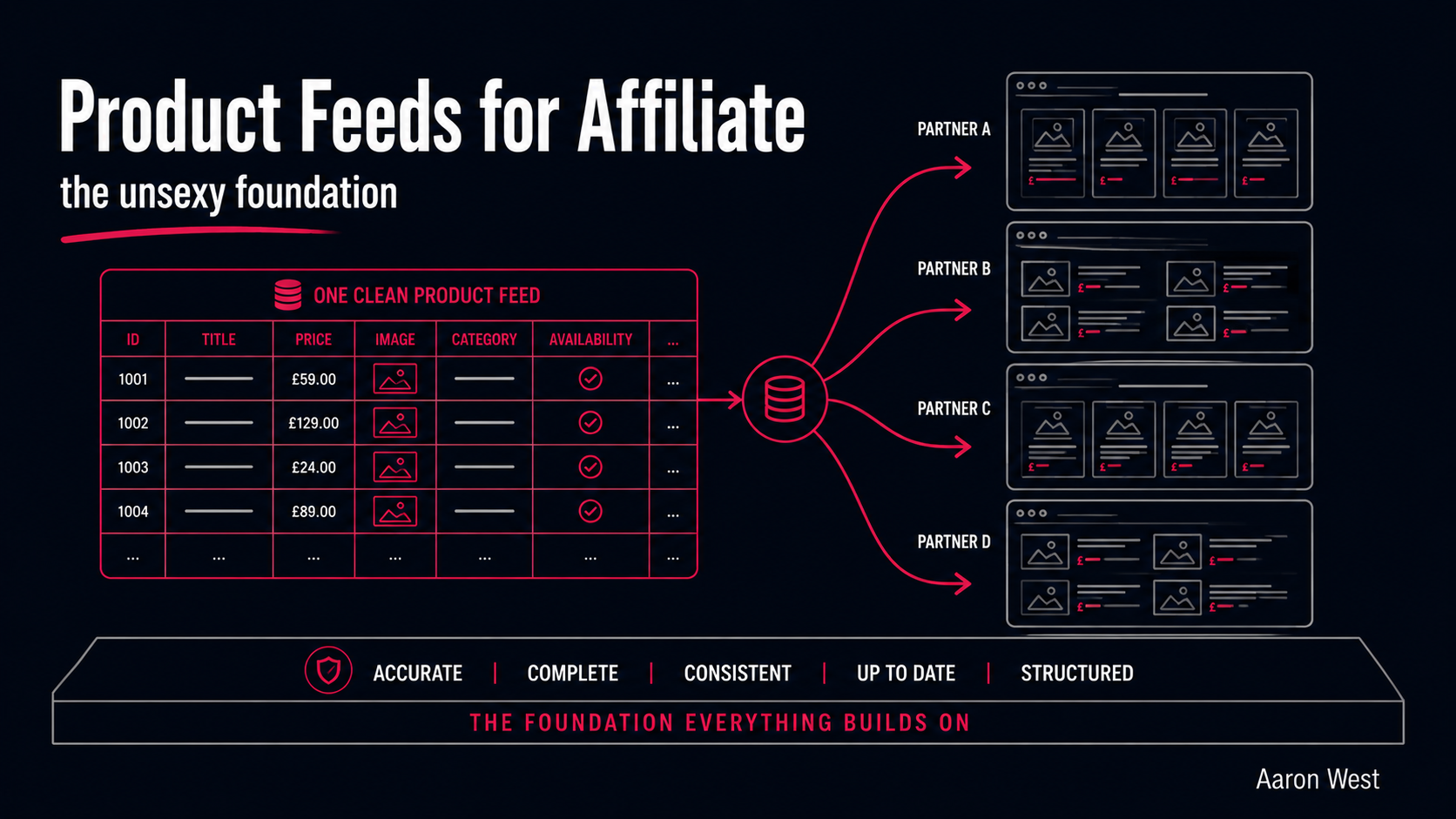
Product Feeds and Data Structure for Affiliate: The Unsexy Foundation
A product feed is a structured, regularly-updated file containing all your product information, name, price, description, image, link, availability, that your affiliate partners use to promote your products accurately. It is the least glamorous part of an affiliate programme and one of the most consequential,…
Continue reading...