Product Taxonomy: The Structure Everything Else Depends On


Table of Contents
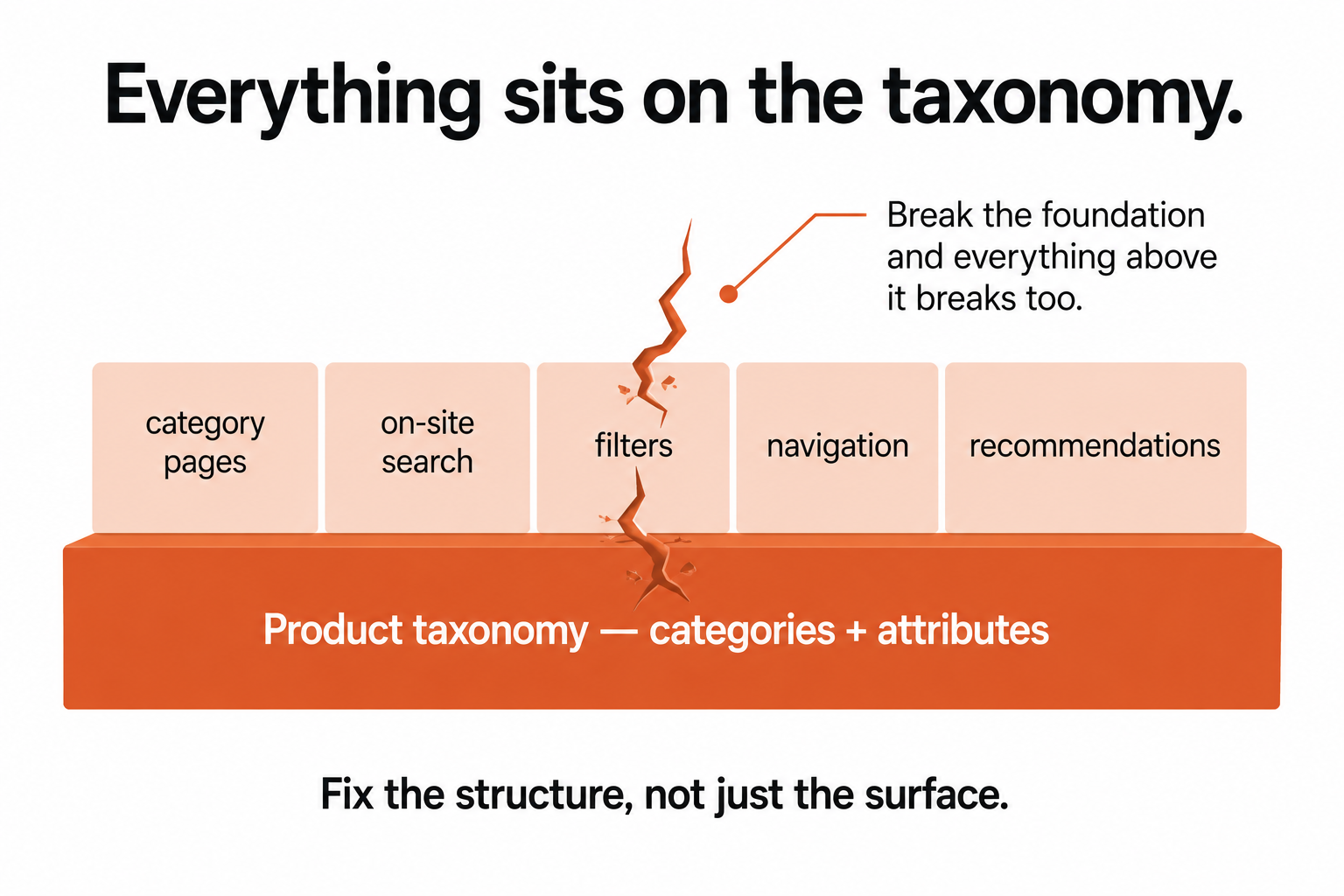
Product taxonomy is how you classify and organise your products, the categories, subcategories, and attributes that everything else is built on top of: search, filters, navigation, category pages, recommendations. It's the most unglamorous decision in merchandising and quietly the most consequential, because when the structure underneath is wrong, no amount of clever search or filtering on top can fix it. You can buy the smartest search tool on the market and it will still fail, because it's standing on a broken foundation.
This closes the Merchandising pillar, and it's deliberately last, because taxonomy is the thing under everything the other pieces talked about. The category pages are taxonomy nodes. The filters are attributes. The navigation is the tree. Get this layer right and the rest has a chance; get it wrong and the rest is built on sand. Here's how taxonomy works, how it breaks, and why it's so rarely fixed.
What taxonomy actually is
Strip away the jargon and product taxonomy is two distinct things working together.
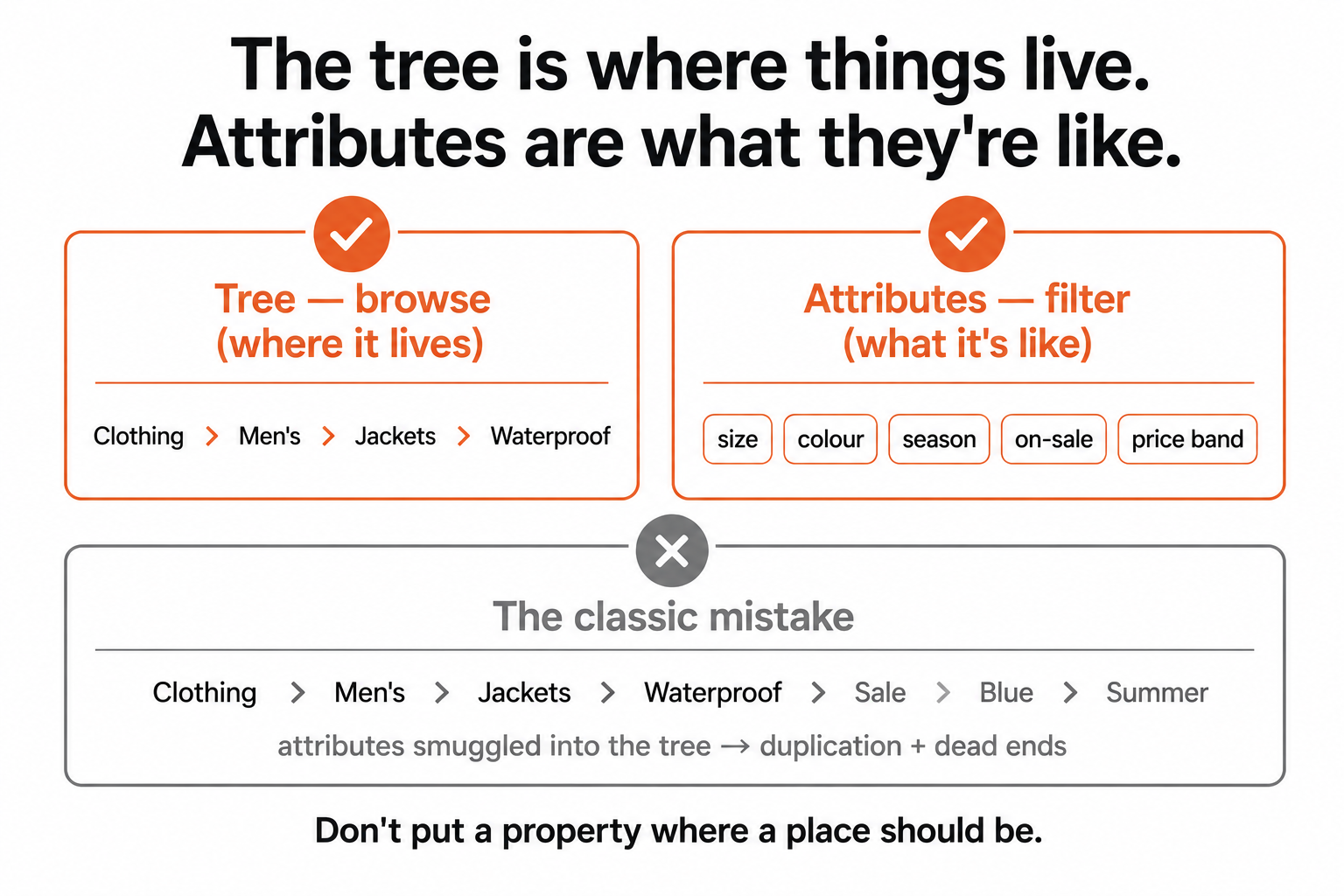
The first is the category tree: the hierarchy of where products live. Clothing, then Men's, then Jackets, then Waterproof Jackets. It's how a browsing customer drills down from a broad area to a specific group, and it's the structure your navigation and category pages are built from. The second is the attributes: the properties a product has, size, colour, material, season, price band. Attributes aren't places; they're descriptions, and they're what powers filtering, letting a customer cut across the tree to find "size large, under fifty, waterproof" regardless of where those products formally sit.
The distinction matters more than it sounds, because the single most common taxonomy mistake is confusing the two. The tree answers "where does this product live." The attributes answer "what is this product like." Browsing uses the tree; filtering uses the attributes. Keep them straight and the whole structure stays clean. Mix them up and everything built on top starts to wobble.
How taxonomies go wrong
Most taxonomy problems trace back to the same origin story: the structure was set up quickly, early, by whoever built the store, when there were fifty products, and then it was never revisited as the catalogue grew to five hundred or five thousand. The tree that comfortably held a small range strains and then breaks under a large one, but nobody goes back to the foundation, because by then there's traffic, there are URLs, and changing it feels dangerous. So the store keeps patching the surface instead. The specific failures cluster into a few shapes:
- Attributes smuggled into the tree. A "Sale" category. A "Blue" category. A "Summer" category. These feel like categories but they're attributes, properties a product has, not places it lives. A jacket can be blue and summer and on sale all at once, so forcing those into the tree means either duplicating the product across several category branches or making arbitrary single-home choices that hide it from the others. This one mistake creates a huge share of taxonomy mess.
- One product, one place. Real products legitimately belong in several categories. A waterproof running jacket is reasonably found under Running, under Outerwear, and under Waterproof. A rigid tree that allows each product exactly one home forces you to pick, and the customer who looked in the other reasonable place never finds it.
- Too deep or too flat. A tree so deep that customers give up drilling down before they reach products, or so flat that a single category holds thousands of items with no useful subdivision. Both make browsing painful.
- Inconsistent attributes. The same property recorded differently across products, "navy" on one, "dark blue" on another, "blue (navy)" on a third, so a colour filter splinters and undercounts. This is where taxonomy meets product-data quality, and it's why a filter can look fine and still return wrong results.
Each of these is invisible on any single page and obvious only when you step back and look at the structure as a whole, which almost nobody does once a store is live.
The principle: tree for browsing, attributes for filtering
The fix follows directly from the distinction. Keep the category tree for where products live, a clean, reasonably shallow hierarchy that reflects how customers think about your range. Keep attributes for what products are like, structured, consistent, and used for filtering across the tree. Don't put attributes into the tree. "On sale," "blue," and "for summer" are filters, not aisles.
Two more rules follow. Let products live in every category where a customer might reasonably look for them, rather than forcing a single home, so the running jacket appears under Running and Outerwear and Waterproof. And keep your attribute values consistent and structured, because a filter is only as good as the data behind it, one canonical "navy," not three spellings of it. That consistency is really a product-data discipline, the foundation beneath even the taxonomy, which is a topic in its own right, but it's where clean filtering ultimately comes from.
Why it's so rarely fixed, and why that's the opportunity
If taxonomy is this foundational, why do so many stores live with a broken one? Because fixing it feels frightening. Re-structuring a live catalogue touches URLs, which touches SEO, which means redirects, which means risk, and a botched re-taxonomy can tank organic traffic overnight. So teams understandably flinch and reach for the safer-feeling fix: a better search tool, a fancier filter widget, a recommendation engine, anything that sits on top of the structure rather than changing it.
The trouble is that those surface tools can't compensate for a broken foundation. A store paying for clever search to work around products that are mis-categorised and inconsistently tagged is treating a symptom. The clever tool fights the bad structure and loses, because it can only work with what the taxonomy gives it. This is why "we spent on search and it didn't help" so often turns out to be a taxonomy problem wearing a search problem's clothes.
That's also where the opportunity is. Because re-taxonomising is scary and unglamorous, almost nobody does it, which means doing it carefully, with proper redirects and an eye on the SEO impact, is some of the highest-leverage merchandising work available. It's not a quick win and it has to be done with care, but fixing the floor plan makes every tool that runs on top of it suddenly work better, all at once.
What this comes down to
Taxonomy is the floor plan of your shop. Search, filters, navigation, and recommendations are just the different ways customers move around it, and you cannot fix how they move if the floor plan itself is wrong. Keep the tree for where products live and attributes for what they're like; let products sit in every category a customer might check; keep your attributes consistent; and don't smuggle properties like "sale" or "blue" into the structure as if they were places.
It's invisible, it's unglamorous, and it's the single thing the entire rest of your merchandising depends on. Most stores never look at it because it was set up once, by accident, years ago. Looking at it on purpose, and fixing it carefully, is one of the most consequential things you can do, precisely because so few will.
A few common questions
What is product taxonomy? It's how you classify and organise your products: the category tree (where products live, like Clothing > Men's > Jackets) and the attributes (what products are like, such as size, colour, season). The tree powers browsing and navigation; the attributes power filtering. Everything else in merchandising, category pages, search, filters, recommendations, is built on top of this structure.
What's the most common taxonomy mistake? Putting attributes into the category tree. A "Sale," "Blue," or "Summer" category feels like a category but is really a property a product has, not a place it lives. Since a product can be blue and summer and on sale at once, forcing these into the tree causes duplication or arbitrary single-home choices that hide products. Keep properties as filterable attributes, not aisles.
Why doesn't a better search tool fix my findability problems? Because search, filters, and recommendations all sit on top of the taxonomy, so a clever tool can only work with the structure it's given. If products are mis-categorised or inconsistently tagged, the tool fights the bad foundation and loses. "We spent on search and it didn't help" is very often a taxonomy problem wearing a search problem's clothes; the fix is structural, not a bolt-on.
Is it worth restructuring a live store's taxonomy? Often yes, but carefully. Re-taxonomising touches URLs and therefore SEO, so it has to be done with proper redirects and attention to organic impact, which is exactly why most stores avoid it and patch the surface instead. That avoidance is also the opportunity: done well, fixing the foundation makes every tool built on top of it work better at once, which is high-leverage work few competitors will do.
You should also read:

Product Recommendations: Beyond "You May Also Like"
Product recommendations are how you show a customer things they didn't come looking for but are genuinely glad to find. They're the discovery half of merchandising, the online version of a good shop assistant saying "if you're buying those shoes, you'll want these socks too."…
Continue reading...
How I Structure an Article to Be Quotable by AI
To get cited by an AI answer engine, the single most important thing is to put a direct, self-contained answer right where the engine can lift it: in the first sentence or two of the piece and of each section, before any build-up. AI engines…
Continue reading...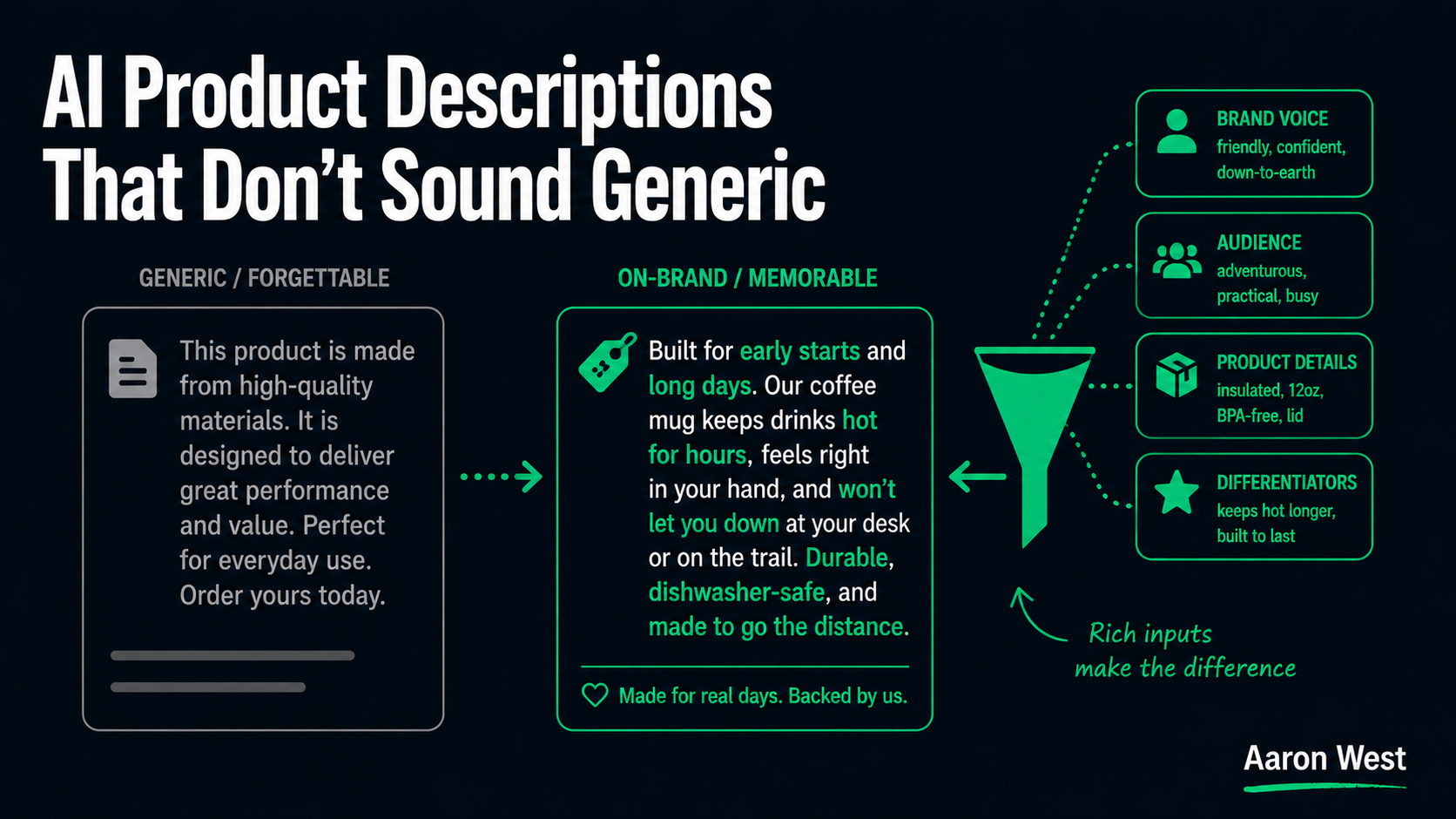
AI for Product Descriptions That Don't Sound Generic
The most common complaint about AI-written product descriptions is that they all sound the same, bland, interchangeable, like they could describe any product from any store. The complaint is fair, and here is the part nobody selling AI tools wants to say plainly: when AI…
Continue reading...