Psychological Pricing: What Actually Works and What's Folklore

Table of Contents
Psychological pricing is the set of tactics that change how a price is perceived rather than what it costs you: charm pricing like €9.99, anchoring against a higher number, decoy options, and the rest. Some of it is genuinely robust, supported by decades of evidence. A lot of it is folklore, repeated so often it sounds true. The practitioner's job is telling the difference, and not letting a clever pricing trick quietly undermine what your brand is trying to be.
This is a core of the Pricing pillar, sitting under the cornerstone idea that price is a strategy. Psychological pricing is about the perception layer on top of that strategy, how the number you've chosen feels to the customer. Used well it sharpens a price you set deliberately. Used carelessly it fights the very positioning your price is supposed to signal. Here's what holds up, what doesn't, and the test that decides whether a tactic helps or hurts.
What it is, and what it isn't
Psychological pricing works on perception, not arithmetic. It doesn't change your costs or your margin; it changes how the customer reads the number. That's a real and legitimate lever, because humans don't evaluate prices in a vacuum. We judge them by comparison, by the digits we see first, by the options sitting next to them. A price isn't experienced as a raw figure; it's experienced relative to context, and psychological pricing is the deliberate shaping of that context.
The trouble is that "shape how the price is perceived" has accumulated a thick layer of cargo-cult advice over the years, rules of thumb passed around as if they were laws of nature. So it helps to sort the toolkit into what the evidence actually supports and what's just repeated confidently.
What's genuinely robust
A handful of these effects are well-supported and worth using deliberately:
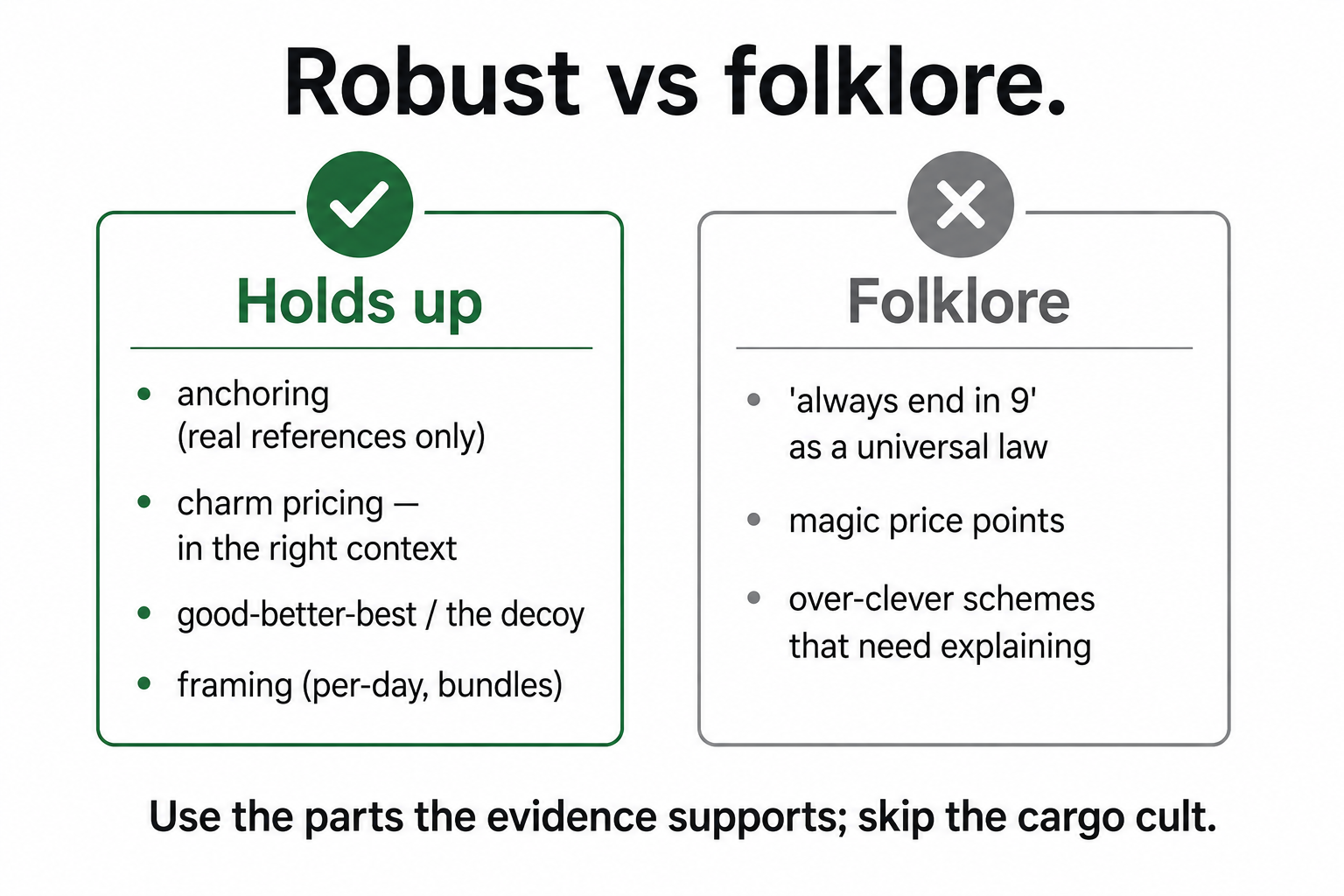
- Anchoring. People judge a price against whatever reference they're given. Show a higher number first, a genuine original price, a premium tier above the one you're selling, a "compare at" reference, and the target price feels more reasonable by comparison. This is one of the most robust effects in the whole field. The crucial caveat: the anchor must be real. A fabricated "was €100" that the product never actually sold for isn't clever pricing; it's deception, and in many places it's now illegal (more on that below).
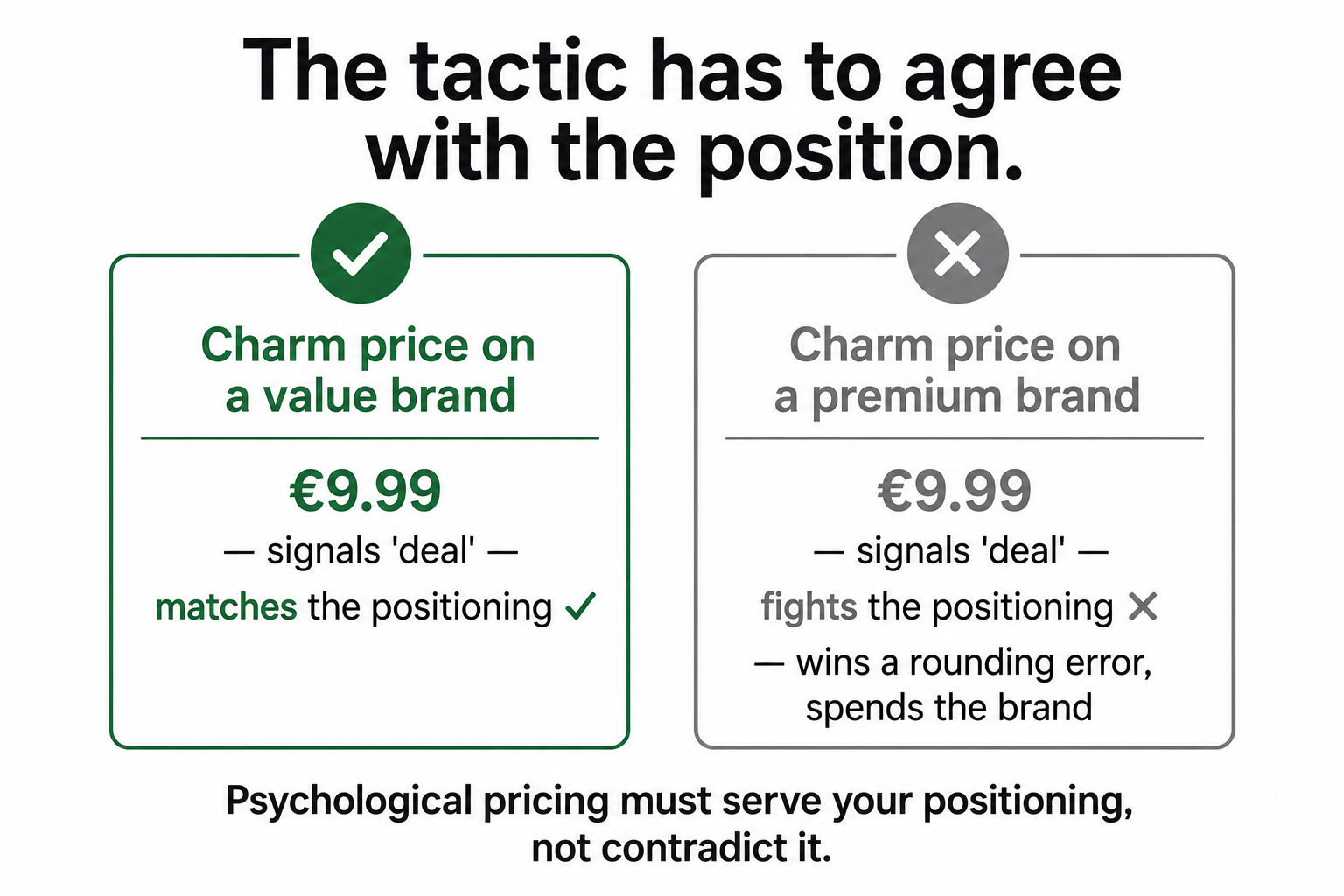
- Charm pricing and the left-digit effect. €9.99 reads as "nine-something" rather than "ten," because we anchor on the leftmost digit. The effect is real, but it's contextual, and that context matters more than the trick. Charm pricing signals value and deal, which is exactly right for a discount store and exactly wrong for a premium brand, where a clean round number signals quality and confidence. The tactic works; whether it suits you depends on what you're selling.
- The decoy, and good-better-best. Add a third option and you change which of the others people choose. A well-placed premium tier makes the middle option look sensible; a deliberately unattractive "decoy" pushes people toward the option you'd prefer they pick. Offering three tiers rather than one also reframes the question from "should I buy" to "which one," which is a stronger position to negotiate from. Robust and genuinely useful.
- Framing. The same price feels different depending on how it's expressed. "€1 a day" lands differently from "€365 a year." Bundling several items into one price changes how the cost is evaluated versus listing them separately. Reframing the unit doesn't change the money, but it changes the perception, and that's legitimate when the framing is honest.
What's folklore
And a fair amount of received pricing wisdom doesn't hold up, or holds up only in the narrow context where it was first observed:
- "Always end in 9" as a universal law. It isn't one. Ending in 9 signals a deal, which helps a value proposition and hurts a premium one. There's no magic in the digit itself; there's a context where it fits and contexts where it actively cheapens you. Applying it as a blanket rule is how premium brands accidentally make themselves look like discounters.
- Magic price points and oversold uplift numbers. The confident claims that some specific price threshold unlocks a precise conversion jump are mostly folklore, drawn from one study in one category and generalised far past where the evidence supports it. Treat any "this exact tactic reliably lifts sales by X%" claim with suspicion.
- Over-clever schemes. Elaborate pricing puzzles, conditional discounts that need a paragraph to explain, structures so intricate the customer can't tell what they'll actually pay. Confusion is the enemy of conversion. A pricing tactic that needs explaining has already failed, because the cognitive cost of working it out outweighs whatever perception gain it was chasing.
The test that matters: does it serve your positioning?
Here's the principle that turns this from a bag of tricks into something strategic. Every psychological pricing tactic sends a signal, and that signal has to agree with what your price and brand are already saying, or it works against you. The cornerstone made the point that price signals quality and selects your customer. Psychological pricing operates on that same signal, which means a tactic that contradicts your positioning wins a tiny perception battle and loses the bigger war.
A premium brand using aggressive charm pricing is the clearest example. The €9.99 might nudge a few more conversions in isolation, but it tells every customer "we're a discount proposition," which undercuts the premium price's whole job of signalling quality. You've spent your positioning to win a rounding error. The same goes for heavy, constant anchoring on a brand built on trust: if every product screams "was €200, now €79," customers stop believing any of your prices are real, and the tactic that was meant to make prices feel like deals instead makes your whole store feel like a permanent, slightly suspect sale.
So the test for any psychological pricing tactic isn't "does this lift conversion in a lab." It's "does this agree with what we want our price to say." If it does, use it. If it fights your positioning, the conversion bump isn't worth what it costs you.
The honesty line, and the law
One area deserves a clear flag, because it's where psychological pricing crosses from clever into deceptive. Fake reference prices, showing a "was" price the product never genuinely sold at, are dishonest, and increasingly they're illegal. In the EU, for instance, when you advertise a price reduction you generally have to show the lowest price the product was offered at over the previous thirty days, precisely to stop the inflated-anchor trick. Other regions have their own versions of the same principle. This isn't legal advice, and the exact rules vary by country, so check what applies where you sell, but the durable principle underneath is simple: anchor against real prices, not invented ones.
That principle is good business even where it isn't yet law. The whole value of an anchor is that the customer believes it. Fake anchors work until customers catch on, and once they suspect your "original" prices are fiction, every price you show loses its credibility. Honest psychological pricing compounds trust; deceptive psychological pricing borrows against it, and the bill comes due.
What this comes down to
Psychological pricing is a real toolkit and a folklore minefield in equal measure. Use the parts the evidence supports, anchoring against genuine references, charm pricing where it fits the brand, good-better-best tiers, honest framing, and skip the cargo cult of universal digit rules and magic price points. Above all, make every tactic agree with what your price is already trying to say, because a trick that fights your positioning costs more than it earns.
The best psychological pricing is the kind the customer never notices, because it simply confirms what the price already told them. The moment a tactic draws attention to itself, or contradicts the brand it's attached to, it's stopped helping. Perception is a lever worth pulling, but only in the same direction your strategy is already pointing.
A few common questions
Does psychological pricing actually work? Parts of it are genuinely robust: anchoring (judging a price against a reference), the left-digit effect behind charm pricing like €9.99, good-better-best tiers and decoys, and honest framing such as "per day" versus "per year." Other parts are folklore, like "always end in 9" treated as a universal law or claims that a specific price point reliably lifts sales by a set amount. The skill is using the evidence-backed tactics and skipping the cargo cult.
Should all my prices end in 9? No. Ending in 9 signals a deal, which suits a value or discount proposition but actively cheapens a premium brand, where a clean round number signals quality and confidence. There's nothing magic in the digit itself; there's a context where it fits and contexts where it works against you. Applying it as a blanket rule is how premium brands accidentally make themselves look like discounters.
Is showing a "was" price a good idea? Anchoring against a higher reference is one of the most robust pricing effects, but only if the reference is real. A fabricated "was" price the product never sold at is deceptive and, in many places including the EU, now illegal, where you generally must show the lowest price from the previous thirty days when advertising a reduction. This isn't legal advice and rules vary by region, so check locally, but the durable principle is to anchor against genuine prices, not invented ones.
How do I know if a pricing tactic is right for my store? Ask whether it agrees with what your price and brand are already trying to say. Psychological pricing operates on the same signal as your price, so a tactic that contradicts your positioning wins a small perception bump and loses the bigger battle, like a premium brand using discount-store charm pricing. If the tactic confirms your positioning, use it; if it fights it, the conversion gain isn't worth what it costs your brand.
You should also read:
Dynamic and Competitive Pricing: When to Move With the Market
Dynamic pricing means changing your prices in response to demand, time, inventory, or competitors. Competitive pricing means setting them relative to your rivals. Both can be smart in the right conditions and quietly destructive in the wrong ones, and the difference is almost never the…
Continue reading...
Everything I Know About Building Chatbots That Actually Work
The hard part of building a chatbot was never the technology. I learned this in 2019, building a natural-language chatbot from scratch for a large hotel group, across dozens of locations and several languages, back when "conversational AI" was a research term and not a…
Continue reading...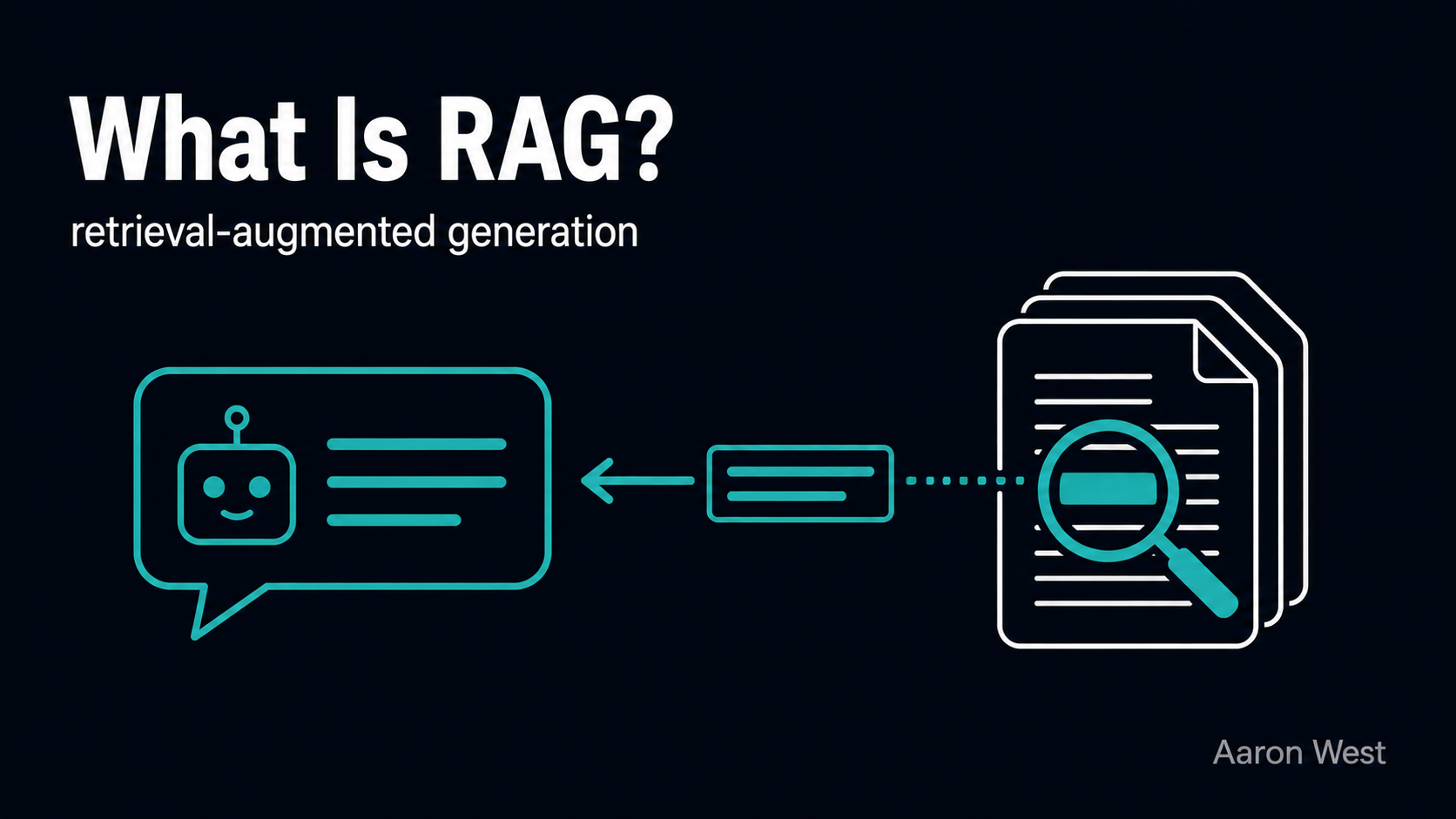
What Is RAG (Retrieval-Augmented Generation), and Why Everyone Is Using It
RAG, retrieval-augmented generation, is a way of making an AI model answer from a specific, trusted set of documents instead of relying only on what it absorbed during training. Before the model writes its answer, the system goes and fetches the most relevant material from…
Continue reading...