Pricing Is a Strategy, Not a Number You Pick

Table of Contents
Pricing is the most powerful lever in your business and the one most stores treat most carelessly. A change in price flows almost entirely to profit, signals your quality, positions your brand, and decides who buys from you, yet most stores set prices by adding a margin to cost or copying a competitor and then never think about it again. Price isn't a number you settle once and forget. It's a strategic decision about what you are.
This opens the Pricing & Promotions pillar, the monetisation core of the hub, and it's the cornerstone everything else here links up to: psychological pricing, dynamic and competitive pricing, how to run promotions without rotting your brand, and the discounting capstone that treats a discount as a loan against your margin. But all of it starts here, with the idea that price is a strategy, because if you get the strategy wrong, no clever pricing tactic on top of it will save you.
Why price is the most powerful lever you have
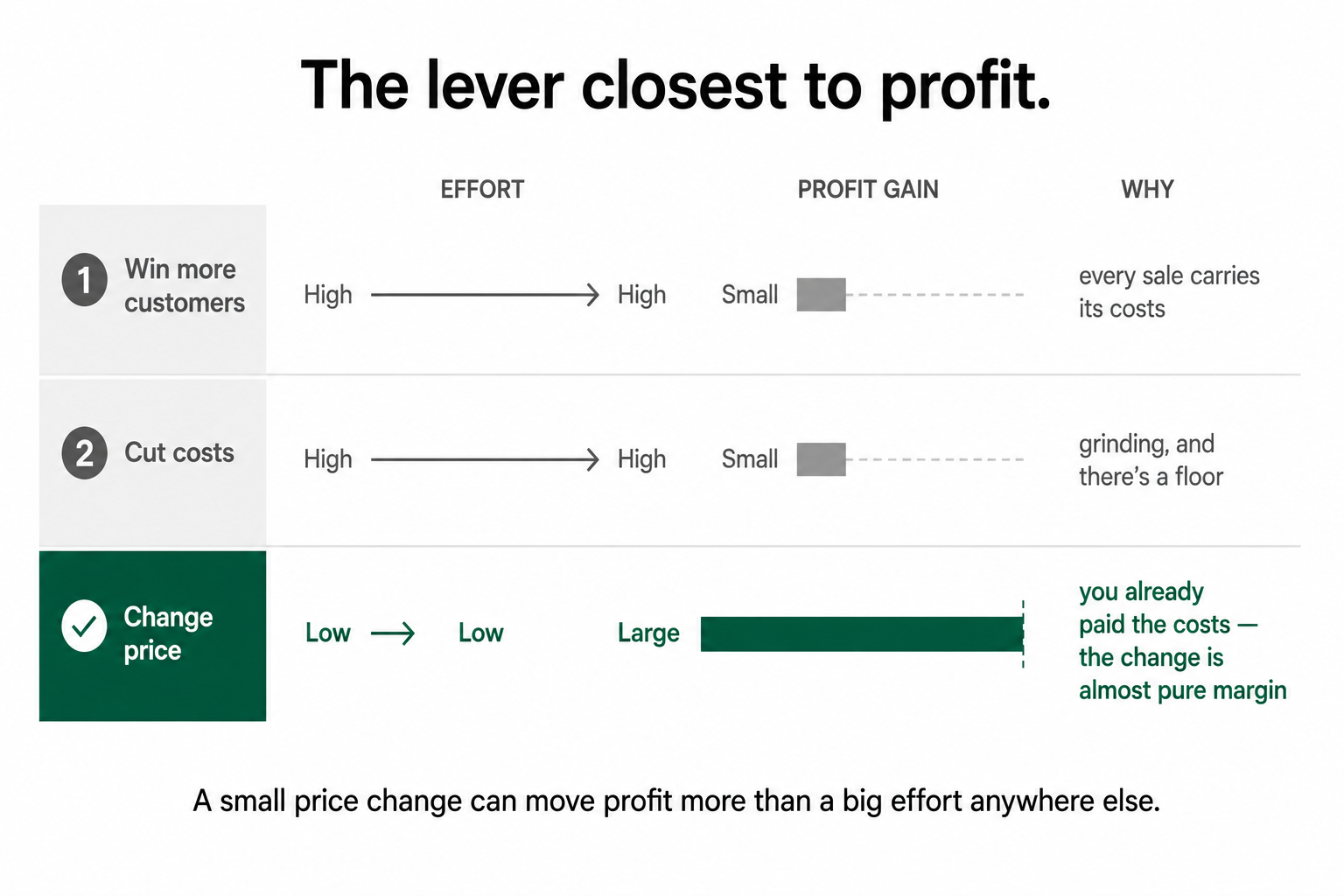
Most businesses have three big levers on profit: get more customers, cut costs, or change prices. The first two are slow, expensive, and competitive. The third is the one that works almost instantly, and it's the one most people touch least.
Here's the mechanism, in plain terms. When you raise a price, you've already paid the costs of making and selling that product, so the extra almost all drops through to profit. There's no additional manufacturing, no extra acquisition spend, no new overhead; it's nearly pure margin. Compare that to growing volume, where every extra sale carries its costs with it, or cutting costs, which is grinding work with a floor you eventually hit. A modest, well-judged price change can move profit more than a large effort spent anywhere else. Price is the lever closest to the bottom line, with the least friction between pulling it and seeing the result.
And yet it's the lever stores agonise over least. Teams will spend weeks optimising an ad campaign worth fractions of a percent, or A/B testing a button colour, while the single highest-leverage number in the business sits on a lazy default nobody has revisited in years. The easy money in most stores is on the pricing page, and almost nobody works it.
The two lazy defaults
If price is so powerful, why do so many stores set it carelessly? Because there are two defaults that feel safe and require no thought, and almost everyone reaches for one of them.
The first is cost-plus: take what the product costs you, add a fixed margin, done. It feels responsible because it guarantees you cover costs, but it's blind to the one thing that actually determines a good price, what the product is worth to the customer. Cost-plus leaves money on the table for products people value highly (you could have charged more and they'd happily have paid) and overprices products they don't value (where your standard margin prices you out). Your costs are your business; they have almost nothing to do with what a customer will pay.
The second is competitor-copy: find what a competitor charges and match or undercut it. This feels safe because someone else did the thinking, but you're handing your pricing to a company whose costs, brand, customer base, and strategy you don't actually know. Maybe their costs are lower, maybe they're running a loss-leader, maybe they're a different proposition entirely. Copy their price and you import their assumptions and their mistakes, and if everyone in the category does it, the whole market spirals into a race to the bottom that destroys margin for all of you. Watching competitors is useful intelligence; outsourcing your price to them is not a strategy.
Both defaults share the same flaw: they answer "what number is safe to put here" instead of "what should this price be doing for us."
The three jobs a price actually does
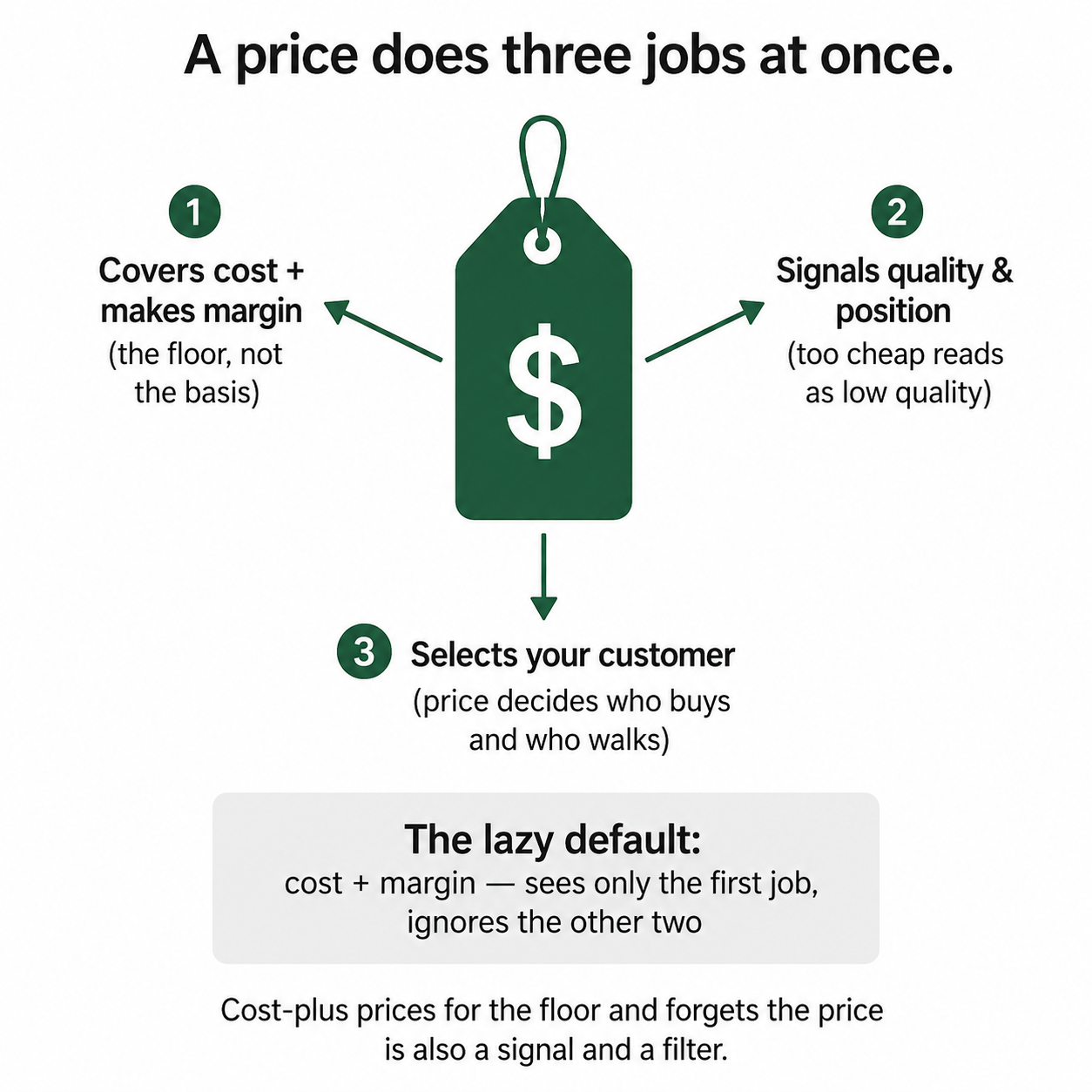
Once you stop seeing price as a number that covers cost and start seeing it as a strategic signal, it becomes clear that a price is doing several jobs at once, and only one of them is about covering cost.
The first job is the obvious one: cover cost and make margin. Cost is the floor; you can't sustainably price below it. But that's the floor, not the basis, and treating it as the basis is the cost-plus mistake.
The second job is signalling quality and position. Price is information to the customer before they've tried anything. A price that's too low doesn't read as "great value"; it often reads as "probably not very good," because people use price as a proxy for quality when they can't judge it directly. The premium price isn't just capturing margin; it's part of the product, telling the customer what tier they're in. Underprice a genuinely good product and you can actively make people trust it less.
The third job is selecting your customer. Price decides who buys and who walks away, and that's a positioning choice, not an accident. A higher price repels the bargain-hunter and attracts the customer who associates price with quality and is less likely to churn over a discount elsewhere. A lower price does the reverse. Either can be right; what's wrong is not realising you're making the choice. Your price is quietly choosing your customer base whether you think about it or not.
The shift: from "what does it cost" to "what is it worth, and what do we want to be"
Put those three jobs together and the move is clear. Stop starting from your cost and adding a margin, and start from two strategic questions: what is this product genuinely worth to the customer who values it, and what do we want our brand to be? Cost is a constraint, the floor you can't go below, but the price itself should be set by the value delivered and the position you want to hold. That's value-based pricing, and it's where the real margin lives, because it captures what the customer is actually willing to pay rather than mechanically marking up your costs.
There's an important honesty point here, because "price strategically" gets misread as "charge as much as possible." It doesn't mean that. Sometimes the right strategic price is lower, a deliberate choice to win volume, broaden access, penetrate a market, or anchor a position as the accessible option. The point isn't to maximise the number; it's to choose it on purpose, tied to what you're trying to achieve, rather than letting a cost-plus formula or a competitor's price chart decide it for you. A deliberately low price is a strategy. A thoughtlessly low price is just lost margin.
This is the lens for the whole pillar. Psychological pricing is about how the price is perceived. Promotions and discounting are about what happens when you move the price down, and the danger of doing it reflexively. All of it sits on the foundation that price is a deliberate strategic instrument, not a number you pick once to make the spreadsheet balance.
What this comes down to
Every other lever in the business, more traffic, higher conversion, lower costs, is hard work for incremental gains. Price is the one lever that moves profit almost directly, signals what your brand is, and chooses which customers you get. Treating it as a number to settle once, by adding a margin to cost or copying a competitor, leaves the most valuable decision you make running on autopilot.
Set your price on purpose. Start from what the product is worth and what you want to be, keep cost as the floor rather than the basis, and decide deliberately whether you're the premium option, the accessible one, or something in between, because your price is making that decision either way. The only question is whether you're the one making it.
A few common questions
Why is pricing the most powerful lever in a business? Because a price change flows almost entirely to profit. You've already paid the costs of making and selling the product, so extra price is nearly pure margin, with none of the added cost that comes with winning more customers or the grinding effort of cutting costs. A modest, well-judged price change can move profit more than a large effort spent on traffic or efficiency, which is why it's the highest-leverage and most-neglected number in most stores.
What's wrong with cost-plus pricing? It's blind to the one thing that determines a good price: what the product is worth to the customer. Adding a fixed margin to cost feels responsible, but it leaves money on the table for products people value highly and overprices ones they don't. Your costs are your business; they have almost nothing to do with what a customer is willing to pay. Use cost as a floor, not as the basis for the price.
Should I just match my competitors' prices? Watching competitors is useful intelligence, but copying their prices isn't a strategy. You're handing your pricing to a company whose costs, brand, and strategy you don't know, importing their assumptions and mistakes, and if everyone does it the market spirals into a margin-destroying race to the bottom. Set your price from your own value and positioning, and use competitor prices as context, not as the answer.
Does pricing strategically mean charging as much as possible? No. It means choosing the price on purpose, tied to what you're trying to achieve, rather than defaulting to cost-plus or a competitor's number. Sometimes the right strategic price is lower, to win volume, broaden access, or hold an accessible position. A deliberately low price is a strategy; a thoughtlessly low price is just lost margin. The goal is a deliberate price, not a maximum one.
You should also read:
Dynamic and Competitive Pricing: When to Move With the Market
Dynamic pricing means changing your prices in response to demand, time, inventory, or competitors. Competitive pricing means setting them relative to your rivals. Both can be smart in the right conditions and quietly destructive in the wrong ones, and the difference is almost never the…
Continue reading...
Psychological Pricing: What Actually Works and What's Folklore
Psychological pricing is the set of tactics that change how a price is perceived rather than what it costs you: charm pricing like €9.99, anchoring against a higher number, decoy options, and the rest. Some of it is genuinely robust, supported by decades of evidence.
Continue reading...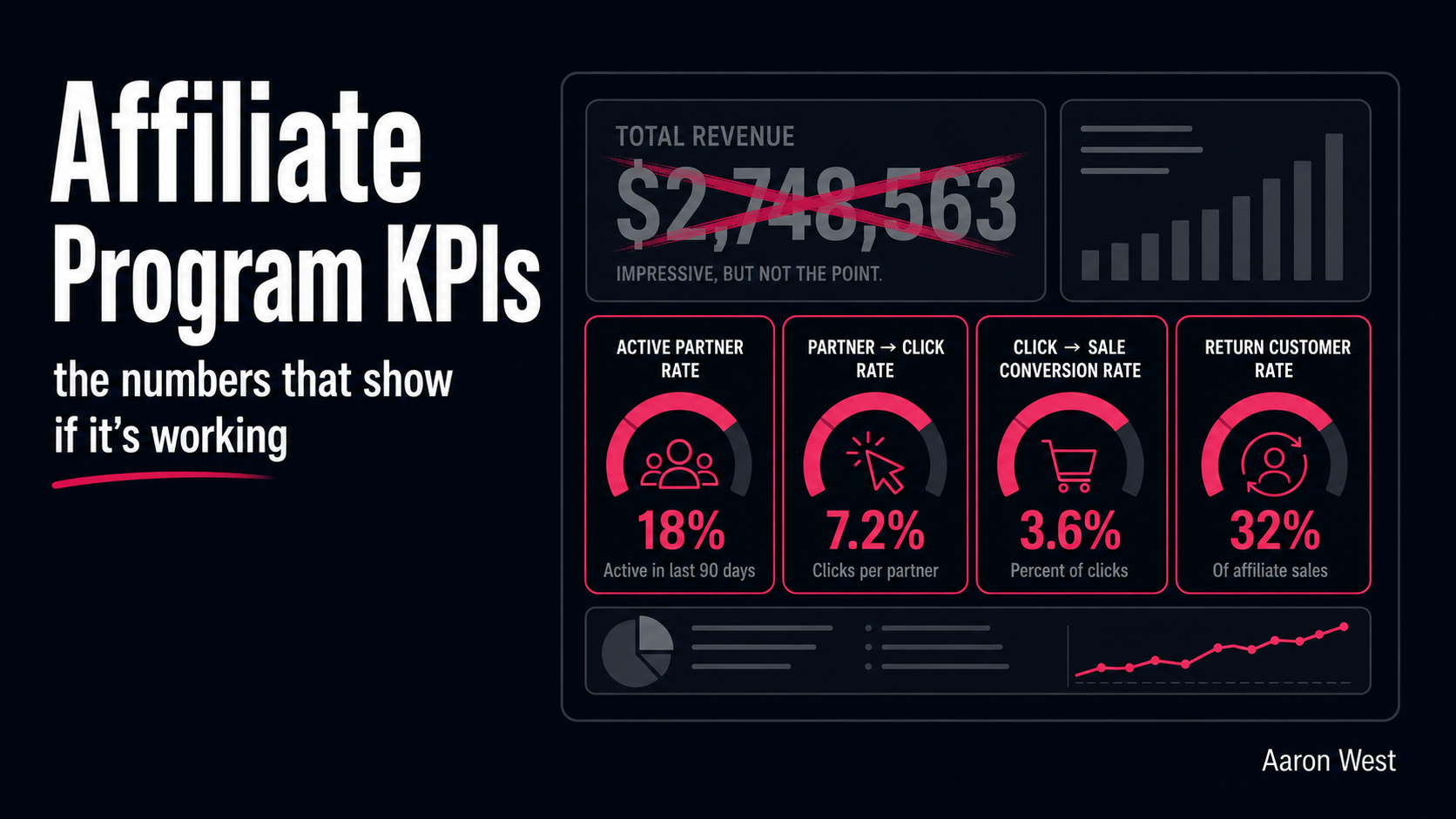
Affiliate Program KPIs: The Numbers That Show If It's Actually Working
Most affiliate dashboards proudly display the numbers that mean the least. Total affiliates, total clicks, total revenue: big, reassuring, and almost useless for deciding what to do next. The numbers that actually tell you whether your programme is working, and what to fix, are quieter…
Continue reading...