Product Recommendations: Beyond "You May Also Like"

Table of Contents
Product recommendations are how you show a customer things they didn't come looking for but are genuinely glad to find. They're the discovery half of merchandising, the online version of a good shop assistant saying "if you're buying those shoes, you'll want these socks too." Most stores bolt a generic "you may also like" carousel onto every page, watch it do nothing, and conclude that recommendations don't work for them. The problem is almost never the algorithm. It's that the recommendation ignores where the customer is and what they're trying to do at that exact moment.
This is a core of the Merchandising pillar, and it's the engine behind the cornerstone's second job: discovery, helping customers find things they didn't know they wanted. Here's why context matters more than cleverness, and why the same recommendation that wins on one page actively loses sales on another.
Recommendations are the discovery engine
Findability gets the determined customer to the thing they came for. Discovery does the opposite job: it shows the open-minded customer something worth their attention that they weren't looking for. In a physical shop, that's the well-placed display, the staff suggestion, the thing by the till. Online, it's the recommendation.
Done well, recommendations help the customer and grow the basket at the same time, which is the territory where merchandising meets average order value. A customer who came for one thing and left with three didn't get tricked; they got shown things they were genuinely pleased to find, the way a helpful assistant points out the cable you'll need with the device. That's the standard a good recommendation should meet: the customer is glad you suggested it.
The "you may also like" failure is what happens when stores treat this as a checkbox. One generic widget, the same logic everywhere, recommending vaguely related products nobody clicks. It's recommendations as decoration, and because it predictably does nothing, the store concludes the whole idea doesn't work and stops trying. The idea works fine. The generic, context-blind execution doesn't.
Context decides what's a good recommendation
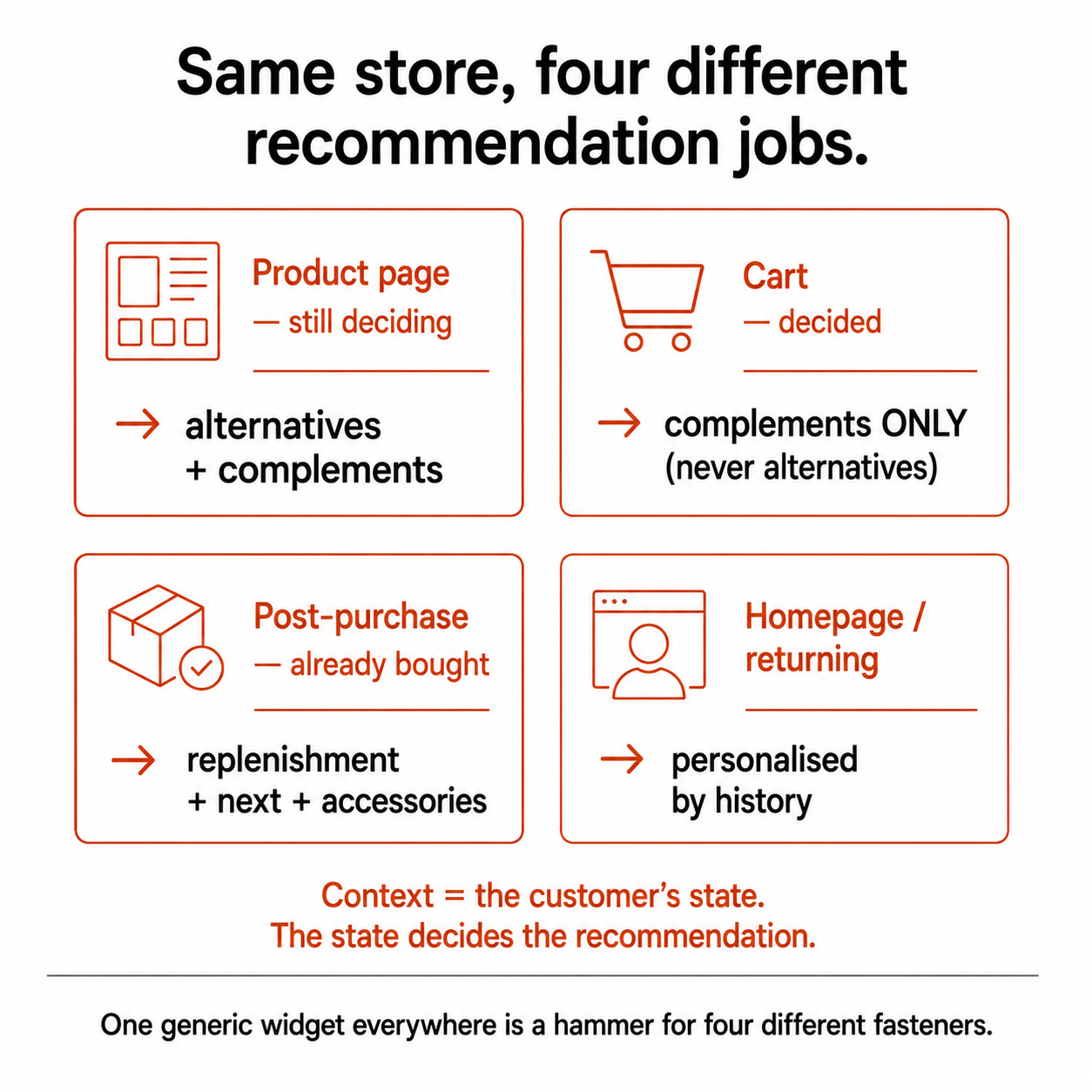
Here's the insight that turns recommendations from decoration into a real lever: the same customer needs a completely different kind of recommendation depending on where they are and what they're doing. The algorithm matters far less than matching the suggestion to the moment. Walk through the main placements and you can see how different the jobs are:
- On a product page, the customer is still deciding. They need two things: alternatives (other options like this one, in case this isn't quite right) and complements (things that go with it, for when it is). Both belong here, doing different jobs for the same undecided shopper.
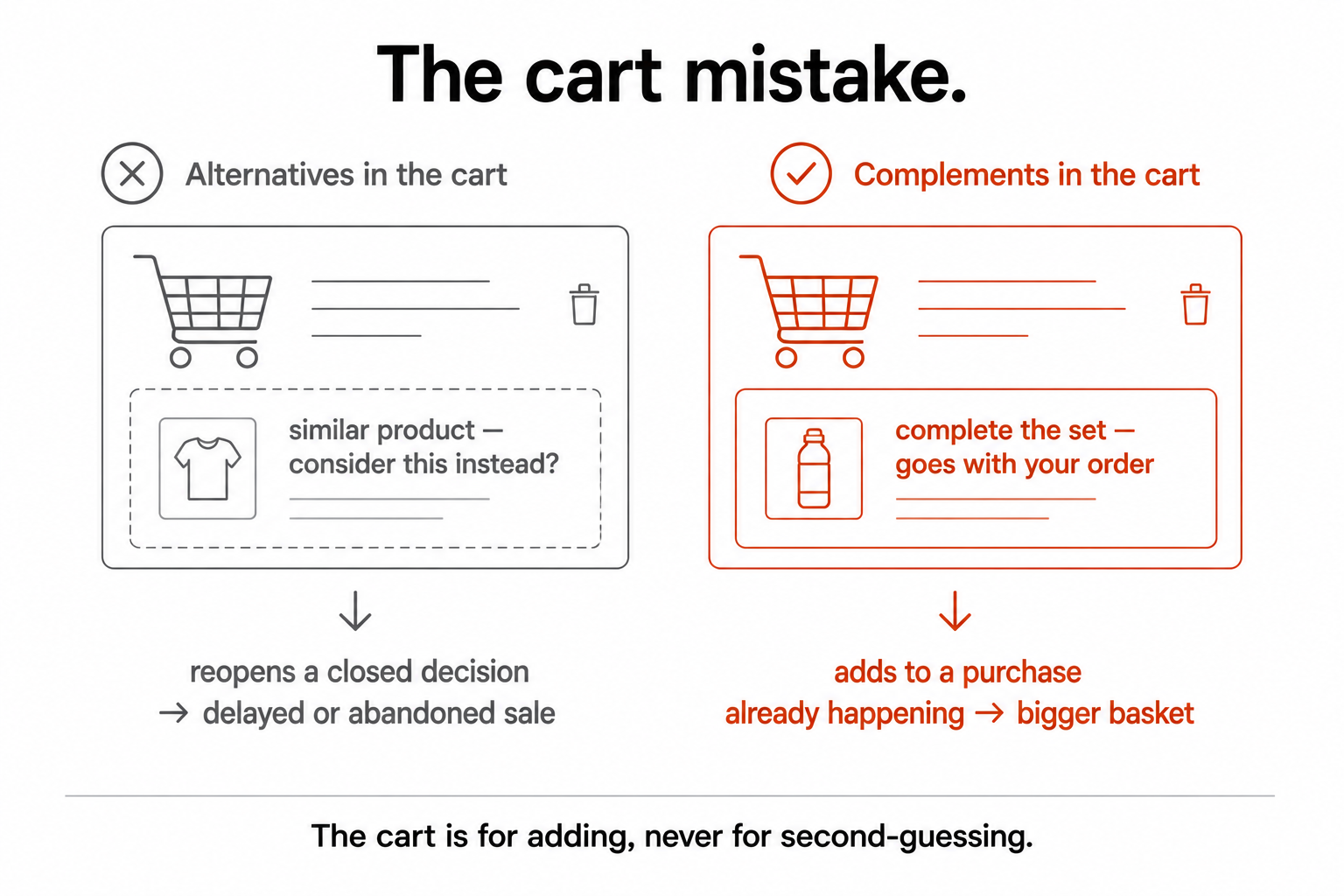
- In the cart, the customer has decided. This is the one most stores get dangerously wrong. Here you want complements and "complete the set" suggestions, the classic cross-sell. What you absolutely must not show is alternatives, because suggesting a similar-but-different product to someone who's about to buy reopens a decision they'd already closed, and a reopened decision is a delayed or abandoned sale. The cart is for adding, never for second-guessing.
- Post-purchase, in the confirmation page or the follow-up email, the customer already bought. Now the useful recommendations are replenishment ("running low?"), accessories for what they bought, or the natural next purchase, which connects to the CRM lifecycle.
- On the homepage or for a returning customer, the best recommendations are personalised by history, picking up where they left off rather than starting cold.
Four placements, four different customer states, four genuinely different recommendation jobs. A store running one generic widget across all of them is using a hammer for four different fasteners and wondering why it's not working.
The recommendation logics, and where each belongs
Underneath the placements are a few types of recommendation logic. None is "best"; each is right in some contexts and wrong in others:
- "Similar to this" (alternatives). For the still-deciding shopper on a product or category page. Helps them find a better fit. Wrong in the cart, where it reopens a closed decision.
- "Goes with this" (complements). For the decided shopper, on the product page and especially the cart. This is the highest-value cross-sell, because it adds to a purchase that's already happening rather than competing with it.
- "Others also bought / viewed" (behavioural). Doubles as social proof and discovery. Useful broadly, strongest where the customer is exploring.
- "Based on your history" (personalised). For returning or known customers, on the homepage and in lifecycle emails. Cold for a first-time visitor with no history, so it needs a sensible fallback.
The single most expensive mistake is putting "similar alternatives" in the cart. It feels helpful, more choice, but it's the digital equivalent of a shop assistant interrupting someone at the till to say "actually, have you considered this other one instead." You don't help them; you stall a sale that was about to close.
Fix the placement before the algorithm
The instinct, when recommendations underperform, is to reach for a smarter algorithm or a fancier personalisation engine. Usually that's premature. A perfect algorithm in the wrong place still fails, because it's answering a question the customer isn't asking at that moment. Get the context right first, the right kind of recommendation in each placement, and even a simple logic performs. Then, if you want, improve the algorithm on top of a structure that already makes sense.
There's also an honesty line that matters for a brand built on trust. Recommendations should help the customer, not just maximise the basket. Suggesting the genuinely useful complement, the thing they'll be glad they didn't forget, builds trust and brings them back. Stuffing the slots with random high-margin products they don't need does the opposite; customers can feel when they're being upsold rather than helped, and it costs more in eroded trust than it makes in the moment. The best recommendation is one the customer would thank you for, which is also, not coincidentally, the one most likely to convert.
And judge them honestly. A recommendation widget that gets impressions but no clicks, or clicks but no resulting purchases, isn't working, however good its dashboard looks. Measure recommendations on whether they led to a good outcome, the same decision-metric discipline the rest of the hub argues for.
What this comes down to
A good recommendation is the right suggestion at the right moment, exactly the instinct a great shop assistant has. Show the still-deciding shopper alternatives and complements. Show the decided shopper in the cart what completes the set, and never an alternative that reopens the decision. Show the post-purchase customer what comes next. Show the returning customer something built on their history. The placement tells you the customer's state, and the state tells you the recommendation.
"Recommendations don't work for us" almost always means "we ran one generic widget everywhere." The fix isn't a cleverer algorithm; it's matching the suggestion to the moment, and being the kind of store that recommends what the customer will be glad to find rather than what you're most eager to sell. Context, not cleverness, is what makes recommendations work.
A few common questions
Why don't my product recommendations work? Almost always because you're running one generic "you may also like" widget in every location, ignoring what the customer is doing at each point. Recommendations aren't a checkbox; the same customer needs a different kind of suggestion on a product page than in the cart or after purchase. The problem is rarely the algorithm and almost always the lack of context.
What should I recommend in the shopping cart? Complements and "complete the set" items, never alternatives. The customer in the cart has already decided, so suggesting a similar-but-different product reopens a closed decision and stalls or loses the sale. Show them what goes with what they're buying (the highest-value cross-sell), not another version of it. The cart is for adding, not second-guessing.
What are the main types of product recommendation? "Similar to this" (alternatives, for the still-deciding shopper), "goes with this" (complements, for the decided shopper and the strongest cross-sell), "others also bought or viewed" (behavioural, doubling as social proof), and "based on your history" (personalised, for returning customers). None is universally best; each is right in some placements and wrong in others, which is why context decides.
Should I improve my recommendation algorithm or its placement first? Placement and context first. A perfect algorithm in the wrong place still fails, because it answers a question the customer isn't asking at that moment. Get the right kind of recommendation into each placement, then improve the algorithm on top of a structure that already makes sense. And recommend what genuinely helps the customer, not just high-margin products, because trust converts better than pushiness.
You should also read:
Product Taxonomy: The Structure Everything Else Depends On
Product taxonomy is how you classify and organise your products, the categories, subcategories, and attributes that everything else is built on top of: search, filters, navigation, category pages, recommendations. It's the most unglamorous decision in merchandising and quietly the most consequential, because when the structure…
Continue reading...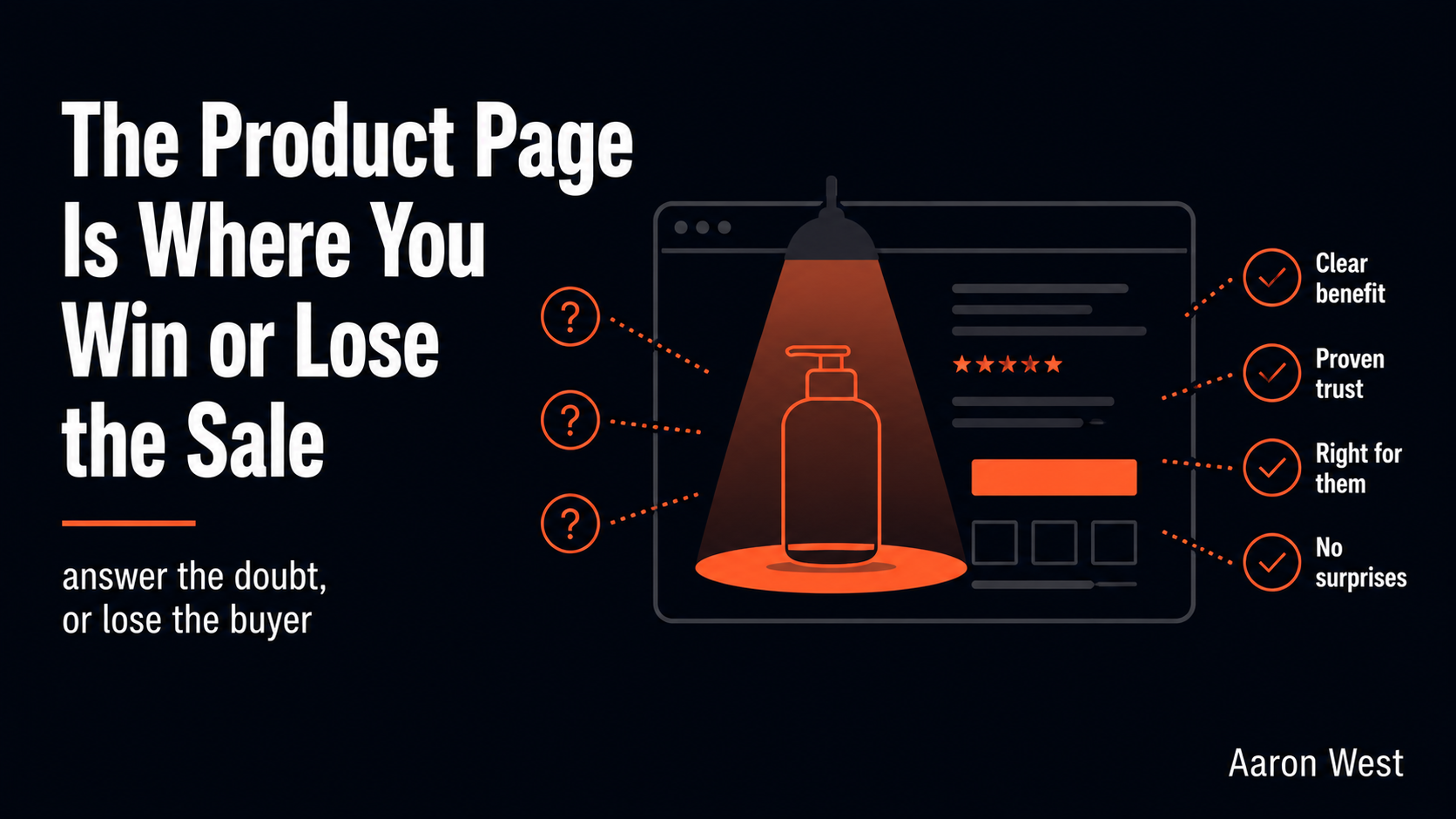
The Product Page Is Where You Win or Lose the Sale
The product page is where the buying decision actually gets made, which makes it the most important page on your store, and the one most stores treat as an afterthought. Everything before it, the ads, the homepage, the category listings, only does one job: deliver…
Continue reading...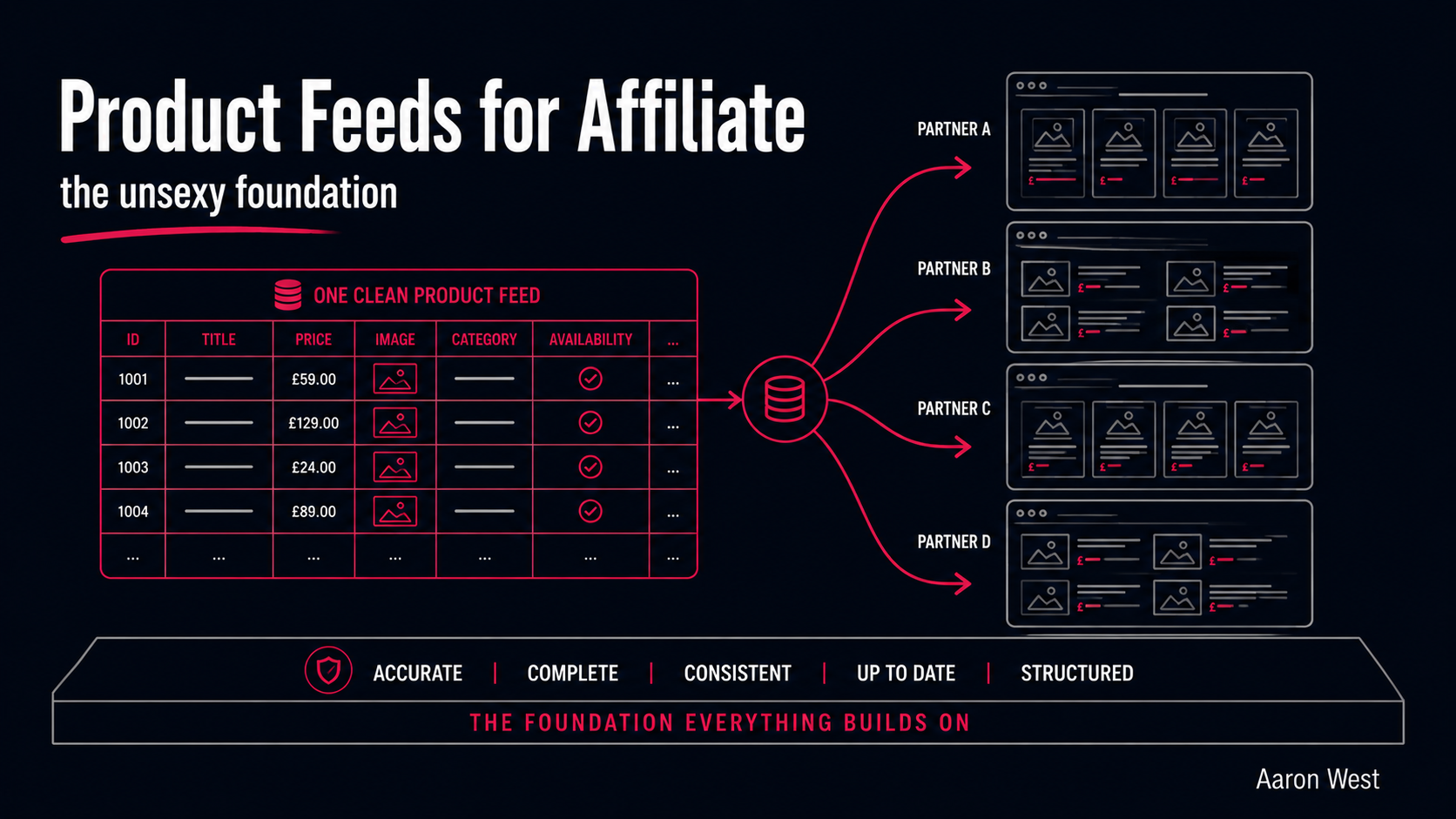
Product Feeds and Data Structure for Affiliate: The Unsexy Foundation
A product feed is a structured, regularly-updated file containing all your product information, name, price, description, image, link, availability, that your affiliate partners use to promote your products accurately. It is the least glamorous part of an affiliate programme and one of the most consequential,…
Continue reading...