Product Feeds and Data Structure for Affiliate: The Unsexy Foundation

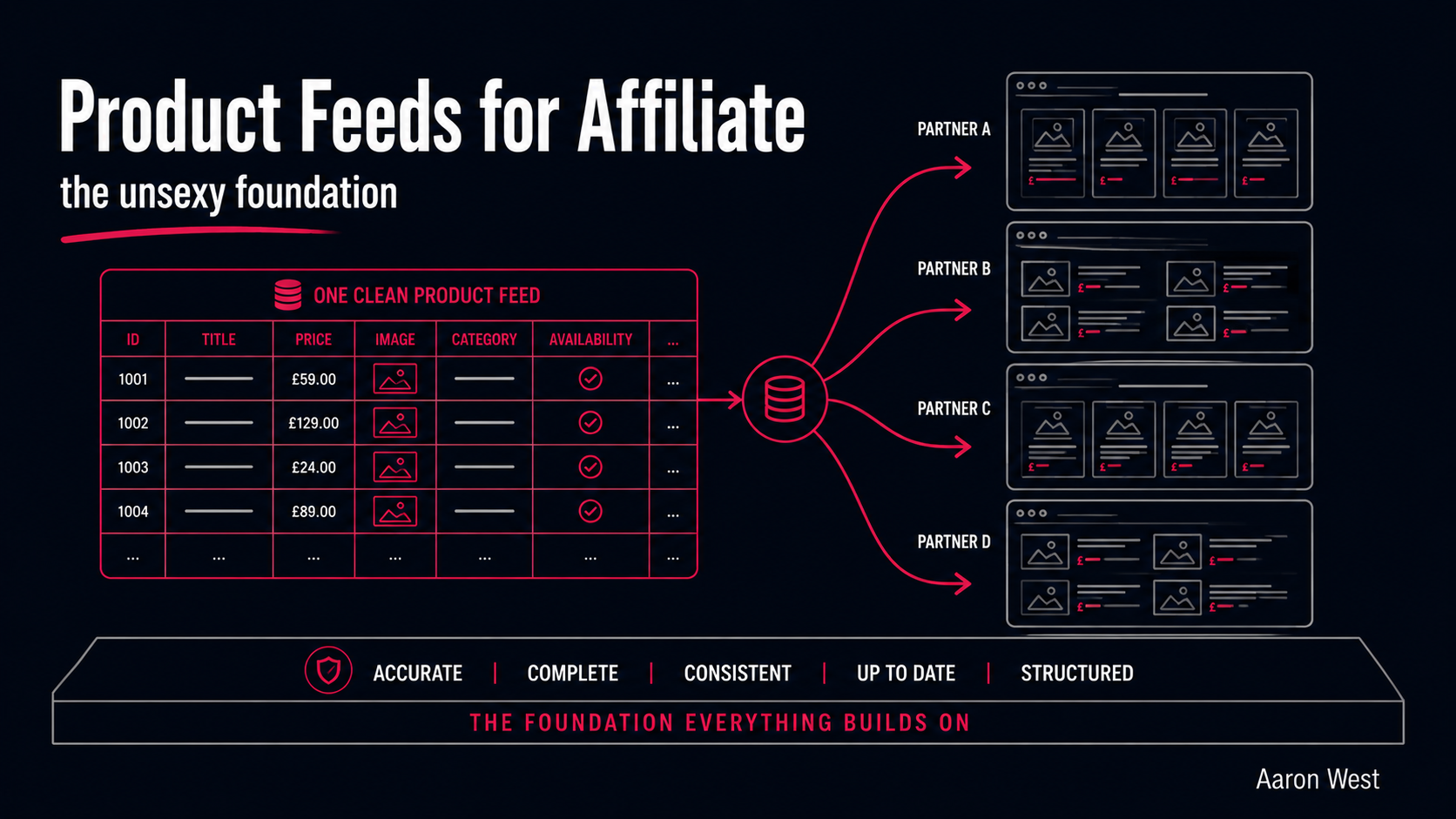
Table of Contents
A product feed is a structured, regularly-updated file containing all your product information, name, price, description, image, link, availability, that your affiliate partners use to promote your products accurately. It is the least glamorous part of an affiliate programme and one of the most consequential, because no partner can promote products they cannot see, and a stale or incomplete feed quietly caps how much your best partners can sell for you. Comparison sites, content publishers, and shopping channels all build their listings from your feed. If the feed is thin, wrong, or out of date, so are they, and so is the revenue they send you.
This is the infrastructure piece nobody puts on a slide, sitting in the affiliate cluster under the technology layer. It is the data foundation that the comparison sites and other catalogue-driven partners depend on entirely. I will keep it plain and practical, no technical background needed: what a feed actually is, what goes in it, the formats explained simply, why feed quality decides how much your affiliate channel can earn, and why in 2026 the feed matters more than it ever has.
What a product feed actually is
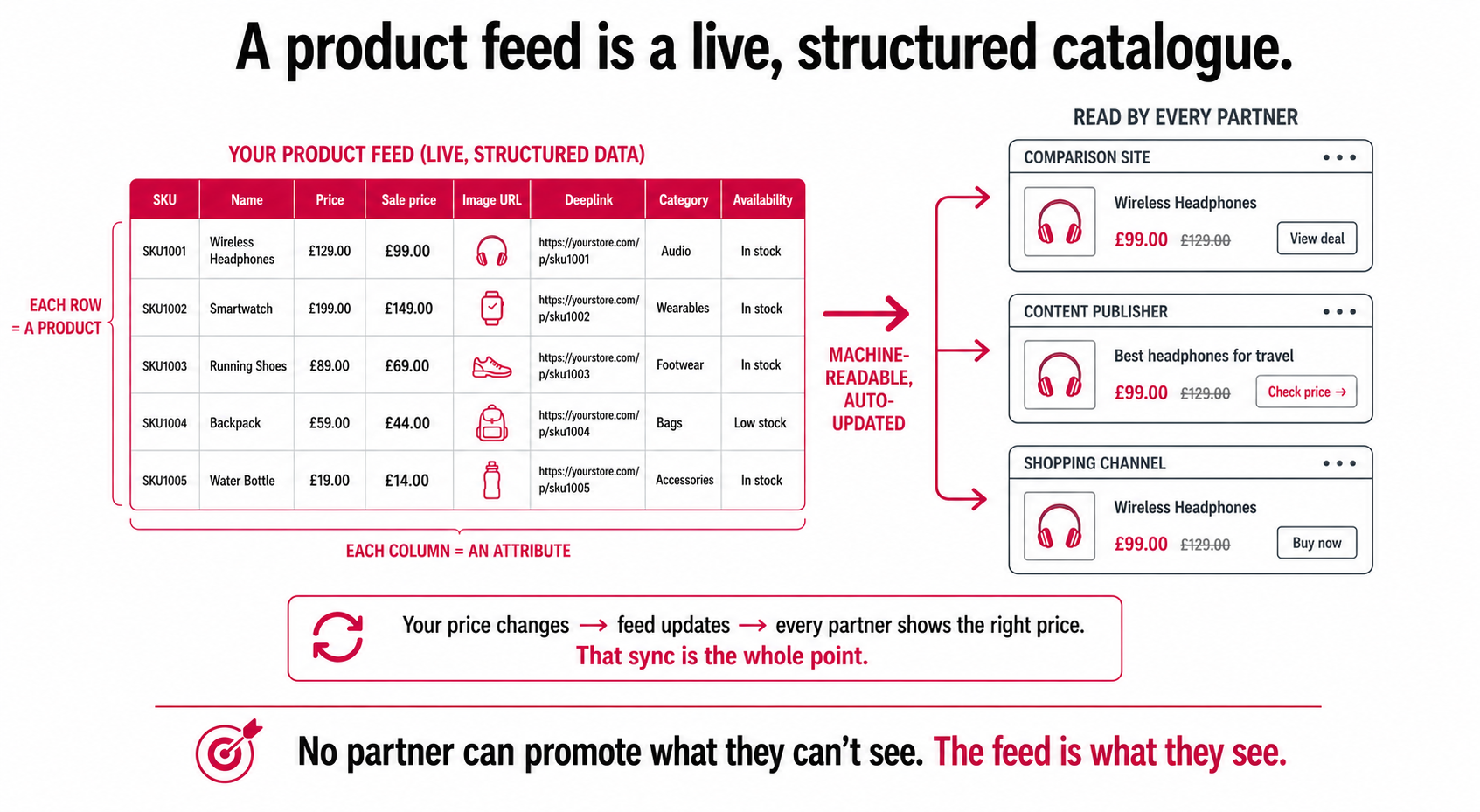
Strip away the jargon and a product feed is a live digital catalogue of your products in a structured file. Think of a spreadsheet where each row is one product and each column is one attribute, name in one column, price in the next, image link in another, and so on, kept continuously up to date as your prices and stock change. That structure is the whole point: because the data is organised into predictable fields, a machine (a publisher's website, a comparison engine, a shopping channel) can read it automatically and display your products without anyone copying anything by hand.
A typical affiliate feed carries, per product: a unique identifier (SKU or product ID), the product name, a description, the price (and sale price, if any), the product image URL, the deeplink to that product's page (carrying the affiliate's tracking), the category, and availability or stock status. Richer feeds add more, brand, colour, size, dimensions, specifications, additional images, and as we will see, the richer the feed, the more useful it is. The feed is generated on your side (the advertiser's) and made available to your partners through your network or platform, which keeps everyone's listings synchronised with your real catalogue. When your price changes, the feed updates, and every partner showing that product shows the right price. That synchronisation is the magic, and the thing that breaks loudest when a feed goes stale.
The formats, explained simply
Feeds come in a few file formats, and the names sound technical but the idea is simple, they are all just ways of arranging the same table of data so a machine can read it:
- CSV (comma-separated values) is the simplest, essentially a spreadsheet saved as plain text, with commas separating the columns. Easy to create in Excel or Google Sheets and widely accepted. A fine starting point.
- TSV (tab-separated values) is the same idea, but uses tabs instead of commas to separate columns. Functionally identical to CSV.
- XML (extensible markup language) is the most widely used format for affiliate feeds and shopping channels. It is more flexible than a flat spreadsheet, it can handle richer, nested information like multiple images or complex attributes per product, which is why networks and comparison engines tend to prefer it. It is less readable to a human eye but more capable.
You do not need to hand-build any of these, your platform or network specifies the format it wants and usually helps generate it. The only thing worth knowing as a marketer is that the format is just a container; what matters is the quality of what is inside it, which is the part people neglect.
Why feed quality decides what you earn
Here is the part that turns this from a technical chore into a revenue lever, because feed quality is not a hygiene issue, it directly determines how much your affiliate channel can sell.
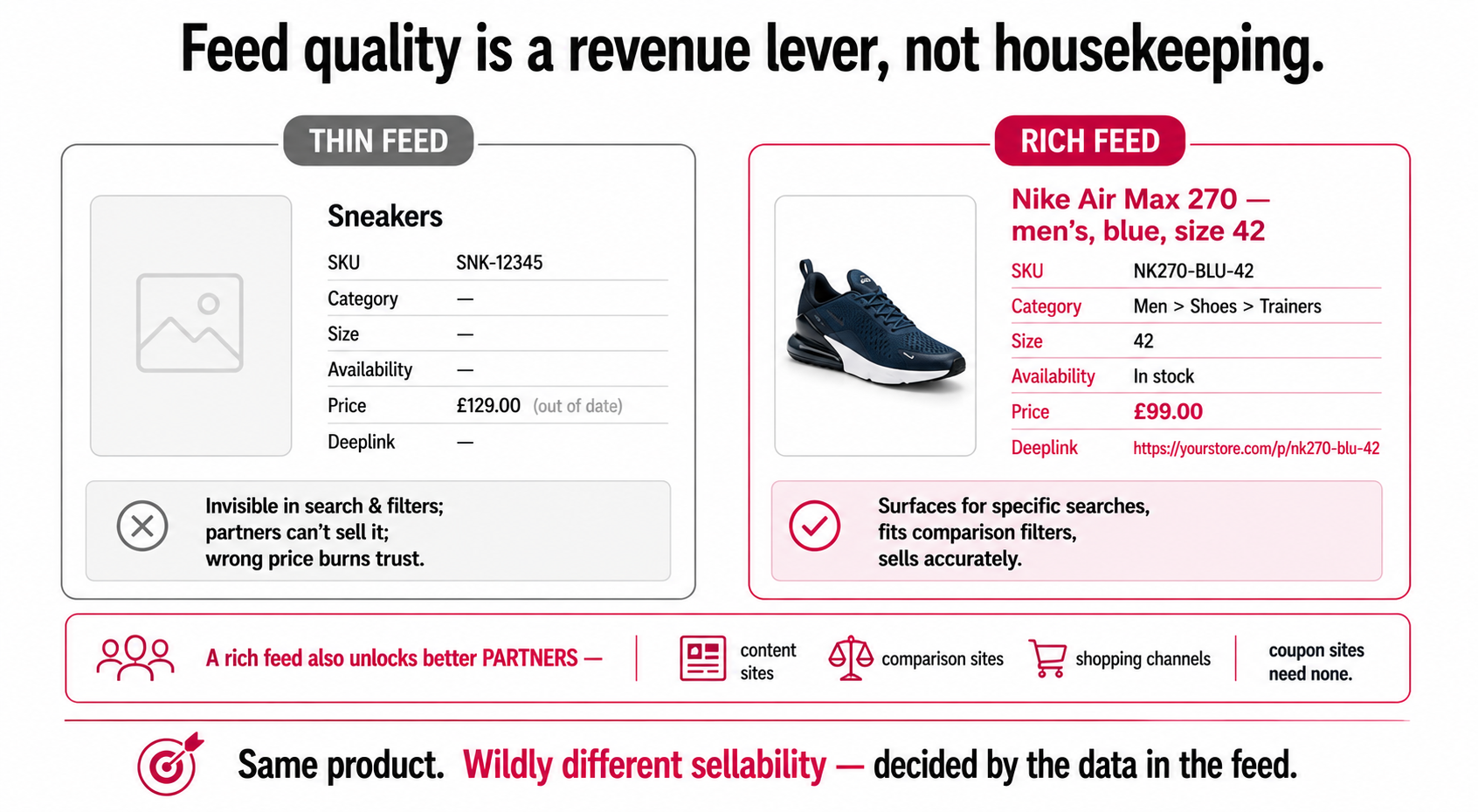
The principle: the richer and cleaner your feed, the more discoverable and sellable your products are. A feed entry that says "Sneakers" gives a publisher almost nothing to work with. One that says "Nike Air Max 270, men's, blue, size 42" lets that product surface for a specific search, appear in the right comparison filters, and be promoted accurately. Same product, wildly different sellability, decided entirely by the data in the feed. Detailed, well-structured fields let partners filter and organise your products, match them to specific customer needs, and present them compellingly. Thin fields make your products invisible in exactly the moments a customer is ready to buy.
This is why feed quality is a genuine performance metric. A good rule of thumb from the network side: keep missing mandatory fields (category, SKU, name, image URLs) to a small minimum, every product with a blank where an image or category should be is a product partners can't properly show. Stale data is just as costly: a feed that lags your real prices and stock means partners promote sold-out items or wrong prices, which burns customer trust and wastes the click. So the unglamorous work, complete fields, accurate prices, frequent updates, good images, is not housekeeping. It is the difference between a partner being able to sell your catalogue and only being able to sell the fraction of it your feed describes properly.
There is a strategic payoff too, beyond per-product sellability. A good feed diversifies your partner mix. A rich, reliable catalogue opens the door to the content publishers, comparison sites, and shopping partners who drive new-customer acquisition and upper-funnel discovery, the demand-creators, rather than just the coupon partners who need no feed at all. In other words, a strong feed does not just sell more of each product; it lets you recruit better partners. The feed quietly shapes the kind of programme you can build.
Why the feed matters more in 2026
One forward-looking reason to take the feed seriously now, because its importance is rising, not falling. As AI-driven search and shopping interfaces grow, the product feed is becoming the source of truth that AI engines read to understand and recommend your products. These systems do not just scan a page for keywords; they interpret structured product data to understand a product's attributes, context, and fit for a query. So when a shopper asks an AI assistant for "a lightweight rain jacket for hiking in unpredictable spring weather," the products that surface are the ones whose feeds carry well-labelled fields, type, material, weight, features, seasonality, that let the machine match them to that intent. Products with thin feeds lose to competitors with richer data, regardless of how good the product itself is.
This is the same shift the discoverability pillar describes for content: structured, machine-readable data is increasingly what determines whether you are found and recommended. For products, the feed is that structured data. So the unsexy foundation is quietly becoming one of the higher-leverage investments in the whole programme, the better your feed, the better both your affiliate partners and the AI engines can find, understand, and sell your products. That convergence, the same feed serving human partners and machine recommenders, is why the feed deserves more attention in 2026 than it has ever had.
That is the unsexy foundation, and why it is worth caring about. A product feed is just a live, structured catalogue of your products, but it is the data every catalogue-driven partner builds on, the lever that decides how sellable each product is, the gatekeeper that determines which partners you can attract, and increasingly the source of truth AI shopping engines read. The formats are simple containers; the quality of the data inside them is the real work, complete fields, accurate prices, frequent updates, rich attributes. Nobody puts the product feed on a conference slide. But the programmes that treat it as a serious, maintained asset out-sell the ones that treat it as a file they exported once and forgot. Get the foundation right, and everything built on top of it works better.
A few common questions
What is an affiliate product feed? A product feed is a structured, regularly-updated file (a live digital catalogue) containing your product information, unique ID/SKU, name, description, price, image URL, deeplink, category, and availability, that your affiliate partners use to promote your products accurately. Comparison sites, content publishers, and shopping channels build their listings directly from it, so its completeness and accuracy directly shape how much they can sell for you.
What format should an affiliate product feed be in? The common formats are CSV (a spreadsheet saved as plain text, simplest), TSV (the same but tab-separated), and XML (the most widely used for affiliate and shopping channels because it handles richer, nested data like multiple images). You usually don't build these by hand, your network or platform specifies the format and helps generate it. The format is just a container; what matters far more is the quality and completeness of the data inside.
Why does product feed quality matter? Because it directly determines how sellable your products are. A feed entry reading "Sneakers" gives a partner almost nothing; "Nike Air Max 270, men's, blue, size 42" lets the product surface for specific searches, fit comparison filters, and be promoted accurately. Rich, clean, current feeds make products discoverable and let you attract demand-creating partners (content and comparison sites); thin or stale feeds make products invisible at the moment of purchase and burn trust with wrong prices or sold-out items.
Why do product feeds matter more with AI search? Because AI shopping and search interfaces read structured product data, not just page keywords, to understand a product's attributes and match it to a shopper's intent. A feed with well-labelled fields (type, material, weight, features, seasonality) lets an AI match your product to a complex query like "a lightweight rain jacket for spring hiking," while a thin feed loses to competitors with richer data. The feed is becoming the source of truth AI engines use to find and recommend products, making it a higher-leverage investment than ever.
You should also read:
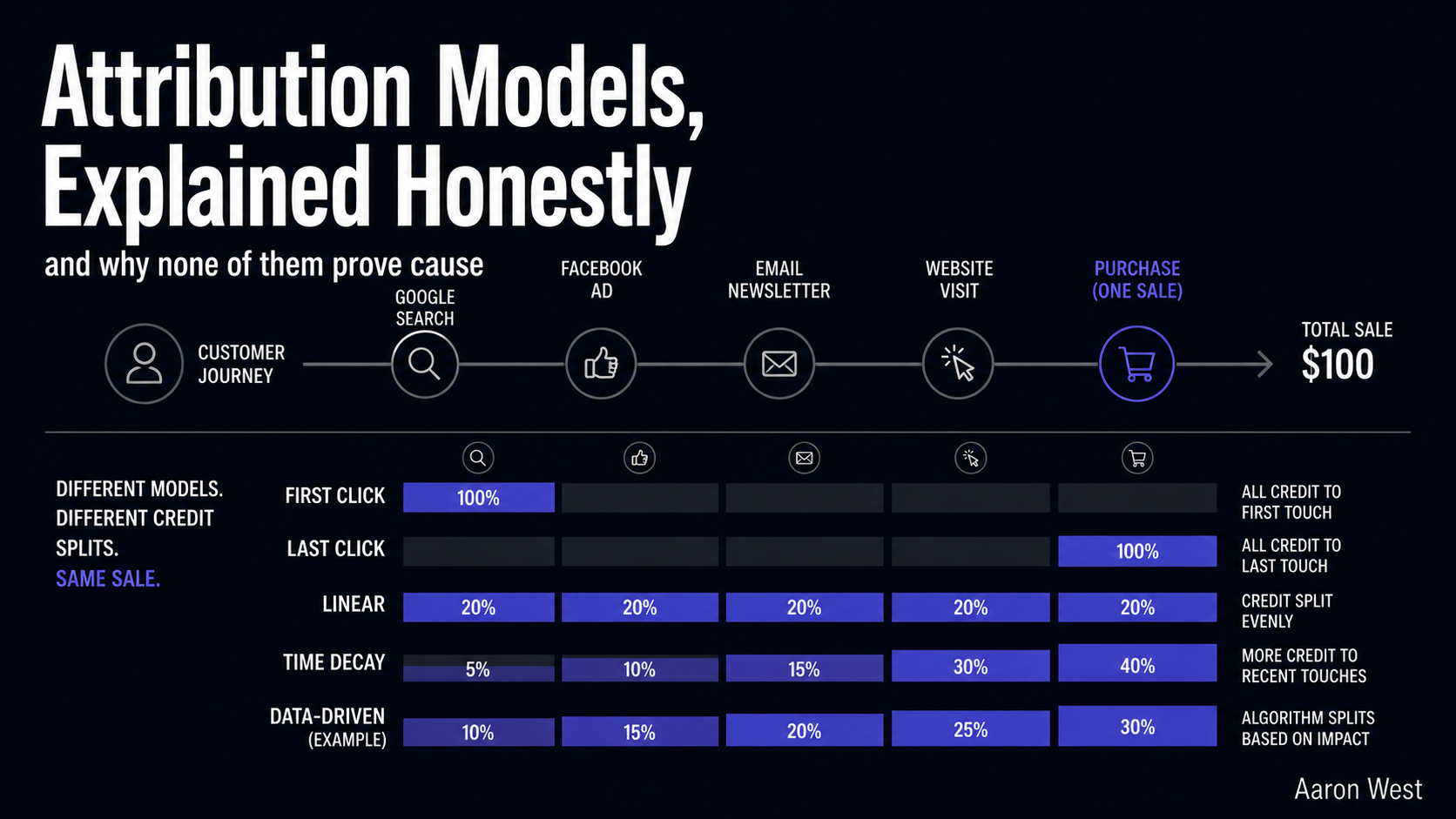
Attribution Models, Explained Honestly: Last-Click, First, Linear, Data-Driven
An attribution model is simply a rule for deciding which marketing touchpoint gets credit for a sale, and the uncomfortable truth is that every one of them is, to some degree, a guess. A customer might see your Instagram ad, read a review, click a…
Continue reading...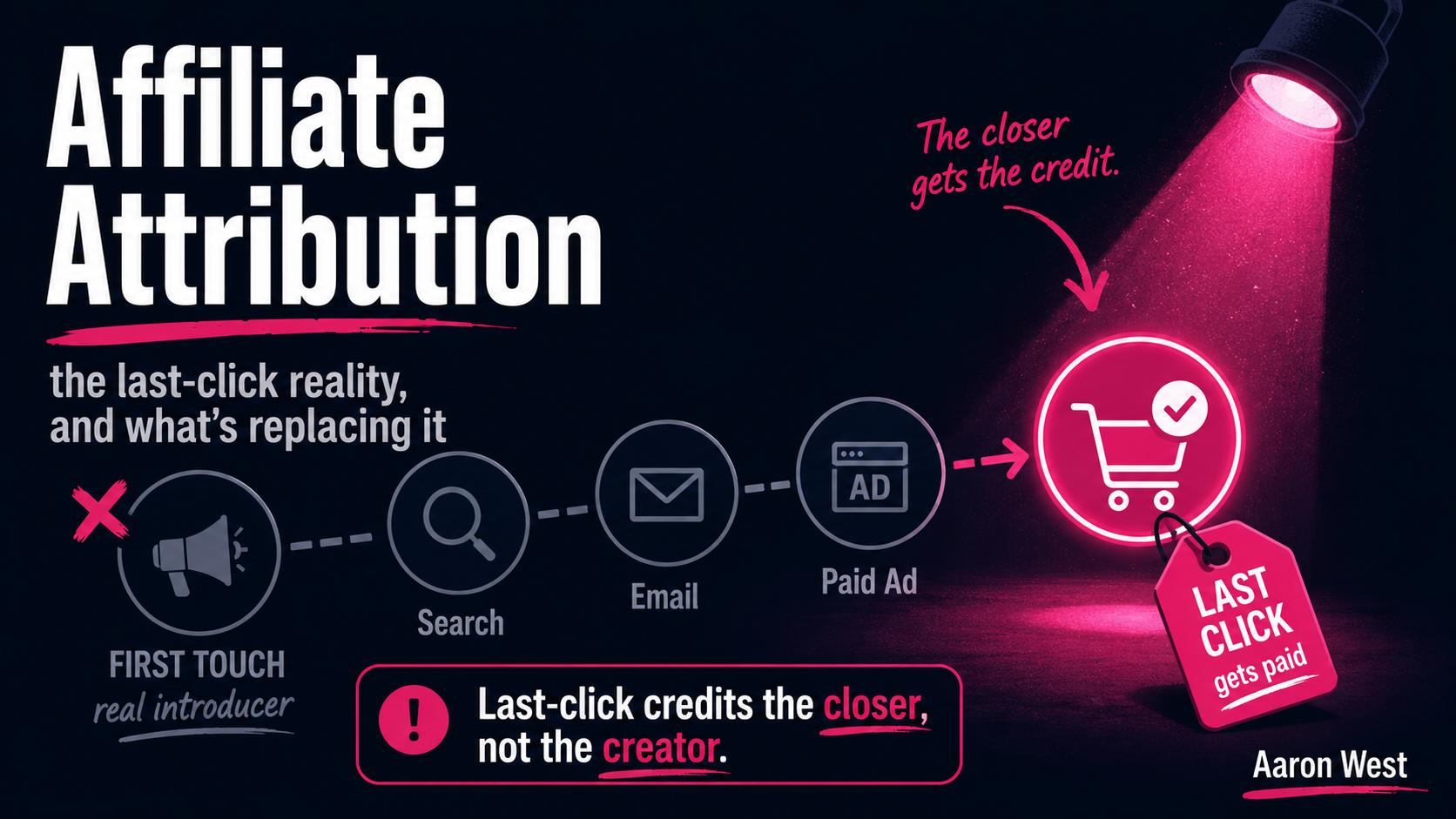
Attribution for Affiliate: The Last-Click Reality and What's Replacing It
Affiliate attribution is the rule that decides which affiliate, and which touchpoint, gets credit for a sale, and for most of the channel's history that rule has been brutally simple: last click wins. Whoever set the last click before purchase takes 100% of the credit…
Continue reading...
How I Structure an Article to Be Quotable by AI
To get cited by an AI answer engine, the single most important thing is to put a direct, self-contained answer right where the engine can lift it: in the first sentence or two of the piece and of each section, before any build-up. AI engines…
Continue reading...