Affiliate Networks vs SaaS Platforms vs In-House: How to Choose

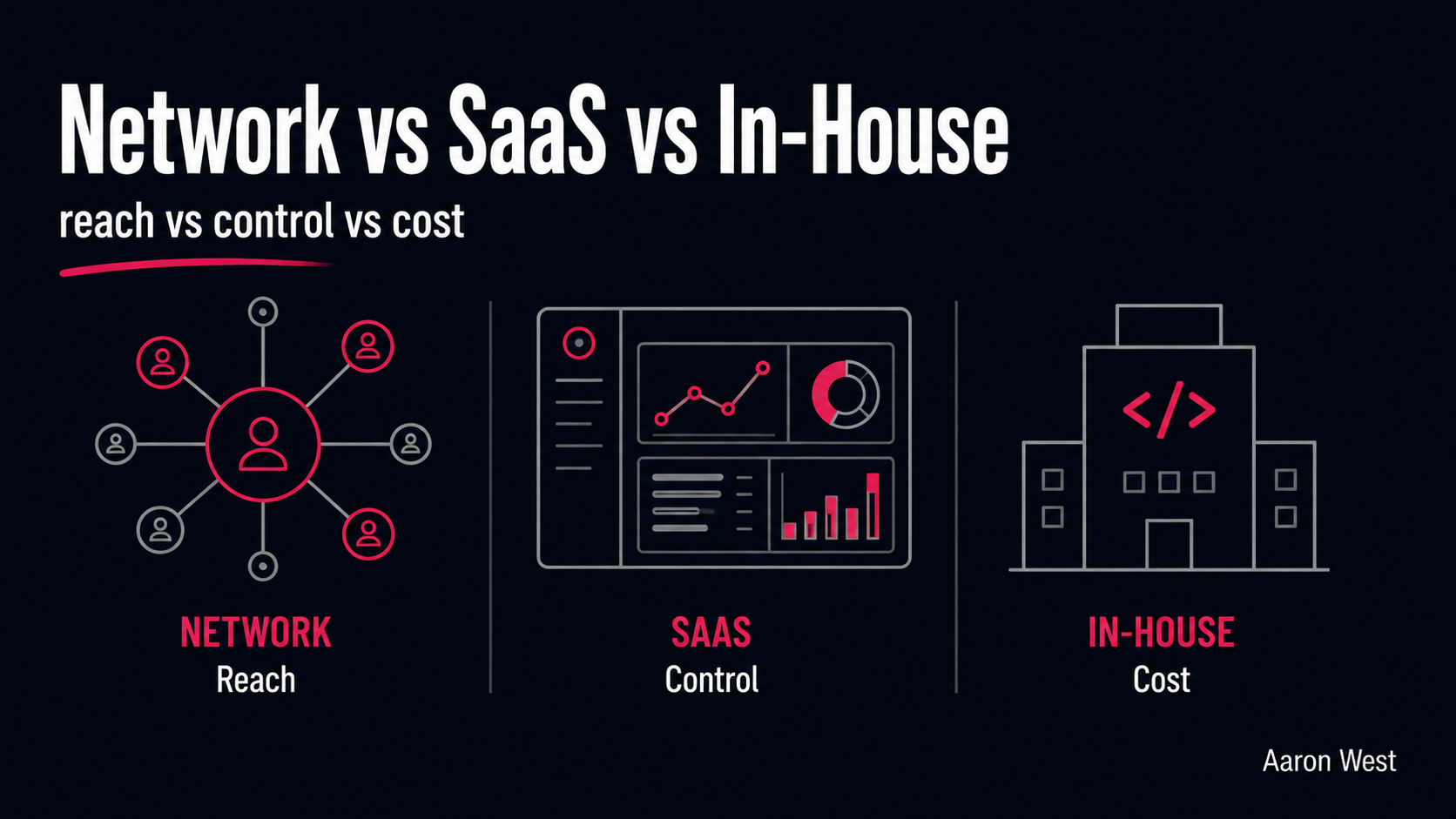
Table of Contents
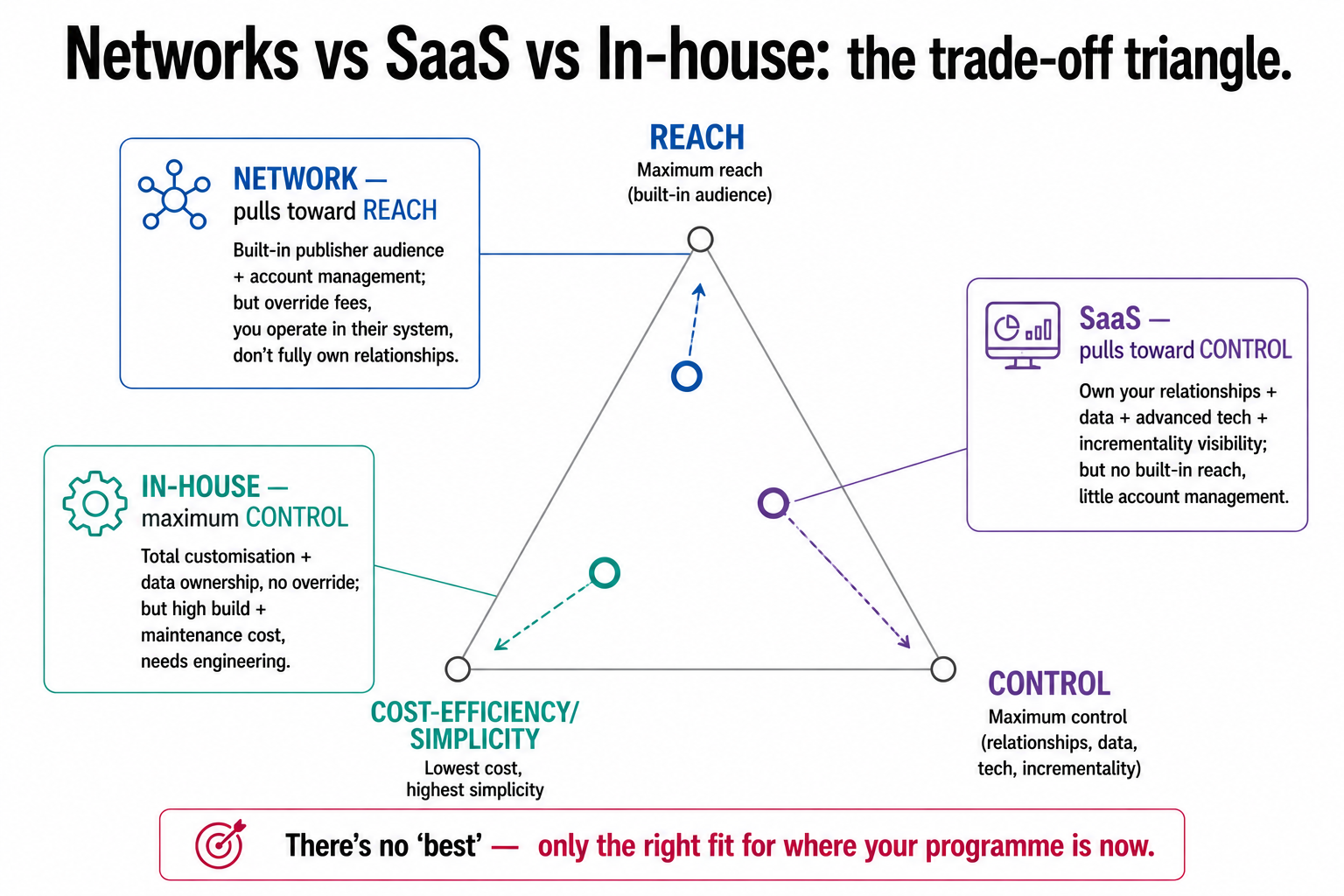
The choice between an affiliate network, a SaaS platform, and an in-house build comes down to a single trade-off: reach versus control versus cost. A network hands you a built-in audience of publishers and a manager to help, but you operate inside someone else's system and never fully own the relationships. A SaaS platform gives you control, data, and modern technology, but no ready-made audience and little hand-holding. An in-house build gives you total control and complete data ownership, but you pay for all of it, forever, in engineering time. There is no universally right answer, there is only the right answer for where your programme is now, and most of the confusion in this decision comes from people comparing the three as if one were simply "best."
This is the infrastructure decision in the affiliate cluster, and it sits a level below the tracking technology that all three options ultimately run on. It is also the decision people most often get backwards, picking the platform first and the strategy second, when it should be the other way round. This piece lays out what each option actually is, the honest trade-offs, and a simple way to decide based on your programme's stage rather than on whatever a vendor demo made look shiny.
The three options, plainly
First, clear definitions, because the categories blur in marketing copy and the differences matter.
An affiliate network is a marketplace that connects advertisers with a large existing pool of publishers, and usually bundles in tracking, payments, and some level of account management. Its defining feature is the built-in audience: you join, and there are already thousands of potential partners on the platform. You typically pay an override (a percentage on top of the commissions you pay affiliates), and you operate inside the network's system, using its tools, its rules, and to a large degree its relationships.
A SaaS platform sells you the technology to run your own programme, the tracking, attribution, partner management, and reporting, as software you control, but it does not come with a built-in publisher audience. The defining feature is ownership: you own your partner relationships and your data directly, rather than renting access to a network's pool. Because their whole business is selling the platform, the leading SaaS providers tend to have the most advanced, fastest-evolving technology. You generally bring your own recruitment, though, and you get little or no account management.
An in-house build is exactly what it sounds like: you build the tracking and management system yourself, on your own infrastructure. The defining feature is total control, every feature, every integration, complete data sovereignty, tailored precisely to your needs, with no override fees to anyone. The cost is equally total: high upfront engineering, ongoing maintenance, and the need for a technical team to keep it alive in a changing market.
The honest trade-offs
Definitions are easy; the trade-offs are where the real decision lives. The ones that actually matter:
Reach. This is the network's trump card and the reason networks still dominate for new programmes. A network gives you immediate access to a large pool of publishers actively looking for offers, you can start recruiting on day one. With SaaS or in-house, you start with an empty programme and have to recruit every partner yourself. If your biggest constraint is "we don't know any affiliates," that is a powerful argument for a network, at least to start.
Control and ownership. This is SaaS and in-house's trump card, and it has become more important as the channel shifts toward incrementality. When you own your programme directly, you get full visibility into your funnel and your costs, you can build custom attribution and pay partners based on real incremental value rather than last-click defaults, and you own the partner relationships outright rather than mediating them through a network. If your goal is to turn affiliates into genuine, directly-managed partners and to measure what they really add, owning the programme matters.
Cost. This one is widely misunderstood. Networks compete on price, but their override fees are ongoing and scale with your revenue, the more you sell, the more the override costs, forever. SaaS is typically a more predictable platform fee. In-house has no fees at all but the highest total cost of ownership once you count engineering and maintenance. The honest summary: a network is often cheapest to start and most expensive to scale; in-house is most expensive to build and cheapest per euro at very large scale; SaaS sits in between with the most predictable costs. Cost is not "which is cheaper" but "cheaper at what stage."
Account management. Networks usually include some level of management, a team who can help recruit and optimise, which is genuinely valuable if you lack in-house expertise (a well-managed programme is worth a substantial revenue uplift over an unmanaged one). SaaS and in-house generally leave the managing to you, which is fine if you have the skill and the bandwidth, and a problem if you do not.
Technology. Because selling the platform is their business, the leading SaaS providers tend to have the most advanced and fastest-evolving tracking and tooling. Some networks invest heavily in their platforms too, but others run on ageing legacy systems they mostly maintain rather than improve. If advanced tracking and modern partnership features matter to you, do not assume a network's technology matches a dedicated platform's.
How to actually choose
Strip away the vendor noise and the decision is mostly a function of your programme's stage and resources. A workable way to think about it:
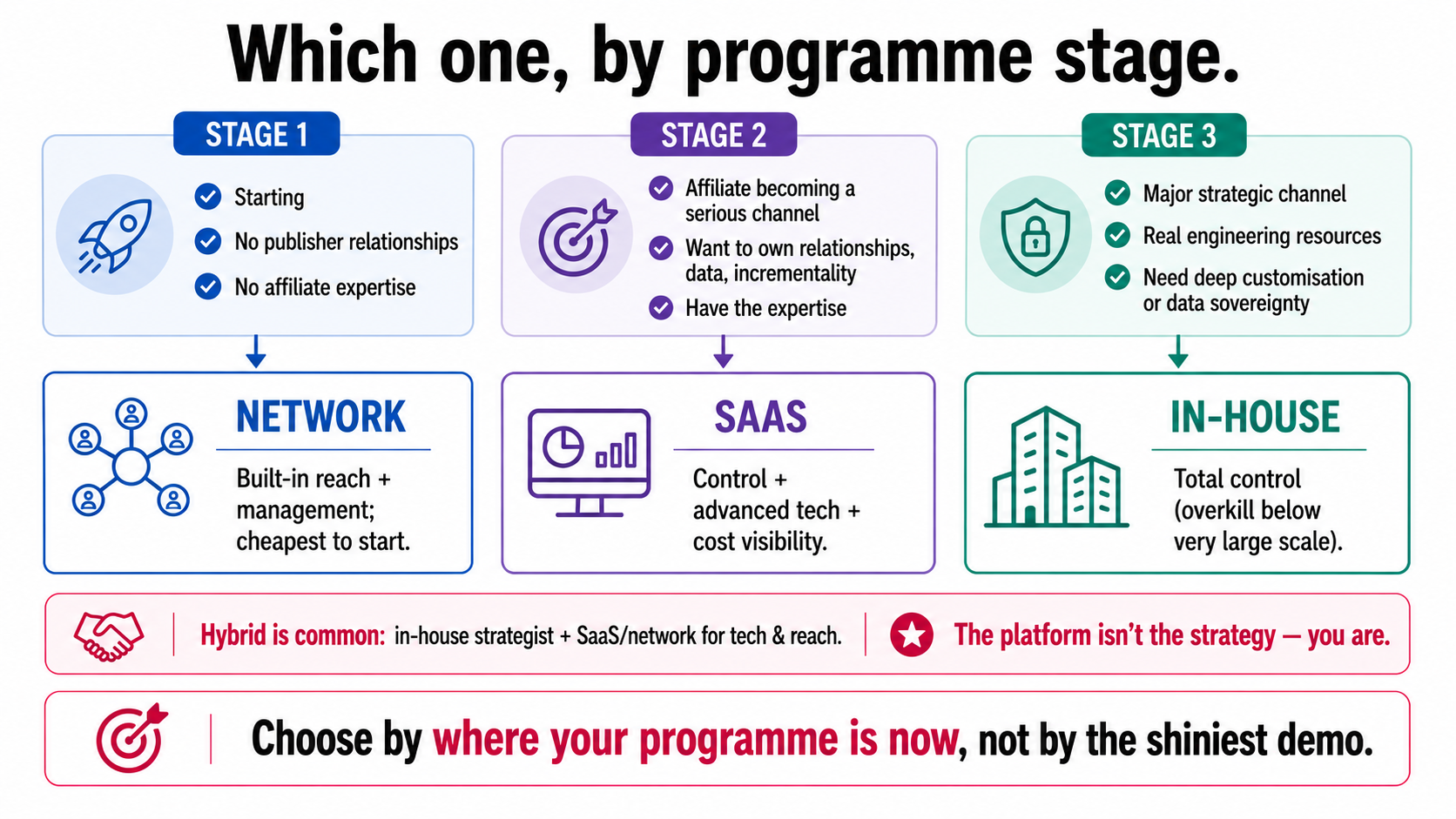
Choose a network if you are starting out or lack publisher relationships, you want to recruit from day one without building an audience, you value bundled account management because you lack in-house affiliate expertise, and predictable simplicity matters more than maximum control. For most new and small programmes, this is the right answer, the built-in reach and management outweigh the override.
Choose a SaaS platform if affiliate is becoming a serious channel, you want to own your partner relationships and your data, you care about incrementality and full-funnel visibility, and you have (or can hire) the expertise to run recruitment and management yourself. This is increasingly where growing programmes land as they mature past the network's starter benefits and want control.
Choose in-house if affiliate is a major strategic channel, you have genuine engineering resources, and you need deep customisation or data sovereignty that no external platform provides. This is the enterprise answer, and for most programmes it is overkill, the maintenance burden rarely justifies itself below very large scale.
And know that hybrid is common and often sensible: many mature programmes run an in-house strategist for the relationships and strategy alongside a SaaS platform (or even a network) for the technology and reach. The categories are not a religious choice, they are tools, and the right setup often combines them. The mistake to avoid is treating the platform as the strategy, the platform tracks and pays and provides reach, but as the management piece argued, it does not run the programme. You do.
The decision under the decision
Here is the thing the whole comparison is really about, and the reason picking platform-first is the classic mistake. Your infrastructure should follow your strategy, not define it. If your strategy is "get started cheaply and recruit fast," a network is right. If it is "build a controlled, incrementality-driven partner programme we own," SaaS or in-house is right. The technology question only has a good answer once you have answered the strategy question, and programmes that buy the platform first routinely end up with infrastructure that fights their actual goals, a network when they wanted control, an expensive in-house build when they just needed to recruit.
So decide the strategy, then choose the infrastructure that serves it, and be honest about your stage: most programmes overestimate how much control they need early and underestimate how much it matters later. Start where your reach and expertise constraints actually are, a network if you are building from nothing, a platform if you are scaling something real, and let the infrastructure evolve as the programme does. Migrating later is normal and increasingly easy; locking yourself into the wrong setup because a demo was impressive is the expensive mistake. The platforms are just tools. The programme is yours to run, and the right tool is whichever one gets out of the way of you running it well.
A few common questions
What's the difference between an affiliate network, a SaaS platform, and in-house? A network is a marketplace connecting you to a built-in pool of publishers, bundled with tracking, payments, and some account management, you operate inside its system and pay an override. A SaaS platform sells you the technology to run your own programme with full control of relationships and data, but no built-in publisher audience and little management. An in-house build is your own custom system: total control and data ownership, but high build and maintenance cost requiring an engineering team. The trade-off is reach vs control vs cost.
Which is cheaper, a network or a SaaS platform? It depends on stage, which is why "cheaper" is the wrong question. Network override fees are ongoing and scale with revenue, so a network is often cheapest to start but most expensive to scale. SaaS is typically a predictable platform fee, sitting in the middle. In-house has no fees but the highest total cost of ownership once engineering and maintenance are counted, only cheapest per euro at very large scale. Ask "cheaper at what stage," not "cheaper."
When should I move from a network to a SaaS platform? Typically when affiliate becomes a serious channel and you want what a network can't fully give you: ownership of your partner relationships and data, custom attribution built around incrementality rather than last-click, full-funnel cost visibility, and modern tracking technology. The prerequisite is having (or hiring) the expertise to run recruitment and management yourself, since SaaS won't do that for you the way a network's managed service might.
Can I use more than one? Yes, and many mature programmes do. A common hybrid runs an in-house strategist for relationships and strategy alongside a SaaS platform or network for technology and reach. The categories are tools, not a single binding choice, the right setup often combines them. What matters is that the platform serves your strategy rather than becoming it.
You should also read:
Affiliate Fraud: The Types, the Detection Methods, and the Controls
Affiliate fraud is any attempt to earn commissions for results that were not genuinely driven, faked clicks, faked leads, or stolen attribution, and because the whole channel pays for results, it has always attracted people who try to fake results. The defining shift in 2026…
Continue reading...
The Affiliate Marketing Glossary: Every Term, in Plain English
Affiliate marketing is full of acronyms and jargon, CPS, EPC, S2S, dedup, postback, cookie window, that can make a simple channel sound impenetrable. This glossary defines the terms that actually matter, in plain English, grouped so you can see how they fit together. Each definition…
Continue reading...
The Affiliate Publisher Landscape: Every Partner Type, Explained
"Affiliate" covers wildly different kinds of partner, content sites, cashback platforms, coupon sites, influencers, comparison engines, and the single most important thing to understand is that they do fundamentally different jobs. Some genuinely introduce new customers to your brand; others mostly intercept customers who were…
Continue reading...