Recruiting and Managing Publishers Like a Sales Team

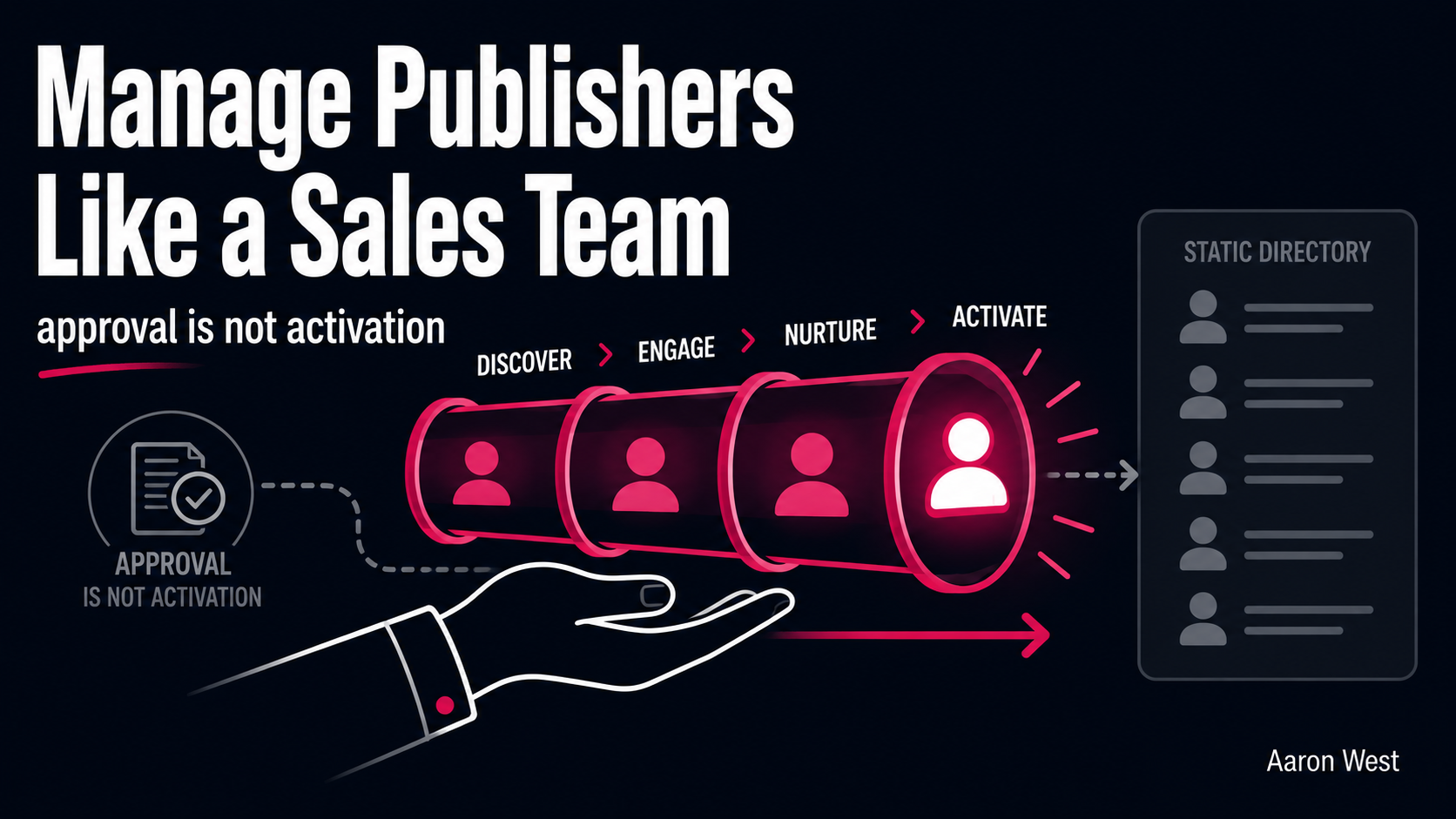
Table of Contents
The single biggest difference between an affiliate programme that scales and one that plateaus is not the commission rate, the network, or the tracking. It is whether the person running it treats their partners like a sales team they actively manage or like a list of links they passively host. Most programmes do the second, recruit broadly, approve everyone, then wait, and most programmes underperform for exactly that reason. The hard truth that reframes everything: approval is not activation. You can have a thousand approved affiliates and a programme that barely moves, because signing a partner up and getting them to actually drive sales are completely different jobs, and only one of them is on autopilot.
This is the operating philosophy behind the whole affiliate cluster, the practical expression of the idea that affiliate at scale is a relationship programme, not a link programme. It is also the most under-appreciated skill in the channel, because the software makes it look like a set-and-forget system, and it is anything but. This piece is about the actual work: how to recruit the right partners, how to activate them, how to manage them by tier, and why the manager who treats the roster like a pipeline beats the one who treats it like a directory, every time.
Approval is not activation: the number that exposes it
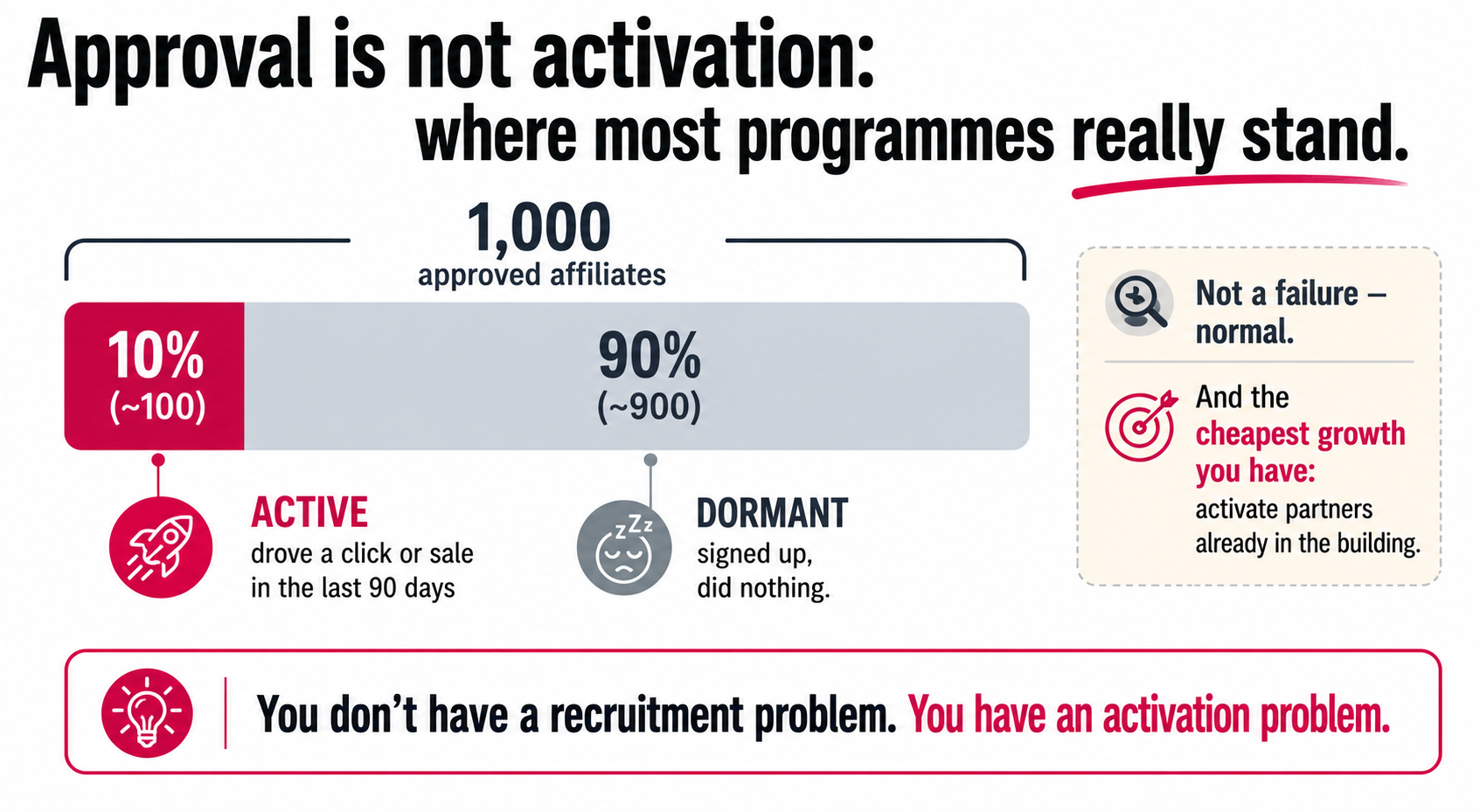
Start with the metric that tells you the truth about your programme, because most managers never look at it. Your active rate is the percentage of your approved affiliates who have actually driven a click or sale in a given window, say the last 90 days. For most programmes, that number sits somewhere around 5 to 20%. Read that again: in a typical programme, 80 to 95% of approved affiliates signed up and then did nothing meaningful at all.
That is not a failure, it is normal, and it is the most important thing to understand about running a programme, because it reframes where the opportunity is. If most of your roster is dormant, then growth does not have to come from recruiting more partners; it can come from activating the ones you already have. A programme with a thousand affiliates and a 10% active rate has a hundred working partners and nine hundred dormant ones. You do not have a recruitment problem. You have an activation problem, and an activation problem is far cheaper to fix than a recruitment problem, because the partners are already in the building. The manager who sees "1,000 affiliates" and feels good has misunderstood their own programme. The manager who sees "100 active, 900 asleep" knows exactly where the next quarter's growth is hiding. This is the shift from passive tracking to active partner management, and it is the whole game.
Recruit deliberately, not broadly
If activation is the bigger opportunity, recruitment still matters, but the way most programmes recruit actively works against them. The passive approach, open applications, low-barrier or automatic approval, take whoever shows up, feels like growth and quietly fills your roster with the wrong partners. Specifically, it invites the last-click interceptors, the toolbar and coupon partners who jump in at the end of a purchase journey someone else created, because those are exactly the partners who find easy auto-approval programmes and exploit them. Recruit by waiting for applications and you get a roster skewed toward interception.
Recruiting like a sales team means the opposite: you decide who you want and you go and get them. You identify the partner types that create genuine demand for a brand like yours, the content publishers and creators in your niche, the relevant newsletters, the review sites, the communities, and you proactively reach out, the same way a sales team builds a target account list rather than waiting for inbound. A particularly strong and underused source: your own happy customers, people who already advocate for you make natural partners, and in a market shifting from big publishers to trusted niche voices, a customer who genuinely loves your product can be worth more than a large generic publisher. The principle is simple: a smaller roster of deliberately-chosen, demand-creating partners beats a huge roster of whoever-applied, every time. Recruit for fit and incrementality, not for headcount.
Activation: the work that actually drives revenue
Here is the part the software does not do for you, and the part that separates operators from administrators. Getting a good partner approved does nothing; getting them active is the job. A partner can be accepted and never send a single click, and most do exactly that unless someone makes activation happen. Activation is deliberate work:
- A real welcome and onboarding. Not an automated "you're approved" email, but actual product education, what you sell, who it is for, what makes it different, so the partner can promote you credibly.
- The assets to succeed. Approved messaging, creative, deeplinks, product information, suggested content angles, a promotional calendar. Remove every bit of friction between "I'd like to promote this" and "here is everything I need."
- A clear path to the first sale. The time-to-first-sale is a moment that matters, a partner who makes a sale early stays engaged; one who hears nothing back drifts into the dormant 90%. Make the first win easy and visible.
- Ongoing contact for the ones who matter. Not mass email blasts, but real communication with the partners worth communicating with, which leads directly to the next point.
None of this is automatable in the way approval is, and that is precisely why it is where the advantage lives. The programmes that scale are run by someone who treats activation as their core job, not an afterthought the platform handles.
Manage by tier: the managed-versus-self-serve split
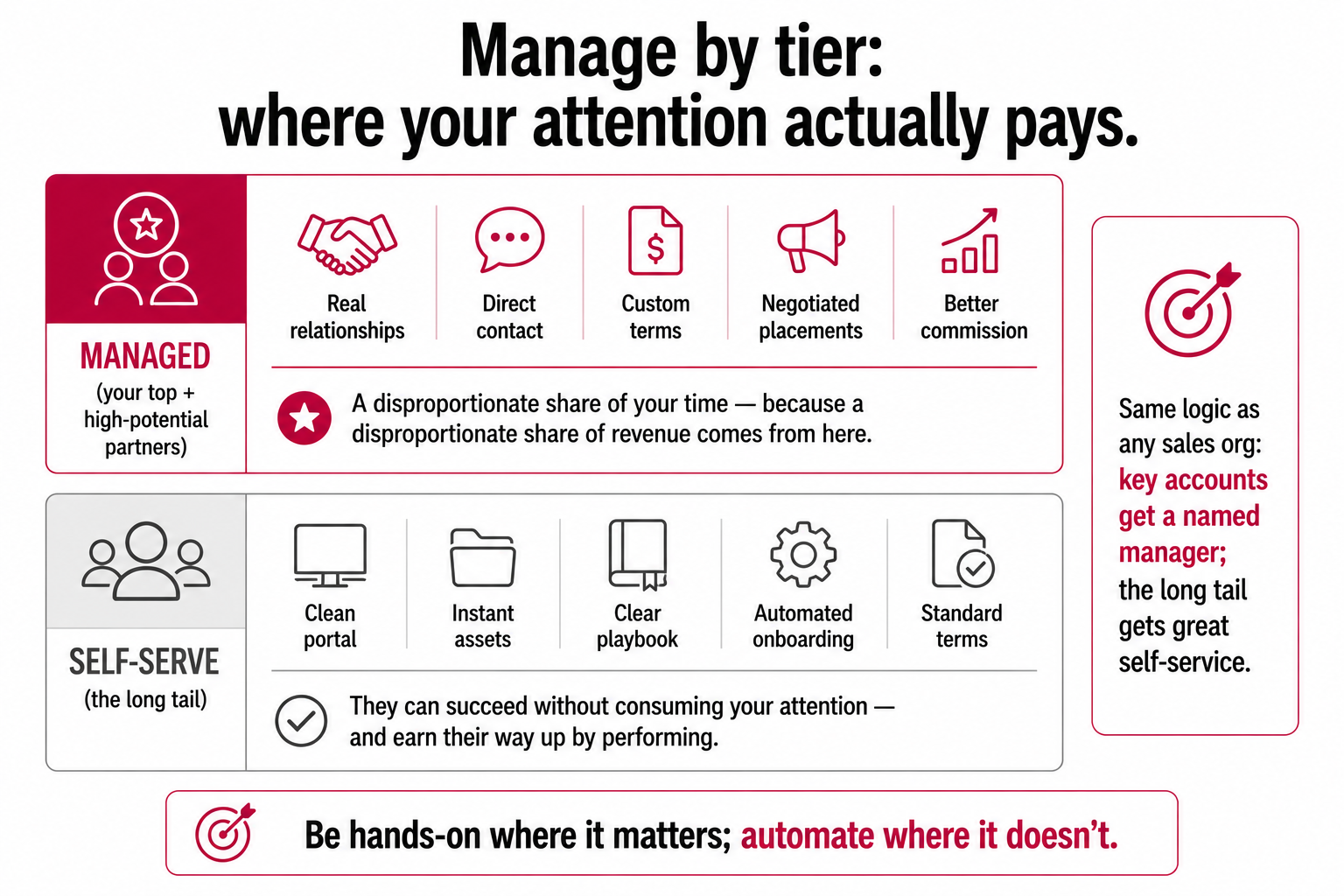
You cannot give every one of a thousand affiliates the white-glove treatment, nor should you, most will never justify the time. So the practical structure that makes active management possible at scale is tiering: you split your roster and spend your attention where it pays.
The model that works is a two-track split. Your top partners (the handful driving most of your revenue, and the high-potential ones you have deliberately recruited) go on a managed track: real relationships, direct contact, custom terms, negotiated placements, the treatment a sales team gives its key accounts. This is where a disproportionate share of your time should go, because a disproportionate share of your revenue comes from here. Everyone else goes on a self-serve track: a clean portal, instant access to assets and a clear playbook, automated onboarding, so they can succeed without consuming your attention, and can earn their way onto the managed track by performing. This split is what lets you be genuinely hands-on where it matters without drowning in a roster of hundreds. It is the same logic any good sales organisation uses: key accounts get a named manager, the long tail gets good self-service, and you do not confuse the two.
Crucially, tiering also drives how you pay. A single flat commission for every partner overpays the bottom-funnel interceptors and underpays the demand-creators, so match the commission to the partner's real contribution, higher rates and better terms for the partners who introduce customers and earn the managed track, standard terms for the self-serve tail. Manage, and pay, by value delivered.
The mindset: operator, not administrator
Pull it together and the whole thing is a mindset shift. An administrator sets up the software, approves applications, and waits for the dashboard to fill in. An operator treats the programme as a living pipeline: deliberately recruiting demand-creating partners, actively working to activate the dormant majority, building real relationships with the top tier, matching pay to contribution, and enforcing quality (the fraud controls, the validation discipline, the incrementality lens) that keeps the roster honest. The software is a tool the operator uses; it is not the strategy. It tracks, pays, and reports. It does not decide who is worth recruiting, negotiate a placement, activate a dormant partner, or judge whether a partner is creating value or just claiming it. Those are the manager's job, and they are the job that determines whether the programme grows.
That is what "manage publishers like a sales team" actually means. Not a metaphor, an operating model: a target list you recruit deliberately, an activation process that turns sign-ups into sellers, key accounts you manage closely and a long tail you serve well, and pay that follows value. The programmes that treat affiliate as a channel you run will keep pulling ahead of the ones that treat it as a system you install. The tracking and the tools are table stakes now; everyone has them. The durable advantage is the management, the unglamorous, relationship-driven, sales-team work that the software conspicuously cannot do for you. That is where affiliate programmes are won.
A few common questions
What does it mean to manage affiliates like a sales team? It means treating your partners as a pipeline you actively work, not a list of links you passively host. That involves deliberately recruiting the partners you want (rather than approving whoever applies), running a real activation process to turn sign-ups into active sellers, managing your top partners as key accounts with direct relationships, serving the long tail through good self-service, and matching commission to the value each partner actually delivers. The software tracks and pays; the management is the strategy.
What is an affiliate activation rate, and why does it matter? The activation (or active) rate is the percentage of approved affiliates who actually drove a click or sale in a given window. For most programmes it sits around 5-20%, meaning 80-95% of approved affiliates do nothing meaningful. That's normal, but it reframes growth: instead of recruiting more partners, you can activate the dormant majority you already have, which is far cheaper. A low active rate isn't a failure, it's the clearest opportunity in most programmes.
How should I recruit affiliate partners? Deliberately, not broadly. Passive open/auto-approval fills your roster with last-click interceptors (toolbar and coupon partners) who exploit easy-entry programmes. Instead, identify the demand-creating partners you want, content publishers, creators, newsletters, review sites in your niche, and proactively reach out, like a sales team building a target list. Your own happy customers are an underused source of high-trust partners. Recruit for fit and incrementality, not headcount.
How do I manage a large affiliate roster without being overwhelmed? Tier it. Put your top and high-potential partners on a managed track with real relationships, direct contact, custom terms, and negotiated placements, where most of your time should go because most of your revenue does. Put everyone else on a self-serve track with a clean portal, instant assets, and a clear playbook, so they can succeed without consuming your attention and earn their way up by performing. Match commission to contribution across both tiers.
You should also read:

Product Recommendations: Beyond "You May Also Like"
Product recommendations are how you show a customer things they didn't come looking for but are genuinely glad to find. They're the discovery half of merchandising, the online version of a good shop assistant saying "if you're buying those shoes, you'll want these socks too."…
Continue reading...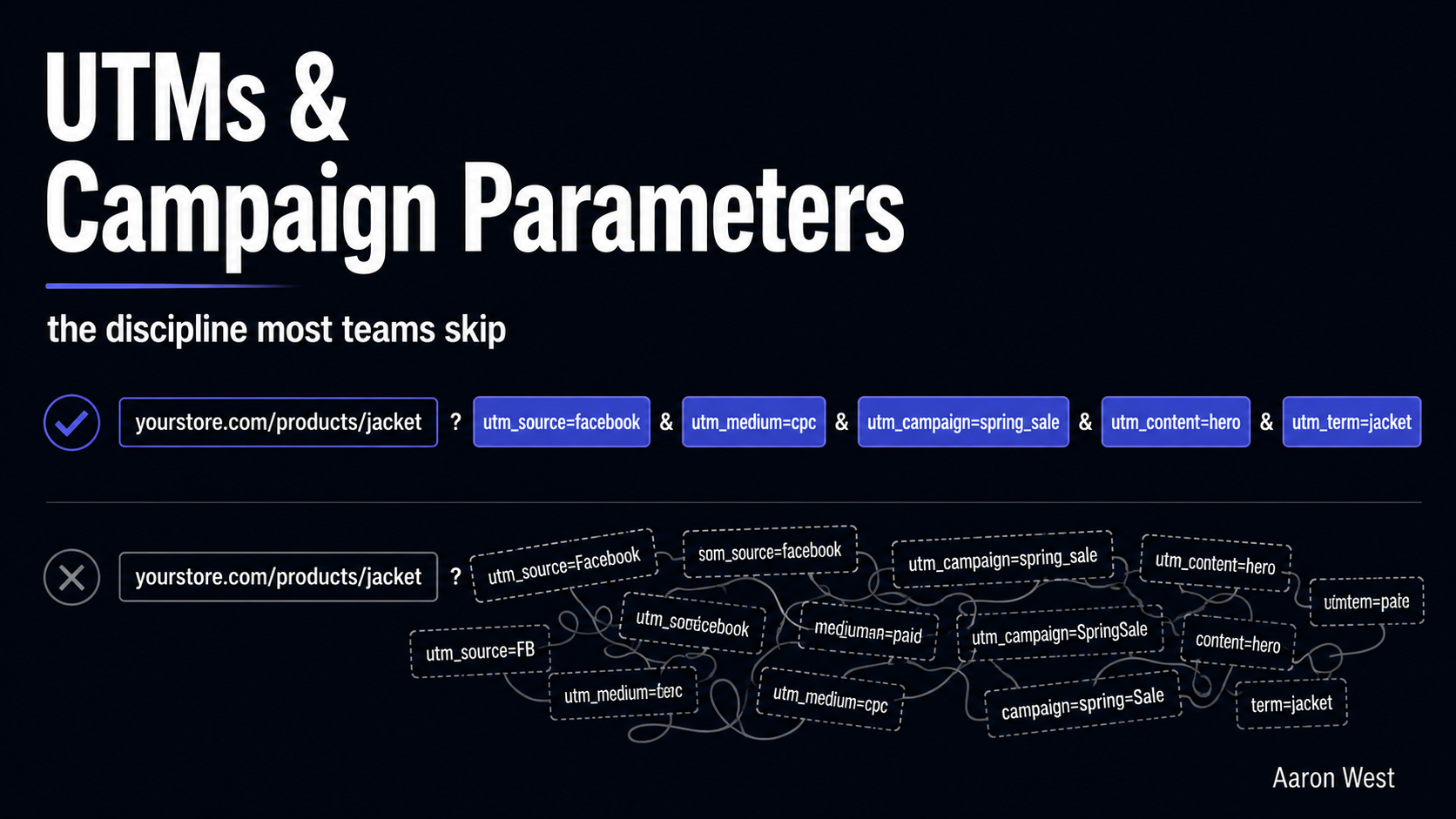
UTMs and Campaign Parameters: The Discipline Most Teams Skip
A UTM parameter is a small tag added to the end of a link that tells your analytics where a visitor came from, and the difference between a team that uses them with discipline and one that does not is the difference between knowing which…
Continue reading...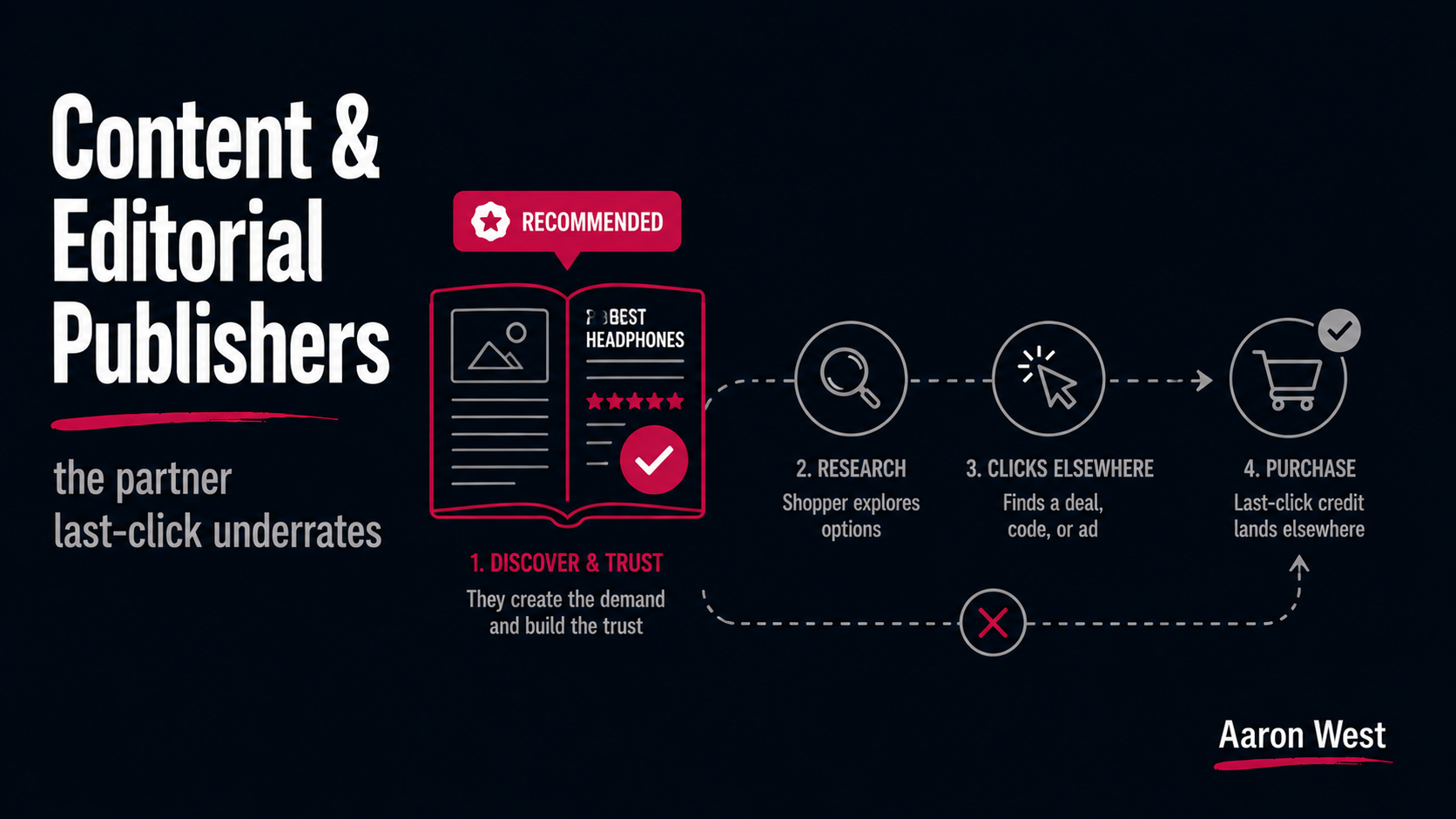
Content and Editorial Publishers: The Affiliate Partner Last-Click Underrates
Content and editorial publishers are affiliate partners who earn commission through genuine editorial work, product reviews, buying guides, comparisons, how-to articles, the kind of content people actively seek out when they are trying to decide what to buy. They are the opposite end of the…
Continue reading...