Affiliate Commission Models: CPS, CPA, CPL, Hybrid and How to Choose

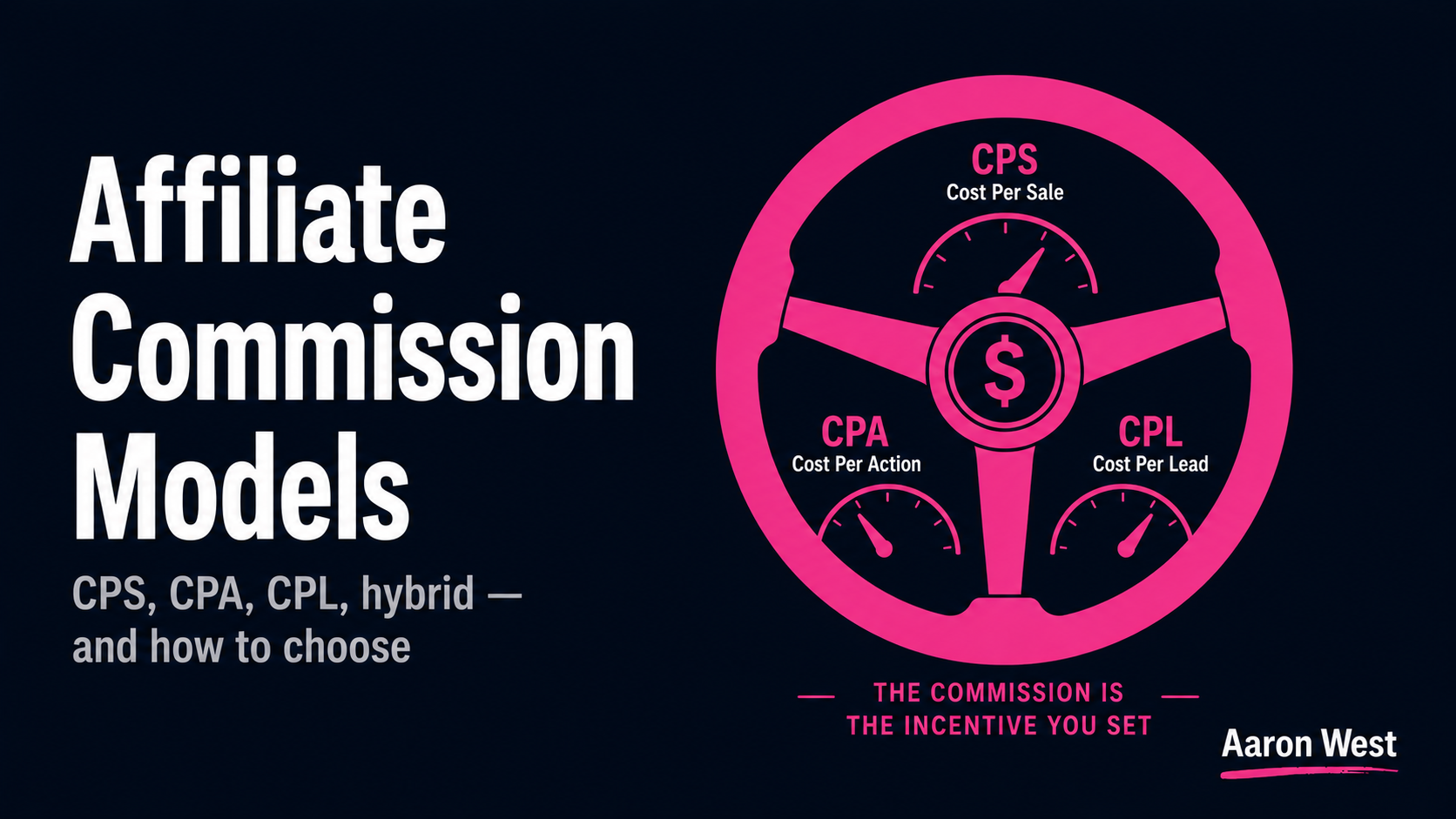
Table of Contents
An affiliate commission model is simply the rule for what you pay a partner and when, and the main ones are CPS (a cut of each sale), CPA (a fixed fee for a defined action), CPL (a fee per qualified lead), and various hybrids and flat fees that combine or extend these. The choice matters far more than it first appears, because the commission is not just a cost line, it is the incentive you are setting. You get the behaviour you pay for, so the model you pick quietly decides which partners you attract and what they do to earn from you.
This is the money half of running a programme, and it pairs with how affiliate tracking works, tracking is how you count what happened, commission models are how you pay for it. Get the model right and your incentives line up with your goals automatically; get it wrong and you either bleed margin or fail to attract anyone worth having. This piece is the practitioner's guide to the models, how each one works, what behaviour it rewards, and how to actually choose. It is part of the broader affiliate guide.
The core models
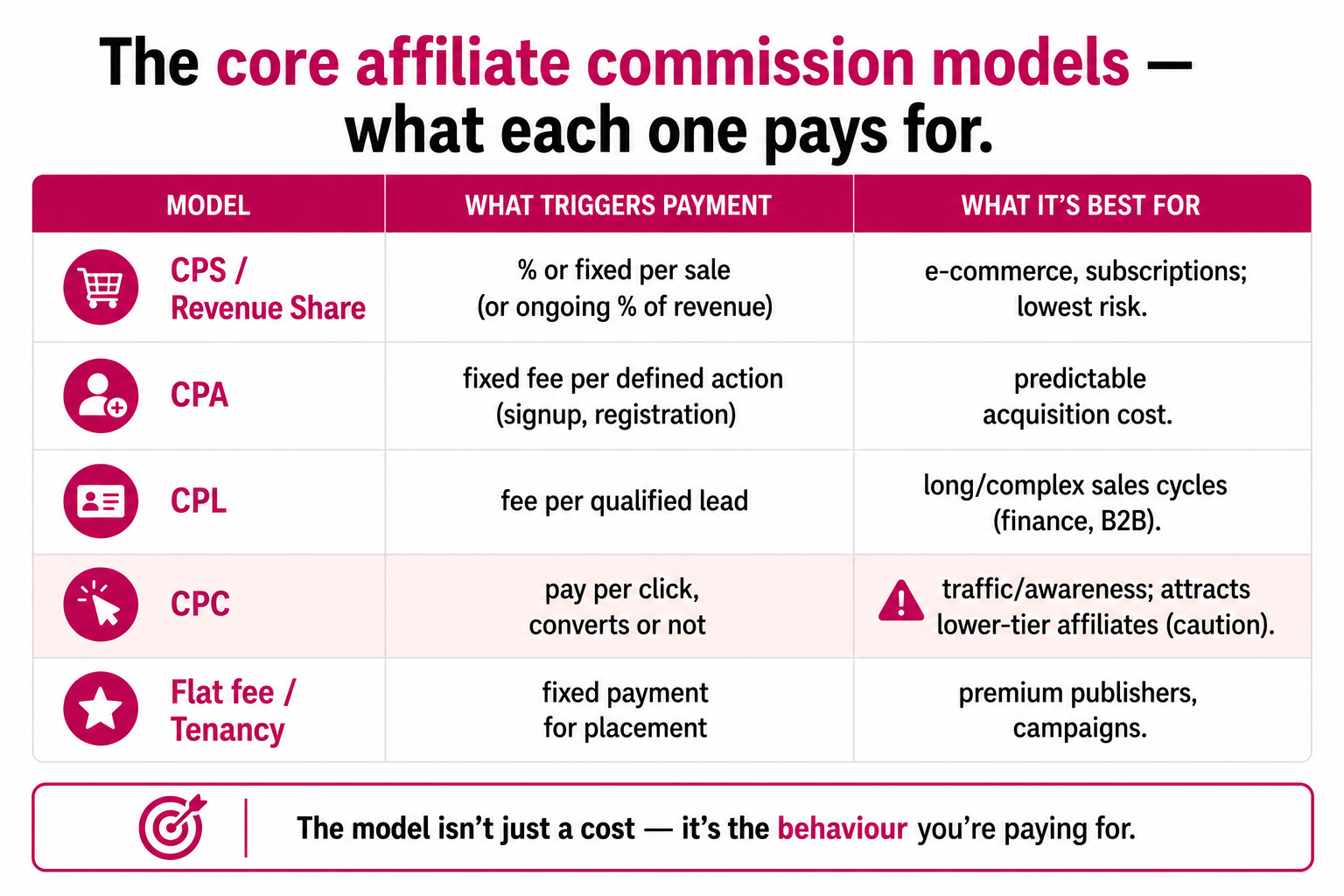
Most programmes are built from a handful of models. Here is what each one actually pays for, in plain terms.
CPS (cost per sale), also called revenue share. The classic affiliate model: the partner earns a percentage of, or a fixed amount per, each sale they drive. It is the most common model in e-commerce, the lowest-risk for the merchant (you only pay when you get paid), and the most familiar to affiliates. When the payout is an ongoing percentage of revenue from a referred customer over time, it is usually called revenue share, common in subscription and SaaS businesses where the value is recurring.
CPA (cost per action). A fixed fee each time a referred user completes a defined action, which may or may not be a sale, a signup, a registration, a completed application. It gives you a predictable, clean acquisition cost (you know what each conversion costs before it happens), which makes budgeting easy, and it suits cases where the immediately valuable outcome is not a purchase.
CPL (cost per lead). A fee for each qualified lead, a form submission, a free-trial signup, a quote request. It fits businesses with longer or more complex sales cycles (finance, insurance, B2B), where capturing genuine interest is the meaningful first step and the sale closes later, often offline.
CPC (cost per click). Payment for clicks regardless of whether they convert. It exists, but be wary, I will come back to why experienced affiliates often read a CPC offer as a quiet admission that the product does not convert well.
Flat fee / tenancy. A fixed payment for a placement, a sponsored post, a homepage feature, a newsletter slot, independent of performance. Used for premium publishers and specific campaigns where you are buying visibility, not a tracked outcome.
The two structural choices on top: flat vs percentage, and tiered vs flat-rate
Beyond which model, two design choices shape how a commission actually behaves.
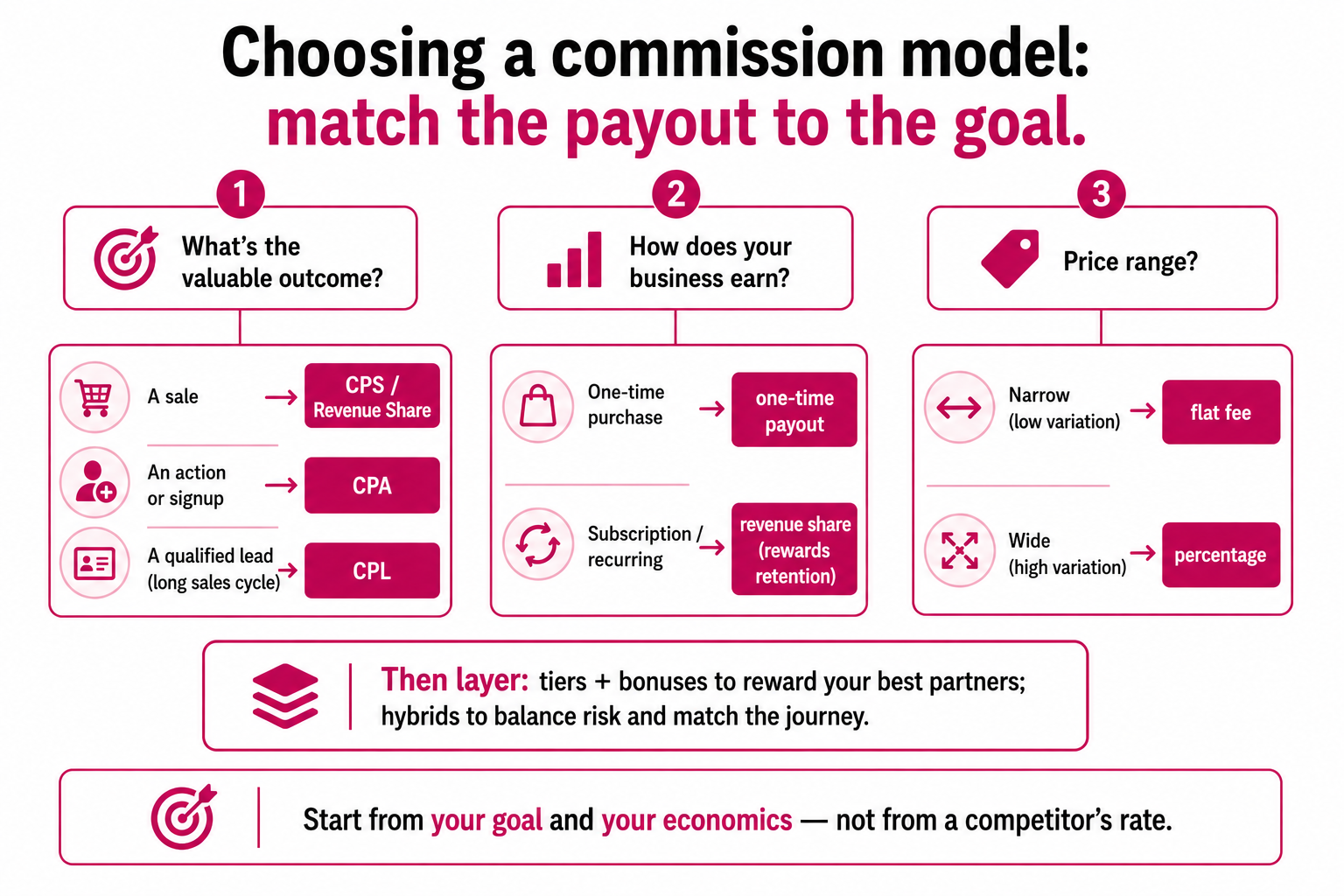
Flat fee versus percentage. Within CPS, you can pay a fixed amount per sale or a percentage of the order value, and the right one depends on your price range. Flat fees work well when products cluster around a similar price, because affiliates know exactly what they will earn per sale. Percentages work better when your range spans very different price points, because the payout scales with the order naturally, a 10% rate pays a little on a cheap item and a lot on an expensive one, which keeps the incentive aligned across the catalogue rather than over-rewarding cheap-item volume.
Tiered and bonus structures. Rather than one flat rate, many programmes raise the rate as a partner hits higher performance thresholds (a higher percentage after a certain number of sales or revenue level), or pay one-off bonuses at milestones. This is a deliberate incentive: it rewards your best partners for scaling and gives good affiliates a reason to push harder, because the next tier is worth chasing. Used well, tiering is one of the cleanest ways to align a partner's effort with your growth, which is part of the wider craft of managing publishers.
Recurring versus one-time. A final axis, especially for subscription businesses: do you pay once for the acquisition, or an ongoing share for as long as the customer stays? Recurring (revenue share) aligns the affiliate with retention, they earn longer when the customer stays longer, which is powerful for subscription models. One-time suits transactional e-commerce where there is no recurring revenue to share. The principle: the payout shape should mirror how your business actually makes money.
Hybrids: why most serious programmes blend models
In practice, the cleanest single model is often not enough, and the dominant pattern in mature programmes is the hybrid, a deliberate combination that balances risk between you and the partner and matches different parts of the journey. A hybrid might pair a small CPA for the signup with a CPS or revenue share on the eventual purchase, so you reward both the lead and the sale. Or a programme might offer partners a choice: a larger one-time payment, or a smaller recurring share, and let each partner pick what fits how they work.
That choice point is more strategic than it looks, because different partners self-select. A content creator who wants predictable income often takes the one-time payment; a partner with a large audience who thinks long-term often takes the recurring share. By offering both, you attract a wider, healthier mix of partners and let each optimise for their own model, which is exactly the partner diversity a strong programme wants (more on that in the publisher landscape). Hybrids dominate in 2026 precisely because they reflect the real complexity of modern programmes, where one flat rule rarely fits every partner and every stage of the customer journey.
How to actually choose (and the mistakes to avoid)
The single most common mistake is setting your rate by copying a competitor, "they pay 20%, we'll offer 22%", with no reference to your own economics. That is how programmes end up either bleeding margin or unable to recruit anyone good. The right starting point is your own numbers: your margin, what a customer is worth to you over time, and your target acquisition cost. Those tell you the ceiling you can afford, and a sensible move is to launch somewhat below that ceiling so you have room to raise rates for partners who prove their quality, rather than starting at the top with nowhere to go.
Then match the model to the partner and the goal, because different partner types genuinely respond to different structures. Content and review publishers tend to respond well to performance-tied CPS or CPA. Coupon and cashback sites typically expect higher percentages to justify their placement. B2B referral partners expect tiered rewards scaled to deal size. The model is part of how you attract the right partners, not just any partners.
A few specific judgments worth internalising. First, on CPC: paying for clicks regardless of conversion sounds generous, but experienced affiliates often read it as a signal that your product does not convert well enough to support a performance model, so CPC tends to attract a lower tier of partner. Use it sparingly and deliberately, if at all. Second, and this is the one most merchants miss: good affiliates do not evaluate your programme by its headline commission rate. They evaluate it by EPC, earnings per click, which combines your rate and how well your site converts. A generous 20% commission means nothing to a partner if your landing page converts at a fraction of a percent. This is liberating once you absorb it, because it means improving your own conversion rate makes your programme more attractive to partners without raising the commission at all. The best way to compete for good affiliates is often to convert better, not to pay more, which is why affiliate strategy and conversion work are so tightly linked.
So that is the commission landscape. CPS and revenue share for sales, CPA for actions, CPL for leads, flat fees for placements, tiers and bonuses to reward your best partners, and hybrids to balance risk and match the journey, all chosen from your own margins and goals rather than a competitor's rate card. Hold the one idea that ties it together: the commission is the incentive you are setting, so design it to reward the behaviour you actually want. Pay for sales and you get partners chasing sales; pay flat for clicks and you get partners chasing clicks. The model is not the price of the channel. It is the steering wheel.
A few common questions
What are the main affiliate commission models? CPS (cost per sale, a percentage or fixed amount per sale, the most common in e-commerce); revenue share (an ongoing percentage of a referred customer's revenue, common in subscriptions); CPA (cost per action, a fixed fee for a defined action like a signup); CPL (cost per lead, paying for qualified leads in longer sales cycles); CPC (cost per click); and flat fee / tenancy (a fixed payment for placement). Many programmes combine these into hybrids.
What is the difference between CPS and CPA? CPS (cost per sale) pays a percentage or fixed amount tied to an actual sale, so the payout scales with what's purchased and you only pay when you earn. CPA (cost per action) pays a fixed fee for a defined action that may not be a sale, like a registration or signup. CPS suits transactional e-commerce; CPA gives a predictable acquisition cost and suits cases where the valuable outcome isn't an immediate purchase.
Should I pay a flat fee or a percentage commission? Flat fees work well when your products cluster around a similar price, because affiliates know exactly what they'll earn per sale. Percentages work better when your price range is wide, because the payout scales with the order value and keeps the incentive aligned across cheap and expensive items. Many programmes use percentages for the catalogue and flat fees or tenancy for specific premium placements.
How do I decide on an affiliate commission rate? Start from your own economics, your margin, customer lifetime value, and target acquisition cost, which set the ceiling you can afford, rather than copying a competitor's rate. Launch somewhat below that ceiling to leave room to reward proven partners. And remember affiliates judge programmes by EPC (earnings per click), which combines your rate and your conversion rate, so improving your site's conversion can make your programme more attractive without raising the commission at all.
You should also read:
Attribution for Affiliate: The Last-Click Reality and What's Replacing It
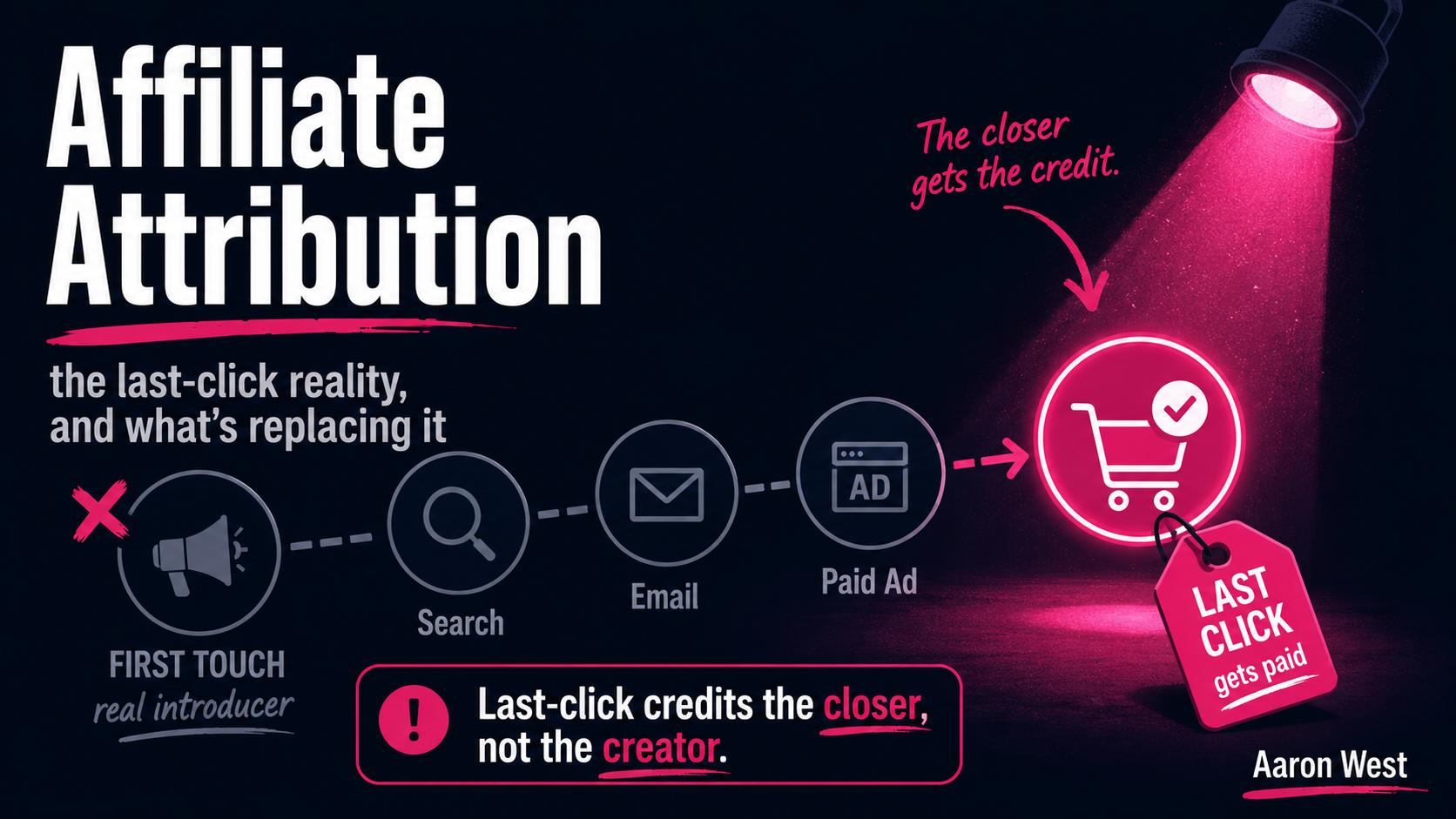
Affiliate attribution is the rule that decides which affiliate, and which touchpoint, gets credit for a sale, and for most of the channel's history that rule has been brutally simple: last click wins. Whoever set the last click before purchase takes 100% of the credit…
Continue reading...
Affiliate Fraud: The Types, the Detection Methods, and the Controls
Affiliate fraud is any attempt to earn commissions for results that were not genuinely driven, faked clicks, faked leads, or stolen attribution, and because the whole channel pays for results, it has always attracted people who try to fake results. The defining shift in 2026…
Continue reading...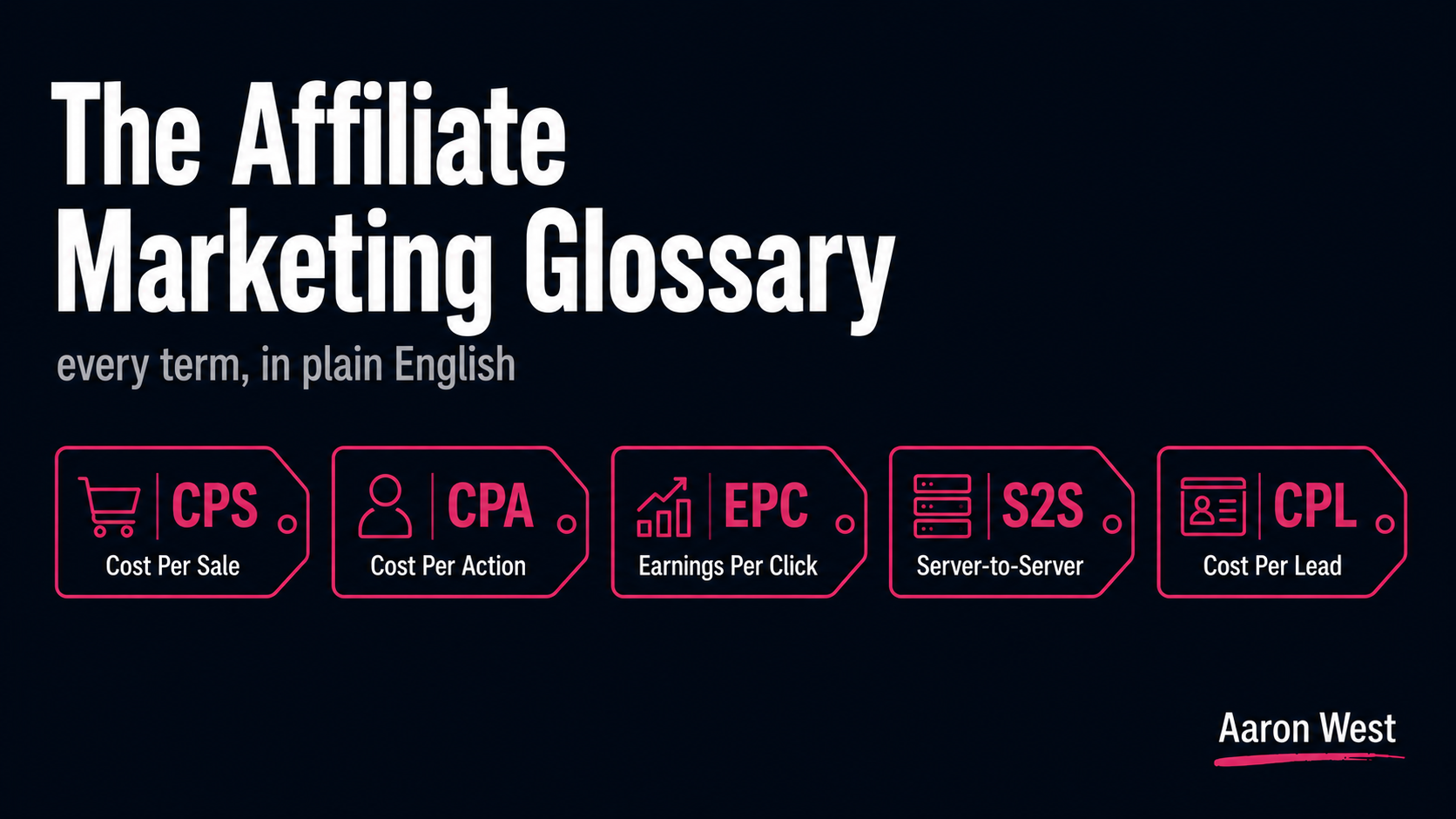
The Affiliate Marketing Glossary: Every Term, in Plain English
Affiliate marketing is full of acronyms and jargon, CPS, EPC, S2S, dedup, postback, cookie window, that can make a simple channel sound impenetrable. This glossary defines the terms that actually matter, in plain English, grouped so you can see how they fit together. Each definition…
Continue reading...