The Affiliate Publisher Landscape: Every Partner Type, Explained

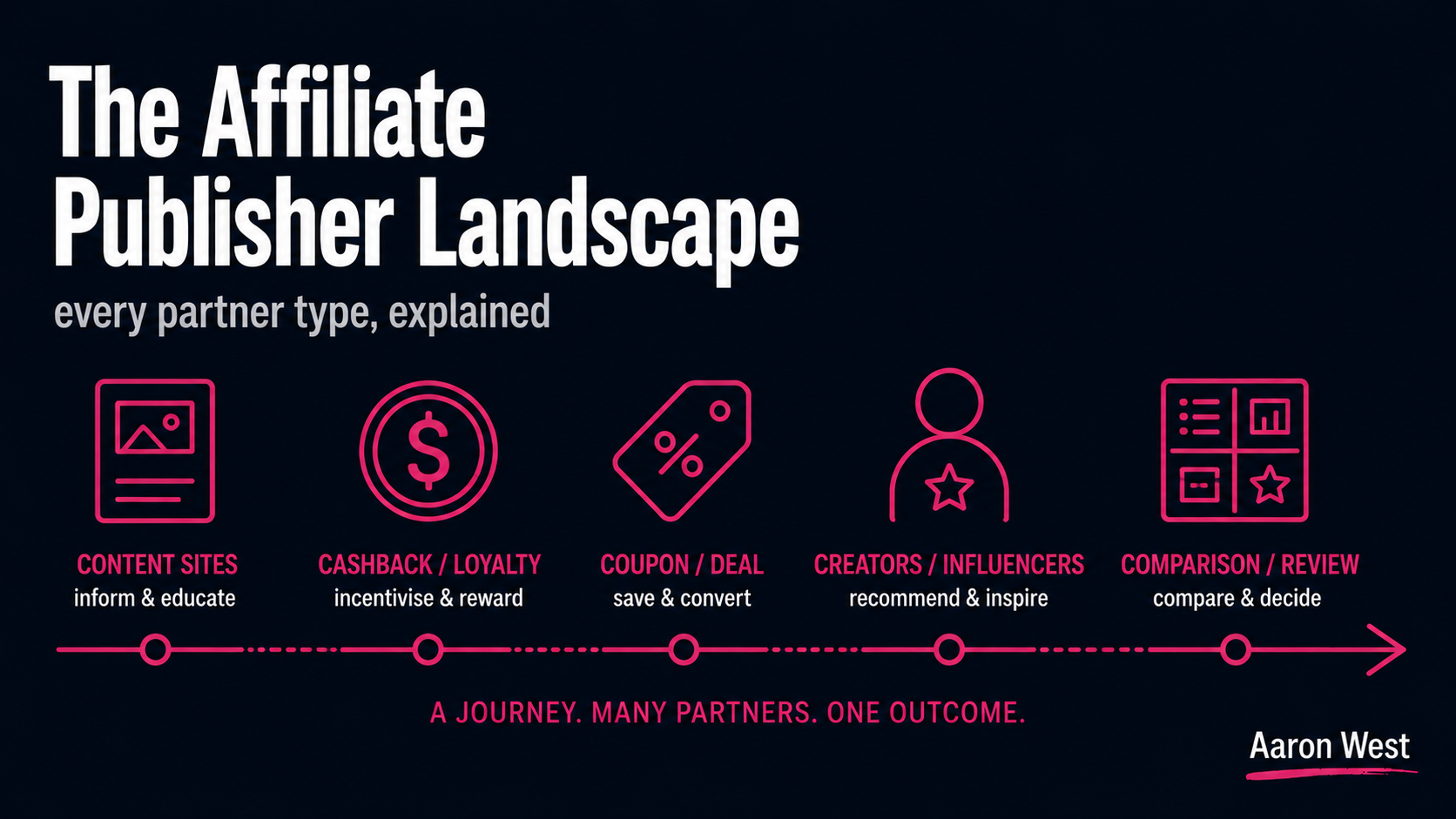
Table of Contents
"Affiliate" covers wildly different kinds of partner, content sites, cashback platforms, coupon sites, influencers, comparison engines, and the single most important thing to understand is that they do fundamentally different jobs. Some genuinely introduce new customers to your brand; others mostly intercept customers who were already on their way to buy. Paying both as if they are identical is one of the most common and expensive mistakes in affiliate marketing, and the health of a programme depends far more on the mix of partner types than on the headline number of partners.
This is the strategic heart of running a programme, and it pairs with how commission models work, because different partner types respond to and deserve different commission structures. This piece maps the main publisher types, what each actually does in the customer journey, and the question that should sit underneath every partnership decision: is this partner creating demand or just capturing it? It is part of the broader affiliate guide, and it is where most of the real strategic work of the channel lives.
The main publisher types
The ecosystem has a handful of distinct categories, each with its own economics and its own role in how a customer gets from "never heard of you" to "bought."
Content and editorial publishers. Blogs, review sites, and increasingly major editorial brands that recommend products within genuine content, the "best running shoes" review, the buying guide, the comparison article. These are often the highest-quality, most defensible partners, because they reach people early, in the discovery and research phase, and they build the kind of trust a discount code never will. Their role is expanding for a reason worth noting: large language models increasingly draw on exactly this kind of structured, trustworthy content, so a strong content partner is now valuable in the AI-search era too. I go deeper in content publishers and the editorial-commerce shift.
Cashback, loyalty and rewards publishers. Platforms that share part of their commission back with the shopper as cashback or points. They command a large share of affiliate spend, often the single largest category, because they drive serious volume. But that volume comes with a question you have to ask honestly, covered below and in cashback and loyalty publishers.
Coupon and deal sites. Partners that promote discount codes and offers. They can drive real volume and introduce price-sensitive shoppers, but they also sit right at the bottom of the funnel, often catching customers who were already heading to checkout and searching for a code. Whether they add value or quietly leak margin is the central question of coupon and deal sites.
Influencers and creators. The fastest-growing category, by a clear margin, as budgets shift toward creators who combine genuine audience trust with awareness-stage reach. This is the social-commerce shift, and it brings authenticity and new audiences rather than search-intent traffic, a different job from any of the above (see influencers and creators in affiliate).
Comparison sites, CSS and sub-networks. The price-comparison engines, comparison-shopping services, and aggregators that quietly drive a lot of considered-purchase volume, plus sub-networks that aggregate many smaller publishers under one relationship. Easy to overlook, often significant (more in comparison sites, CSS and sub-networks).
The question under everything: incrementality
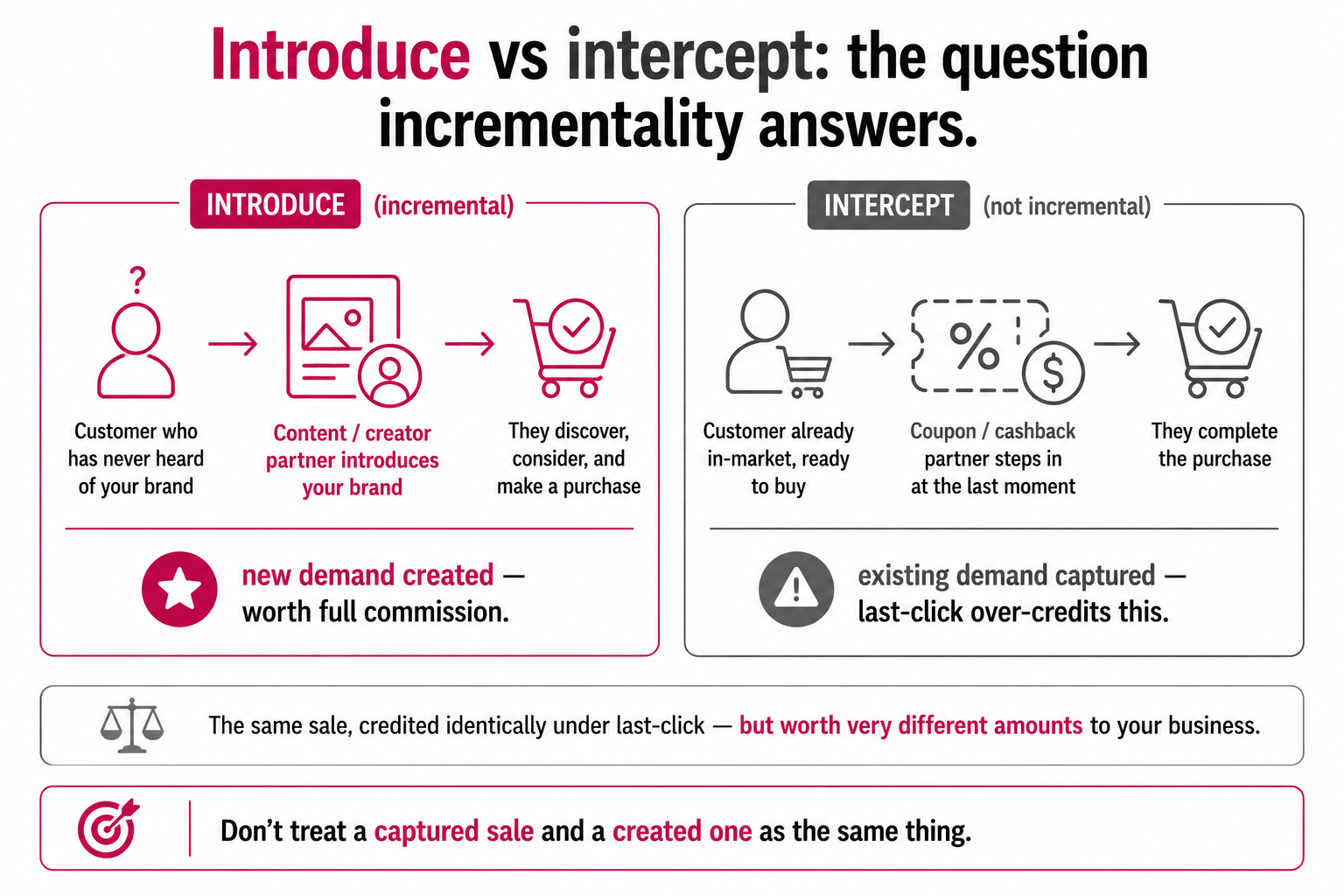
Here is the idea that separates a managed programme from a neglected one, and it is the most important concept in the whole channel right now: incrementality. The question is simple and uncomfortable: did this partner actually create a sale that would not have happened otherwise, or did they just take credit for one that was already going to happen?
This matters because the affiliate channel was born in the deal-blog and coupon world, and for many brands that origin never faded, they still run programmes built around discount partners, flat commission rates regardless of partner value, and last-click measurement that rewards whoever touched the customer last. The problem is that last-click systematically over-credits the partners closest to checkout. A cashback or coupon site that a customer visits after deciding to buy, specifically to find a code, gets full credit under last-click, even though the customer was already buying. That is not creating demand. That is capturing it, and paying full commission for it.
In 2026 this is no longer a theoretical concern, it is reshaping how budget gets allocated. Advertisers under pressure to justify acquisition costs are running incrementality tests (holdout experiments that measure what actually changes when a partner is present versus absent), and the results consistently shift leverage toward the partners who introduce genuinely new customers, content sites, comparison sites, and creators, while coupon and cashback partners face more scrutiny. The honest framing is not that discount partners are bad, they drive real volume and serve real shoppers. It is that they should be evaluated and paid for what they actually contribute, not waved through on last-click volume as if a captured sale and a created one are worth the same. They are not.
Why the mix is the strategy
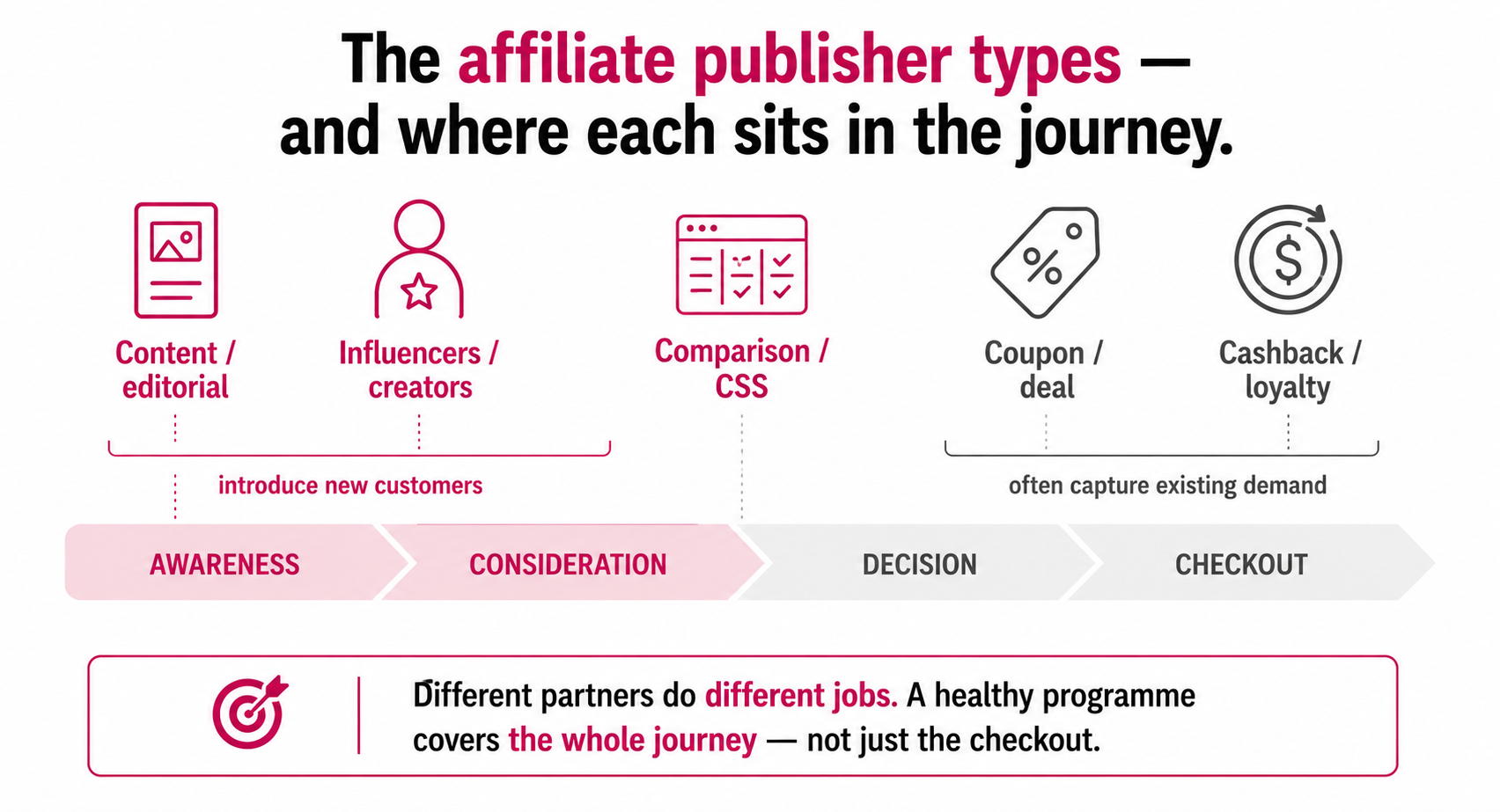
Once you see partners by the job they do, the strategic move becomes obvious: build a mix that covers the whole customer journey, rather than concentrating in one type. A healthy programme has awareness-stage partners (content, creators) bringing in people who did not know you, consideration-stage partners (comparison, email) helping them decide, and conversion-stage partners (coupon, cashback) closing, with each understood and paid for its actual role.
The failure mode is concentration, especially concentration in cashback and coupon alone. A programme built only on discount partners generates conversion volume but almost no awareness, which leaves it fragile (you are dependent on a few large publishers who can change terms or leave) and quietly capped (you are only ever harvesting demand that already exists, never growing it). The compounding value, new customers discovering you through trusted content and creators, never gets built. This is exactly why the most useful thing you can do with your affiliate data is stop treating it as one number. Segment it by partner type and measure each separately, because a single blended figure (one ROAS, one last-click total) hides the entire story, the slow-burn content partner and the instant-win coupon site get averaged into a meaningless middle. Segment, and you can see which partners introduce and which intercept, then invest accordingly. That segmentation, plus periodic incrementality testing, is what holds up when a finance team asks what the channel actually contributes.
What this means in practice
So when you look at your programme, or plan one, the questions are not "how many affiliates do we have?" or "which pays the most volume?" They are: what job does each partner do, where in the journey do they act, and are they introducing customers or intercepting them? Those questions lead to better decisions than any volume report.
Practically: recruit deliberately across the journey rather than accepting whoever signs up (most neglected programmes are accidentally all-coupon because that is who self-selects into an unmanaged programme). Pay partners in line with the value they actually create, which is why tiered and differentiated commissions matter, a content partner introducing new customers and a coupon site catching existing ones should not automatically earn the same rate. And protect the high-value end: your content and creator partners are the ones building something that compounds, so they deserve the attention, the better terms, and the relationship management that an unmanaged programme never gives them.
That is the publisher landscape. Content and editorial, cashback and loyalty, coupon and deal, influencers and creators, comparison and sub-networks, each doing a genuinely different job in the journey from stranger to customer. The whole game is to see them clearly, build a mix that covers the full journey rather than just the checkout, and pay each for the value it actually creates, not the credit last-click happens to hand it. Get that right and the programme grows the business. Get it wrong, concentrate at the bottom of the funnel and pay everyone the same, and you build an expensive machine for taking credit for sales you were going to make anyway. The partners are not interchangeable. Treating them as if they are is the most expensive habit in the channel.
A few common questions
What are the main types of affiliate publishers? The main categories are content and editorial publishers (review sites, blogs, buying guides), cashback and loyalty/rewards platforms, coupon and deal sites, influencers and creators, and comparison sites, CSS (comparison-shopping services) and sub-networks. Each does a different job in the customer journey, from awareness-stage discovery (content, creators) to conversion-stage closing (coupon, cashback).
What is incrementality in affiliate marketing? Incrementality is whether a partner actually created a sale that wouldn't have happened otherwise, versus capturing a sale that was already going to occur. It's the key metric for evaluating affiliate partners in 2026, because last-click attribution over-credits partners near checkout (like coupon and cashback sites) who often intercept existing demand rather than introducing new customers. Advertisers use holdout tests to measure it.
Are coupon and cashback affiliates bad for my programme? No, but they should be evaluated for what they actually contribute. They drive real volume and serve real shoppers, but they often sit at the bottom of the funnel and capture demand that already existed, which last-click attribution over-rewards. The problem isn't the partner type, it's concentrating your programme in them and paying them the same as partners who introduce genuinely new customers.
How should I balance my affiliate partner mix? Build a mix that covers the whole customer journey: awareness-stage partners (content, creators) who introduce new customers, consideration-stage partners (comparison, email) who help people decide, and conversion-stage partners (coupon, cashback) who close. Segment your data by partner type rather than using one blended number, and pay each in line with the value it actually creates. Concentration in any single type, especially coupon and cashback, leaves a programme fragile and capped.
You should also read:
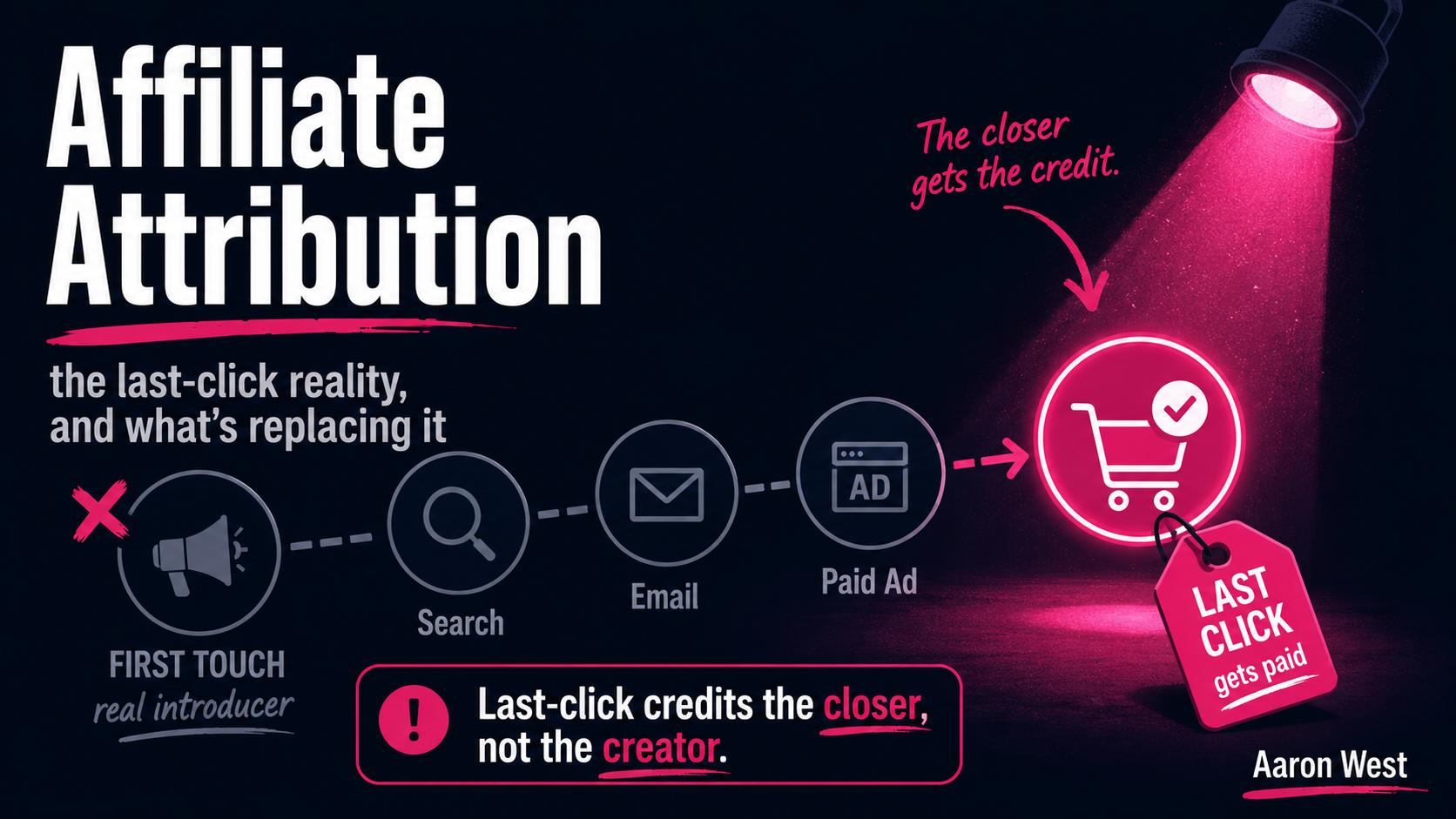
Attribution for Affiliate: The Last-Click Reality and What's Replacing It
Affiliate attribution is the rule that decides which affiliate, and which touchpoint, gets credit for a sale, and for most of the channel's history that rule has been brutally simple: last click wins. Whoever set the last click before purchase takes 100% of the credit…
Continue reading...
Affiliate Fraud: The Types, the Detection Methods, and the Controls
Affiliate fraud is any attempt to earn commissions for results that were not genuinely driven, faked clicks, faked leads, or stolen attribution, and because the whole channel pays for results, it has always attracted people who try to fake results. The defining shift in 2026…
Continue reading...
The Affiliate Marketing Glossary: Every Term, in Plain English
Affiliate marketing is full of acronyms and jargon, CPS, EPC, S2S, dedup, postback, cookie window, that can make a simple channel sound impenetrable. This glossary defines the terms that actually matter, in plain English, grouped so you can see how they fit together. Each definition…
Continue reading...