Affiliate Fraud: The Types, the Detection Methods, and the Controls

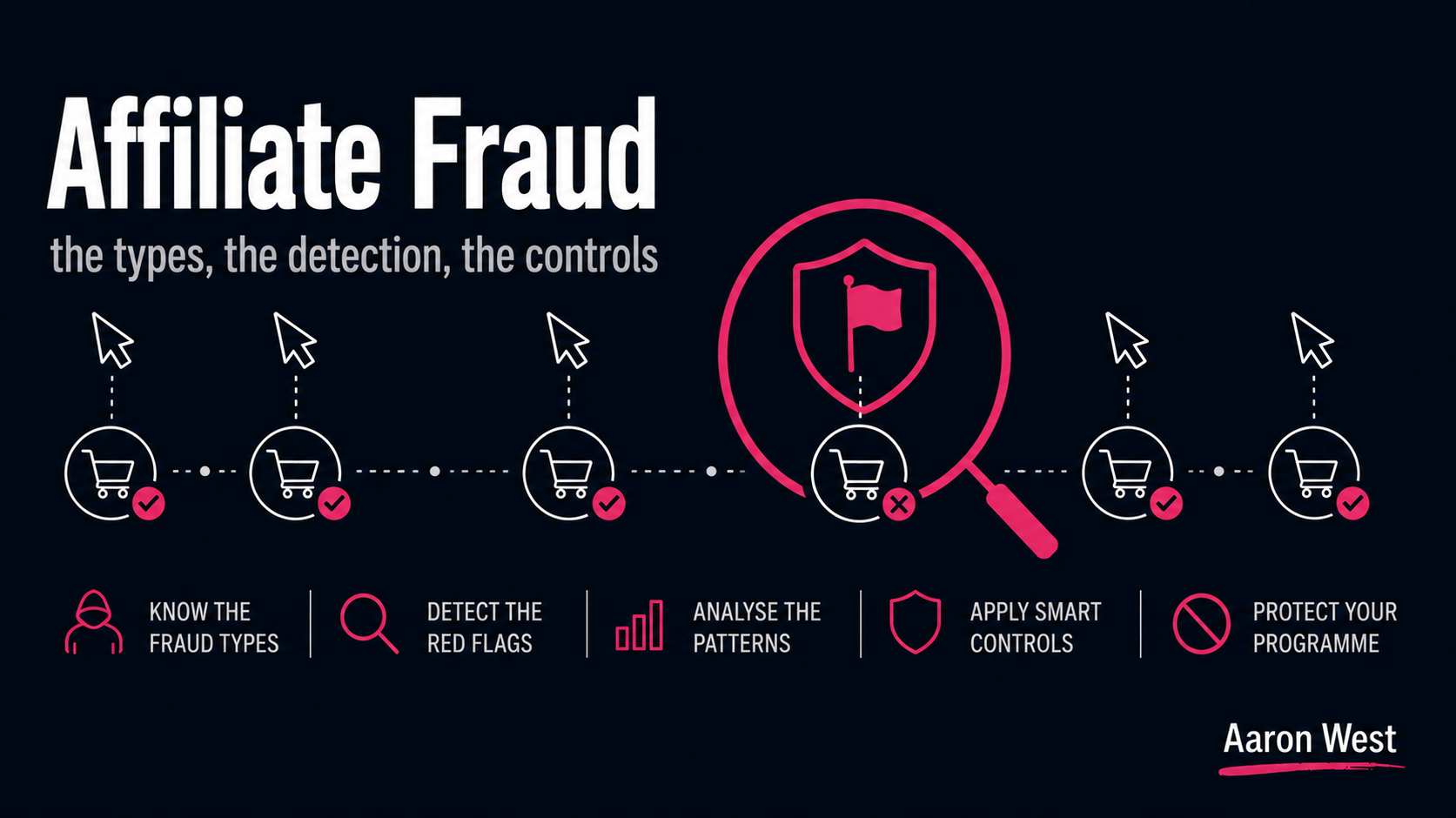
Affiliate fraud is any attempt to earn commissions for results that were not genuinely driven, faked clicks, faked leads, or stolen attribution, and because the whole channel pays for results, it has always attracted people who try to fake results. The defining shift in 2026 is that the fraud has gotten smart: the crude old tricks still exist, but the real threat now is AI-driven bots that scroll, hover, and fill out forms convincingly enough to pass for human. The good news is that the defences have a clear logic, and the single most effective one is not a tool at all. It is knowing your partners.
This is the unglamorous half of running a programme, the part that protects everything else, and it sits in the integrity layer of the affiliate cluster alongside validation and deduplication. This piece maps the main fraud types, how each one is detected, and the controls that actually work, written for someone who has to keep a real programme honest, not just describe the problem. Let us go through it the way you would actually approach it: know the attacks, know the signals, build the defence.
The main types of affiliate fraud
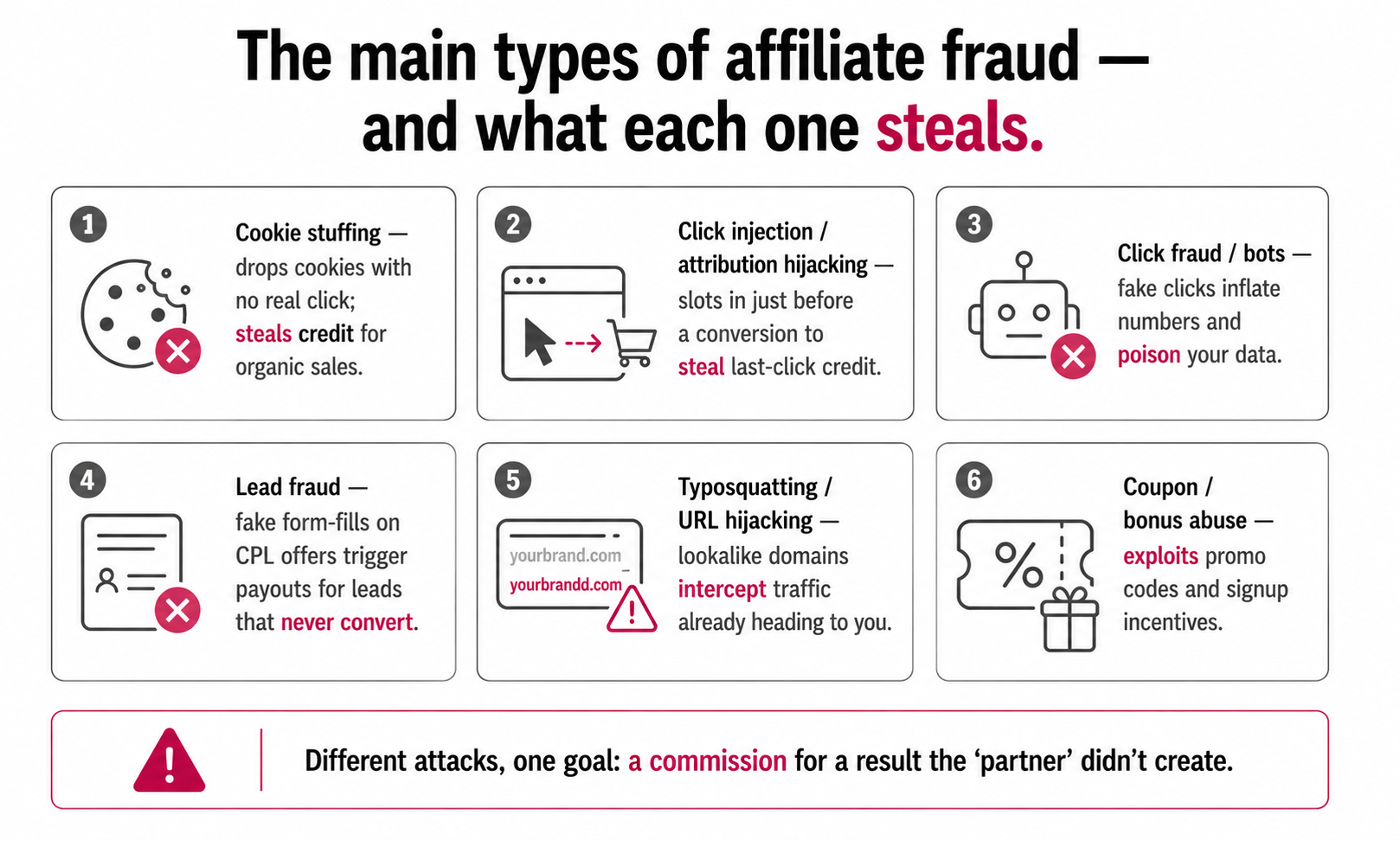
Fraud takes several forms, and they exploit different weaknesses in tracking and attribution. The ones that matter:
Cookie stuffing. The oldest scam in the channel and still the costliest for e-commerce: a fraudster secretly drops affiliate tracking cookies onto tens of thousands of browsers without any real click, so that when any of those users later buys naturally, the fraudster claims the commission. It is pure attribution theft, the sale was organic, the "affiliate" did nothing, and you pay anyway. Often delivered through browser extensions that inject a cookie at the last second.
Click injection and attribution hijacking. A more sophisticated cousin: the fraudster inserts a tracking event right before a conversion that was already going to happen, stealing last-click credit at the final moment. Multi-touch and hybrid attribution models are especially vulnerable, because the attacker just has to slot in at the right point in the funnel. The result is the same, you pay commission on a sale the "partner" did not cause.
Click fraud and bot traffic. Automated clicks, from simple bots or organised fraud farms, generating fake traffic to inflate an affiliate's numbers. Beyond the direct cost, this poisons your data: if a chunk of your "affiliate traffic" is bots, your analytics are lying to you, and you optimise toward a channel that is really a sinkhole.
Lead fraud. On CPL programmes, bots or fraud farms submit fake form fills, signups, or applications using fabricated or stolen data, to trigger lead payouts for leads that will never convert.
Typosquatting and URL hijacking. Registering misspellings or lookalikes of your domain to intercept traffic that was already heading to your brand, then claiming affiliate credit for those captured visitors. Impersonation dressed up as partnership.
Coupon and bonus abuse. Exploiting promo codes or signup incentives, leaking or auto-applying codes that should have been restricted, or repeatedly claiming new-customer bonuses, to extract value the programme never intended to give.
What changed in 2026: the fraud got smart
You cannot write about affiliate fraud now without addressing the shift that has made old defences insufficient. For years, fraud detection was largely rules-based: block this IP range, flag this click rate, reject conversions from this country. That worked against crude bots. It does not work against what is emerging now.
The real threat in 2026 is AI-driven bot farms and synthetic traffic. These are not simple scripts firing clicks; they are systems that scroll a page, hover over elements, fill in lead forms with realistic data, and mimic human behaviour across multiple steps of a funnel, specifically to slip past rule-based filters. They are generated through device farms, residential proxy networks, and emulated mobile environments, which means they arrive on plausible IPs from plausible locations and look, on the surface, exactly like real users. Geo-spoofing, disguising the true origin of traffic to appear to come from trusted locations, compounds the problem. The consequence is a strategic shift that every serious programme is making: away from static rules and toward behavioural anomaly detection, asking not "is this IP on a blocklist?" but "does this pattern of behaviour actually look human, and does it hold up after the sale?" That last part is the key, and it leads straight to the detection signals that still work.
How fraud is detected: the signals that give it away
However sophisticated the fraud, it tends to leave statistical and behavioural fingerprints, because fakery is hard to sustain consistently. The signals an experienced programme watches for:
- Conversion timing that makes no sense. Conversions arriving from sessions where the click happened weeks earlier with no interaction in between, a classic cookie-stuffing tell.
- Outlier conversion rates. A single affiliate whose conversion rate sits wildly above the programme average. Real partners cluster within a range; fraud spikes.
- Tracking artefacts that should not exist. Iframe drops or tiny 1×1 pixel calls in your tracking logs, the technical signature of cookies being stuffed invisibly.
- Clicks with no legitimate origin. Conversions from users whose IPs show no record of a real click on the affiliate's stated traffic source, the traffic does not match the story.
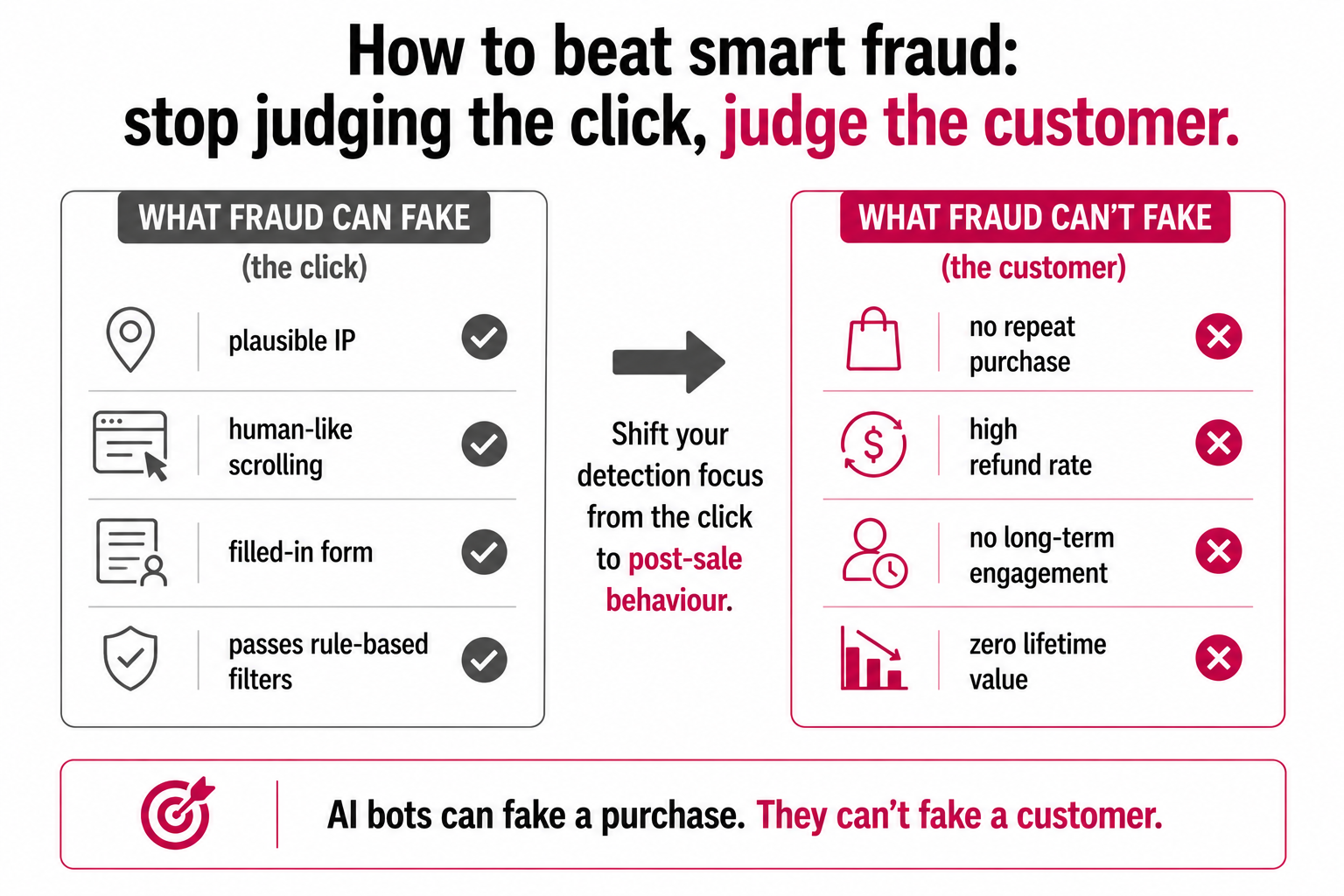
- Post-sale behaviour that falls apart. This is the most powerful modern signal: AI bots can fake the initial purchase, but they cannot fake long-term engagement. So you shift focus to post-sale data, refunds, repeat purchases, customer lifetime value. A "partner" whose customers all refund or never return is producing fake conversions, however human the initial click looked.
That last principle is worth internalising, because it is how you beat AI fraud specifically: stop trying to judge the click and start judging the customer. A real customer behaves like a customer after the sale. A synthetic one does not, and no amount of clever click-faking can sustain a fake customer lifetime.
The controls that actually work
Detection tells you what is happening; controls are what you do about it. A real defence is layered, and only some of it is technology.
Clear, explicit programme terms. The foundation, and the one most programmes neglect: your terms must define prohibited practices in detail, cookie stuffing, click fraud, trademark and brand bidding, incentivised traffic where it is not allowed, and state that they are grounds for withholding payment and termination. Without explicit terms, you have limited recourse when you catch fraud. You cannot enforce a rule you never wrote down.
A validation step with a holding period. Never pay on the raw conversion. Confirm sales are genuine, not cancelled, returned, or fraudulent, before commission is approved, and hold payouts long enough to catch refunds and chargebacks. This single control, covered fully in validation and order approval, stops you paying for sales that quietly reverse later. Detection without enforcement is just bookkeeping, the validation step is where detection turns into protection.
Behavioural and post-sale monitoring. As above, watch behaviour patterns and post-sale outcomes, not just clicks, and let the system learn what normal looks like for your programme so it can flag the deviations. This is where machine-learning-based detection earns its place, not as magic, but as a way to spot anomalies across thousands of conversions faster than a human can.
Server-side (S2S) tracking. Moving attribution off the browser with S2S removes a whole category of browser-based tampering, though note it is not a cure-all, fraudsters have moved to server-side conversion spoofing too, which is exactly why behavioural monitoring still matters on top.
And the one that beats all the tooling: know your partners. This is the practitioner's real edge. The managers who prevent the most fraud are not the ones with the fanciest detection software, they are the ones who actually know who their partners are, where their traffic comes from, and what normal looks like for each. Recruit deliberately rather than approving everyone who applies. Ask new partners to be transparent about their traffic sources. Build relationships with your significant publishers so that an anomaly stands out against a known baseline. Fraud thrives in programmes that are unmanaged, full of partners nobody has ever spoken to, exactly the neglected-programme failure mode I described in the publisher landscape. A known, managed partner base is itself a fraud control, and the cheapest one you have.
So that is affiliate fraud, end to end. The types (cookie stuffing, click injection, bot and lead fraud, typosquatting, coupon abuse) all chase the same thing, a commission for a result the partner did not create. The fraud has gotten genuinely sophisticated in 2026, which is why static rules no longer cut it and the smart move is to judge the customer, not just the click, fake purchases cannot sustain a real customer lifetime. And the defence is layered: clear terms you can enforce, a validation step that holds payouts until sales are confirmed, behavioural monitoring that learns your normal, and, above all, actually knowing your partners. You will never eliminate fraud completely, no programme does. But you can make it small, visible, and not worth the fraudster's effort, which is the realistic goal. A programme you actively manage is a programme fraud finds hard to hide in.
A few common questions
What is affiliate fraud? Affiliate fraud is any deceptive practice used to earn affiliate commissions for results that weren't genuinely driven, such as faked clicks, fake leads, bot traffic, or stolen attribution. Because affiliate marketing pays for results, it attracts people who fake results. Common types include cookie stuffing, click injection, click fraud, lead fraud, typosquatting, and coupon abuse.
What is cookie stuffing? Cookie stuffing is a fraud technique where a fraudster secretly drops affiliate tracking cookies onto users' browsers without any genuine click, often via a browser extension. When any of those users later buys organically, the fraudster claims the commission for a sale they did nothing to drive. It's one of the oldest and still costliest affiliate scams, especially in e-commerce.
How do you detect affiliate fraud? By watching for statistical and behavioural anomalies: conversions from clicks that happened weeks earlier with no interaction, a single affiliate with a conversion rate far above the programme average, suspicious tracking artefacts (iframe or 1×1 pixel calls), conversions whose IPs show no real click, and, most powerfully against AI bots, post-sale behaviour like refunds and zero repeat purchases. The principle: AI can fake a click, but it can't fake a real customer's lifetime.
How do you prevent affiliate fraud? With a layered defence: clear programme terms that define prohibited practices and allow you to withhold payment; a validation step that confirms sales are genuine and holds payouts long enough to catch refunds and chargebacks; behavioural and post-sale monitoring rather than just click checks; server-side tracking to remove browser tampering; and, most effective of all, knowing your partners, recruiting deliberately and building relationships so anomalies stand out. Fraud can't be eliminated entirely, but it can be made small and visible.
You should also read:
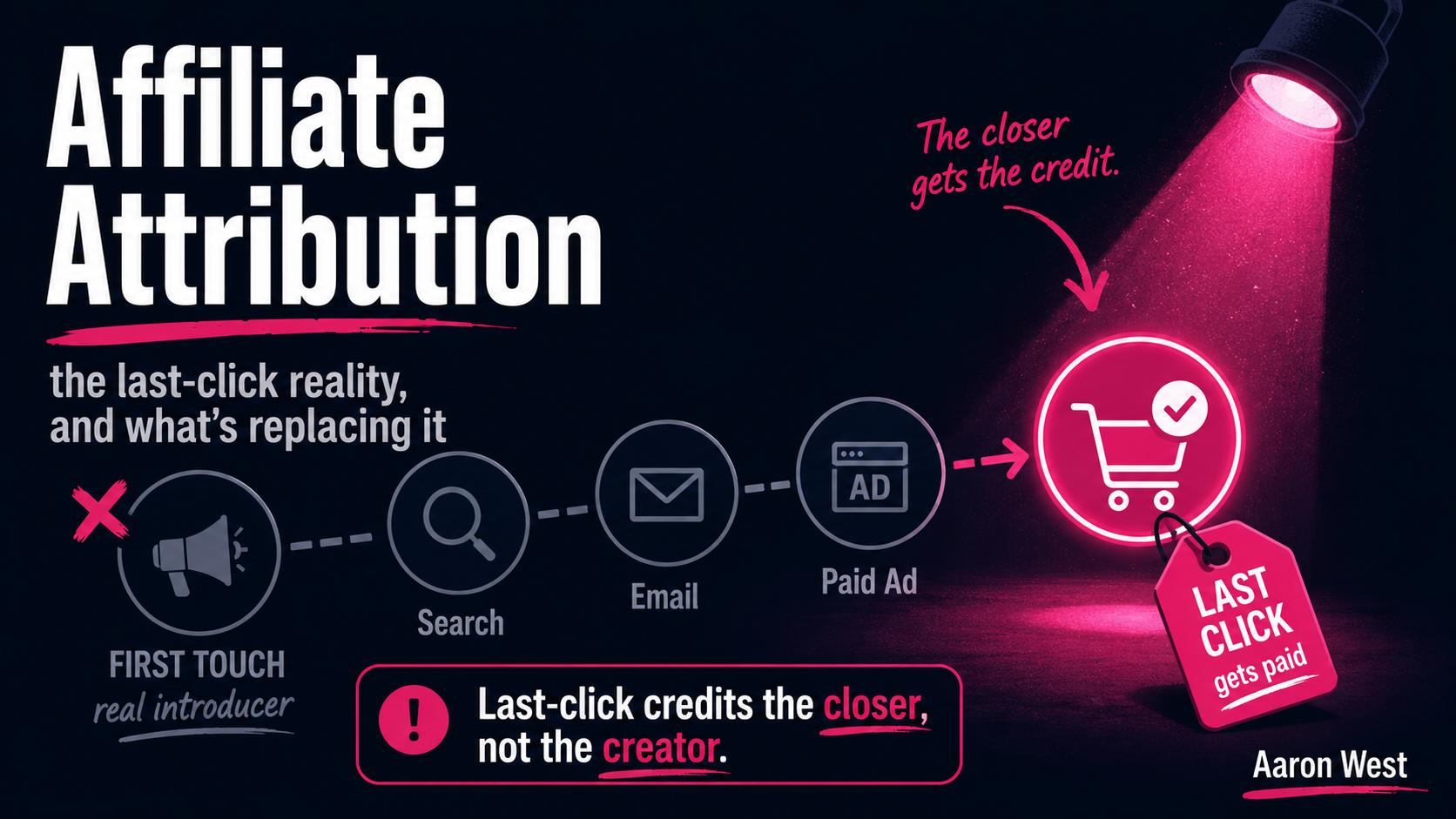
Attribution for Affiliate: The Last-Click Reality and What's Replacing It
Affiliate attribution is the rule that decides which affiliate, and which touchpoint, gets credit for a sale, and for most of the channel's history that rule has been brutally simple: last click wins. Whoever set the last click before purchase takes 100% of the credit…
Continue reading...
The Affiliate Marketing Glossary: Every Term, in Plain English
Affiliate marketing is full of acronyms and jargon, CPS, EPC, S2S, dedup, postback, cookie window, that can make a simple channel sound impenetrable. This glossary defines the terms that actually matter, in plain English, grouped so you can see how they fit together. Each definition…
Continue reading...
The Affiliate Publisher Landscape: Every Partner Type, Explained
"Affiliate" covers wildly different kinds of partner, content sites, cashback platforms, coupon sites, influencers, comparison engines, and the single most important thing to understand is that they do fundamentally different jobs. Some genuinely introduce new customers to your brand; others mostly intercept customers who were…
Continue reading...