Server-to-Server (S2S) and Postback Tracking, Explained

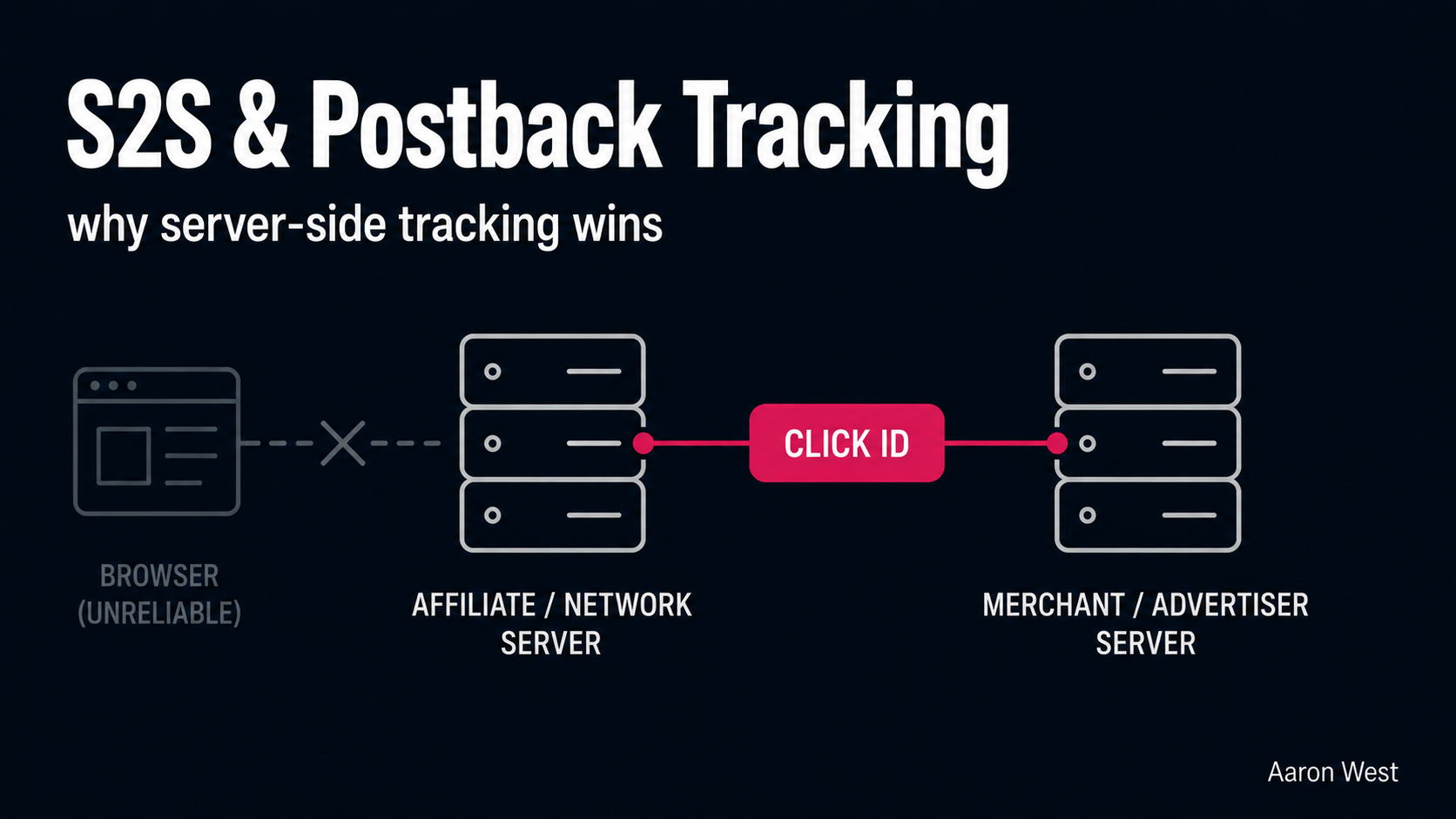
Table of Contents
Server-to-server (S2S) tracking, also called postback tracking, records an affiliate conversion by having the merchant's server send the sale data directly to the affiliate platform's server, with no cookie and no browser involved. That one architectural change, moving the conversion record off the shopper's browser and onto the back end, is why S2S has quietly become the modern standard for affiliate tracking. It survives the cookie loss, ad blockers, and browser privacy restrictions that increasingly break the older pixel method. If you only understand one piece of tracking machinery in 2026, this is the one to understand, and I will explain it in plain terms, because the concept is simpler than the acronyms make it sound.
This is the deep technical sibling to how affiliate tracking works, which introduced the three tracking methods at a high level. Here we go properly into the one that matters most going forward. What S2S actually is, the click-ID round trip that makes it work, how it differs from pixel tracking, why it is winning, and, because I promised you honesty throughout this cluster, the things S2S does not solve. No prior coding knowledge needed.
The core idea: move the record off the browser
Start with the problem S2S solves. The older way to record a conversion, pixel tracking, puts a small piece of code on your "thank you" page that fires from the shopper's browser when the page loads, telling the affiliate platform a sale happened. That works right up until the browser gets in the way, and in 2026 the browser gets in the way constantly: cookies are blocked or deleted, ad blockers stop the pixel firing, privacy features on Safari and other browsers suppress the tracking, or the shopper simply closes the tab before the confirmation page fully loads. Every one of those breaks a browser-based pixel, and every break is a real sale that an affiliate drove but does not get credited or paid for.
S2S removes the browser from the equation entirely. Instead of asking the shopper's browser to report the conversion, the merchant's own server reports it directly to the affiliate platform's server, machine to machine, behind the scenes. The shopper's browser is never asked to do anything, so nothing the browser does, blocking, deleting, closing, can break the record. That is the whole idea in one sentence: stop relying on the shopper's browser to tell you a sale happened, and have your server tell the affiliate platform directly. Everything else is just the mechanism for doing that reliably.
How it works: the click-ID round trip
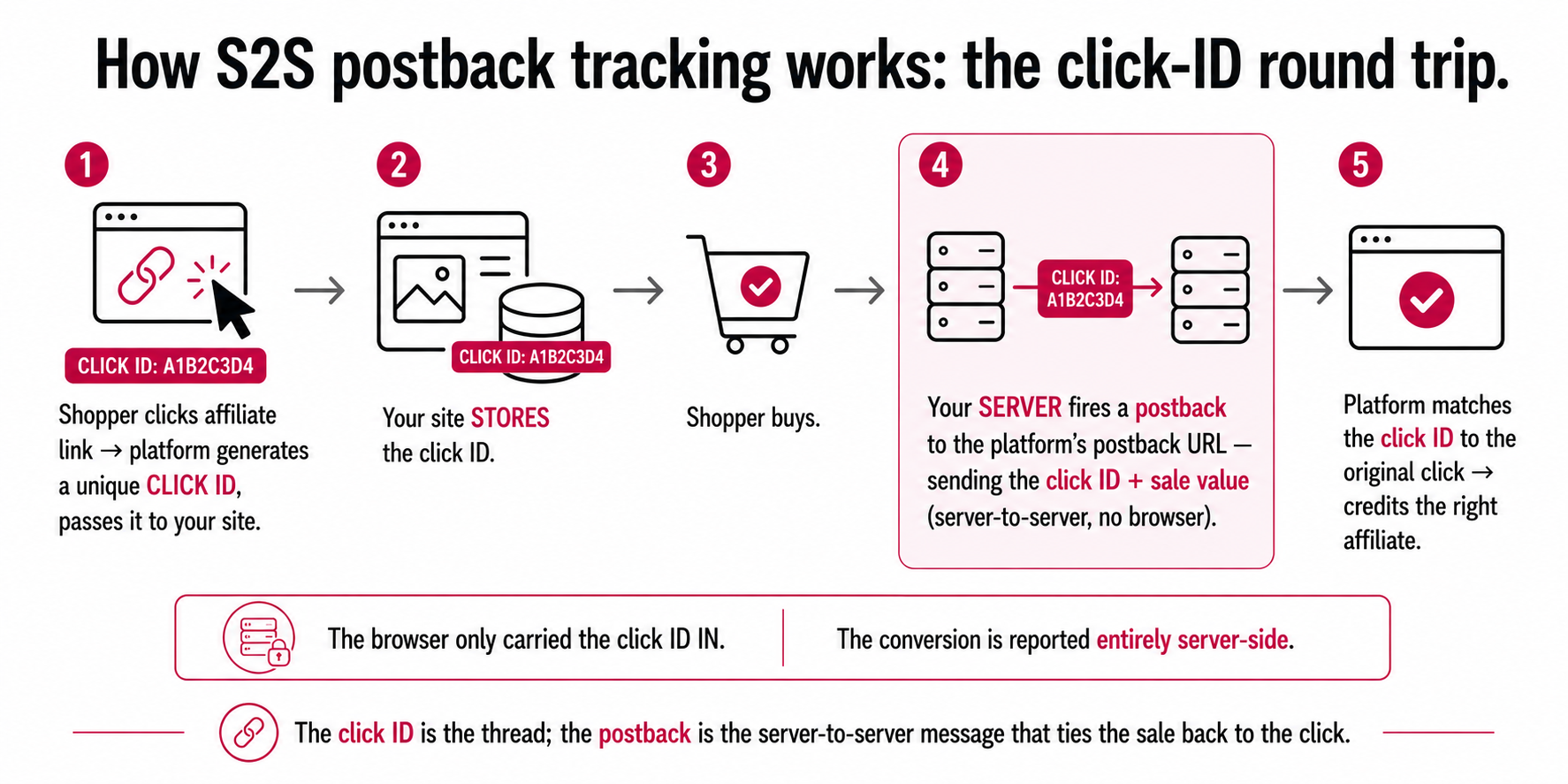
The mechanism is a round trip built around one piece of data, a unique click ID, and it is worth walking through because once you see it, S2S makes complete sense. Five steps:
- The click. A shopper clicks an affiliate's link. The affiliate platform generates a unique click ID, a random identifier for this specific click, and forwards the shopper to your site, passing that click ID along (typically appended to the URL).
- You store the click ID. Your site captures and stores that click ID, holding onto it for this visitor.
- The shopper buys. At some point, the visitor completes a purchase on your site.
- The postback fires. Your server sends a small, silent message, the postback, to a special URL the affiliate platform gave you (the postback URL), reporting the conversion and including the original click ID and details like the sale value. This is server-to-server: your back end talking directly to theirs.
- The match. The affiliate platform receives the postback, looks up the click ID, finds the original click it belongs to, and credits the right affiliate for the sale.
The click ID is the thread that ties the conversion back to the click that caused it. The postback URL is just the agreed address your server sends the result to. Notice what is absent from all five steps: at no point does the shopper's browser have to fire anything at the moment of conversion. The browser's only job was carrying the click ID in at the start; the conversion is reported entirely server-side. That is what makes it robust.
S2S vs pixel: why server-side wins
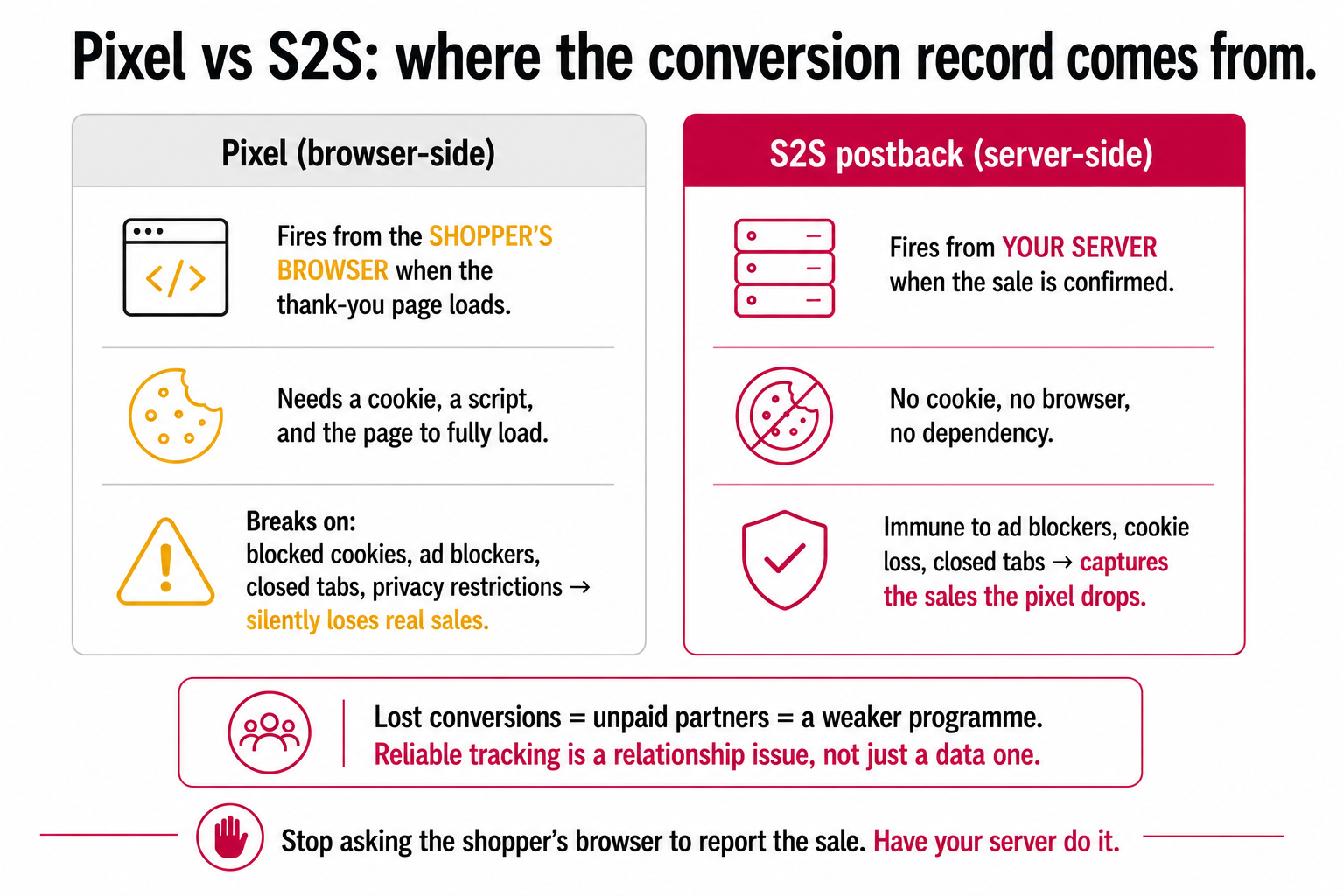
It helps to put the two side by side, because the contrast is the whole case for S2S. A pixel fires from the shopper's browser when the confirmation page loads, depending on a cookie, a script, and the page actually loading fully. A postback (S2S) fires from your server when the sale is confirmed, depending on none of those things. The consequences follow directly:
- Reliability. The pixel breaks whenever the browser interferes, blocked cookies, ad blockers, closed tabs, privacy restrictions. S2S is immune to all of those because the browser is not involved, so it captures conversions the pixel silently loses.
- Cookielessness. As third-party cookies disappear and browsers clamp down on tracking, pixel accuracy degrades, often losing a substantial share of conversions in privacy-heavy environments. S2S does not depend on cookies at all, which is precisely why it is described as the cookieless, future-proof method.
- Accuracy and fairness. Because S2S misses far fewer conversions, affiliates get credited and paid for sales the pixel would have dropped. That is not a small technical nicety, unrecorded conversions mean unpaid partners, which erodes trust and makes your programme less attractive to good affiliates. Reliable tracking is a partner-relationship issue as much as a data one.
This is why the serious affiliate networks and platforms support S2S postbacks, and why high-value conversions especially should always be tracked server-side. The honest practical pattern many programmes use: run S2S as the primary, reliable method, and treat the pixel as a secondary or fallback signal for partners not yet integrated server-side, rather than relying on the pixel alone.
What S2S does not solve (the honest part)
S2S is genuinely the better method, but it is not magic, and pretending otherwise would be exactly the kind of hype this cluster avoids. Three honest caveats.
It is not a fraud cure-all. Moving tracking server-side removes a whole category of browser-based tampering, which is a real fraud benefit. But fraudsters have followed: server-side conversion spoofing exists, where fake conversions are fired straight at the postback URL. So S2S raises the bar without eliminating the problem, which is exactly why the fraud controls in this cluster, behavioural monitoring, post-sale validation, knowing your partners, still matter on top of S2S. Better tracking is not a substitute for fraud discipline.
It is not effortless to set up. The cost of S2S is integration. Because the conversion is reported from your server, someone has to configure your server to fire that postback with the right click ID and data, which is more technical than dropping a pixel snippet on a page. It is a one-time job, not an ongoing burden, but it is real work, and it is the main reason some partners and smaller merchants lag on adopting it. This is why the pixel-as-fallback pattern exists, you do not want to lose a partner's conversions entirely just because their S2S integration is not finished yet.
It is not 100% either. No tracking method captures every conversion perfectly, S2S included. Click IDs can fail to pass or store correctly, integrations can have gaps, cross-device journeys still pose challenges. S2S is dramatically more reliable than pixels, but the goal, as I argued in the tracking overview, is resilience and high accuracy, not a mythical perfect count. Treat S2S as the strong primary method it is, monitor that your postbacks are actually firing and matching, and keep a fallback, rather than assuming "we moved to S2S" means tracking is now a solved problem.
The takeaway
Server-to-server tracking is, in plain terms, your server telling the affiliate platform that a sale happened, instead of relying on the shopper's browser to do it. That single shift, carried by a unique click ID that threads the conversion back to the click and delivered through a postback to an agreed URL, is what makes it survive the cookie loss, ad blockers, and privacy restrictions that increasingly break browser-based pixels. It is more reliable, it is cookieless and future-proof, and crucially it credits affiliates for sales the pixel would silently lose, which makes it a fairness and partner-trust issue, not just a technical one.
If you are running an affiliate programme in 2026 and still tracking primarily on pixels, you are losing conversions you cannot see, and underpaying partners who earned them. Move to S2S as your primary method. Just go in clear-eyed: it takes a one-time integration, it does not by itself stop a determined fraudster, and no method is ever perfect. Set it up properly, keep the pixel as a fallback, monitor that the postbacks fire, and keep your fraud controls running alongside. Do that, and you have the most reliable affiliate tracking available, which is the foundation everything else in your programme is built on. Get the tracking right and the rest of the programme can be trusted; get it wrong and every number you optimise toward is quietly false.
A few common questions
What is server-to-server (S2S) or postback tracking? It's a method of recording an affiliate conversion where the merchant's server sends the sale data directly to the affiliate platform's server, with no cookie or browser involved. It's called "postback" because your server posts the conversion back to a special URL the platform provides. Because the shopper's browser plays no part at the moment of conversion, S2S survives cookie loss, ad blockers, and browser privacy restrictions that break the older pixel method.
How does S2S postback tracking work? Through a click-ID round trip: when a shopper clicks an affiliate link, the platform generates a unique click ID and passes it to your site; your site stores it; when the shopper buys, your server fires a "postback" to the platform's postback URL, sending the click ID and sale details; the platform matches the click ID to the original click and credits the right affiliate. The click ID is the thread tying the conversion back to the click, and the whole conversion report happens server-to-server.
What's the difference between S2S and pixel tracking? A pixel fires from the shopper's browser when the confirmation page loads, so it depends on a cookie, a script, and the page loading fully, and it breaks when cookies are blocked, ad blockers run, or the tab is closed. A postback (S2S) fires from your server when the sale is confirmed, depending on none of those things, so it captures conversions the pixel silently loses. S2S is more reliable and cookieless; the common pattern is to use S2S as primary and keep the pixel as a fallback.
Is S2S tracking more secure against fraud? Partly. It removes browser-based tampering, which is a real benefit, but it isn't a fraud cure-all, fraudsters can fire fake conversions directly at the postback URL (server-side spoofing). So S2S raises the bar but doesn't replace fraud controls like behavioural monitoring, post-sale validation, and knowing your partners. It's also not 100% accurate (click IDs can fail to pass, integrations can have gaps), so monitor that your postbacks are firing and matching rather than assuming the move to S2S solved tracking entirely.
You should also read:
The Tracking Pixel, Explained
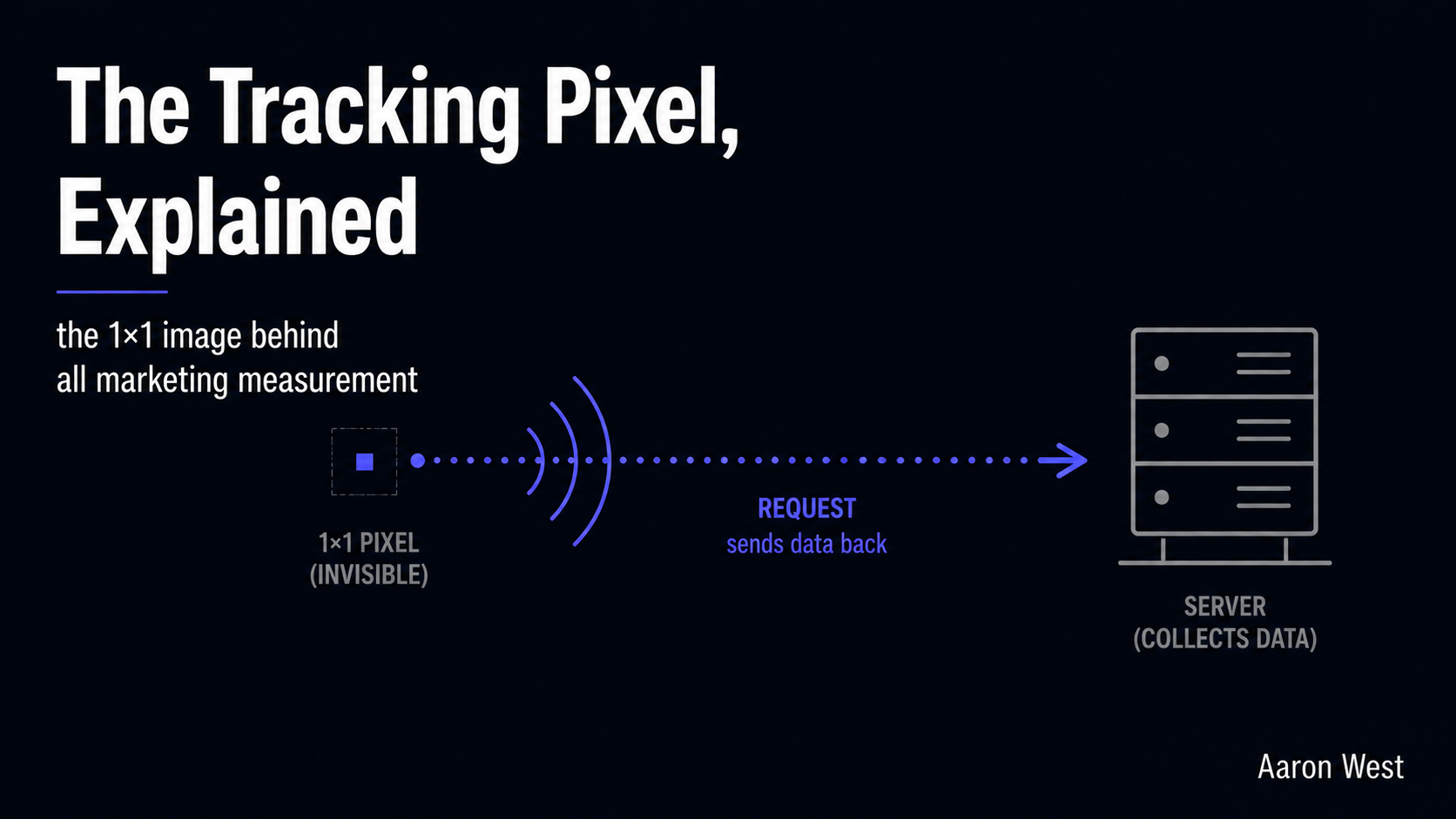
A tracking pixel is a tiny, invisible image, usually a single transparent dot one pixel wide, hidden in the code of a web page, email, or ad, and its only job is to quietly report back when something happens. When the page loads, the pixel…
Continue reading...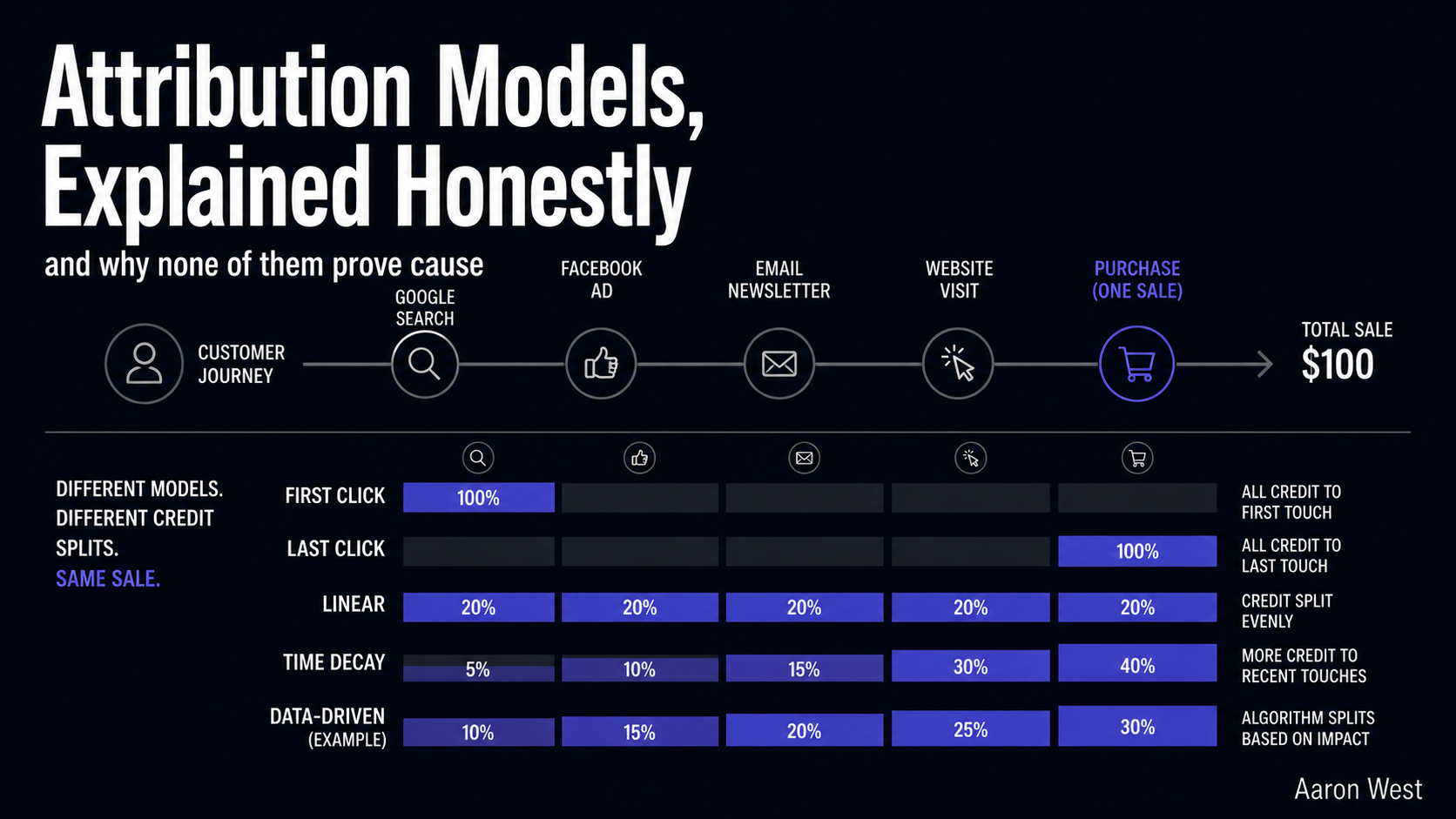
Attribution Models, Explained Honestly: Last-Click, First, Linear, Data-Driven
An attribution model is simply a rule for deciding which marketing touchpoint gets credit for a sale, and the uncomfortable truth is that every one of them is, to some degree, a guess. A customer might see your Instagram ad, read a review, click a…
Continue reading...
The Affiliate Publisher Landscape: Every Partner Type, Explained
"Affiliate" covers wildly different kinds of partner, content sites, cashback platforms, coupon sites, influencers, comparison engines, and the single most important thing to understand is that they do fundamentally different jobs. Some genuinely introduce new customers to your brand; others mostly intercept customers who were…
Continue reading...