Why You're Under-Counting: Cookie Loss, ITP, and Tracking Loss

Table of Contents
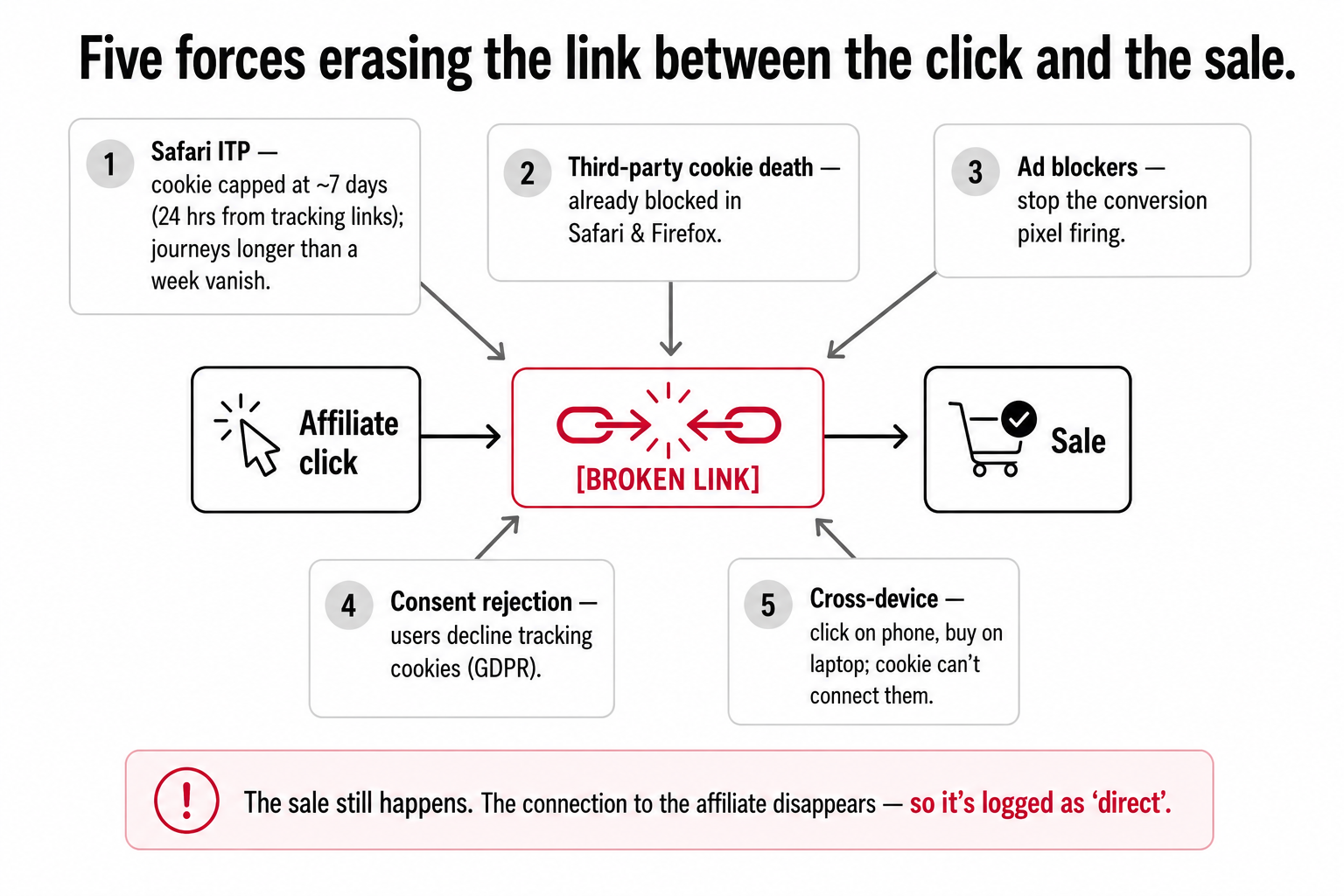
If you run an affiliate programme, you are almost certainly crediting your partners for fewer sales than they actually drove, and the gap is widening every year. The cause is the steady collapse of browser cookie tracking: privacy features like Safari's Intelligent Tracking Prevention, the death of third-party cookies, ad blockers, and consent rejection are all quietly erasing the link between an affiliate's click and the sale it produced. The conversion still happens. The connection back to the affiliate just disappears, so the sale gets recorded as "direct" or "organic," the affiliate gets nothing, and you congratulate yourself on cheap direct traffic that an affiliate actually paid to send you.
This is the problem that server-to-server tracking exists to solve, and understanding it properly is what makes the case for S2S obvious rather than abstract. It sits in the tracking layer of the affiliate cluster, beneath the tracking cornerstone. This piece explains what is causing the loss, why it hits affiliate programmes in a specific and damaging way, how to spot it, and what to actually do, in plain terms, because the mechanics matter and they are not as complicated as the acronyms suggest.
What's actually causing the loss
Tracking loss is not one problem; it is several, all pulling in the same direction. The main causes:
Safari's Intelligent Tracking Prevention (ITP). The biggest single factor. Apple's privacy system in Safari aggressively limits how long tracking cookies survive. First-party cookies set via JavaScript are capped at roughly seven days, and when a visitor arrives from a link carrying tracking parameters (which affiliate links do), that window can shrink to around 24 hours. The practical effect is brutal for affiliate: if a customer clicks an affiliate link and buys nine days later, Safari has already deleted the cookie that connected them, so the affiliate loses the sale entirely. Any purchase journey longer than a week becomes invisible in Safari, and Safari dominates mobile browsing in exactly the high-value Western markets most programmes care about.
The death of third-party cookies. The broader cookie apocalypse. Safari and Firefox already block third-party cookies by default, and the entire industry has spent years moving away from them. Tracking methods that ever relied on third-party cookies are simply failing.
Ad blockers. A large and growing share of users run ad blockers or privacy extensions that stop tracking scripts and pixels from firing at all. If the affiliate's conversion pixel is blocked, the sale is invisible to the programme.
Consent rejection. Under GDPR and similar regimes, users can decline tracking cookies, and many do, clicking "reject" on the consent banner. Every rejection is a customer whose affiliate-driven journey cannot be tracked through cookies.
Cross-device journeys. A customer discovers a product via an affiliate on their phone, then buys later on their laptop. Cookie tracking lives on a single browser on a single device, so it cannot connect the two, and the affiliate who started the journey gets no credit for the sale that finished it elsewhere.
Each of these alone causes loss. Together they compound, and the customer journey, click on mobile Safari, browse, leave, return on desktop a week later, breaks in several places at once.
Why it hits affiliate programmes specifically
Tracking loss hurts all digital marketing, but it does something uniquely damaging to affiliate, and it is worth being precise about why, because it is not just a data problem. It is a trust-and-payment problem.
Affiliate is a performance channel: partners are paid only when a sale is tracked back to them. So when tracking fails, the affiliate does not just vanish from a report, they do not get paid for work they genuinely did. Worse, there is a specific broken promise involved. When an affiliate joins your programme, they see a cookie window, "you have a 30-day cookie," meaning a sale within 30 days of their click should be credited to them. But if the customer is on Safari, ITP may have silently cut that 30-day promise down to seven days, or 24 hours. The affiliate invested in content or traffic on the understanding of a 30-day window, and is quietly being paid on a fraction of it without anyone telling them. That is the gap that erodes partner trust: not the abstract data loss, but the lived experience of driving sales that never show up in earnings. Good affiliates notice. They compare their own analytics to your reported conversions, see the discrepancy, and conclude, often correctly, that your programme under-tracks. Then they take their best traffic to advertisers whose tracking pays them fairly. So tracking loss does not just understate your affiliate channel's value in your reports (though it does, making you under-invest in a channel that is working better than it looks). It actively drives away the partners you most want to keep. It is the same partner-fairness theme that runs through validation and deduplication: reliable, fair measurement is not a back-office detail, it is the foundation of the partner relationship.
How to spot it
You cannot fix what you cannot see, and tracking loss is, by its nature, invisible in your normal reports, the lost sales just are not there. So you have to look for it deliberately. The clearest signals:
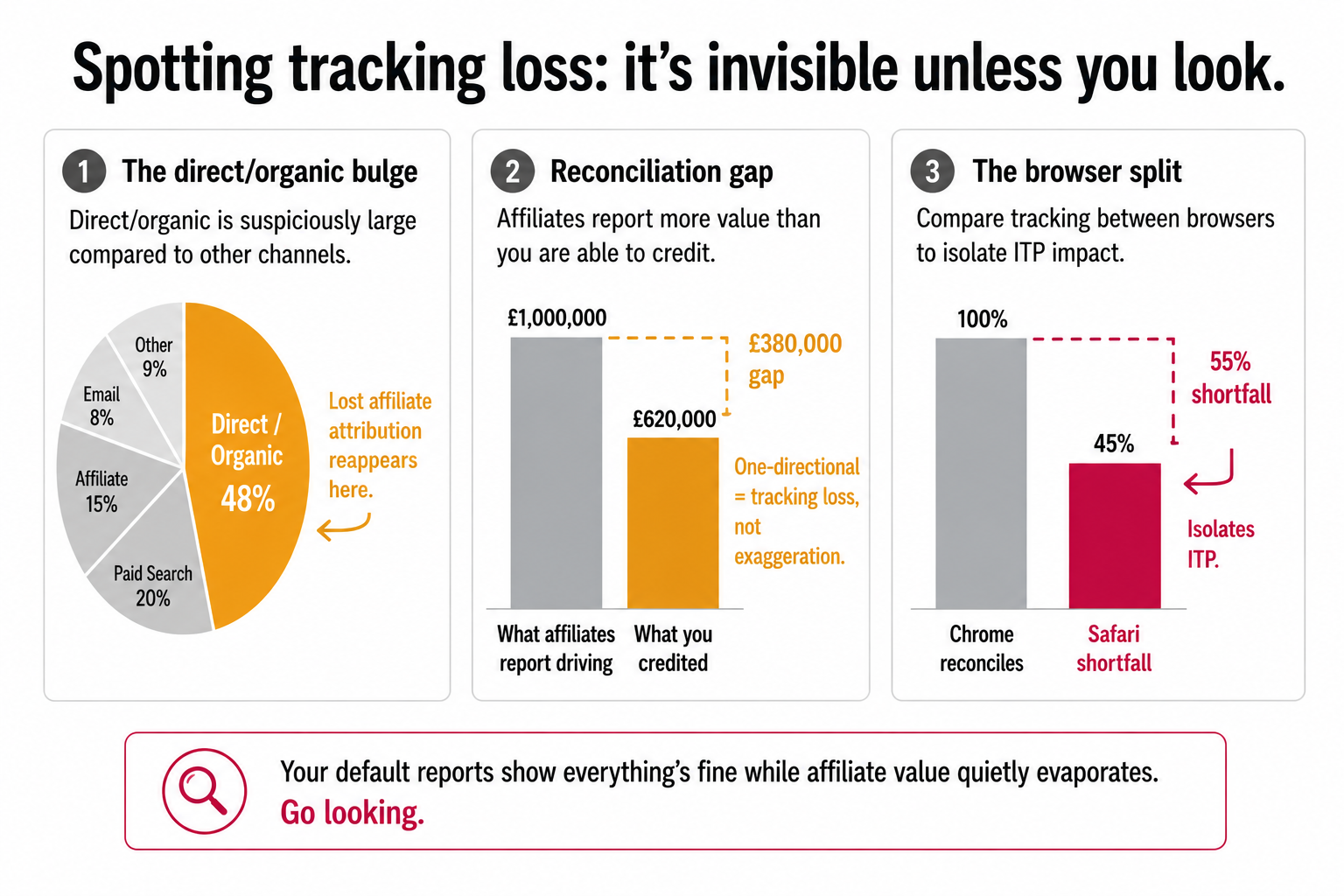
- The "direct/organic" bulge. When affiliate-driven conversions lose their tracking, they get reattributed to "direct" or "organic." A suspiciously large direct/organic segment, especially one that grows as your affiliate activity grows, is often affiliate (and other paid) traffic that lost its attribution.
- Reconciliation gaps. Compare what your affiliates report driving against what your system credited them. Persistent, one-directional discrepancies (affiliates consistently report more than you recorded) point to tracking loss, not affiliate exaggeration.
- The browser split. Segment your conversion tracking by browser. If everything reconciles on Chrome but Safari shows a conspicuous shortfall, you have isolated ITP as a major cause. The Safari gap is usually the loudest single signal.
None of these is exact, but together they tell you whether you have a tracking-loss problem and roughly how big. The point is to go looking, because the default reports will quietly tell you everything is fine while a chunk of your affiliate value evaporates.
What to actually do
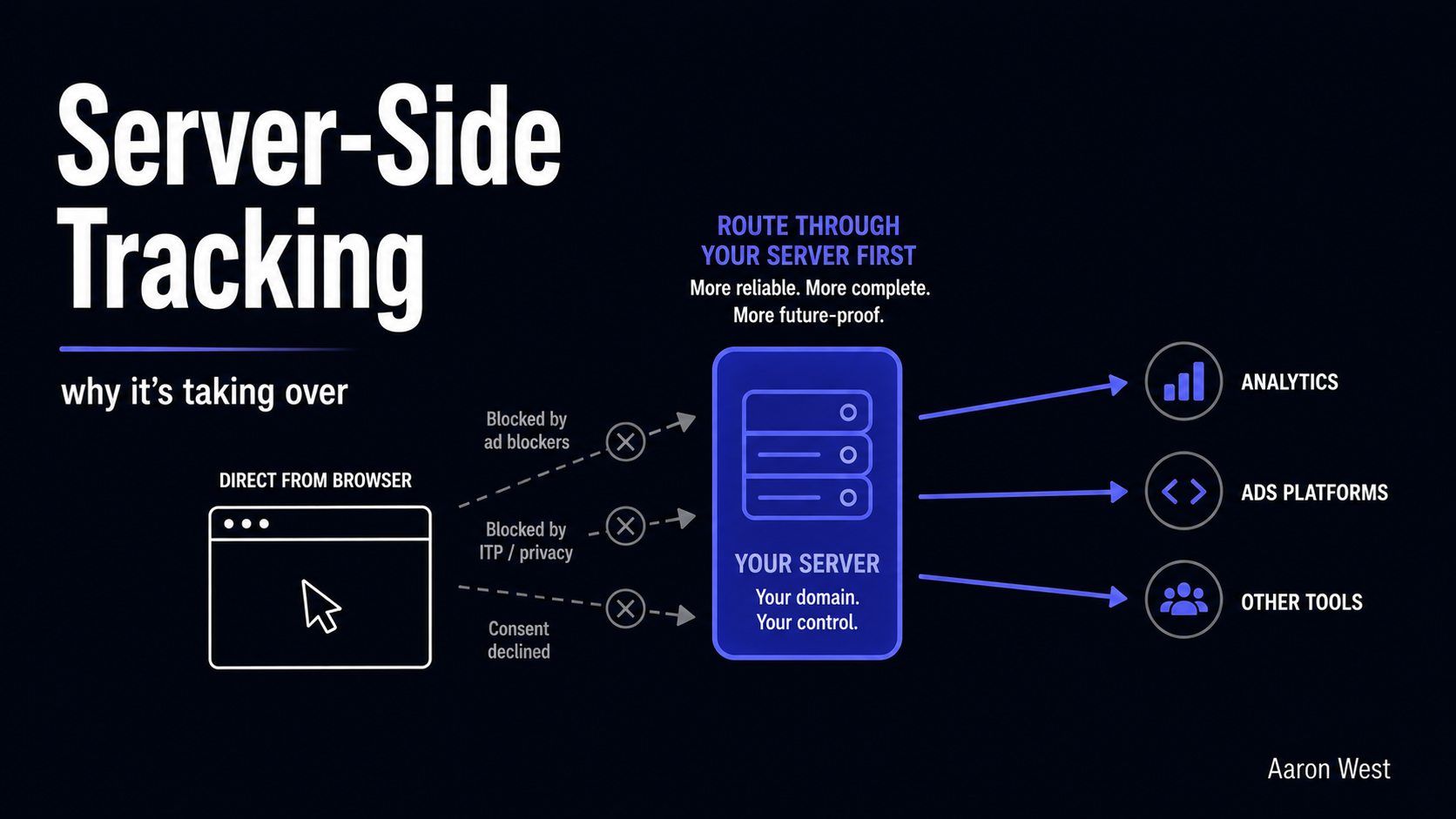
The good news is that the fix is well understood, even if it is not effortless. The core move, and the reason the previous piece in this cluster matters, is to shift your tracking off the browser and onto the server with server-to-server (S2S) tracking. Because S2S reports the conversion from your server rather than the shopper's browser, none of the browser-side causes, ITP cookie limits, ad blockers, consent-blocked scripts, can break it. It directly recovers the conversions that browser tracking loses, which is exactly why it has become the standard. If you do one thing about tracking loss, make S2S your primary tracking method.
But honesty matters here, and a few realistic points round it out. S2S is the biggest lever, not a magic eraser, cross-device journeys, for instance, remain genuinely hard even server-side, because connecting a phone click to a laptop purchase needs identity resolution that no tracking method solves perfectly. So set realistic expectations: the goal is to recover most of the recoverable loss and understand the rest, not to achieve a mythical perfect count, the same resilience-over-perfection principle from the tracking cornerstone. And do the unglamorous monitoring: actually run the reconciliation and browser-split checks above on a schedule, so you know your tracking loss is shrinking rather than assuming it. Finally, be transparent with partners, when affiliates know you track server-side and measure fairly, it becomes a reason to bring you their best traffic rather than a reason to suspect you.
That is tracking loss, start to finish. The forces erasing affiliate attribution, Safari's ITP cookie windows, the death of third-party cookies, ad blockers, consent rejection, cross-device journeys, are real, growing, and largely outside your control. What is in your control is whether you keep relying on the browser-based tracking they break, or move to server-side tracking that survives them. The programmes that under-count silently will keep under-investing in a channel that works better than it looks, and quietly losing the partners whose sales they fail to credit. The ones that face the problem, move to S2S, monitor the gap, and tell their partners the truth, will pay fairly, see their affiliate channel's real value, and keep the partners the under-counters drive away. You are almost certainly under-counting right now. The only question is whether you know by how much.
A few common questions
What is affiliate tracking loss? Tracking loss is when an affiliate genuinely drives a sale but the connection between their click and that sale is broken, so the affiliate isn't credited or paid. The conversion still happens, it just gets recorded as "direct" or "organic" instead of attributed to the affiliate. It's caused by browser privacy features (notably Safari's ITP), the death of third-party cookies, ad blockers, consent rejection, and cross-device journeys, and it's getting worse over time.
How does Safari's ITP affect affiliate tracking? Safari's Intelligent Tracking Prevention aggressively limits how long tracking cookies survive, first-party cookies set via JavaScript are capped at around seven days, and as little as roughly 24 hours when a visitor arrives via a link carrying tracking parameters (as affiliate links do). So if a customer clicks an affiliate link and buys more than a week later, Safari has already deleted the cookie that connected them, and the affiliate loses the sale. Any affiliate journey longer than the cookie window becomes invisible in Safari.
Why is tracking loss especially damaging for affiliate programmes? Because affiliate is a performance channel where partners are paid only when a sale is tracked to them, so lost tracking means partners don't get paid for work they did. It also breaks a specific promise: an affiliate joins on, say, a 30-day cookie window, but ITP may silently cut that to seven days or 24 hours for Safari users. Good affiliates notice the discrepancy between their analytics and your reports, conclude your programme under-tracks, and move their best traffic to advertisers who pay them fairly.
How do I fix affiliate tracking loss? The main fix is moving to server-to-server (S2S) tracking, which reports conversions from your server rather than the shopper's browser, so browser-side causes (ITP, ad blockers, consent-blocked scripts) can't break it. S2S recovers most of the recoverable loss. Set realistic expectations, cross-device journeys remain hard even server-side, monitor the gap with reconciliation and browser-split checks, and be transparent with partners that you track server-side, which itself becomes a reason for them to send you their best traffic.
You should also read:
Server-Side Tracking: Why It's Taking Over and What It Means
Server-side tracking moves the job of recording what happens on your site from the visitor's browser to your own server, and that one architectural change is quietly becoming the new standard for serious e-commerce measurement. The reason is simple: the old way, firing tracking tags…
Continue reading...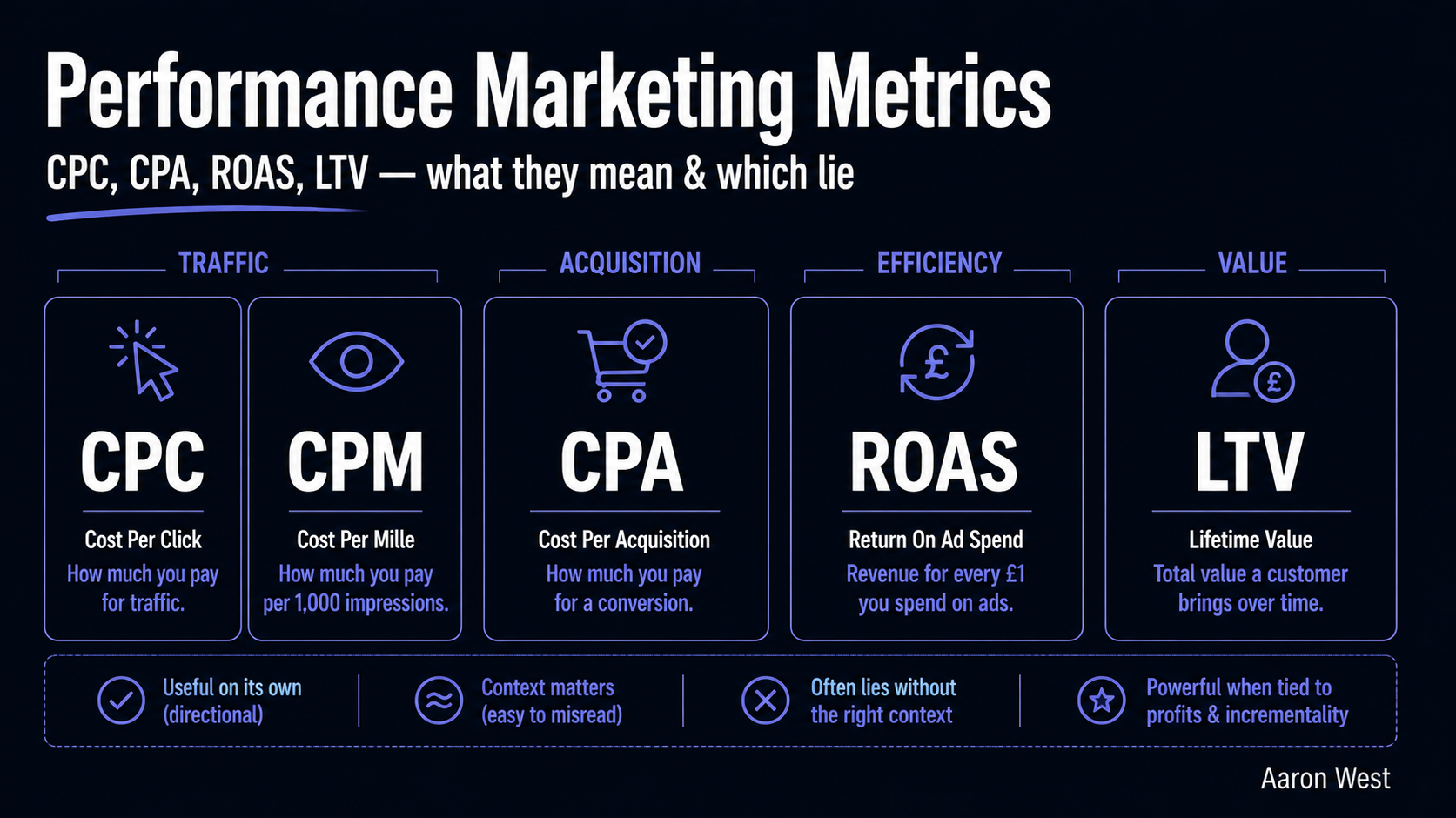
The Performance Marketing Metrics Glossary: CPC, CPM, CPA, CPL, CPS, ROAS, AOV, LTV
Every performance marketing metric answers one of three questions: what does this cost, did it make money, or what is actually happening in between. Sort any acronym you meet into one of those three buckets and the alphabet soup stops being intimidating, CPC, CPM, and…
Continue reading...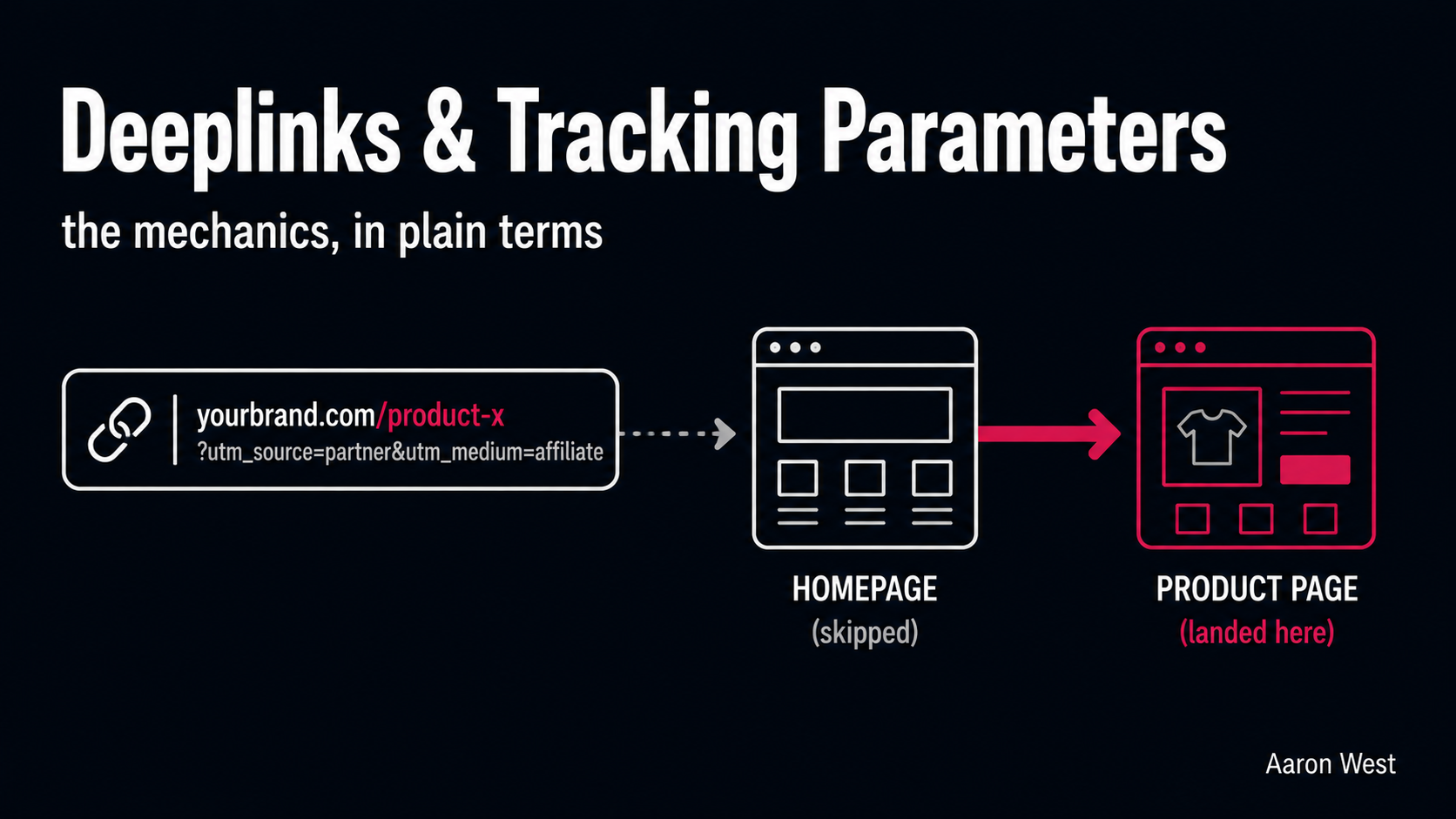
Affiliate Deeplinks and Tracking Parameters: The Mechanics
An affiliate deeplink is a tracking link that sends the shopper to a specific product or category page rather than the merchant's homepage, while still recording which affiliate sent them. It sounds like a small technical detail. It is not. Sending a shopper who clicked…
Continue reading...