Server-Side Tracking: Why It's Taking Over and What It Means

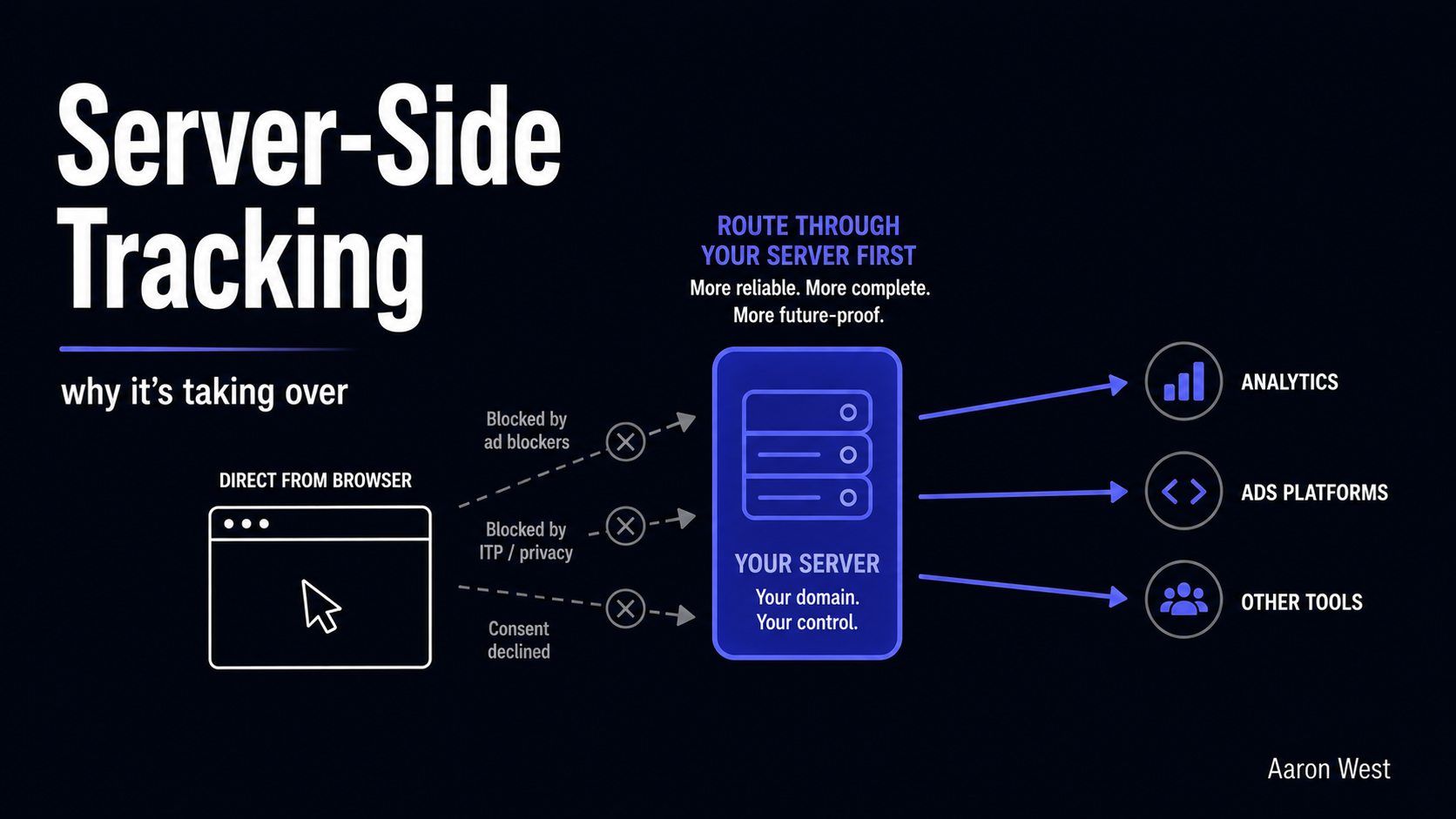
Table of Contents
Server-side tracking moves the job of recording what happens on your site from the visitor's browser to your own server, and that one architectural change is quietly becoming the new standard for serious e-commerce measurement. The reason is simple: the old way, firing tracking tags inside the browser, is breaking. Ad blockers stop the tags, Apple's privacy features delete the cookies, shoppers decline consent, and a growing share of your real activity simply never gets recorded. Server-side tracking sidesteps almost all of that by collecting the data on infrastructure you control before sending clean, complete signals onward. It is more work to set up, and increasingly it is worth it.
This is the forward-looking piece in the tracking layer of the performance marketing pillar, and if it sounds familiar, that is because I have written its close cousin before: server-to-server tracking in affiliate is the same idea applied to partner conversions. Here I will explain the broader version, in plain terms: what client-side and server-side tracking actually are, why the browser-based way is failing, what moving to the server buys you, and the honest trade-offs, because this is not magic and it is not free. No engineering background needed.
Client-side vs server-side: where the data is collected
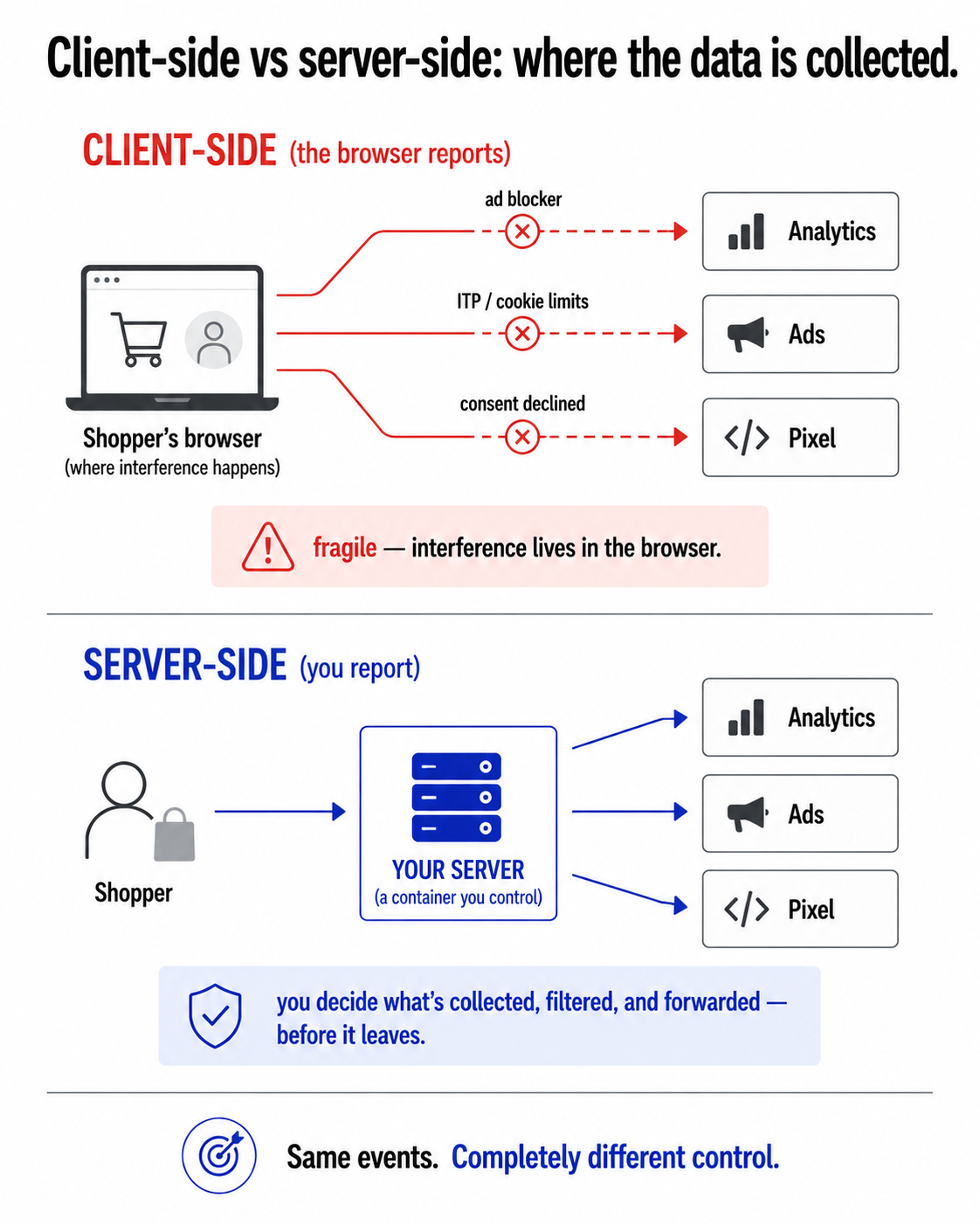
Start with the distinction, because the whole topic rests on it, and it is simpler than the jargon suggests. The question is just: where does the recording happen, in the shopper's browser, or on a server you control?
Client-side tracking is the traditional way. A piece of JavaScript (a "tag" or "pixel") runs inside the visitor's browser, and when they do something, view a product, buy, the browser sends that information directly to the analytics or advertising platform. The browser is doing the reporting. This is how most tracking has always worked, and it is increasingly fragile, because the browser is exactly where all the interference now lives.
Server-side tracking changes the path. Instead of the browser reporting directly to a dozen third-party platforms, the data goes first to your own server (a "server container"), and your server then forwards clean, processed signals on to the analytics and advertising platforms. You have inserted a step you control between the shopper and the outside world. That single change, routing through your infrastructure first, is what unlocks everything else, because once the data passes through a server you own, you decide what happens to it before it leaves.
The neat way to hold the two in mind: client-side is the shopper's browser shouting your data directly at a dozen platforms, with whatever the browser allows to get through. Server-side is everything reporting to you first, and you forwarding a clean, complete, controlled signal onward. Same events, completely different control.
Why the browser-based way is failing
To see why this shift is happening now rather than five years ago, look at what has happened to client-side tracking, because every one of these is a hole that server-side plugs:
- Ad blockers. A large and growing share of users run ad blockers or privacy extensions that stop tracking scripts from loading at all. When the script is blocked, the visitor browses, buys, and your analytics records nothing. That is invisible lost data, sales you made that your reports never see.
- Browser privacy features. Apple's Intelligent Tracking Prevention and similar measures in other browsers aggressively limit or delete the cookies client-side tracking relies on, the same mechanism behind the tracking-loss problem. Journeys longer than a few days quietly fall out of the data.
- Consent and PII leakage. With client-side tags, data goes straight to third parties the moment the tag fires, and you have limited visibility into exactly what gets sent. Personal information can leak to platforms without your full knowledge or control, a genuine compliance risk under GDPR.
Each of these chips away at client-side data, and together they mean a browser-based setup is increasingly recording a partial, distorted picture of what is actually happening on your site. The data does not just get smaller; it gets biased, because the losses are not random (Safari users, privacy-conscious users, and ad-blocker users drop out disproportionately). You end up optimising on a sample that systematically misrepresents your real customers.
What moving to the server buys you
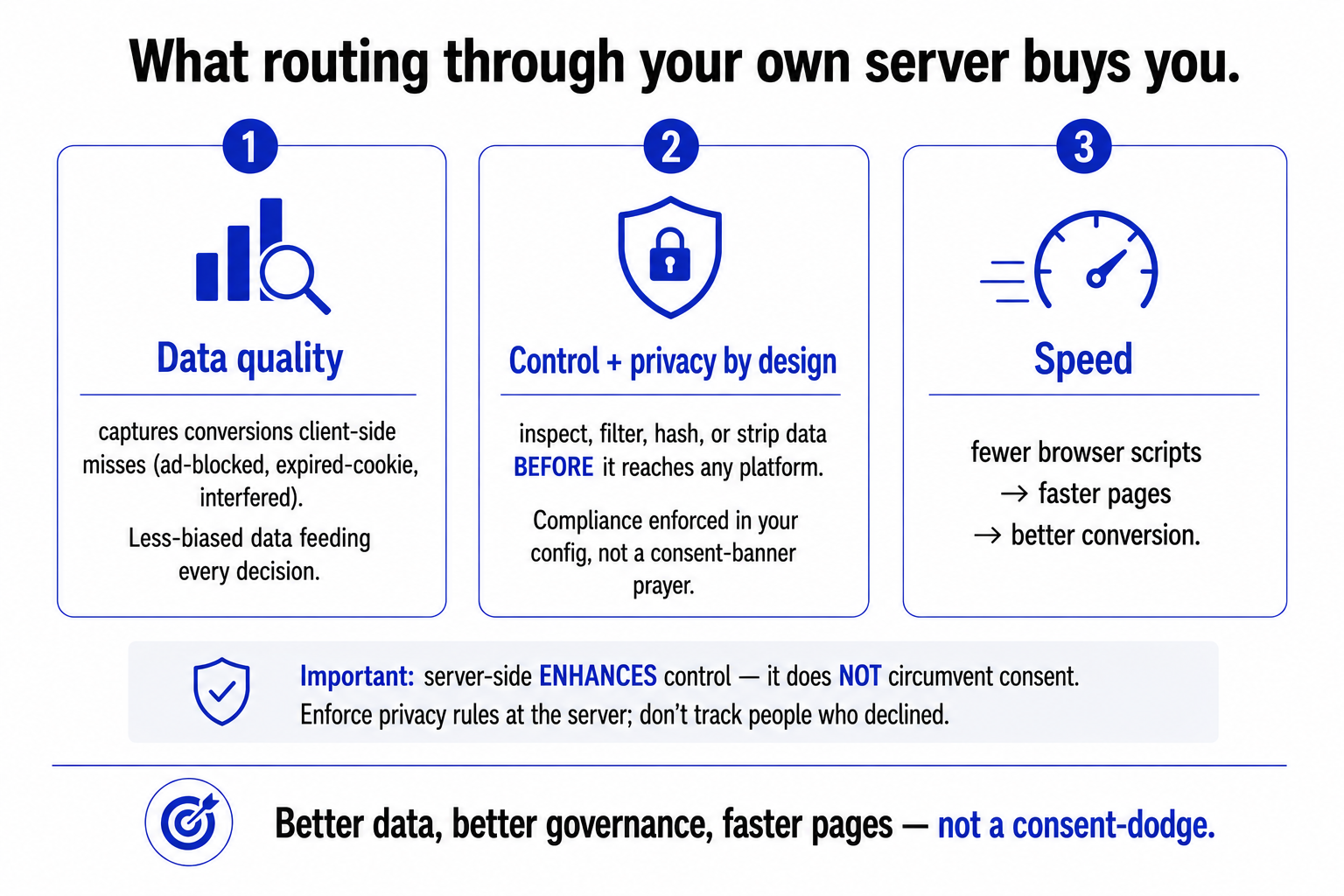
Routing through your own server first fixes those holes and adds a few things browser tracking never could. The real benefits, in order of how much they matter:
Data quality and completeness. Because the data is collected by your server rather than a browser script that can be blocked, server-side captures conversions that client-side tracking misses entirely, the purchases that happened behind an ad blocker, after a cookie expired, despite the interference. More of your real activity actually gets recorded, which means better, less-biased data feeding every decision and every ad platform's algorithm.
Control and privacy compliance by design. This is the one people underrate. When all your data passes through your server first, you can inspect, filter, hash, or strip any information before it reaches an external platform. Privacy compliance stops being a prayer that your consent banner loaded correctly and becomes something enforced architecturally, in your server configuration. You decide what data goes to whom, you can apply different rules by region or consent status, and sensitive information never leaves your infrastructure unless you allow it. For a business operating under GDPR, that architectural control is genuinely valuable.
Speed. Fewer scripts running in the visitor's browser means pages load faster, and page speed is itself a conversion and ranking factor. Moving the tracking work off the browser is a quiet performance win on top of the data win.
One honest and important clarification, because it gets misrepresented: server-side tracking enhances control, it does not circumvent consent. Done properly, it respects user consent and privacy law, it just enforces those rules at the server instead of trusting fragile browser-side banners to do it. It is a tool for better, more compliant data governance, not a way to track people who declined. Anyone selling it as a consent-dodge is selling you a lawsuit.
The honest trade-offs
Server-side tracking is not free and not always necessary, and pretending otherwise is how people end up with expensive infrastructure they did not need. The real costs:
Setup complexity. It requires more technical work than dropping a tag on a page, server infrastructure to run the container, APIs to connect to each platform, and someone who can implement and maintain it. This is a real project, not a checkbox. It is also why it has historically been the domain of larger or more technically-resourced businesses, though it is steadily getting more accessible.
Ongoing maintenance. A server-side setup is infrastructure you now own, which means it needs monitoring and upkeep. The flip side, and a genuine long-term advantage, is adaptability: when a browser changes its rules or a platform updates its requirements (which happens constantly), a server-side architecture lets you adapt centrally without rebuilding your tracking from scratch every year. You are trading more setup now for less fragility later.
So who should actually do this? If you run meaningful ad spend, operate under strict privacy regulation, or you are watching a widening gap between your real sales and what your analytics records, server-side tracking increasingly earns its cost, the data-quality and compliance gains pay back the complexity. If you are a small store with modest spend and tracking that is basically working, it may be more than you need right now, and that is a perfectly fine answer. The right call is the same stage-based judgment that applies to most infrastructure: match the investment to where your business actually is, not to what is fashionable.
That is server-side tracking, and why it is taking over. The browser, where tracking has always lived, has become hostile territory, blocked, restricted, and privacy-limited, so the data flowing out of it is shrinking and skewing. Moving collection to a server you control plugs those holes, gives you better and less-biased data, puts privacy compliance under your architectural control rather than a consent banner's, and speeds up your pages, at the cost of real setup and maintenance work. It is the same principle as the server-to-server tracking that already underpins serious affiliate programmes, applied to your whole measurement stack. For a growing e-commerce business in a privacy-first world, the question is shifting from whether to move server-side to when, and the answer is roughly: when the gap between what you sell and what you can measure starts costing you real decisions. That gap is only going to widen. Server-side is how you close it.
A few common questions
What is server-side tracking? Server-side tracking collects data about what happens on your site using your own server rather than the visitor's browser. Instead of browser-based JavaScript tags reporting directly to analytics and advertising platforms (client-side tracking), the data goes first to a server you control, which then processes and forwards clean signals onward. That extra step, routing through your infrastructure first, is what lets you control, filter, and complete the data before it leaves.
Why is server-side tracking replacing client-side? Because browser-based (client-side) tracking is increasingly broken. Ad blockers stop the tags from loading, browser privacy features like Apple's ITP delete the cookies it relies on, and consent declines block it, so a growing and non-random share of real activity never gets recorded. The losses skew toward privacy-conscious and Safari users, biasing your data. Server-side collection sidesteps most of this by recording events on your server before interference can stop them, producing more complete and less-biased data.
What are the benefits of server-side tracking? Three main ones: better data quality (it captures conversions client-side tracking misses entirely, behind ad blockers or expired cookies); control and privacy compliance by design (because all data passes through your server first, you can inspect, filter, hash, or strip information before it reaches any platform, enforcing privacy rules architecturally rather than relying on a consent banner); and faster pages (fewer browser scripts). Crucially, it enhances control, it does not circumvent consent, done properly it still respects privacy law.
Do I need server-side tracking? It depends on your stage. If you run meaningful ad spend, operate under strict privacy regulation (like GDPR), or see a widening gap between your real sales and what your analytics records, it increasingly earns its cost. If you're a small store with modest spend and tracking that's basically working, it may be more setup than you need right now. It requires server infrastructure, platform integrations, and ongoing maintenance, so match the investment to where your business actually is, not to what's fashionable.
You should also read:
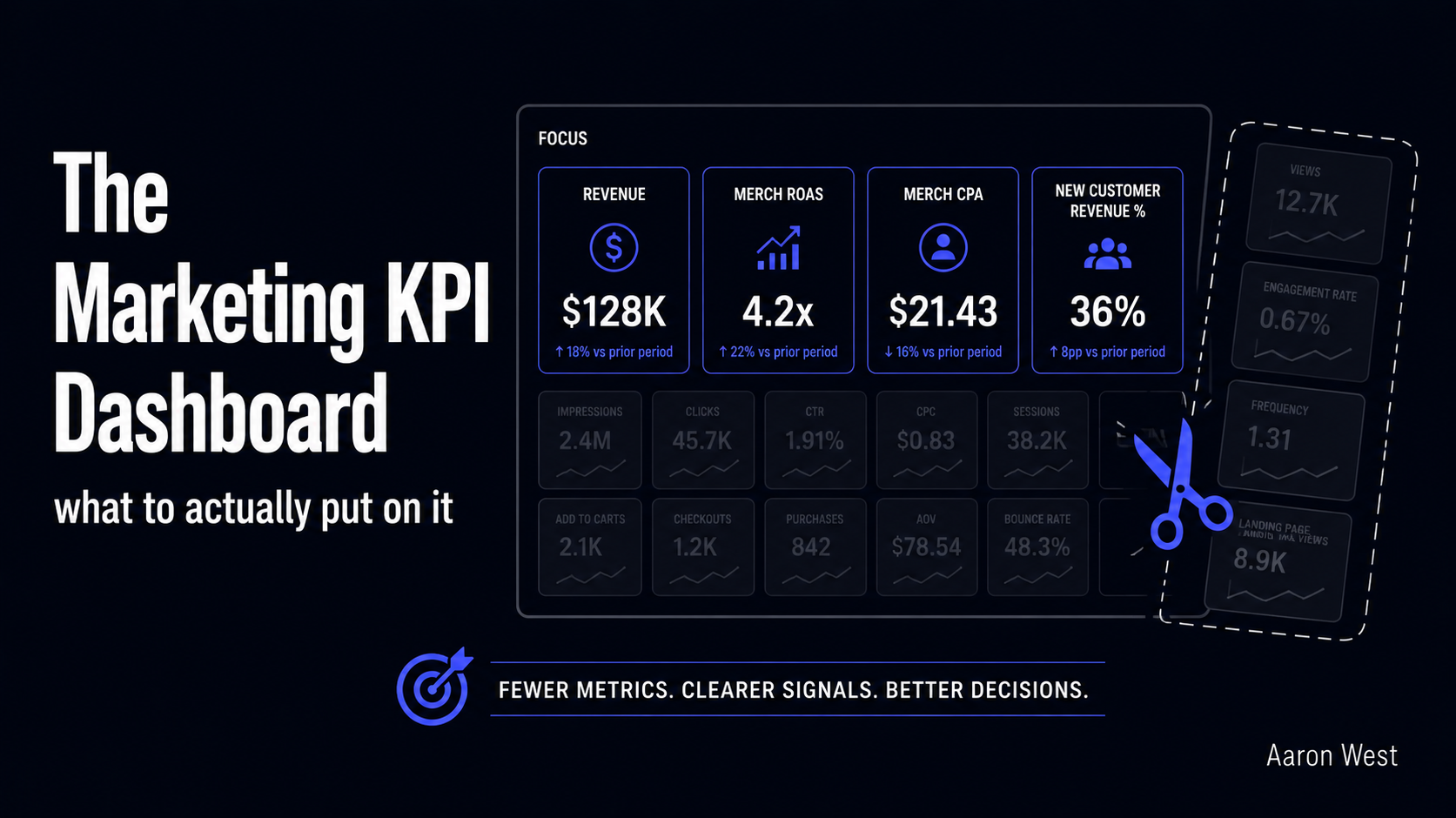
The Marketing KPI Dashboard: What to Actually Put On It
A good marketing dashboard is not the one with the most numbers on it. It is the one that answers a single question fast: what should I do next? Most dashboards fail this test. They are crowded with every metric the tools can produce, impressions,…
Continue reading...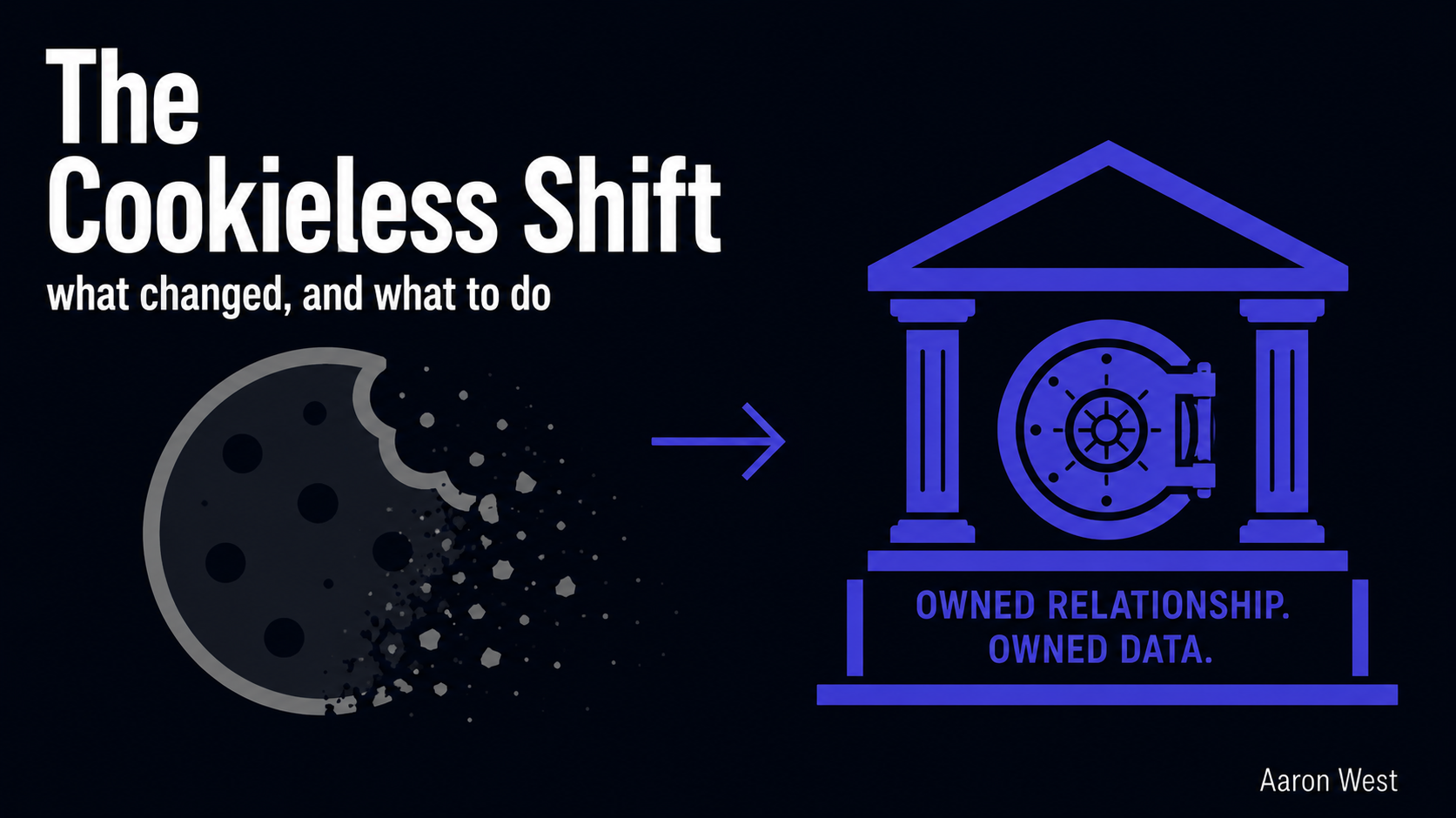
The Cookieless Shift and First-Party Data: What Changed and What to Do
For years the marketing world braced for "the death of the cookie," the moment Chrome would block third-party cookies and the old way of tracking people across the web would collapse. Then in 2025 Google confirmed it was not going to do it after all.
Continue reading...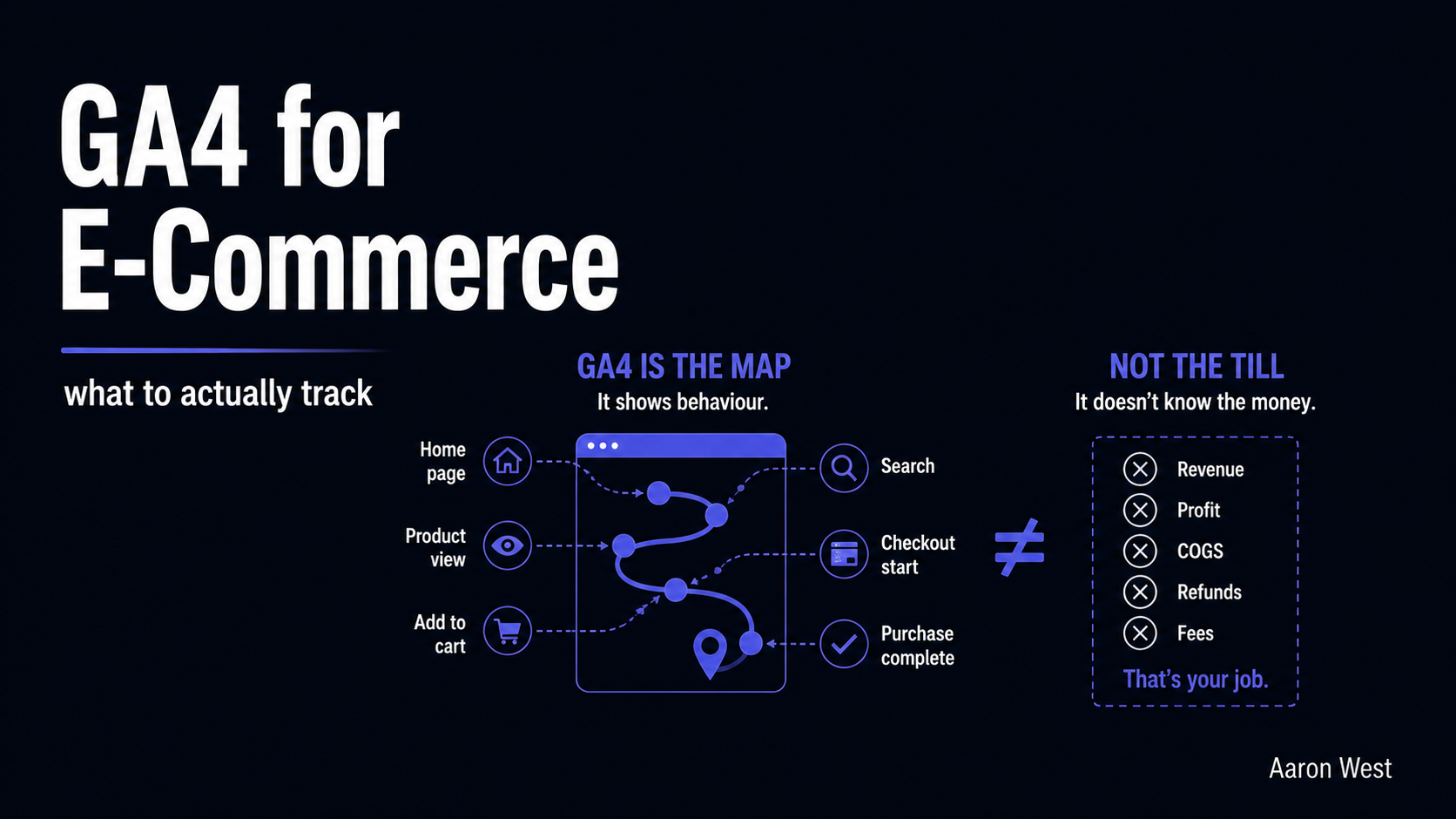
Google Analytics (GA4) for E-Commerce: What to Actually Track
The most important thing to understand about GA4 for e-commerce is also the thing almost nobody is told up front: it is not your sales report, and using it as one will mislead you every time. GA4 is a behaviour tool. It tells you how…
Continue reading...