The Cookieless Shift and First-Party Data: What Changed and What to Do

Table of Contents
For years the marketing world braced for "the death of the cookie," the moment Chrome would block third-party cookies and the old way of tracking people across the web would collapse. Then in 2025 Google confirmed it was not going to do it after all. Third-party cookies are staying in Chrome. If you only read that headline, you might conclude the whole thing was a false alarm and you can carry on as before. That would be a mistake. The deadline died; the direction did not. Third-party cookies are becoming a steadily less reliable foundation regardless of what Google decided, and the smart response, building on data you own, was always the right move and still is.
This is the privacy piece in the attribution and measurement layer of the performance marketing pillar, and it is genuinely confusing right now because the news seems to contradict itself. So let me lay it out plainly: what third-party cookies actually are and why they were in trouble, what Google actually decided and what it changed, why the underlying shift is happening anyway, and the practical answer, first-party and zero-party data, that makes you more resilient no matter what any browser does next. No hype, no "the sky is falling," just what changed and what to do about it.
What was actually at stake
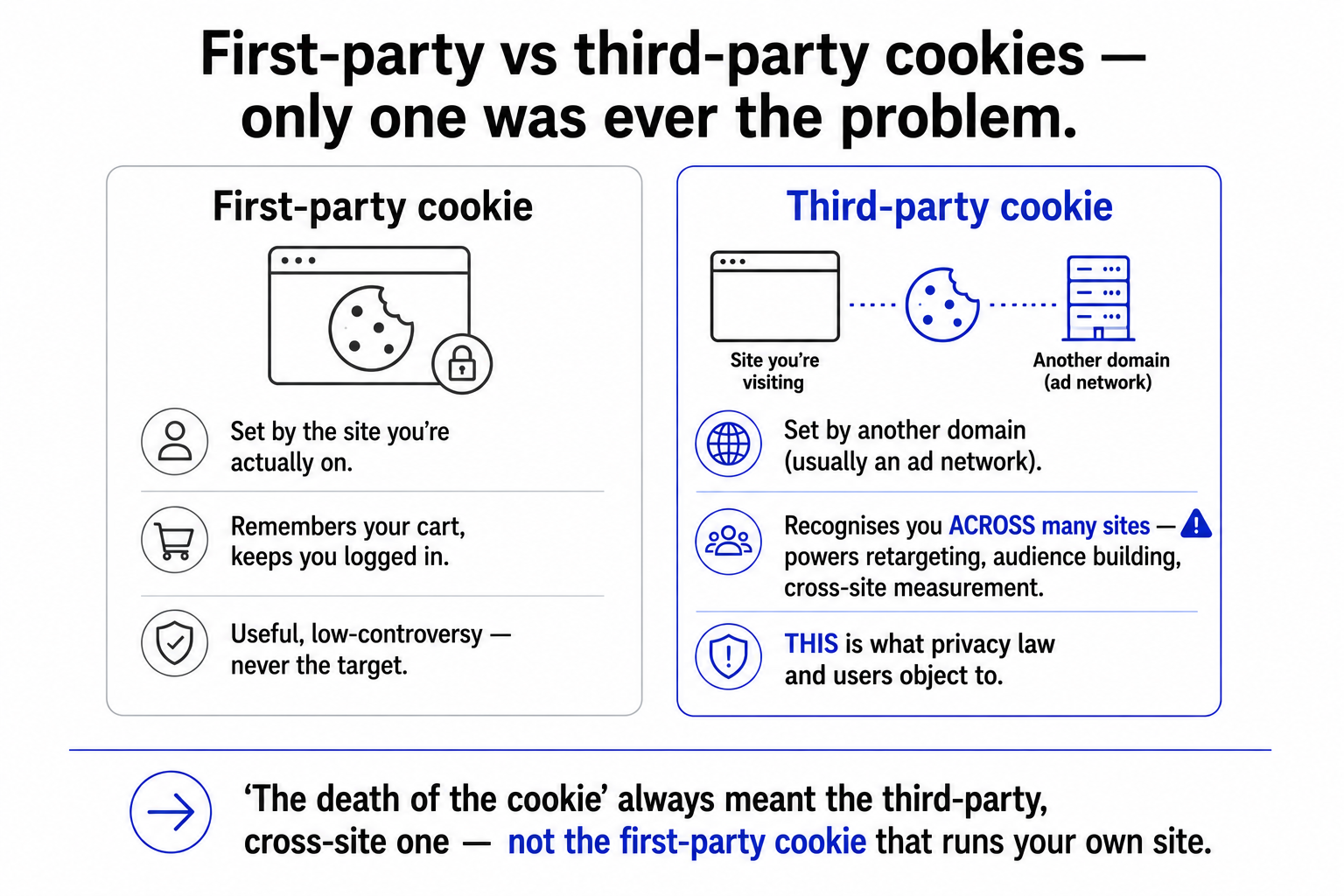
First, the distinction that the whole topic depends on, because the reversal makes sense only once you have it. A third-party cookie is set by a domain other than the site you are visiting, typically an advertising network, and it is what lets that network recognise you across many different websites. That cross-site recognition is what powers the familiar machinery of retargeting (the shoes that follow you around the internet), audience building, and a lot of conversion measurement. A first-party cookie, by contrast, is set by the site you are actually on, and is generally used for things like keeping you logged in or remembering your cart. First-party cookies were never the problem. Third-party cookies are, because cross-site tracking is exactly the large-scale profiling that privacy law and privacy-conscious users object to.
So when people said "the cookie is dying," they always meant the third-party one, the cross-site tracker. The fear was that removing it would break retargeting, audience targeting, and measurement across the open web, the plumbing a lot of digital advertising quietly runs on. That is a real dependency, which is why the prospect caused years of anxiety and why Google's roadmap to remove it kept slipping, originally targeted years ago, then pushed back repeatedly.
What Google actually decided, and what it didn't
Here is the part that confuses everyone, untangled. Google's original plan, under its "Privacy Sandbox" initiative, was to fully phase out third-party cookies in Chrome and replace them with new privacy-preserving alternatives. After several delays, Google changed course: rather than removing third-party cookies outright, it moved to a user-choice model, giving Chrome users control over their tracking preferences, and in 2025 confirmed it would not go ahead with the full phase-out. Third-party cookies remain available in Chrome.
What that decision did change: the cliff-edge is gone. There is no single date when cookie-based tracking suddenly breaks for every Chrome user, so the panic-driven urgency has eased, and current cookie-based methods still work for now. What that decision did not change is everything that actually mattered. Chrome moving to user choice means a meaningful share of users will still turn cookies off, just gradually rather than all at once. And crucially, Chrome was never the whole story: Safari, Firefox, and Edge already block or heavily restrict third-party cookies by default, and have for years, so for a large slice of your traffic the cookie already does not work, Google's decision or not. Layer on privacy laws that keep tightening and treat tracking cookies as personal data requiring consent, and the conclusion is unavoidable. Third-party cookies did not die on schedule, but they are dying slowly, unevenly, and irreversibly. Building your measurement on them is building on ground that is quietly subsiding.
Why the shift is happening regardless of Google
It helps to see that the cookie deadline was never the real driver. Three forces are pushing toward a privacy-first world, and none of them depends on what Chrome does:
- Browser behaviour. Most browsers other than Chrome already block third-party cookies by default. That alone means cross-site tracking is unreliable for a substantial and privacy-engaged portion of your audience, today, regardless of any roadmap.
- The law. GDPR, the ePrivacy rules, and similar regulations worldwide treat many tracking cookies as personal data and require genuine opt-in consent before they fire. That is a legal floor that only ever rises, and it applies to you no matter what Google's product team decides. (This is the same consent layer I cover in the GDPR and consent context.)
- People. A large and growing share of users actively manage their privacy, declining cookies, using privacy browsers, installing blockers. This is the tracking-loss problem from the other pieces in this pillar: the data does not just shrink, it skews, because the people who opt out are not a random sample.
Put together, these mean the reliability of third-party-cookie tracking has been declining for years and will keep declining, on a curve that Google's reversal barely bent. Anyone treating the 2025 decision as permission to stop adapting is reading a pause in one browser's roadmap as a reprieve from a structural shift. It is not.
The answer: data you actually own
Here is the genuinely good news, and the reason the smart players were never panicking. The alternative to renting access to people through third-party cookies is to build relationships where customers share data with you directly, and that data is both more durable and, frequently, more accurate. There are two kinds worth knowing by name:
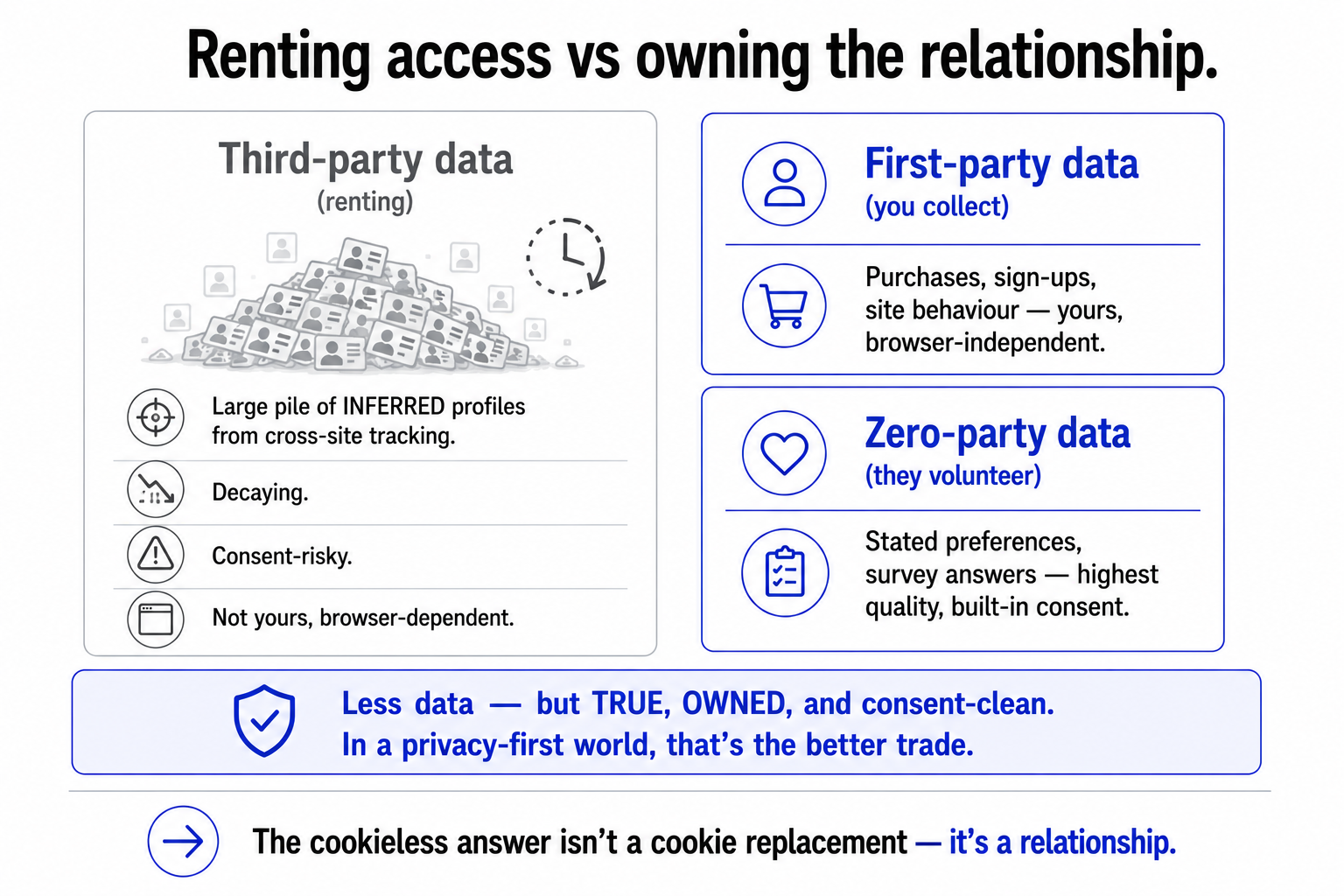
First-party data is information you collect directly from your own customers through their interactions with you: purchases, account sign-ups, email subscriptions, behaviour on your own site, support conversations. You own it, it is not dependent on any browser's cookie policy, and it describes your actual customers rather than an ad network's inferred profile of them.
Zero-party data is information customers intentionally and voluntarily give you: stated preferences, survey answers, quiz responses, what they tell you they want. It is the highest-quality data there is, because the customer chose to share it, which means it comes with built-in consent and reflects what they actually think rather than what an algorithm guessed.
The counter-intuitive part, and the bit that should change how you feel about the whole "cookie death" story: this data is often more valuable even though there is less of it. A third-party-cookie profile is a large pile of inferred, decaying, consent-risky guesses. A first-party purchase history and a zero-party stated preference are smaller but they are true, they are yours, and they carry no compliance risk because the customer gave them to you willingly. You trade volume for accuracy, ownership, and trust, and in a privacy-first world that is a very good trade. It is also why this connects to server-side tracking: once you are building on data you own and collect through your own infrastructure, you control its quality, its compliance, and its longevity in a way that renting third-party signals never allowed.
What to actually do
So, practically, what should a growing e-commerce business take from all this? Not panic, and not complacency either. The action is the same whether or not Google ever removes the cookie: shift the centre of gravity of your marketing toward data you own. Make collecting first-party and zero-party data a deliberate priority, give people genuine reasons to sign up, log in, tell you their preferences, and treat that owned data as the durable asset it is. Get your consent practices genuinely right rather than treating them as a compliance nuisance, because clean consent is what makes owned data usable and trustworthy. And lean on the infrastructure that supports all of this, server-side collection for control and quality, honest analytics that you read knowing their limits.
The framing that cuts through the confusing headlines: the cookieless future was never really about cookies. It is about a permanent shift from tracking people without their knowledge to building relationships with their consent, and that shift is happening because browsers, laws, and people are all pushing the same direction, not because of any single Google announcement. Google's reversal changed the timeline, removing the cliff-edge and easing the panic. It changed nothing about the destination. The businesses that will be in the strongest position in a few years are the ones that, instead of waiting to see what Chrome does, quietly got on with building a direct, consented, owned relationship with their customers. That work pays off no matter what any browser decides next, which is exactly what makes it the right work. Cookies were always a rented foundation. The point was never to find a new thing to rent. It was to start owning.
A few common questions
Did Google get rid of third-party cookies or not? No, Google reversed its plan. After years of delays, Google confirmed in 2025 that it will not fully phase out third-party cookies in Chrome, moving instead to a user-choice model where Chrome users control their own tracking preferences. So third-party cookies remain available in Chrome, the cliff-edge is gone, and current cookie-based methods still work for now. But that's only Chrome, Safari, Firefox, and Edge already block third-party cookies by default, so for a large share of traffic the cookie already doesn't work regardless of Google's decision.
If cookies aren't dying, do I still need to prepare for a cookieless future? Yes. The deadline died, but the direction didn't. Most non-Chrome browsers already block third-party cookies, privacy laws keep tightening and require consent, and a growing share of users actively opt out, so the reliability of third-party-cookie tracking keeps declining regardless of Google. Treating the 2025 reversal as permission to stop adapting mistakes a pause in one browser's roadmap for a reprieve from a structural shift. Preparing for a privacy-first world is still one of the smarter moves you can make.
What's the difference between first-party and zero-party data? First-party data is information you collect directly through customers' interactions with you, purchases, sign-ups, email subscriptions, behaviour on your own site. Zero-party data is information customers intentionally and voluntarily give you, stated preferences, survey answers, quiz responses. Both are owned by you and not dependent on any browser's cookie policy. Zero-party is the highest-quality data there is because the customer chose to share it, which means it comes with built-in consent and reflects what they actually think rather than what an algorithm inferred.
Is first-party data better than third-party data? Often yes, even though there's less of it. Third-party-cookie data is a large pile of inferred, decaying, consent-risky profiles built by tracking people across sites. First-party and zero-party data are smaller in volume but they're accurate (they describe your actual customers), owned (not dependent on a browser policy), and consent-clean (the customer gave them to you). You trade volume for accuracy, ownership, and trust, which in a privacy-first world is a very good trade.
You should also read:
The Marketing KPI Dashboard: What to Actually Put On It
A good marketing dashboard is not the one with the most numbers on it. It is the one that answers a single question fast: what should I do next? Most dashboards fail this test. They are crowded with every metric the tools can produce, impressions,…
Continue reading...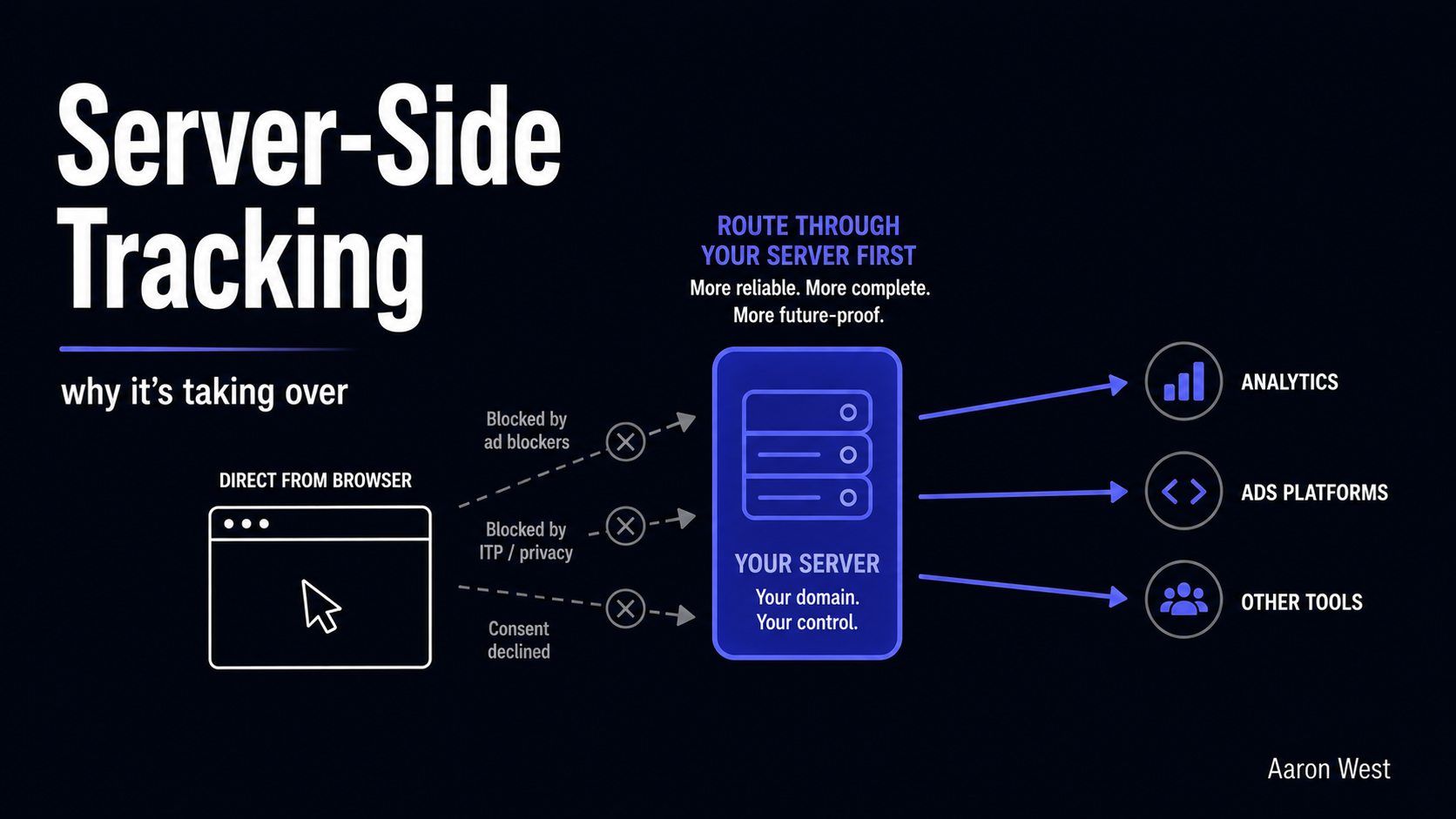
Server-Side Tracking: Why It's Taking Over and What It Means
Server-side tracking moves the job of recording what happens on your site from the visitor's browser to your own server, and that one architectural change is quietly becoming the new standard for serious e-commerce measurement. The reason is simple: the old way, firing tracking tags…
Continue reading...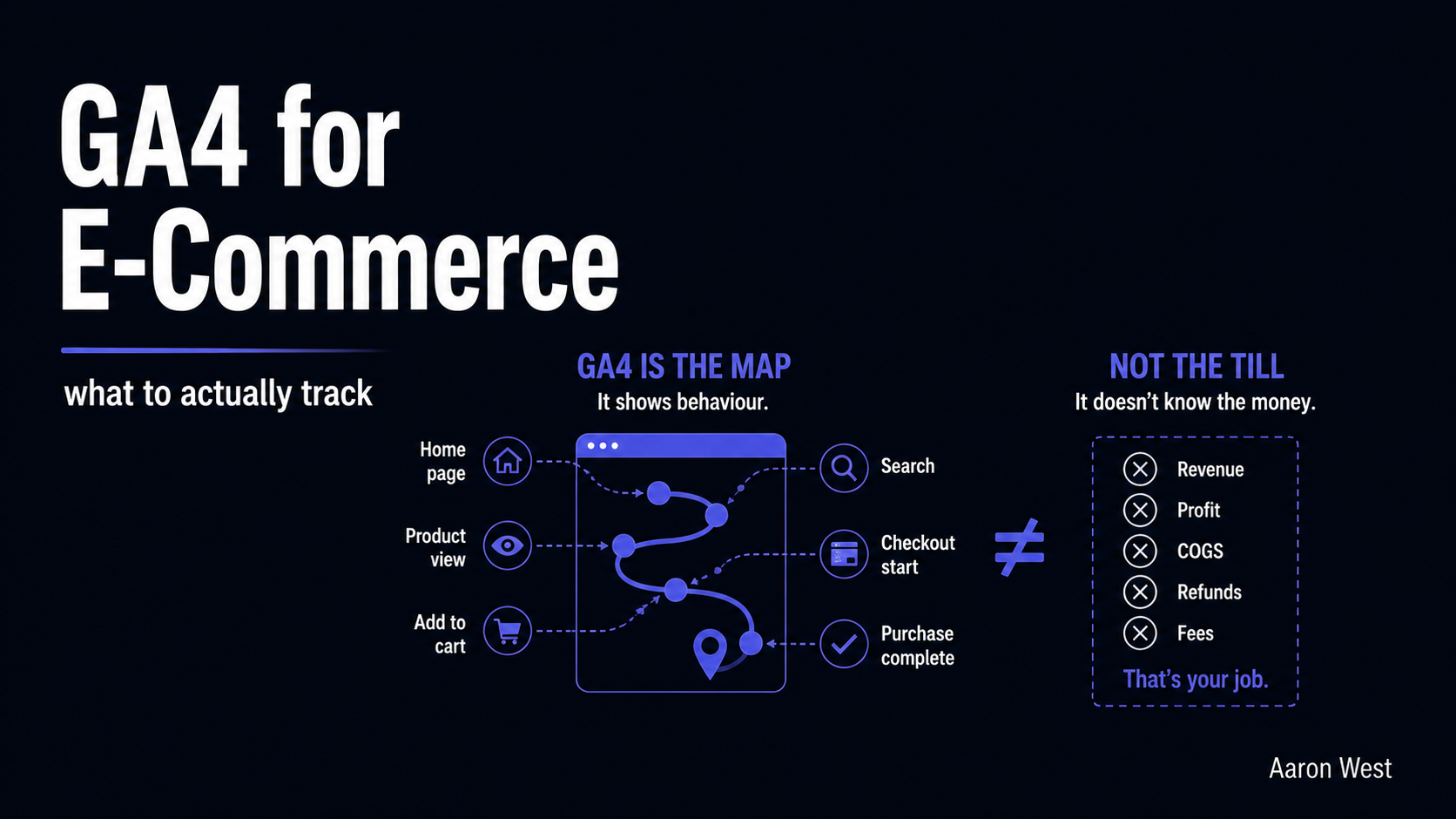
Google Analytics (GA4) for E-Commerce: What to Actually Track
The most important thing to understand about GA4 for e-commerce is also the thing almost nobody is told up front: it is not your sales report, and using it as one will mislead you every time. GA4 is a behaviour tool. It tells you how…
Continue reading...