Cross-Channel Deduplication: When Every Platform Claims the Same Sale

Table of Contents
If you add up the conversions your ad platforms report, Google Ads says it drove these sales, Meta says it drove those, your email tool claims some too, and the total comes out higher than the number of actual orders in your shop, you have not discovered a miracle. You have discovered double-counting, and it is one of the most common and expensive measurement problems in e-commerce. Every platform counts the same sale independently, each genuinely believing it deserves the credit, so the combined figure is inflated. Deduplication is the discipline of making sure each real sale is counted once, and getting it wrong means making budget decisions on numbers that are simply too big.
This is the practical consequence of the attribution problem: if every platform claims credit for a sale, and you trust each platform's own report, you are not just mis-assigning credit, you are multiplying it. This piece in the performance marketing pillar explains the two distinct ways conversions get double-counted, why it quietly wrecks your most important metrics, and the one principle that fixes it, anchoring everything to a number that cannot lie. (There is an affiliate-specific version of this too, because in affiliate the stakes are higher, double-counting means double-paying. Here I am dealing with the general cross-channel case.) Plain language, no setup walkthrough.
Why the numbers don't add up
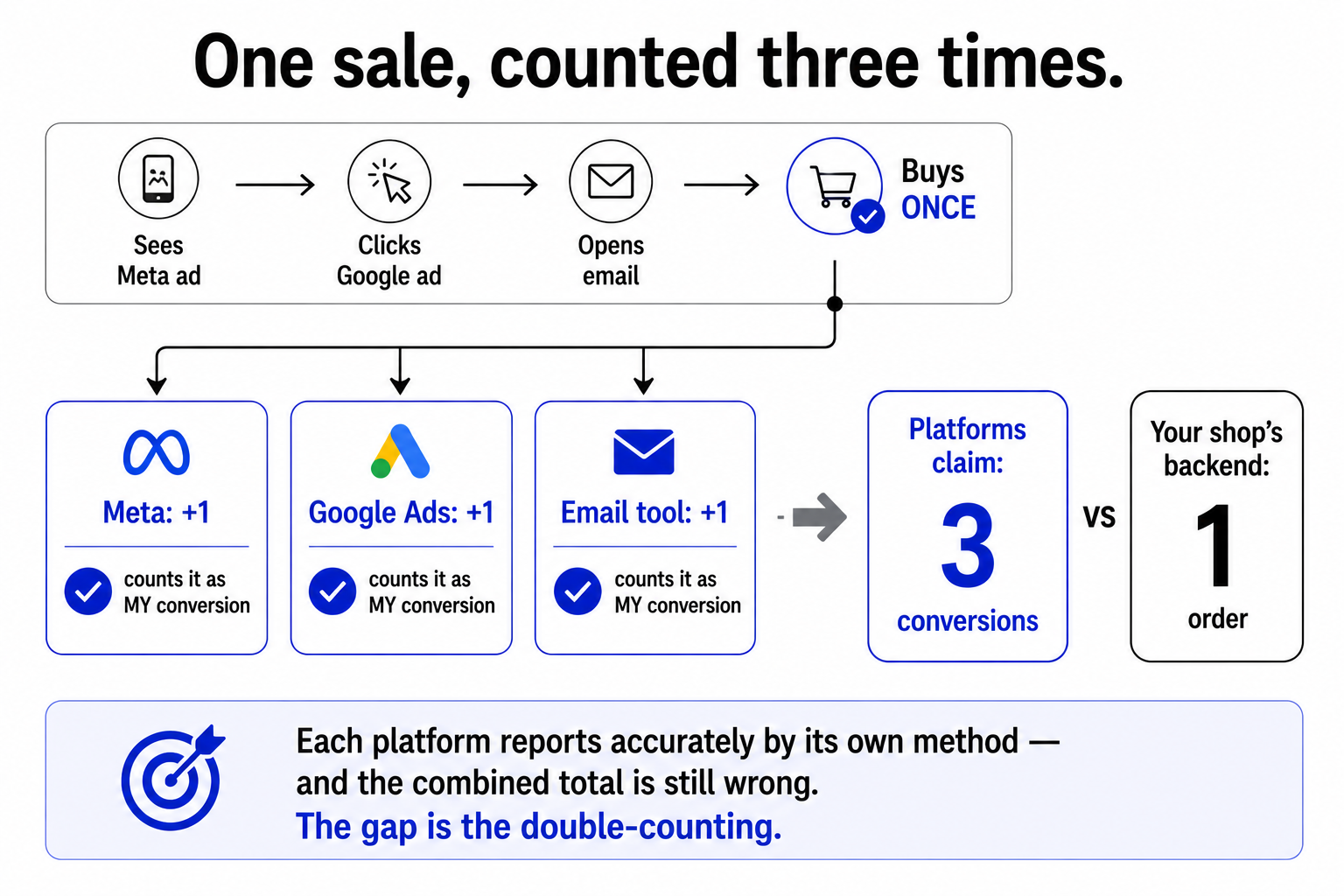
Start with the mechanism, because once you see it, the inflated totals stop being mysterious. Each advertising platform tracks conversions through its own pixel or tag, and each one is trying to prove its own worth. So when a customer sees a Meta ad, later clicks a Google ad, and then buys, both platforms record that purchase as their conversion. Neither is technically lying, by each platform's own measurement, it touched the customer before they bought. But the sale happened once, and now it is counted twice (or three times, once you add in your analytics tool and email platform).
The crucial thing to understand: each platform reports accurately according to its own methodology, and the combined picture is still wrong. This is not a bug you can blame on one tool. It is the inevitable result of asking several self-interested measurement systems to each report on the same event in isolation. There is no referee. Every platform marks its own homework, and they all give themselves the credit.
The result is a total that exceeds reality, and the tell is simple: when your combined platform-reported conversions are clearly higher than the actual orders in your shop's backend, cross-channel duplication is almost always the cause. Your shop knows exactly how many orders it processed. Your ad platforms, summed up, claim more. The gap between those two numbers is the double-counting, made visible.
Why it costs you real money
Double-counting is not just untidy data. It actively corrupts the two metrics you use to allocate budget, which means it pushes your money in the wrong direction.
It inflates ROAS. Return on ad spend is revenue divided by spend, and if the revenue figure is doubled by duplication while spend stays the same, your ROAS looks roughly twice as good as it really is. A channel that is quietly losing money can look like a winner, purely because its conversions are being counted alongside everyone else's claims on the same sales.
It hides your true cost-per-acquisition. If a platform thinks it drove twice as many conversions as it really did, its reported cost-per-acquisition is half the truth. You think you are acquiring customers cheaply on that channel, so you pour more budget in, when in reality you are paying twice what the dashboard says per genuine new customer.
Put those together and the damage is clear: duplication makes your worst channels look like your best ones, because the channels most prone to claiming sales others actually drove (broad retargeting, for instance) are exactly the ones that benefit most from the inflated count. You then reward them with more budget. You are not just measuring wrong, you are systematically funding the wrong things, and the better your "data culture" the worse it bites, because you are confidently acting on numbers that are confidently inflated. This is the same lesson as the ROAS critique and the GA4 honesty point, wearing a different hat: a number you trust without understanding what it counts is more dangerous than no number at all.
The two kinds of duplication, and the fixes
There are actually two distinct double-counting problems, and they have different fixes. Worth separating them.
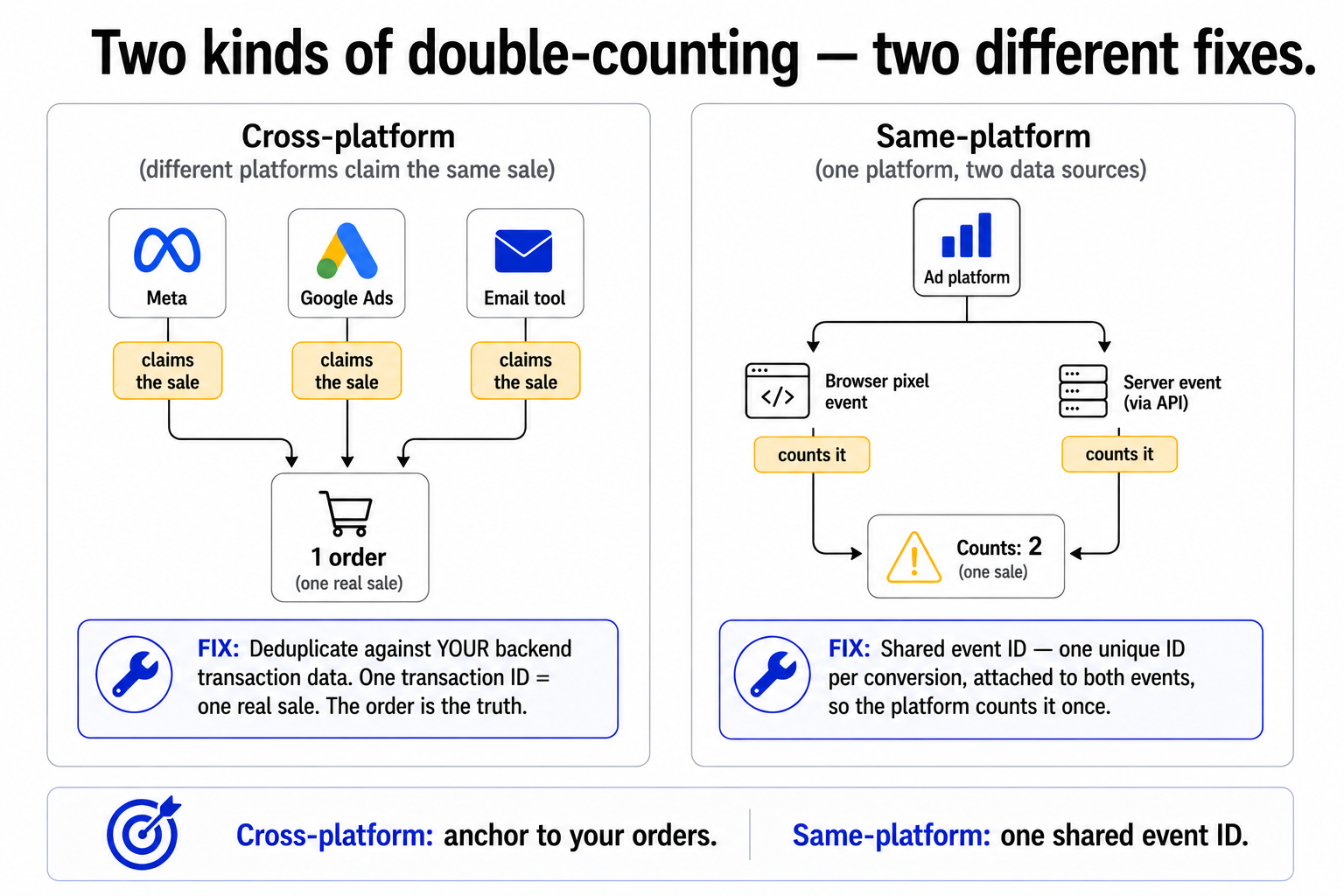
Cross-platform duplication is the one above: different platforms (Google, Meta, your email tool) each claiming the same sale. You cannot fix this inside any one platform, because each is doing its job correctly in isolation. The fix is to stop trusting the platforms' summed self-reports and instead deduplicate against a single source of truth: your own backend transaction data. Your shop knows every order, each with a unique transaction ID, and each transaction ID is, by definition, one real sale. When you aggregate the platform data and match it back against your actual orders, you can see which claims correspond to the same transaction and count it once. The order is the truth; the platform claims are just competing stories about that one order.
Same-platform duplication is more technical and increasingly common: a single platform counting one sale twice because it is receiving the event from two sources. The classic case is running both a browser-based pixel and server-side tracking for the same conversion, the purchase fires once from the browser and once from the server, and without a way to recognise them as the same event, the platform logs two. The fix here is a shared event ID: you generate one unique ID per conversion and attach it to both the browser event and the server event, so the platform sees the matching IDs and knows to count them as one. It is a small piece of plumbing with a big effect on accuracy, and it is the most common cause of a single platform's numbers being mysteriously inflated.
The common causes across both: tracking that grew organically over time (a developer added a pixel, a marketer added it again through a tag manager, an agency layered on their own), missing or inconsistent IDs, and conversion-counting settings left on their defaults. Most duplication is not exotic. It is accumulated mess.
The principle underneath it all
Strip away the technical detail and deduplication comes down to one principle, the same one that runs through this whole pillar: anchor your measurement to a number that cannot lie, and treat everything else as a claim to be checked against it. Your backend, the actual orders, the actual revenue, the actual transactions, is that number. It is the one source that has no incentive to over-report and no methodology of its own to inflate. Every platform's conversion count is a story about how those orders came to be, and stories from self-interested narrators need reconciling, not summing.
So the practical posture is not "which platform's number is right." It is "my orders are the truth, and I will compare every platform's claim against that truth rather than adding them up." When you do that, you stop deduplication being a one-off technical chore and turn it into the right habit of mind: platform dashboards are useful for direction (this campaign is improving, this audience is responding), but the moment you need to know how much you actually sold and what it actually cost, you go to the source that counts each sale exactly once. Get this right and your ROAS, your cost-per-acquisition, and your budget decisions all rest on solid ground. Get it wrong, and you will spend real money chasing conversions that were only ever counted twice. The orders are the truth. Everything else is a platform telling you how good it is, and platforms always think they are very good indeed.
A few common questions
What is conversion deduplication? Conversion deduplication is the practice of making sure each real sale is counted only once, even though it may be recorded by several systems. When a customer interacts with multiple channels before buying (a social ad, a search ad, an email), each platform may claim that single sale as its own conversion, so the combined total is inflated. Deduplication identifies these overlaps and counts the underlying transaction once, so your metrics reflect reality.
Why do my ad platforms report more conversions than I have orders? Because each platform counts conversions independently and each one credits itself. If a customer saw a Meta ad and clicked a Google ad before buying, both platforms record the purchase as their conversion, even though the sale happened once. Summed across Google, Meta, your analytics, and your email tool, the total exceeds your actual orders. When combined platform-reported conversions clearly exceed the real orders in your backend, cross-channel duplication is almost always the cause.
How do I deduplicate conversions across platforms? Stop trusting the platforms' summed self-reports and reconcile against a single source of truth: your own backend transaction data. Your shop records every order with a unique transaction ID, and each ID is one real sale. By matching platform-reported conversions back against your actual orders, you can see which claims refer to the same transaction and count it once. For same-platform duplication (a browser pixel and a server event both firing for one sale), the fix is a shared event ID attached to both events so the platform counts them as one.
Why does double-counting matter for my budget? Because it corrupts the metrics you use to allocate spend. Inflated conversions inflate ROAS (revenue looks higher against the same spend) and understate cost-per-acquisition (a platform thinks it drove more customers than it did), so money-losing channels can look profitable. You then reward them with more budget, systematically funding the wrong channels. The channels most prone to claiming sales others drove benefit most from the inflation, which makes the distortion worse precisely where it costs you most.
You should also read:

The Affiliate Marketing Glossary: Every Term, in Plain English
Affiliate marketing is full of acronyms and jargon, CPS, EPC, S2S, dedup, postback, cookie window, that can make a simple channel sound impenetrable. This glossary defines the terms that actually matter, in plain English, grouped so you can see how they fit together. Each definition…
Continue reading...
The Affiliate Publisher Landscape: Every Partner Type, Explained
"Affiliate" covers wildly different kinds of partner, content sites, cashback platforms, coupon sites, influencers, comparison engines, and the single most important thing to understand is that they do fundamentally different jobs. Some genuinely introduce new customers to your brand; others mostly intercept customers who were…
Continue reading...
Everything I Know About Building Chatbots That Actually Work
The hard part of building a chatbot was never the technology. I learned this in 2019, building a natural-language chatbot from scratch for a large hotel group, across dozens of locations and several languages, back when "conversational AI" was a research term and not a…
Continue reading...