The Affiliate Marketing Glossary: Every Term, in Plain English

Table of Contents
Affiliate marketing is full of acronyms and jargon, CPS, EPC, S2S, dedup, postback, cookie window, that can make a simple channel sound impenetrable. This glossary defines the terms that actually matter, in plain English, grouped so you can see how they fit together. Each definition is written to stand on its own, and where a term carries a judgment people get wrong, I have added a short practitioner note, because knowing what a word means and knowing why it matters are two different things.
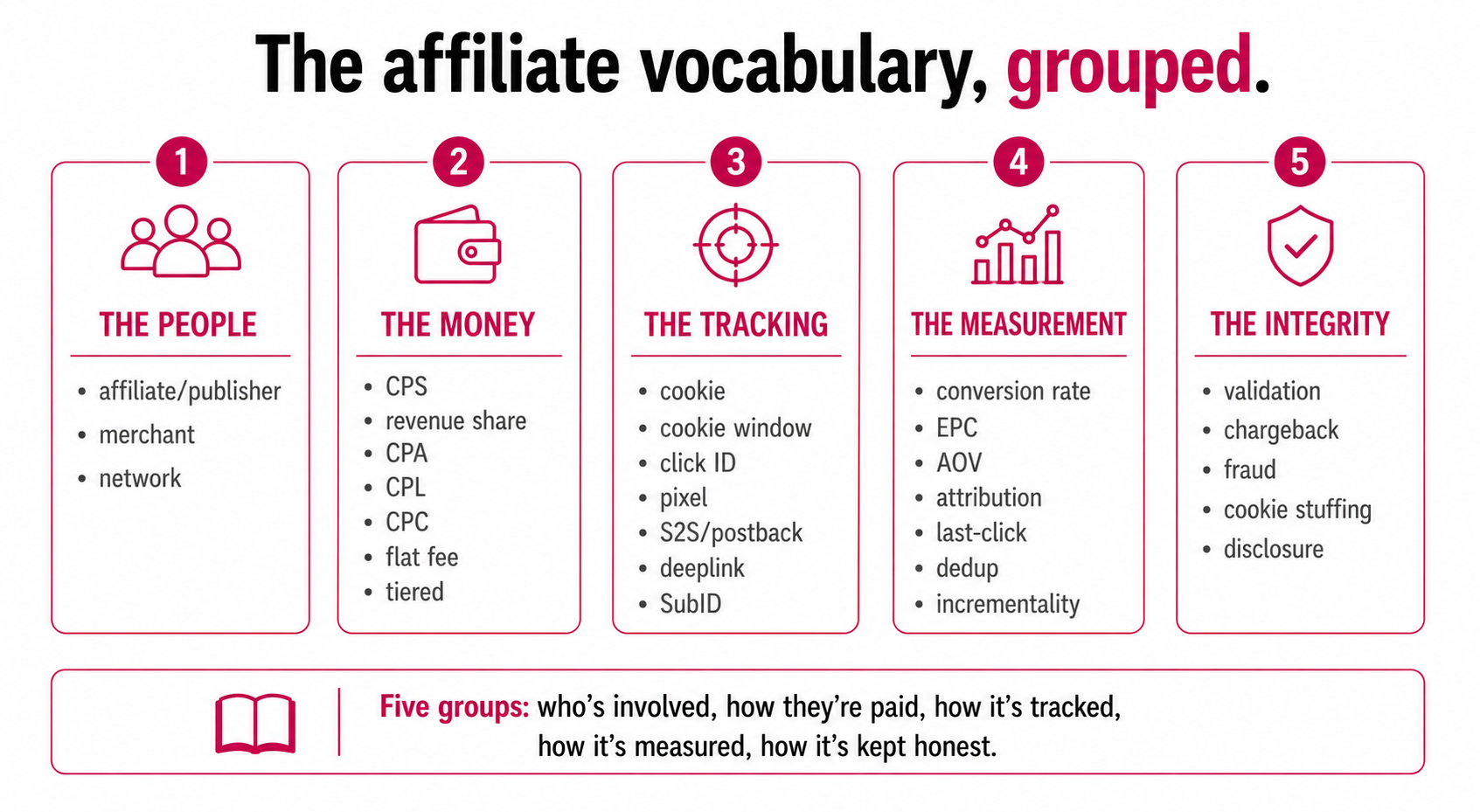
It is the reference companion to the rest of this cluster: where a term has its own deep-dive, I link to it. If you are new to the channel, start with how affiliate marketing actually works for the full picture, then use this to keep the vocabulary straight. Terms are grouped into the people, the money, the tracking, the measurement, and the integrity of a programme.
The people and the basics
- Affiliate (publisher). A person or business that promotes a merchant's products and earns a commission on the actions they drive. "Affiliate" and "publisher" mean the same role; the industry increasingly says "publisher."
- Merchant (advertiser). The business selling the product and running the affiliate programme. It sets the commission, approves partners, and validates sales.
- Network. A platform that sits between merchants and publishers, handling tracking, reporting, and publisher payments. Optional, but common.
- Affiliate link. A unique URL containing an identifier that tells the system which publisher sent a visitor.
- Commission. The payout a publisher earns for a sale or action, set as a percentage of the sale or a flat fee.
- Affiliate programme. The whole arrangement a merchant runs: the terms, the partners, the tracking, and the payouts.
The money: commission and payout terms
- CPS (cost per sale). A commission paid as a percentage of, or a fixed amount per, each sale. The most common e-commerce model. Practitioner note: lowest-risk for the merchant, you only pay when you earn.
- Revenue share. An ongoing percentage of the revenue a referred customer generates over time, common in subscriptions. It aligns the publisher with retention, they earn longer when the customer stays longer.
- CPA (cost per action / acquisition). A fixed fee for a defined action, a signup, a registration, a sale, agreed in advance. Gives a predictable acquisition cost, which makes budgeting clean.
- CPL (cost per lead). A fee for each qualified lead, common where the sale closes later (finance, insurance, B2B).
- CPC (cost per click). Payment per click regardless of whether it converts. Rare and risky in affiliate, good affiliates often read a CPC offer as a sign the product does not convert well.
- Flat fee / tenancy. A fixed payment for a placement (a homepage feature, a newsletter slot), independent of performance.
- Tiered commission. Higher commission rates unlocked as a publisher hits performance thresholds, used to reward and motivate top partners.
- The full picture of how these fit together is in affiliate commission models.
The tracking: how a click becomes a credited sale
- Cookie. A small file stored in the visitor's browser that records which publisher referred them, so a later purchase can be attributed. Increasingly unreliable as browsers and privacy rules restrict cookies.
- Cookie window (cookie duration / cookie life). The period after a click during which a purchase still earns the publisher a commission. Industry default is around 30 days; a longer window credits slower conversions and signals fairness, a stingy one quietly minimises payouts.
- Click ID. A unique identifier attached to a click and carried through the customer's journey, so a later conversion can be matched back to the right publisher. The thread modern tracking depends on, if it is lost through the funnel, attribution fails.
- Tracking pixel. A small piece of code on the confirmation page that fires when a sale completes and reports the conversion. Browser-based, so ad blockers and closed tabs can stop it, and it needs a click ID to know who to credit.
- Postback / S2S (server-to-server) tracking. A method where the conversion is reported directly from the merchant's server to the affiliate platform's server, with no browser involved. The most reliable method, immune to ad blockers, cookie loss, and device switches, the standard for serious programmes. Full detail in S2S and postback tracking explained.
- First-party cookie. A cookie set by the merchant's own domain rather than a third party. Survives browser privacy restrictions far better than third-party cookies.
- Deeplink. An affiliate tracking link pointing to a specific product or page deep inside the merchant's site, rather than the homepage. Improves the customer experience and conversion, you send people straight to what they came for.
- Sub ID (SubID). An extra parameter a publisher adds to a link to label which campaign, creative, or source a click came from. Without sub IDs you see only totals and cannot tell what is actually working.
- The whole chain is explained in how affiliate tracking actually works.
The measurement: the numbers that show if it's working
- Conversion rate. The percentage of clicks (or visitors) that complete the desired action, such as a purchase.
- EPC (earnings per click). The average commission earned per click, usually per 100 clicks. The metric good affiliates actually judge a programme by, because it combines your commission rate and your conversion rate. A generous rate means nothing if your page converts poorly.
- AOV (average order value). The average amount spent per order. It directly shapes what a percentage commission pays out and what a customer is worth.
- Attribution. The rule that decides which publisher (or channel) gets credit for a conversion. See attribution explained honestly.
- Last-click attribution. The most common rule: 100% of the credit goes to the last affiliate link clicked before purchase. Simple, but it systematically over-credits partners near checkout and under-credits the ones who introduced the customer earlier.
- First-click attribution. Credit goes to the first affiliate that referred the customer, even if others were clicked later.
- Deduplication (dedup). Removing duplicate credit so two partners (or two channels) are not both paid for the same single sale. The control that stops you paying twice for one order.
- Incrementality. Whether a partner actually created a sale that would not have happened otherwise, versus capturing one that was already going to occur. The most important idea in evaluating partners today, it separates introducing demand from intercepting it. More in the publisher landscape.
The integrity: keeping a programme honest
- Validation (order approval). The step where a merchant confirms a sale is genuine, not cancelled, returned, or fraudulent, before paying commission on it. The step that protects your margin; skip it and you pay for sales that never really happened.
- Chargeback. A reversed transaction (a dispute, a refund, fraud), which usually means the related affiliate commission is clawed back. Why validation and a holding period before payout exist.
- Cookie stuffing. A fraud technique that drops affiliate cookies on users who never clicked, to claim commissions the fraudster did not earn.
- Typosquatting. Registering misspellings of a brand's domain to hijack traffic that was already heading to the brand. A classic way fraudulent affiliates intercept and take credit for sales you would have made anyway.
- Affiliate fraud. Any attempt to claim commissions for results that were not genuinely driven, from cookie stuffing to fake leads. The types and controls are in affiliate fraud: detection and controls.
- Disclosure. The legally required, and trust-preserving, practice of an affiliate telling their audience that links are commercial and may earn a commission.
A few terms you'll hear around the edges
- EPC, network-level. Some networks publish an average EPC across all affiliates for a programme, a rough signal of how well the programme converts and pays before you join it.
- Cloaking. Disguising an affiliate link's destination, often to make it look cleaner; legitimate in moderation, but a red flag when used to hide where a link really goes.
- Co-marketing. A reciprocal arrangement where two businesses promote each other to their respective audiences, related to affiliate but not strictly performance-paid.
- Cross-device tracking. Following a customer's journey when it moves between devices (clicked on a phone, bought on a laptop), one of the hardest problems in attribution.
That is the working vocabulary of affiliate marketing. You do not need to memorise it; you need to recognise it, because the moment the terms stop being noise, the channel stops being mysterious. The model underneath is genuinely simple, connect the right audience to the right offer, track what happens, and pay fairly for the value created. The jargon is just the shorthand practitioners use to talk about each part of that precisely. Bookmark this, use it as a reference, and follow the links into the deep-dives when you need the full mechanism behind a term.
A few common questions
What does EPC mean in affiliate marketing? EPC stands for earnings per click, the average commission earned per click (usually measured per 100 clicks). It matters because it combines your commission rate and your conversion rate into one number, which is how experienced affiliates actually judge a programme. A high commission rate means little if the site converts poorly, the EPC reveals the real earning potential.
What is the difference between CPS, CPA, and CPL? CPS (cost per sale) pays a percentage or fixed amount tied to an actual sale. CPA (cost per action) pays a fixed fee for a defined action that may not be a sale, like a signup or registration. CPL (cost per lead) pays for each qualified lead, such as a form submission, common where the sale closes later. CPS suits transactional e-commerce; CPA and CPL suit signups and longer sales cycles.
What is a cookie window in affiliate marketing? The cookie window (also called cookie duration or cookie life) is the period after someone clicks an affiliate link during which a purchase still earns the affiliate a commission. The industry default is around 30 days, ranging from 24 hours to 90+ days. A longer window credits affiliates for slower conversions and signals fairness; a very short one minimises payouts.
What is the difference between a pixel and S2S (postback) tracking? A tracking pixel fires from the customer's browser on the confirmation page, so it can be blocked by ad blockers or missed if the page doesn't load, and it needs a click ID to attribute the sale. S2S (server-to-server, or postback) tracking reports the conversion directly between servers with no browser involved, making it far more reliable, immune to ad blockers, cookie loss, and device switches. S2S is the standard for serious programmes.
You should also read:
Attribution for Affiliate: The Last-Click Reality and What's Replacing It
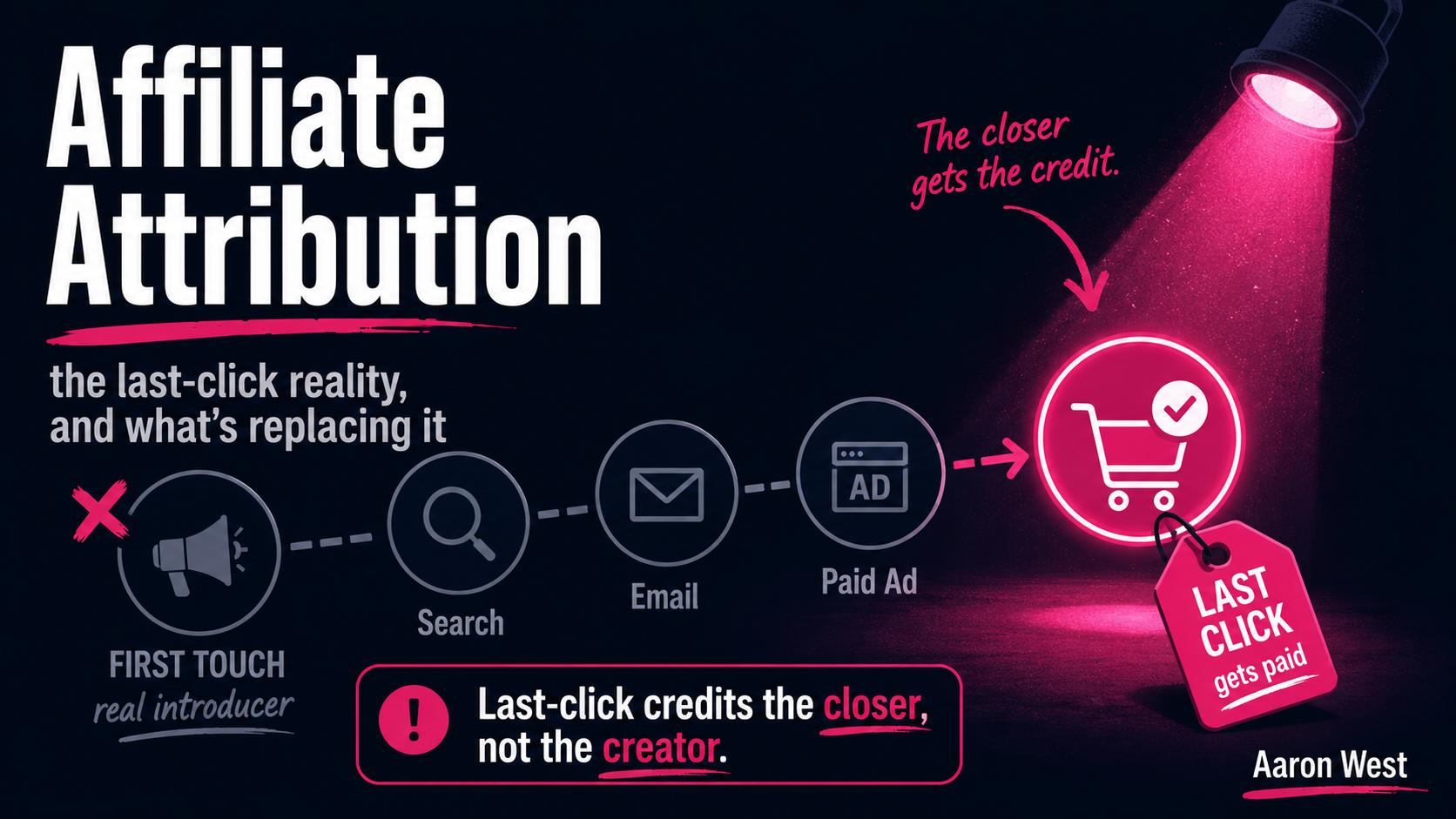
Affiliate attribution is the rule that decides which affiliate, and which touchpoint, gets credit for a sale, and for most of the channel's history that rule has been brutally simple: last click wins. Whoever set the last click before purchase takes 100% of the credit…
Continue reading...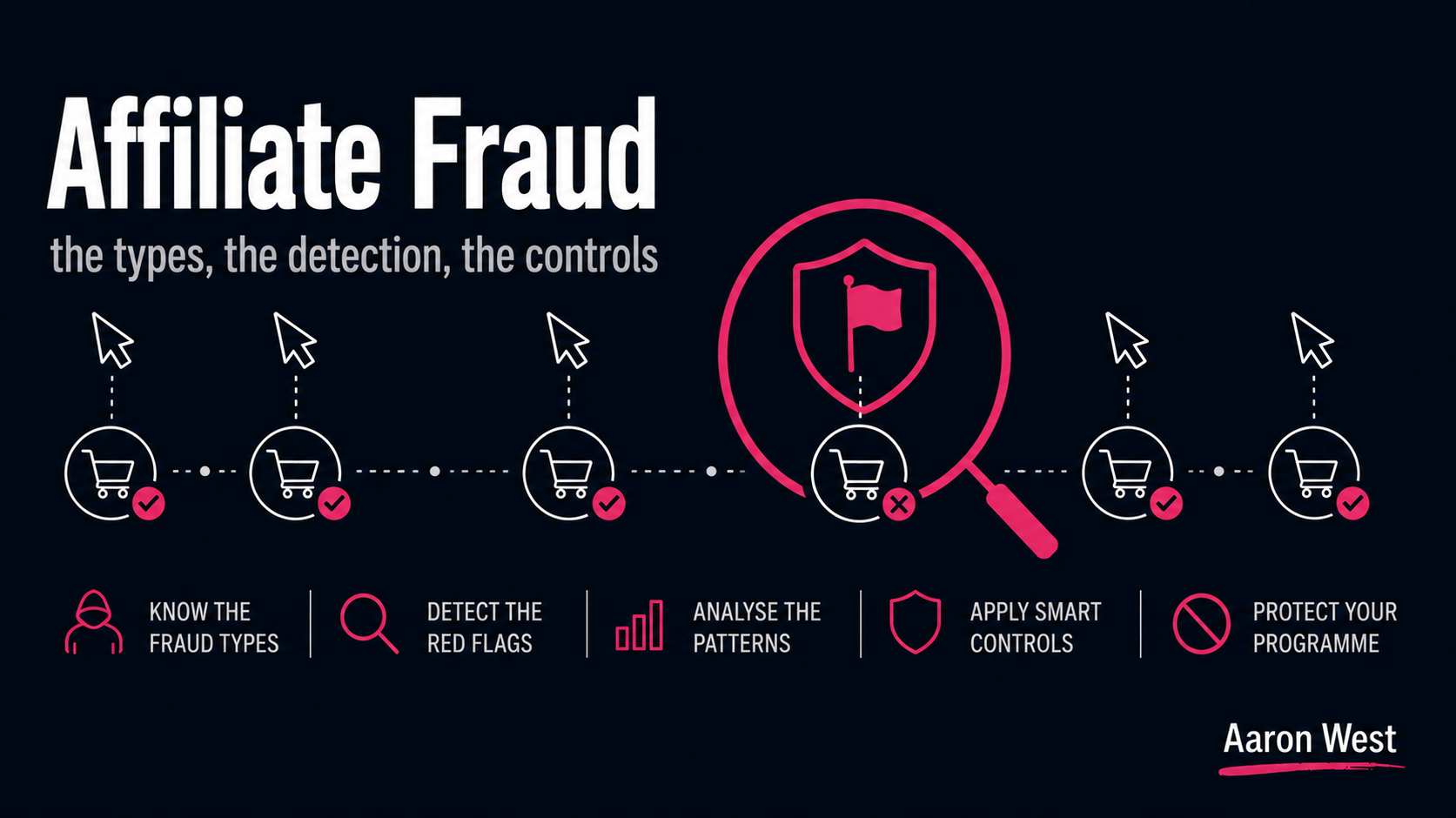
Affiliate Fraud: The Types, the Detection Methods, and the Controls
Affiliate fraud is any attempt to earn commissions for results that were not genuinely driven, faked clicks, faked leads, or stolen attribution, and because the whole channel pays for results, it has always attracted people who try to fake results. The defining shift in 2026…
Continue reading...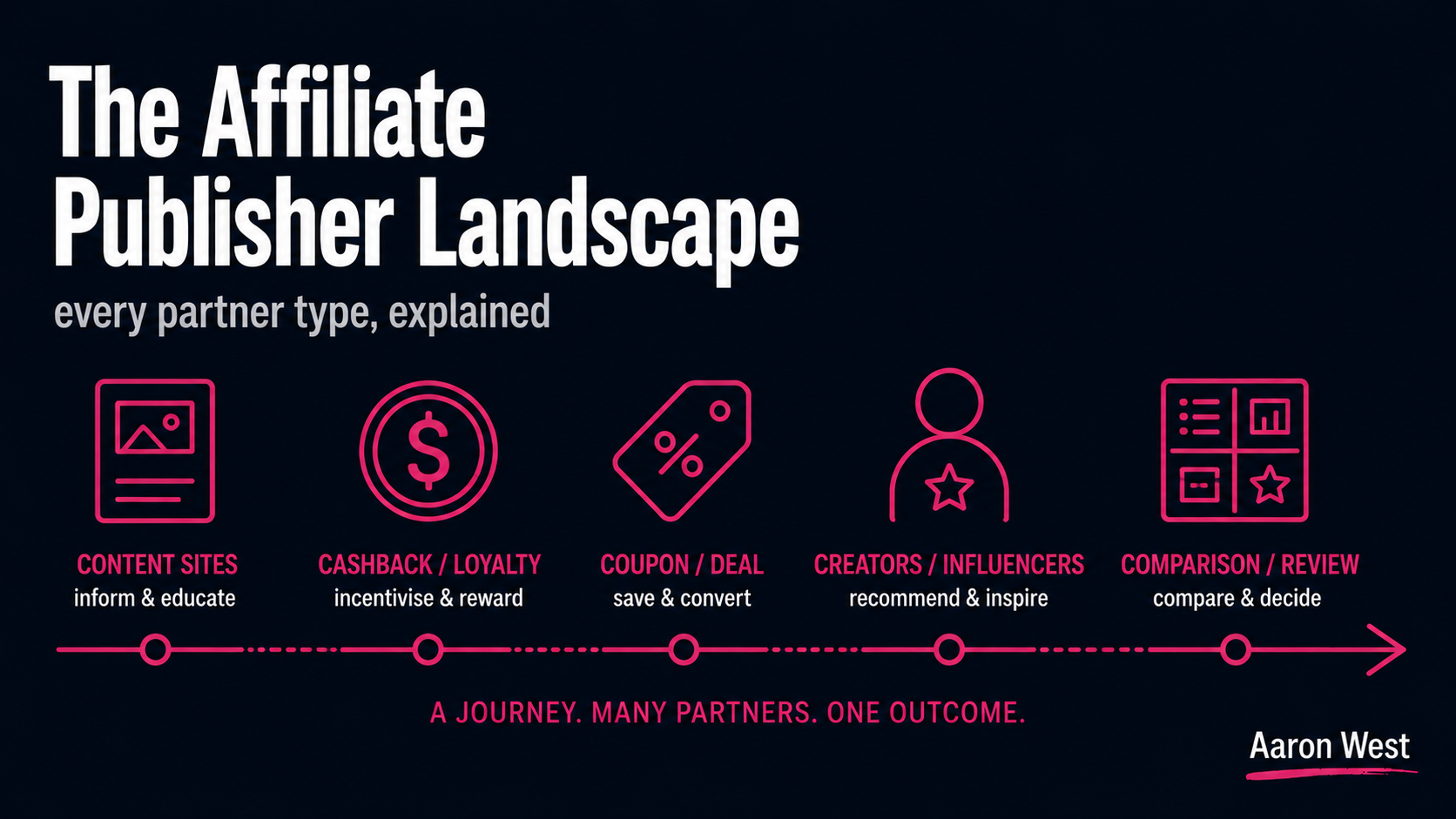
The Affiliate Publisher Landscape: Every Partner Type, Explained
"Affiliate" covers wildly different kinds of partner, content sites, cashback platforms, coupon sites, influencers, comparison engines, and the single most important thing to understand is that they do fundamentally different jobs. Some genuinely introduce new customers to your brand; others mostly intercept customers who were…
Continue reading...