How Affiliate Tracking Actually Works: Clicks, Cookies and Conversions

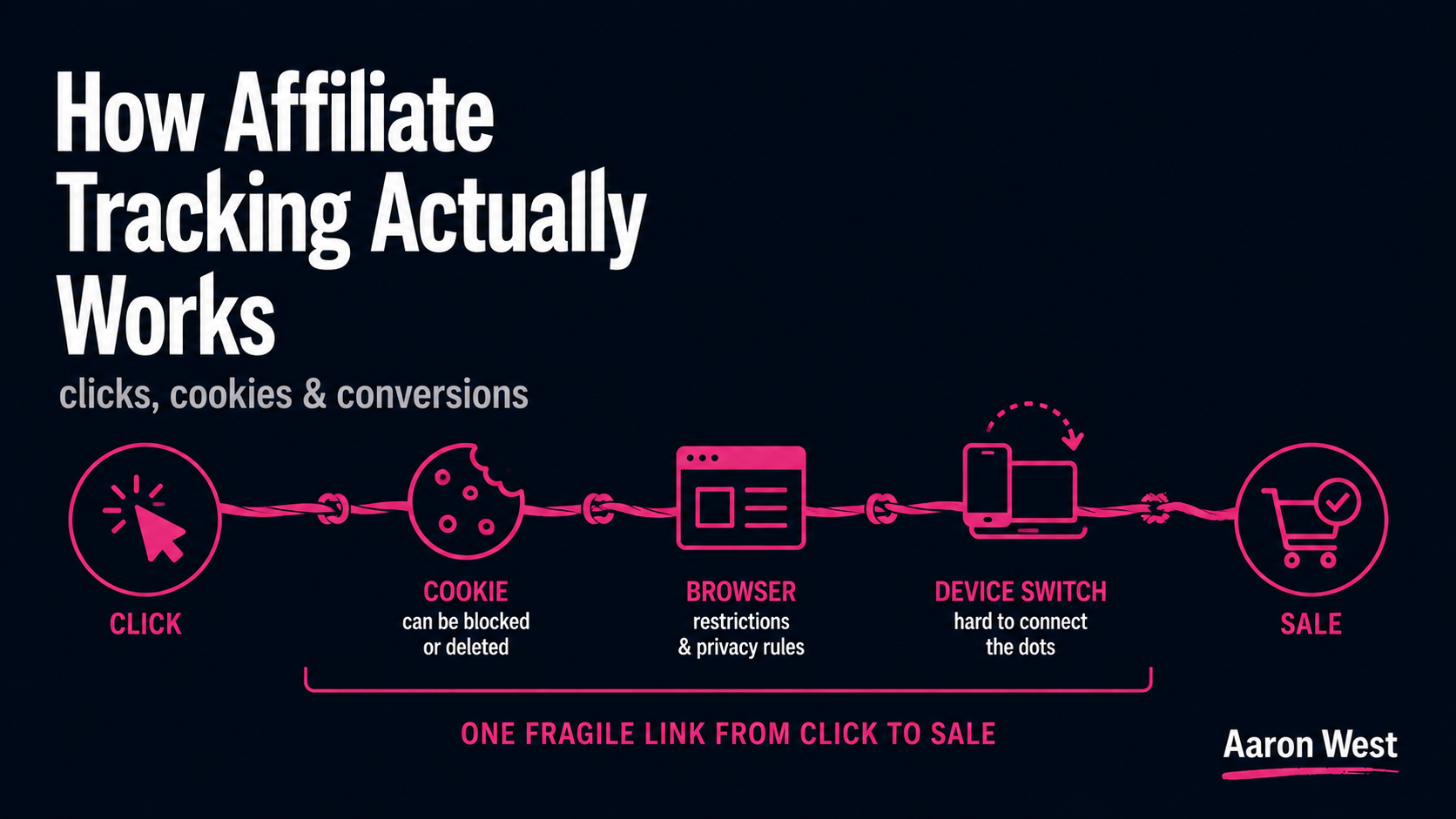
Table of Contents
- The one job: connect a click to a later sale
- Method 1: Cookie (browser) tracking, simple and breaking
- Method 2: Pixel (browser) tracking, better but still browser-bound
- Method 3: Server-to-server (S2S) tracking, the reliable one
- The methods are not either/or: the hybrid reality
- Why this matters to a manager who'll never touch the code
- A few common questions
Affiliate tracking is the machinery that connects a click on a partner's link to a purchase that happens later, so the right partner gets paid, and in 2026 it runs on three core methods: the browser cookie (simple but increasingly unreliable), the tracking pixel (fires from the browser when a sale completes), and server-to-server tracking (the conversion is reported server to server, bypassing the browser entirely). The whole job of tracking is to preserve one fragile link, this click led to that sale, across days, devices, and a web that is actively making that link harder to keep. Understanding how each method does it, and where each breaks, is the difference between a programme that pays partners accurately and one that quietly loses sales it should be crediting.
This is the deep-dive the affiliate guide pointed to. It is genuinely technical in places, but I will keep it in plain language, because every e-commerce manager running a programme should understand this well enough to ask the right questions, even if a platform handles the plumbing. Tracking is where affiliate programmes quietly succeed or fail, and most people never look under the hood. Here is what is actually happening.
The one job: connect a click to a later sale
Every tracking method, however different the technology, exists to do one thing: keep a reliable link between an initial referral and a later action. That is the entire problem, and it is harder than it sounds, because the click and the purchase are separated in time (often days), sometimes in device (clicked on a phone, bought on a laptop), and by a web that increasingly resists being tracked.
So before the methods, hold the shape of the problem. A customer clicks partner X's link today. They leave. Three days later they come back, on a different device, and buy. Tracking's job is to still know, at that purchase, that partner X started it. Every technique below is a different answer to "how do we remember that?", and every technique has a specific point where the memory can be lost. The reliability of your whole programme comes down to how well you hold that thread, which is why the better partners and the better merchants care so much about which method you use.
Method 1: Cookie (browser) tracking, simple and breaking
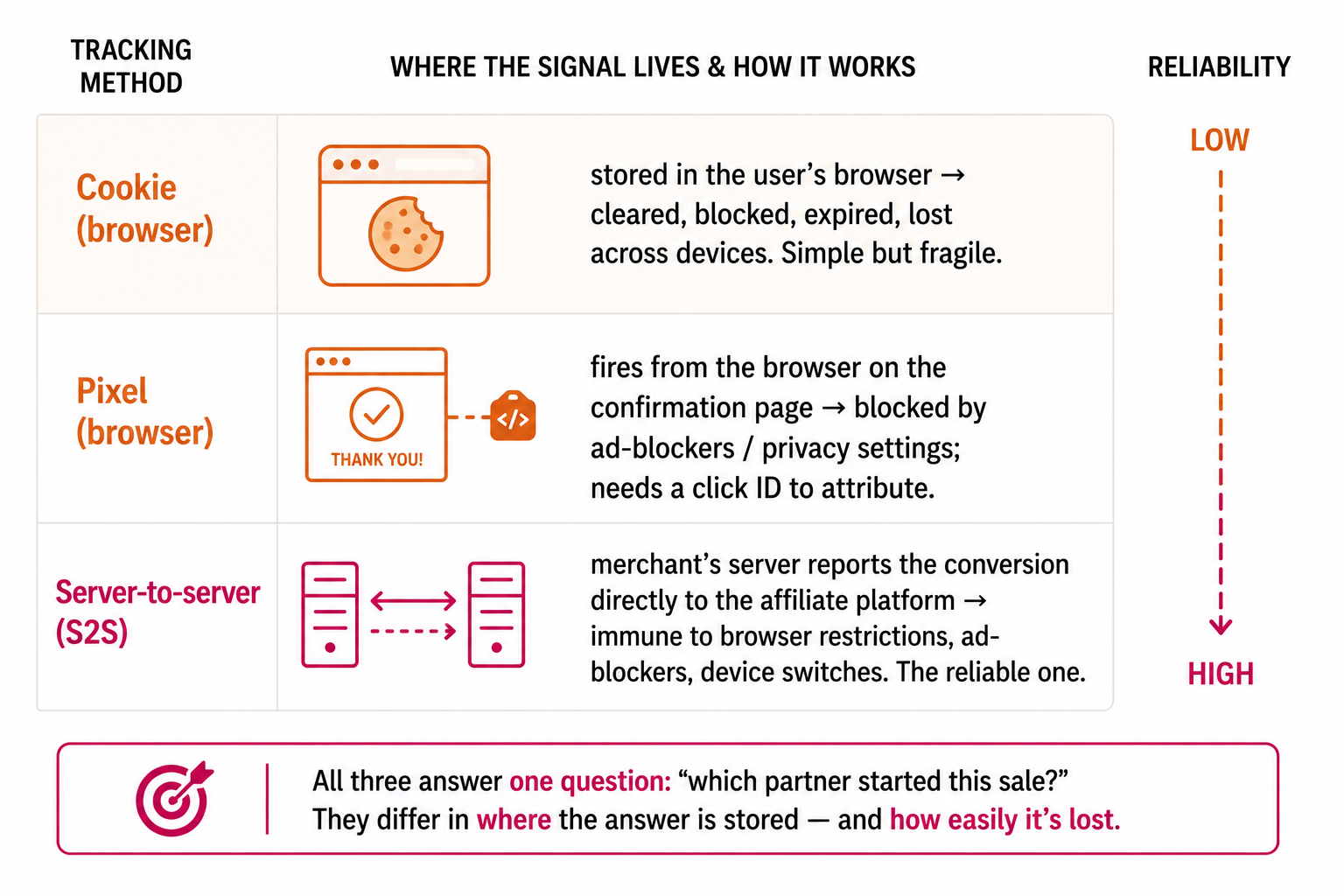
The original and still most common method works through a cookie, a small file stored in the customer's browser. When the customer clicks the affiliate link, the cookie is dropped, recording which partner referred them and when. When they buy, the merchant's site reads the cookie, sees the partner's ID, and credits the sale. Simple, well-understood, and easy to set up, which is why it became the default.
The problem is that the browser cookie is now the least reliable link in the chain, and getting worse. Cookies can be cleared by the user, blocked by the browser, or expired early by privacy features like Safari's Intelligent Tracking Prevention, which deliberately shortens cookie lifespans. And a cookie lives in one browser on one device, so the classic "research on mobile, buy on desktop" journey breaks it completely, the buying device has no cookie, so the sale goes unattributed. None of this means cookies are useless; they still do a lot of work, especially first-party cookies set by the merchant's own domain, which survive far better than third-party ones. But building your whole programme on browser cookies alone, in 2026, means accepting a steady, invisible leak of genuine sales. That leak is real enough to deserve its own piece: why you're under-counting affiliate sales.
Method 2: Pixel (browser) tracking, better but still browser-bound
The second method is the tracking pixel: a small piece of code (often a tiny invisible image or a JavaScript snippet) placed on the merchant's confirmation or thank-you page. When a sale completes and that page loads, the pixel "fires," sending the conversion data back to the affiliate platform. It is a step up from relying purely on reading a cookie at checkout, because it actively reports the conversion at the moment it happens.
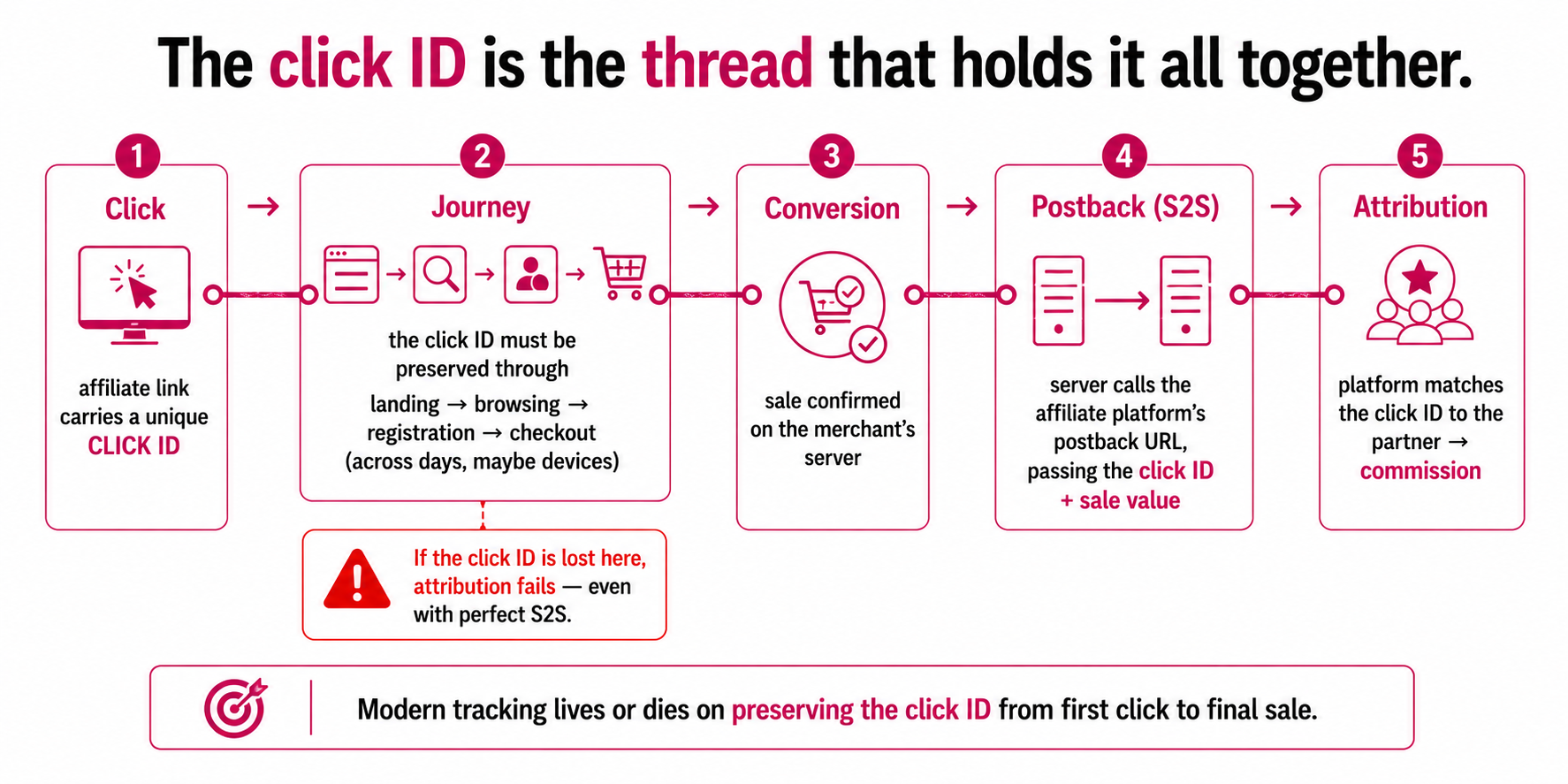
But notice the catch hiding in the description: the pixel fires from the browser, on the thank-you page. So it inherits the browser's weaknesses, ad blockers and privacy settings can block it, and if the customer closes the tab before the confirmation page fully loads, it may never fire at all. There is also a subtlety that trips people up: a pixel firing on its own only knows that a sale happened, not which partner to credit. It has to be combined with a click ID, a unique identifier passed in the original affiliate link and carried through the customer's journey to checkout, so the conversion can be matched back to the referring partner. If that click ID is not preserved properly through the funnel, the pixel fires into the void: you know a sale happened, but you cannot attribute it. Pixel tracking is a reasonable, accessible method, and it is often the easy on-ramp for partners. But it is still tied to the browser, which is exactly the dependency the third method removes.
Method 3: Server-to-server (S2S) tracking, the reliable one
The most robust method, and the standard for anything where the money is serious, takes the browser out of the loop entirely. With server-to-server tracking (also called S2S or postback tracking), the conversion is reported directly from the merchant's server to the affiliate platform's server. When a qualifying event happens on the merchant's side, a confirmed sale, a registration, the merchant's system calls a special postback URL the platform provided, passing the conversion details (including the click ID that identifies the partner). No browser, no cookie, no page that has to load.
Because it bypasses the browser, S2S is immune to the things that break the other two: ad blockers, cookie clearing, privacy restrictions, the closed tab, the switched device. That is why it is the standard in high-stakes performance marketing, where losing even a few percent of conversions means real money, and why industry technical standards have long recognised server-to-server as the more reliable method where browser signals are degraded. It is consistently ranked the most accurate of the methods, often cited in the high-90s percent range. The trade-off is that it is more technical to set up, it requires correctly passing and preserving that click ID from the first click all the way through to the backend event, and if the click ID is lost or mis-mapped along the way, the postback fires without a valid reference and attribution still fails. The mechanism is worth understanding in its own right, so it gets a dedicated piece: server-to-server (S2S) and postback tracking, explained. The headline for a manager: if your programme handles meaningful revenue, S2S should be your primary method, with pixel tracking as a fallback for partners who have not integrated it yet.
The methods are not either/or: the hybrid reality
In practice, serious programmes do not pick one method, they layer them, because each covers the others' gaps. The modern pattern is a hybrid: use first-party cookies where they work, fall back to server-side tracking for the cases that browser methods miss (mobile, blocked, cross-device), and use the most reliable signal available for any given conversion. Many platforms now do exactly this automatically, combining first-party data with S2S so that if one method loses the thread, another catches it.
There are also alternatives for the cases where even these struggle. Coupon-code attribution sidesteps tracking entirely for some partners, especially influencers, by giving each a unique discount code; when it is used at checkout, the partner gets credit, no cookie or pixel required (the mechanics live in deeplinks and tracking parameters). Email-based attribution can recognise a customer by the email they use, useful when the same person appears across devices. And while fingerprinting, identifying a device by its characteristics rather than a stored cookie, was once promoted as a cookie workaround, by 2026 its role is marginal and legally fraught, because modern browsers actively suppress the signals it relies on and privacy law treats it warily. The honest takeaway is that no method captures 100% of conversions, that is simply not achievable, so the goal is not perfection but resilience: layer methods so the failure of any one does not lose the sale.
Why this matters to a manager who'll never touch the code
You may never configure a postback URL yourself, so why understand all this? Because tracking quality is invisible until you look for it, and it directly determines whether your partners trust you and whether your programme's numbers are real. A programme running on browser cookies alone in 2026 is under-reporting conversions, which means it is under-paying good partners (who notice, and leave) and telling you the channel performs worse than it does (so you under-invest in something that actually works). Both failures are silent. Neither shows up unless you know to ask "how are we tracking, and what are we missing?"
So the practitioner's checklist is short. Know which methods your programme uses. Push toward server-side and first-party tracking, away from sole reliance on third-party cookies. Make sure click IDs are preserved through your funnel, because that thread is what every modern method depends on. And accept that some loss is inevitable, then minimise it deliberately rather than pretending it is zero. That is the difference between a programme that pays accurately and earns partner trust, and one that quietly leaks the very results it exists to produce.
So that is how affiliate tracking actually works. Three core methods, cookie, pixel, and server-to-server, each answering the same question (which partner started this sale?) and each with a specific failure point. The cookie is simple and fragile, the pixel is better but browser-bound, and S2S is the reliable backbone for anything that matters, all stitched together by the click ID that has to survive the journey from first click to final sale. The web is making the old browser-based methods leakier every year, and the programmes that win are simply the ones that saw it coming and moved their tracking onto firmer ground. Tracking is not the glamorous part of affiliate marketing. It is the part that decides whether everything else you do gets counted.
A few common questions
How does affiliate tracking work? It connects a click on a partner's link to a later purchase so the right partner is credited. A click is recorded (with a unique click ID), the customer's journey is followed, and when they convert the sale is matched back to the referring partner and a commission is paid. The three core methods for doing this are browser cookies, tracking pixels, and server-to-server (S2S) tracking.
What is the difference between pixel tracking and S2S tracking? A pixel fires from the customer's browser when the confirmation page loads, so it can be blocked by ad blockers or missed if the page doesn't load. S2S (server-to-server) tracking reports the conversion directly from the merchant's server to the affiliate platform's server, with no browser involved, so it's immune to ad blockers, cookie restrictions, and device switches. S2S is more reliable and is the standard for high-value programmes; pixel tracking is a simpler fallback.
What is a click ID and why does it matter? A click ID is a unique identifier attached to an affiliate link and carried through the customer's journey to checkout. It's what lets a conversion be matched back to the partner who referred it. Modern tracking (especially pixel and S2S) depends on the click ID being preserved through the funnel, if it's lost or mis-mapped, attribution fails even when the tracking is otherwise set up correctly.
Why is cookie tracking becoming unreliable? Browser cookies can be cleared, blocked, or expired early by privacy features (like Safari's Intelligent Tracking Prevention), and they only exist on one device, so a customer who clicks on mobile and buys on desktop breaks the link. Combined with the phase-out of third-party cookies, this means cookie-only tracking steadily under-counts genuine sales. The fix is to move toward first-party cookies and server-side (S2S) tracking.
You should also read:
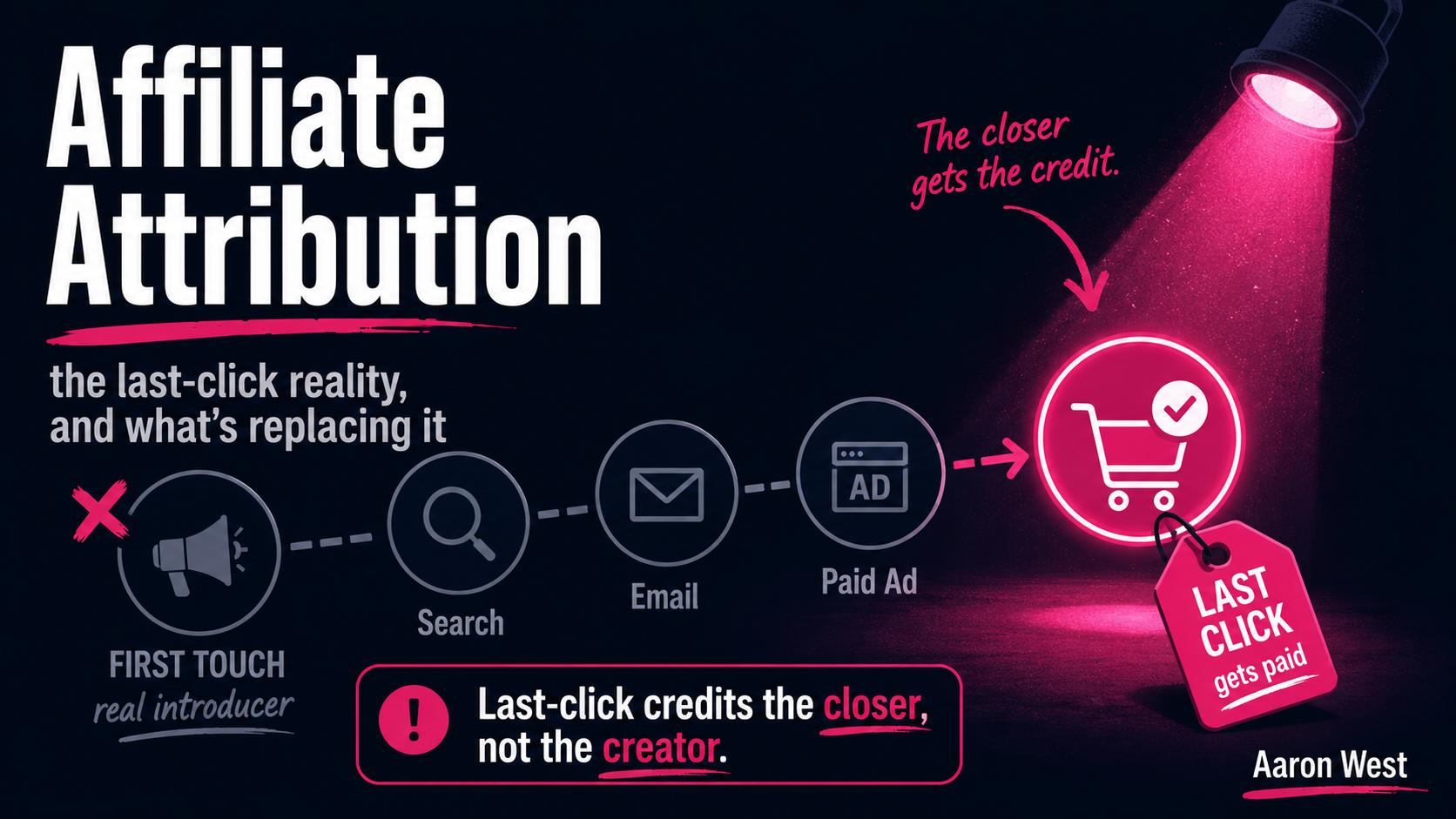
Attribution for Affiliate: The Last-Click Reality and What's Replacing It
Affiliate attribution is the rule that decides which affiliate, and which touchpoint, gets credit for a sale, and for most of the channel's history that rule has been brutally simple: last click wins. Whoever set the last click before purchase takes 100% of the credit…
Continue reading...
Affiliate Fraud: The Types, the Detection Methods, and the Controls
Affiliate fraud is any attempt to earn commissions for results that were not genuinely driven, faked clicks, faked leads, or stolen attribution, and because the whole channel pays for results, it has always attracted people who try to fake results. The defining shift in 2026…
Continue reading...
The Affiliate Marketing Glossary: Every Term, in Plain English
Affiliate marketing is full of acronyms and jargon, CPS, EPC, S2S, dedup, postback, cookie window, that can make a simple channel sound impenetrable. This glossary defines the terms that actually matter, in plain English, grouped so you can see how they fit together. Each definition…
Continue reading...