Deduplication: How to Stop Paying Twice for One Sale

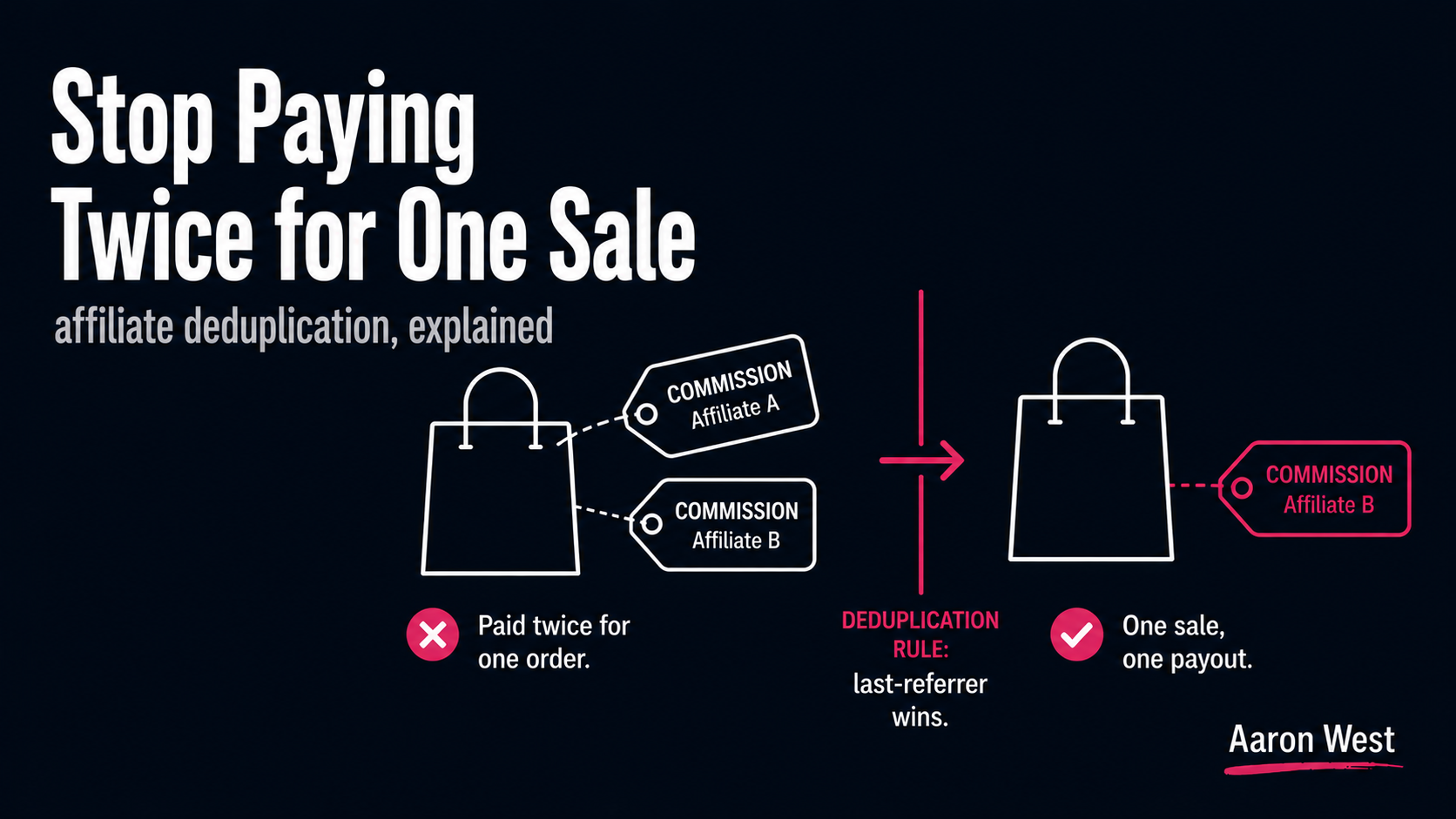
Table of Contents
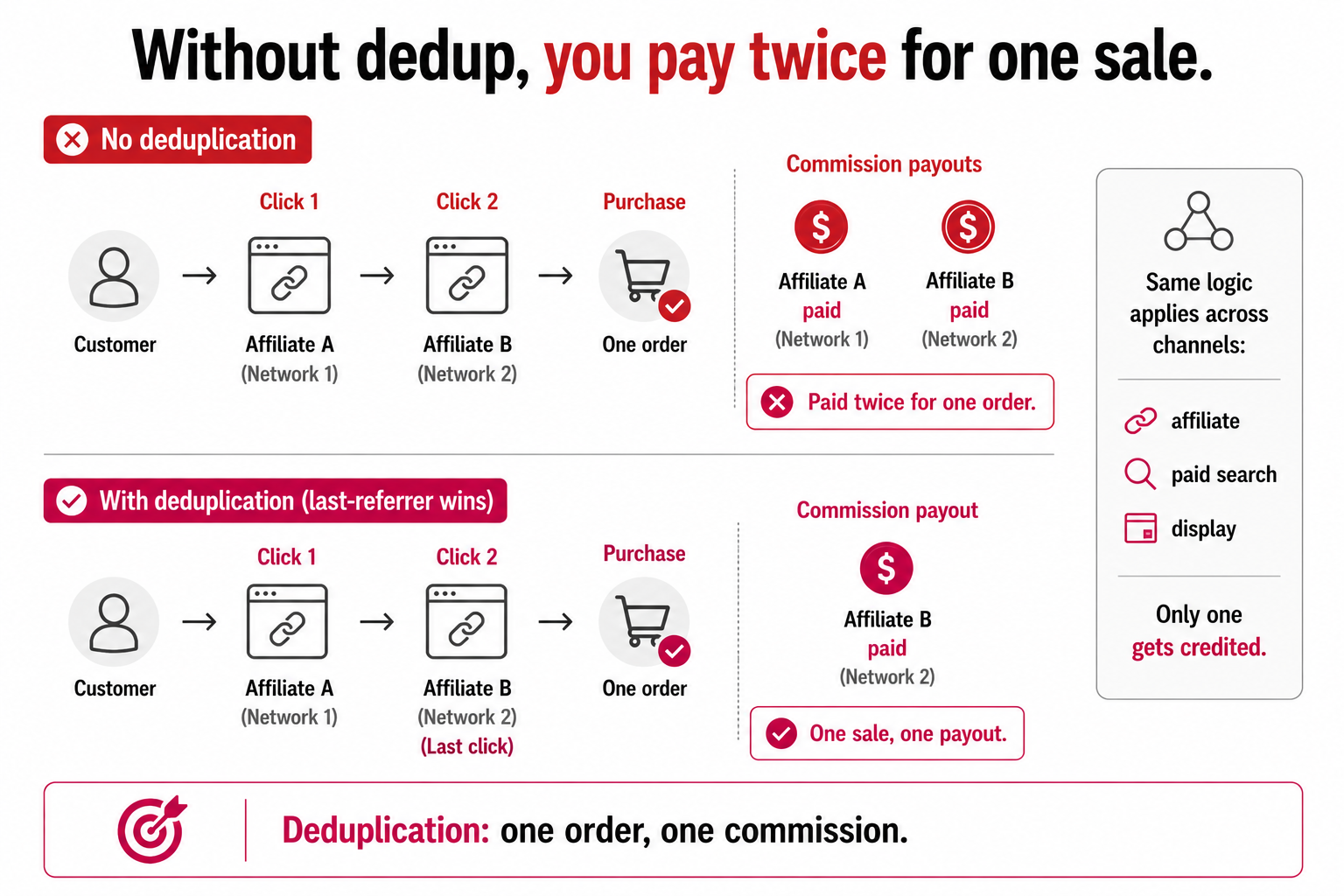
Deduplication is the process of making sure only one channel, or one affiliate, gets paid for a single sale, so you do not pay two commissions on one order. If a customer clicks an affiliate link from one network, then later clicks another affiliate's link from a different network before buying, an advertiser who is not deduplicating pays both, full commission, twice, for one sale. Deduplication is the rule and the mechanism that stops that. It is unglamorous, invisible when it works, and quietly one of the most expensive things to get wrong in a programme.
This sits in the integrity layer of the affiliate cluster, right next to fraud control, because both are about the same discipline: not paying for what you should not pay for. But there is one distinction that has to be clear from the start, because confusing it causes most of the mistakes, deduplication is not attribution. They look related and they are not the same job at all. This piece explains what dedup is, how it works, the two scenarios you use it in, and the judgment that separates a fair, effective policy from one that quietly drives your best partners away.
First, the distinction that matters: dedup is not attribution
Get this straight before anything else, because it is the single most common confusion. Attribution is the analytical question, how much did each channel and touchpoint contribute to a sale, so you understand the true cost and role of each. Deduplication is the narrower operational question, given that a sale happened, which single channel do we pay for it. Attribution is about understanding influence; deduplication is about awarding the sale to exactly one claimant so you do not pay twice.
The reason this matters is that dedup deliberately throws away information that attribution cares about. Deduplication usually credits one channel and ignores the others entirely, even though those others may genuinely have influenced the purchase. That is fine, that is its job, but it means dedup is a payment rule, not an analysis. You still need proper attribution to understand contribution and allocate budget intelligently; dedup just answers "who gets the cheque for this one order." Treat dedup as if it told you the truth about channel value and you will systematically undervalue every channel that tends to touch the customer earlier. Keep the two separate in your head and most dedup decisions get clearer.
The two scenarios you deduplicate in
Deduplication applies in two distinct situations, and it helps to keep them separate.
Scenario one: across multiple affiliate networks. Most programmes of any size run on more than one affiliate network, to reach more publishers. The problem: if a customer clicks affiliate links belonging to two different networks before buying, both networks will report the sale and both will bill you, unless you deduplicate. So multi-network dedup ensures that for any single order, only one network (and so only one affiliate) is credited and paid. If you run on a single network, you do not need this, the network handles uniqueness internally; you need it the moment you add a second.
Scenario two: across marketing channels. The bigger picture: affiliate is one of several channels (paid search, display, email, paid social) that might all touch a customer on the way to a purchase. Cross-channel dedup decides which channel is credited for the sale, so affiliate and paid search do not both claim, and get paid for, the same conversion. A modern transaction can involve three or more channels, which is exactly why this matters more every year, and why so many advertisers being surprised to learn they still are not deduplicating is a genuine, costly oversight.
In both scenarios, the dominant rule is the same: last referrer wins. Whoever set the last click (or last cookie) before the purchase gets credited. It is simple, it is the industry default, and, as we will see, its simplicity is also where the unfairness can creep in.
How it actually works
The mechanism is more straightforward than it sounds. The standard approach uses click-append plus a local cookie. When a visitor arrives from any tracked source, a parameter is appended to the URL identifying that source (for example, source=networkname or source=paidsearch). The merchant's site reads that parameter and writes a local cookie recording the source of this latest referral. Each time the customer comes back through a different source, that cookie is overwritten with the new last source. Then, when the purchase completes, the site fires only the tracking pixel for whichever source the cookie currently holds, crediting that one channel and no other. That is "pixel firing logic", one cookie holding the last referrer, one pixel fired at the end.
There is also a choice about where you dedupe, and it has a real trade-off:
- Dedupe at source (automatic). The duplicate sale is removed at the moment of tracking, so it never enters the network interface or affects your statistics. Efficient and clean for the advertiser. The downside is publisher visibility: an affiliate never sees the sales they were involved in but did not ultimately get credited for, which can feel opaque.
- Manual dedupe (via validation). All sales are tracked, and duplicates are removed during the validation step. More transparent to publishers, but far more work for you, and it generates support queries from affiliates asking why orders were voided.
Most mature programmes dedupe at source for efficiency, and manage the transparency cost through clear communication rather than manual processing. Which leads to the part that actually separates a good policy from a damaging one.
The judgment: what NOT to deduplicate against
This is where dedup stops being a technical setting and becomes a relationship decision, and where most programmes either keep their best partners or quietly lose them. Because the last-referrer-wins rule is blunt, what you choose to dedupe against determines whether your policy is fair or whether it systematically robs affiliates of credit they earned.
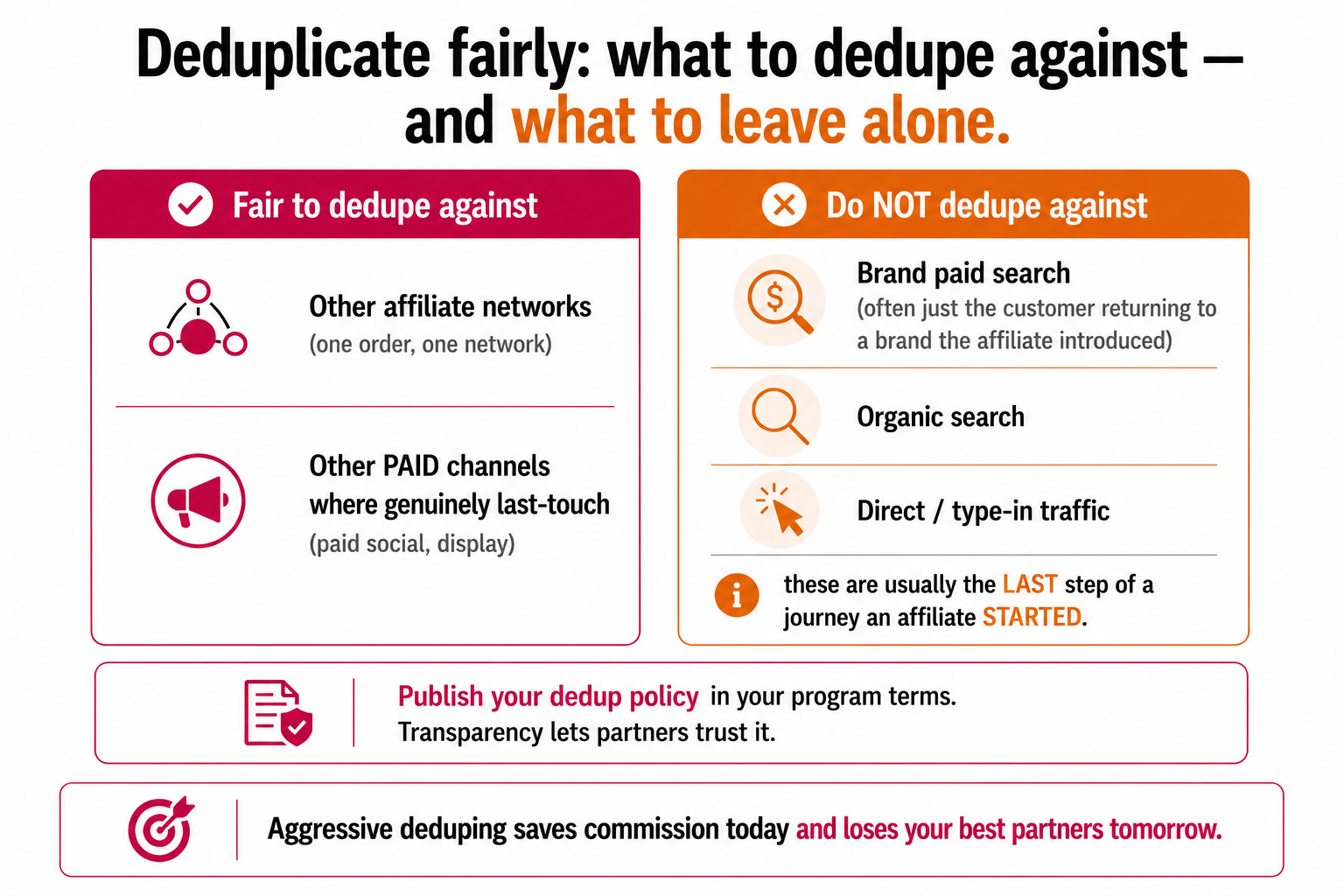
The cardinal rule: do not deduplicate against brand paid search, organic search, or direct traffic. Here is why. Imagine an affiliate genuinely introduces a customer to your brand, the customer clicks the affiliate link, browses, leaves without buying. Days later they come back by typing your brand name into Google and clicking a brand PPC ad, or just typing your URL directly. If you are deduping against brand PPC and direct, the affiliate gets nothing, even though they did the real work of introducing the customer, and the brand search was just the customer finding their way back to a brand they already knew because of the affiliate. That is not fair attribution; it is taking credit for the affiliate's contribution. Brand search and direct traffic are very often simply the last step in a journey the affiliate started, so deduping against them punishes exactly the high-value, top-of-funnel partners you most want to keep, the ones who introduce demand rather than intercept it.
The cautionary tale is well known in the industry: a major UK electronics retailer in the mid-2000s deduped affiliate sales aggressively against paid search, and some affiliates reported that up to 85% of their sales were suddenly refused. The backlash was severe, because the policy did not just cut costs, it told partners their contribution did not count. Affiliates can, and do, simply move their traffic to competitors who do not treat them that way. Dedup that is too aggressive is a false economy: you save on commissions today and lose the partners who drive growth tomorrow.
Make it fair, and make it transparent
The two principles that turn deduplication from a cost-cutting blunt instrument into a sound policy: be fair about what you dedupe against, and be transparent that you do it.
Transparency is non-negotiable and genuinely easy: your deduplication policy belongs in your programme terms, clearly stated and accessible to partners before they join. This is not just courtesy. Publishers compare dedup policies across advertisers when deciding where to send their traffic, so a clear, fair policy is a recruiting advantage, and a hidden or aggressive one is discovered eventually and resented. An affiliate who knows the rules upfront can make an informed decision; one who finds out after the fact that 85% of their sales get refused will leave and warn others.
So the working approach is: dedupe across networks always (you should never pay two networks for one order), dedupe across genuinely-paid channels where the affiliate truly was not the last meaningful touch, never dedupe against brand search, organic, or direct, and write all of it into your terms in plain language. Do that and deduplication does exactly what it should, it stops you paying twice without making your partners feel cheated.
That is deduplication, start to finish. It is the rule that ensures one sale earns one commission, applied across networks and across channels, usually on a last-referrer-wins basis, implemented through a simple cookie-and-pixel mechanism. It is not attribution, it is a payment rule, so do not let it stand in for understanding channel value. And the whole difference between a policy that protects your margin and one that hollows out your programme comes down to judgment: dedupe against the genuine double-counts, leave the affiliate's earned contribution alone, and tell everyone exactly what you do. Get that right and you stop paying twice without ever making a good partner feel robbed, which is the only version of cost-saving worth having.
A few common questions
What is deduplication in affiliate marketing? Deduplication is the process of ensuring that only one channel or affiliate is credited and paid for a single sale, so an advertiser doesn't pay two commissions on one order. It's needed when a customer is touched by multiple affiliates (often across different networks) or multiple marketing channels before buying. The standard rule is "last referrer wins", whoever set the last click before purchase gets credited.
Is deduplication the same as attribution? No, and confusing them causes most dedup mistakes. Attribution is the analysis of how much each channel and touchpoint contributed to a sale, used to understand true cost and allocate budget. Deduplication is the narrower operational rule for which single channel gets paid for a given sale. Dedup deliberately credits one channel and ignores the others, so it's a payment rule, not a measure of channel value.
How does affiliate deduplication work? Most commonly through "click-append plus a local cookie." When a visitor arrives from a tracked source, a parameter identifies that source and writes a cookie recording it; each new referral overwrites the cookie with the latest source. At purchase, only the tracking pixel for the source held in the cookie is fired, crediting that one channel. This is called pixel-firing logic, and the usual rule is last-referrer-wins.
What should you not deduplicate against? Don't deduplicate against brand paid search, organic search, or direct/type-in traffic. These are very often just the customer's final step in a journey an affiliate started, so deduping against them strips credit from the affiliate who genuinely introduced the customer. Aggressive deduping (a UK retailer once had affiliates reporting up to 85% of sales refused) saves commission short-term but drives away the high-value partners who introduce demand. Always publish your dedup policy in your programme terms.
You should also read:

The Down-Sell Nobody Offers (and Why It Saves the Sale)
Almost every online store has an upsell. Almost none have a down-sell. We pour energy into getting customers to spend more, the upgrade, the add-on, the bundle, and we completely ignore the move that saves the sale when a customer is about to spend nothing.
Continue reading...
Payment Friction Is the Last Gate, and the Most Absurd Place to Lose a Sale
The most absurd way to lose a customer is at the very last step, when someone has chosen the product, accepted the price, filled in their details, reached for their wallet, and then cannot pay the way they want to. Every other lost sale is…
Continue reading...
The Product Page Is Where You Win or Lose the Sale
The product page is where the buying decision actually gets made, which makes it the most important page on your store, and the one most stores treat as an afterthought. Everything before it, the ads, the homepage, the category listings, only does one job: deliver…
Continue reading...