Comparison Sites, CSS, and Sub-Networks: The Partners People Forget

Table of Contents
Comparison sites and Comparison Shopping Services (CSS) are affiliate-adjacent partners that list your products alongside competitors so shoppers can compare, then send the click your way for a fee or a commission. They are the partner type most programmes barely think about, which is a mistake, because they sit in a genuinely distinct spot: not the demand creators like content publishers and creators, not the pure interceptors like cashback and coupon sites, but the middle ground. They capture demand that already exists but might genuinely have found a competitor instead of you.
This completes the partner-type tour within the affiliate publisher landscape, and it matters especially in Europe, because the CSS version of this partner is a specifically European mechanism with real cost advantages, and one that many German and EU advertisers either over-rely on or ignore entirely. This piece covers the two things bundled under this heading, traditional price-comparison sites and Google CSS, how each works, where they sit on the incrementality spectrum, and the one debate (CSS-as-affiliate) that genuinely divides practitioners.
Two different things under one label
"Comparison" covers two related but distinct partner types, and conflating them causes confusion, so let us separate them cleanly.
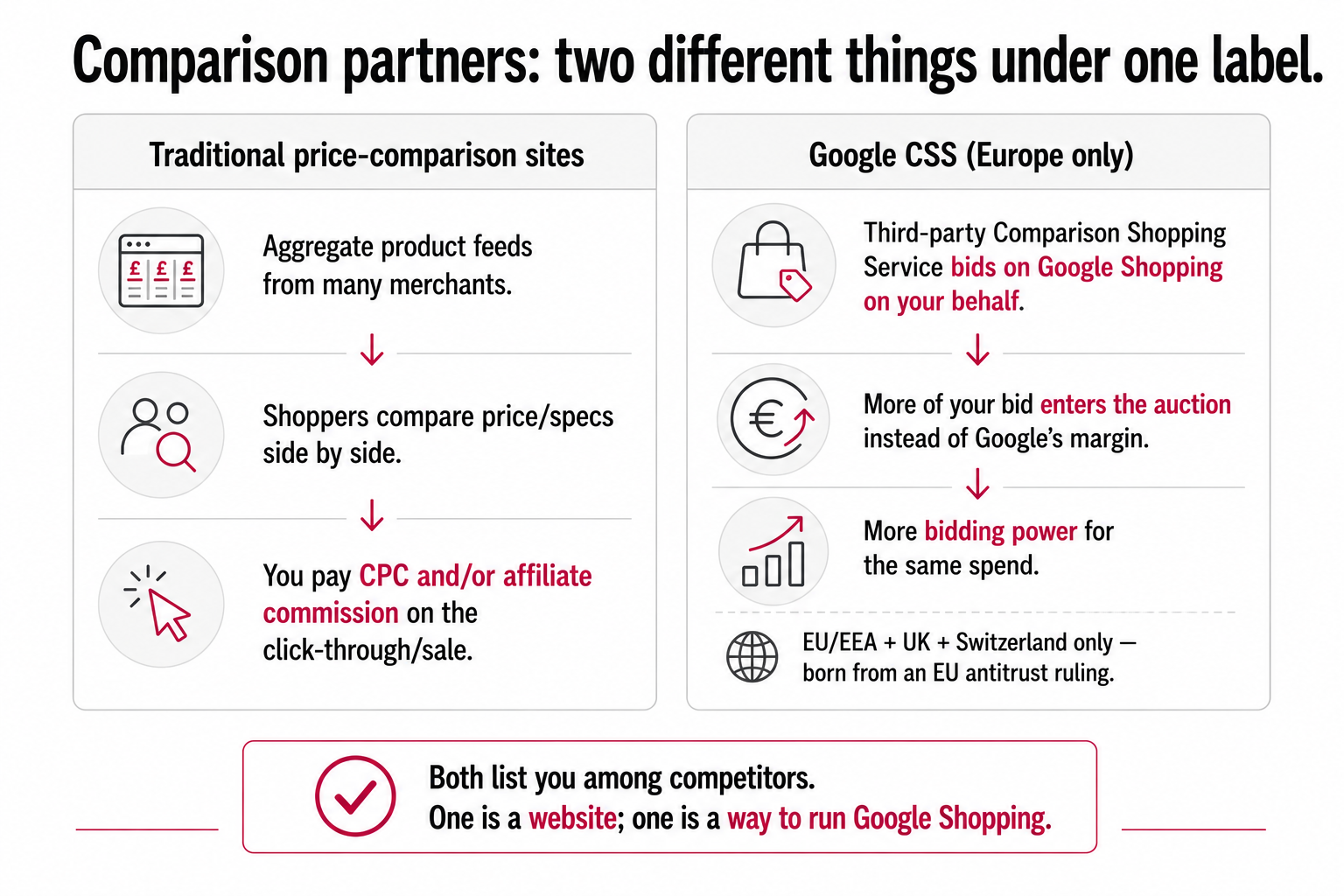
Traditional price-comparison sites. Websites that aggregate product listings from many merchants and let shoppers compare price, specs, and availability side by side. They pull in merchant product feeds (often via affiliate networks that consolidate those feeds), display your products among competitors', and earn either a cost-per-click fee when a shopper clicks through to you, or an affiliate commission on the resulting sale, or a combination of the two. The shopper is actively comparing options, which tells you something important about their mindset, and we will come back to it.
Google CSS (Comparison Shopping Services). This one is specific to Europe and worth understanding properly, because it is genuinely useful and widely misunderstood. CSS exists because of an EU antitrust ruling: regulators found Google had unfairly favoured its own comparison shopping in Shopping ads, and the remedy was to open Shopping ad placements to third-party Comparison Shopping Services that bid on merchants' behalf. The practical effect is a real cost advantage. When you run Google Shopping through a third-party CSS partner rather than Google's own, more of your bid goes into the actual auction rather than being skimmed as Google's margin, which gives you meaningfully more bidding power for the same spend. Crucially, this is an EU/EEA, UK, and Switzerland mechanism, it does not exist in the US, Canada, Australia, or other non-European markets, which is exactly why it is more relevant to a European programme than most English-language affiliate advice acknowledges.
Where they sit on the incrementality spectrum: the middle
Here is the framing that makes sense of this partner type, and it completes the map this whole sub-cluster has been building. Every partner type sits somewhere on a spectrum from creating demand to capturing it. Content publishers and creators create it, they reach people who were not yet shopping. Cashback and coupon sites mostly capture it, they catch people already at checkout. Comparison sites sit squarely in the middle: they capture demand that genuinely exists (the shopper has decided to buy this category of thing) but that might have found a competitor instead of you.
That middle position is the key to valuing them. A shopper on a comparison site has the intent to buy, that part is not incremental, you did not create it. But they have not yet chosen you, and the comparison listing is part of what wins them to you rather than a rival. So a comparison partner's incremental value is real but bounded: it is not creating the purchase, but it can be genuinely deciding who gets it. That is more incremental than a coupon site catching a customer already committed to your brand, and less incremental than a content piece that introduced the category in the first place. Under last-click attribution a comparison site usually looks like a solid mid-table performer, and unlike the interceptors or the creators, that last-click read is not wildly misleading, it roughly matches the middling reality. Which is part of why these partners are easy to forget: they neither flatter nor alarm the dashboard.
They live or die on your product feed
One practical point that applies to the whole comparison category and is too often neglected: these partners run entirely on your product feed. A comparison site or a CSS partner can only display what your feed tells it, and only as accurately as the feed is structured. A messy, incomplete, or stale feed means wrong prices, missing products, poor categorisation, and lost visibility in exactly the comparison context where price accuracy decides the click.
This is the unglamorous foundation behind comparison performance, and it is why feed quality (which I cover fully in the product feeds and data piece) is not a technical afterthought but the thing that determines whether this entire partner type works for you. If you take comparison partners seriously, your product feed is the lever, get it clean, complete, and current, and these partners can perform; neglect it, and no amount of partner management will help, because the data they depend on is broken at the source.
The debate that divides practitioners: CSS-as-affiliate
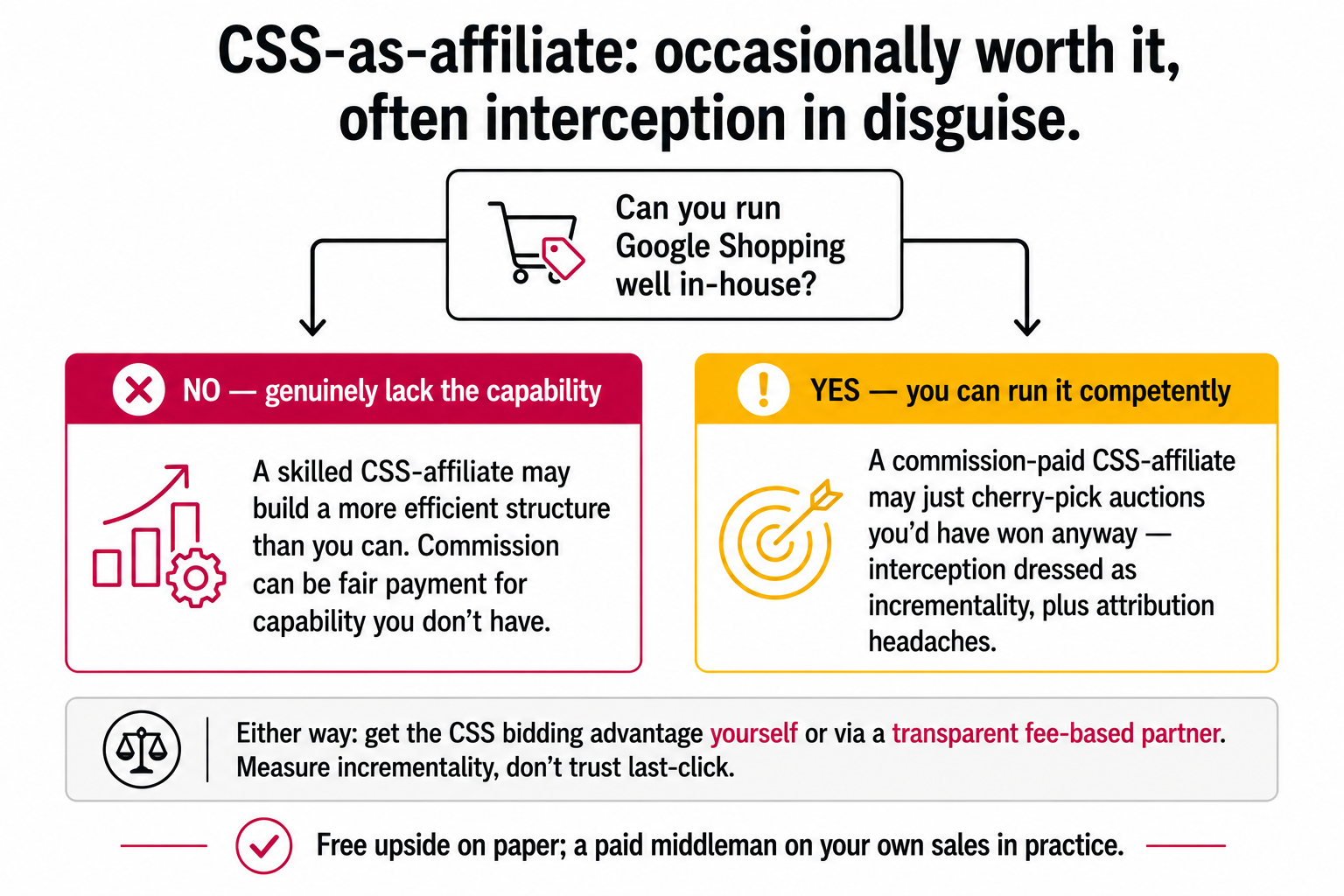
Now the genuinely contested part, because honesty about it is what separates real practitioner advice from a sales pitch. There is a specific arrangement, often called CSS-as-affiliate, where you let an affiliate partner set up their own CSS and run Google Shopping ads on your behalf, alongside your own campaigns, usually on a commission or "no win, no fee" basis. On the surface it looks like free upside: a partner brings extra Shopping visibility and you only pay on results.
In practice it splits opinion sharply, and the criticism is worth taking seriously. The core objection: a CSS-affiliate can simply cherry-pick the auctions your own campaigns would have won anyway, then claim commission on those conversions, giving you an illusion of incremental performance while really just inserting a paid middleman into sales you already had. It is the interception problem wearing a more technical disguise, and it can create real data-integrity and attribution headaches as your own campaigns and the CSS-affiliate's compete for the same clicks. There is also a genuine economic distortion: a commission-paid CSS-affiliate will set a high return-on-ad-spend target to protect their own margin, which can mean they bid only on the easy, high-intent searches, the ones you would have captured cheaply yourself.
The honest verdict, and the one I would give: CSS-as-affiliate is occasionally worth it, but only in a specific case, when you genuinely lack the in-house capability to run Google Shopping well, a skilled CSS-affiliate might build a more efficient structure than you can, and the commission is fair payment for capability you do not have. But if you can run your own Shopping competently, letting a commission-paid affiliate compete in the same auctions usually buys you interception dressed as incrementality. Run the CSS mechanism yourself or through a transparent fee-based partner to get the genuine bidding advantage; be far more sceptical of the commission-based CSS-affiliate model, and if you use it, measure its true incrementality hard rather than trusting the last-click numbers it will happily show you.
How to treat comparison partners
So, the practitioner's stance on the partner type people forget. Do not ignore them, especially in Europe, the CSS bidding advantage is a genuine, structural cost saving on Google Shopping that many EU advertisers leave on the table, and it is worth capturing through your own CSS or a transparent fee-based partner. Treat traditional comparison sites as the mid-spectrum partners they are: real, bounded incremental value, worth having in the mix, judged on whether they genuinely win you shoppers who were comparing rather than rubber-stamping ones already headed your way. Feed your comparison partners well, literally, because their performance is capped by your product-feed quality. And bring the same scepticism here that runs through this whole cluster: be wary of any arrangement, CSS-as-affiliate especially, that lets a partner claim commission on demand you already owned.
That completes the partner map. Creators introduce demand, interceptors capture it at the door, and comparison partners contest the middle, helping decide who wins a shopper who was always going to buy something. None of these partner types is good or bad in itself; each is good or bad depending on whether, in your specific programme, it creates value or merely claims it. The comparison partners are simply the ones most often forgotten, which means they are where a sharp programme manager can find both a real cost advantage (CSS, if you are in Europe) and a quiet leak (CSS-as-affiliate, if you are not paying attention). Worth remembering the partners people forget.
A few common questions
What are comparison shopping sites in affiliate marketing? They're partners that aggregate product listings from many merchants so shoppers can compare price, specs, and availability side by side, then send the click to you for a cost-per-click fee, an affiliate commission on the sale, or a combination. They run on your product feed, displaying your products among competitors', and they reach shoppers who are actively comparing options within a category.
What is a Google CSS (Comparison Shopping Service) partner? A Google CSS partner is a certified third-party Comparison Shopping Service that bids on Google Shopping ad placements on a merchant's behalf. It exists because of an EU antitrust ruling that required Google to open Shopping ads to third-party services. Running Shopping through a third-party CSS rather than Google's own puts more of your bid into the auction instead of Google's margin, giving more bidding power for the same spend. CSS operates only in the EU/EEA, UK, and Switzerland, not in the US or other non-European markets.
Where do comparison sites sit on the incrementality spectrum? In the middle. Unlike content publishers and creators, they don't create demand, the shopper already intends to buy the category. But unlike cashback and coupon sites that catch a customer already committed to your brand, a comparison site can genuinely influence which merchant wins a shopper still choosing between options. So their incremental value is real but bounded: not creating the purchase, but sometimes deciding who gets it.
Is CSS-as-affiliate worth it? Sometimes, but be cautious. CSS-as-affiliate, where a commission-paid partner runs Google Shopping on your behalf alongside your own campaigns, is genuinely useful mainly when you lack the in-house capability to run Shopping well. If you can run it competently yourself, a commission-paid CSS-affiliate often just cherry-picks auctions you'd have won anyway, interception disguised as incrementality, while creating attribution conflicts. Capture the CSS bidding advantage through your own CSS or a transparent fee-based partner, and measure any CSS-affiliate's true incrementality rather than trusting its last-click numbers.
You should also read:
Payment Methods: Match What You Offer to How People Actually Pay
The payment methods you offer are a conversion decision disguised as a technical one. Customers have a preferred way to pay, often a strong one, and if you don't offer it, a meaningful share don't email to complain, they just abandon, silently, at the last…
Continue reading...
Faceted Navigation and Filtering: Helping People Narrow Without Getting Lost
Faceted navigation is the set of filters that lets a customer cut a large category down to the products that actually fit them, by size, price, colour, brand, use, whatever matters to their choice. Done well, it turns an overwhelming catalogue into a manageable shortlist…
Continue reading...
Retail Media and Amazon Ads: Advertising Where People Are Already Buying
Retail media is advertising placed on a retailer's own digital shelf, right where people are already shopping and ready to buy. Its strength is obvious: you reach shoppers at the moment of purchase, with the retailer's real purchase data behind both the targeting and the…
Continue reading...