Payment Methods: Match What You Offer to How People Actually Pay

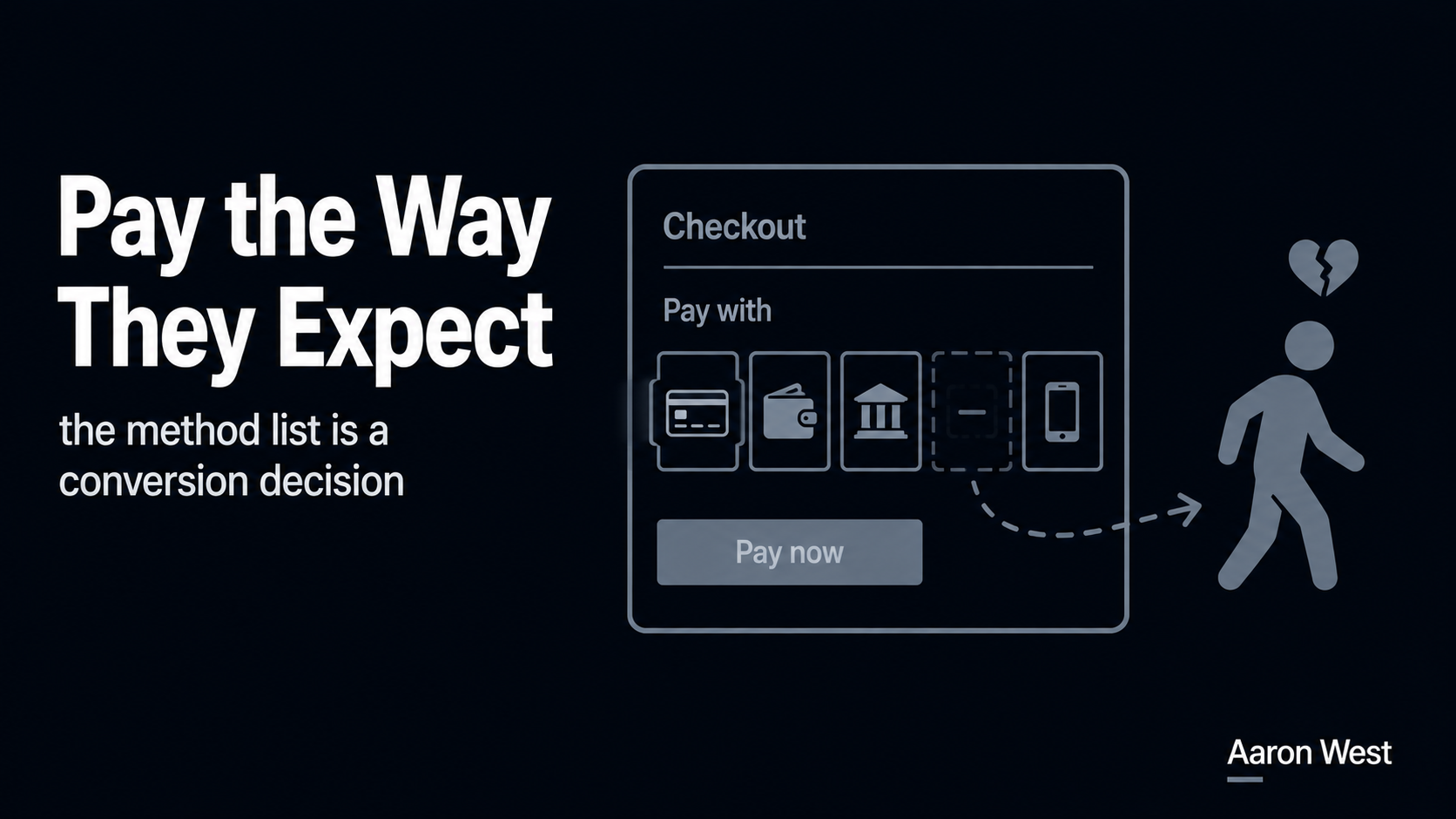
Table of Contents
The payment methods you offer are a conversion decision disguised as a technical one. Customers have a preferred way to pay, often a strong one, and if you don't offer it, a meaningful share don't email to complain, they just abandon, silently, at the last step. The right set of methods isn't "as many as possible." It's the ones your actual customers, in your actual markets, expect to see, because a missing preferred method is a lost sale and every extra method you bolt on carries its own cost and complexity.
This is a core of the Payments pillar, under the cornerstone that payments are infrastructure, not a checkbox. The cornerstone named conversion as the first of the payment layer's four jobs; this piece is that job in detail, because the method list is where most of the silent, invisible abandonment at payment actually happens.
Methods are conversion, not plumbing
The instinct is to treat payment methods as a back-office integration choice: pick what's easy to switch on, what your platform supports out of the box, what you personally recognise. But the customer doesn't experience your integration; they experience whether their trusted way to pay is there when they reach the checkout. And when it isn't, they don't tell you. They don't open a support ticket saying "I'd have bought if you took my method." They just close the tab, and the sale evaporates without a trace, which is what makes this failure so easy to miss and so expensive to ignore.
That's the core reframe. A payment method isn't a feature you add for completeness; it's the removal of a hard stop for the customers who use it. Offering someone's trusted method removes friction at the most sensitive moment in the journey. Missing it puts a wall there, and they turn around.
The preferred-method reality, and how much it varies by market
People have payment defaults they trust and methods they actively distrust, and those defaults are surprisingly strong and surprisingly local. This is where payment methods and going international collide, because the "obvious" set of methods in one market is the wrong set in another.
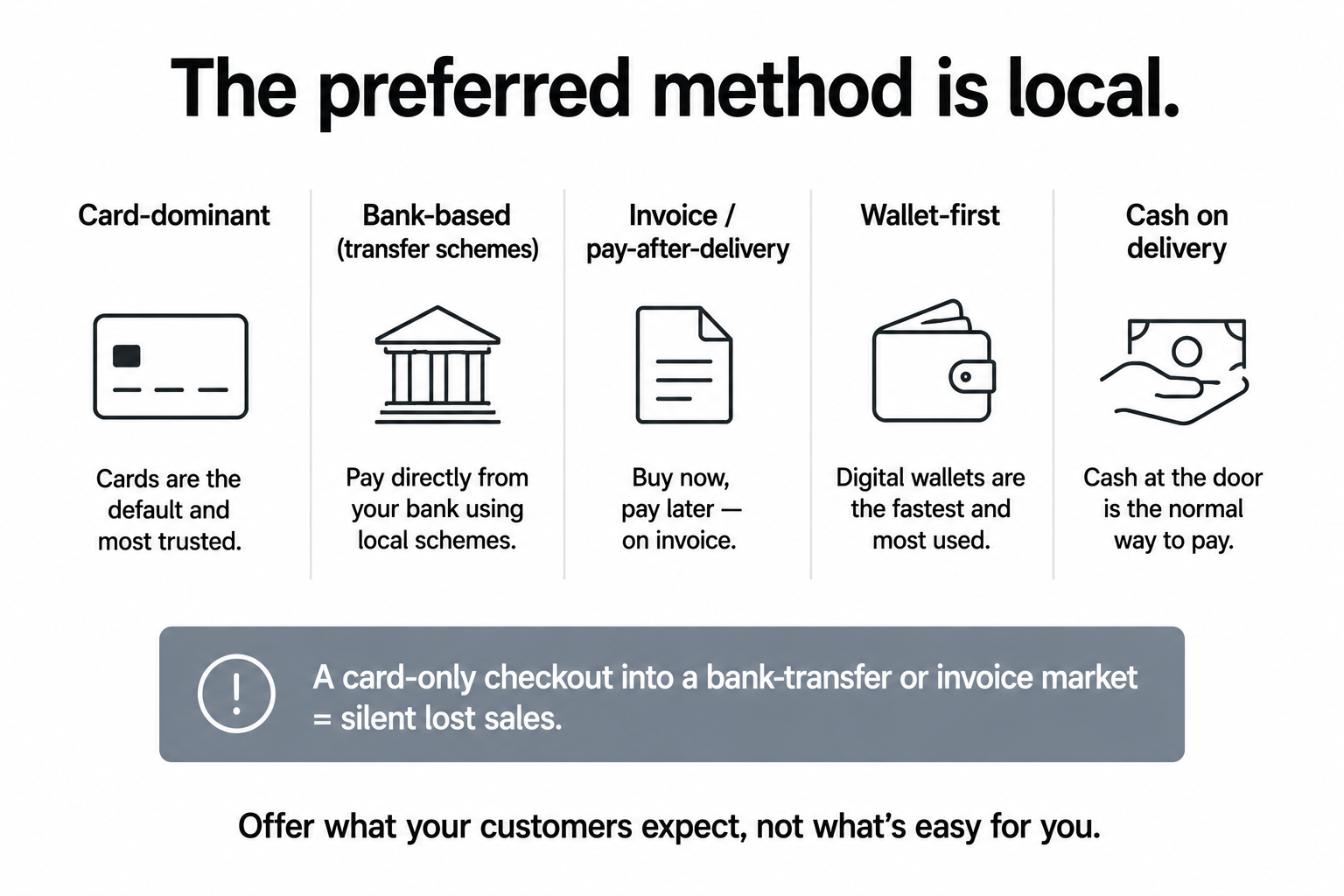
A few illustrative patterns make the point. Some markets are card-dominant, where a credit or debit card is simply how people expect to pay online. Others lean heavily on bank-based methods, a direct bank-transfer scheme that customers trust far more than handing a card to an online store. Some markets have a strong cultural preference for paying on invoice, receiving the goods first and paying afterward, which feels normal and safe to those customers and alien to a store that only takes cards up front. Others are wallet-first, or still rely meaningfully on cash on delivery. None of these is "correct"; they're just what people in that market expect, and a store that offers a card-only checkout into a market that pays by bank transfer or on invoice is leaving real money on the table while wondering why its checkout abandonment is high there.
The transferable point isn't the specific list, which changes by country and over time. It's that you cannot assume your customers pay the way you pay, or the way your home market pays. The preferred method is a property of them, not of you.
The method categories, in plain terms
Underneath the market variation, the methods fall into a few durable categories, each doing a slightly different job:
- Cards (credit and debit). Broad and familiar in many markets, but not universal, and they carry declines and fees. A sensible default in most places, a poor sole option in several.
- Digital wallets and express checkout. The "pay in one tap" buttons that pull in saved details. These massively reduce friction, especially for returning and mobile customers, and they're one of the strongest conversion levers in the whole checkout, because they remove the typing that kills mobile completion.
- Bank-based methods. Direct transfers and regional bank schemes that, in the markets where they dominate, customers trust more than cards. Often cheaper for the merchant too.
- Invoice, pay-on-delivery, and pay-later. Methods that let the customer receive goods before paying, or spread the cost. Culturally important in some markets and a real conversion lever, but they shift risk and cost onto you, which is why buy now, pay later deserves its own careful look.
The mobile angle cuts across all of these: on a phone, anything that avoids typing a long card number wins, which is why wallets and express options matter more on mobile than they ever did on desktop.
More isn't better
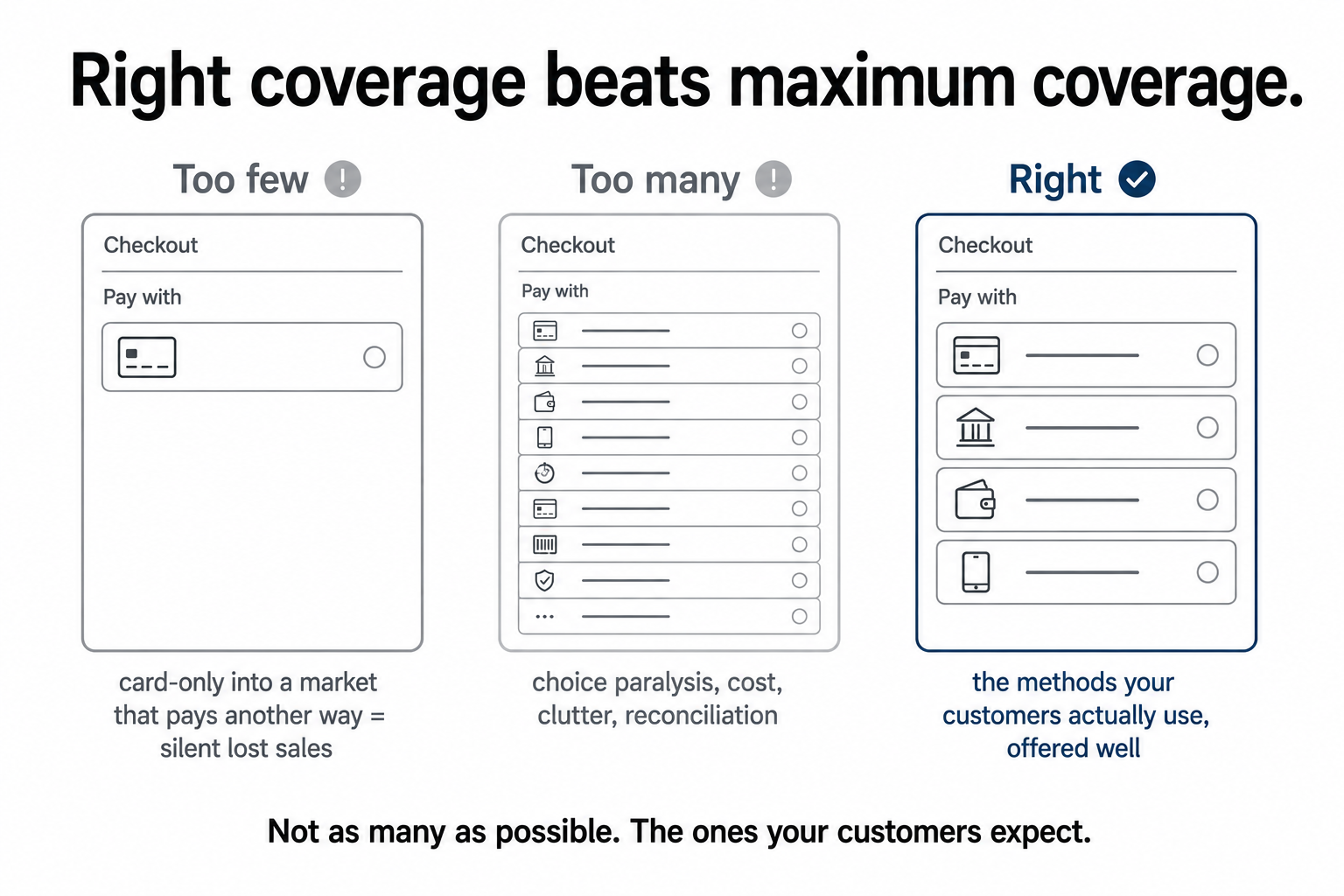
Here's the counterweight to "offer what your customers expect," because it's easy to over-correct into "offer everything." You shouldn't. Every method you add is another integration to maintain, another set of fees, another reconciliation stream, another support surface when something goes wrong, and another option cluttering the checkout. And a checkout with too many payment options creates its own friction: choice paralysis at the worst possible moment, when you want the customer deciding to pay, not deliberating over how.
So the goal isn't maximum coverage; it's the right coverage. Offer the methods that genuinely matter to your customers in the markets you serve, and leave off the long tail that adds cost and clutter without adding sales. A focused, well-chosen set of methods converts better than an exhaustive one, the same way good faceted navigation surfaces the filters that matter rather than every attribute you store.
How to actually decide
The decision comes down to one question, asked honestly: how do the people I'm selling to expect to pay? Answer it from data and market knowledge, where your customers are, what's normal in those markets, what your analytics and your abandonment patterns suggest, rather than from what's easiest to integrate or what you personally use. The most common mistake is projecting your own payment habits onto a customer base that pays differently, and it's an easy one to make precisely because your own habits feel like the default.
Then offer that set, well: prominent, trustworthy, and working smoothly on mobile, and resist the urge to pad it with methods nobody asked for. The method list, done right, is a map of your customers. Done wrong, it's a map of your convenience, and the gap between the two is sales you never knew you lost.
What this comes down to
The question isn't "what payment methods exist" or "what's easiest for us to switch on." It's "how do the people I'm actually selling to expect to pay," and then offering exactly those methods, prominently and well, without drowning the checkout in options nobody uses. Get that right and a silent, invisible source of lost sales, the customer who reached the payment step and didn't see their method, quietly closes up.
Your customers will not tell you when their preferred method is missing. They'll just leave. The only way to know is to look at how they actually pay, not how you assume they do, and to build the method list around them rather than around you.
A few common questions
Do payment methods really affect conversion? Yes, directly. Customers have a strong preferred way to pay, and when it's missing they don't complain, they abandon silently at the last step, so the lost sales never show up as feedback. Offering someone's trusted method removes a hard stop at the most sensitive moment in the journey; missing it puts a wall there. That's why the method list is a conversion decision, not just a technical one.
Which payment methods should I offer? The ones your actual customers, in your actual markets, expect, not as many as possible. Preferred methods vary sharply by market: some are card-dominant, others lean on bank-transfer schemes, invoice/pay-after-delivery, wallets, or cash on delivery. Decide from data and market knowledge about how your customers pay, rather than from what's easiest to integrate or what you personally use, which is the most common mistake.
Should I just offer every payment method available? No. Every method adds integration, fees, reconciliation, support, and checkout clutter, and too many options create choice paralysis at the worst moment. The goal is the right coverage, not maximum coverage: the methods that genuinely matter to your customers, offered well, with the long tail left off. A focused set converts better than an exhaustive one.
Why do digital wallets and express checkout matter so much? Because they remove typing, which is the biggest source of friction on mobile, where much of your traffic is. One-tap options that pull in saved details let returning and mobile customers pay without entering a long card number on a small screen, which is one of the strongest conversion levers in the whole checkout. The harder a method makes paying on a phone, the more sales it quietly costs.
You should also read:
Local Payment Methods: The Cross-Border Detail That Kills Conversion
When you sell into a new country, the fastest way to kill your conversion there isn't getting the language slightly wrong. It's failing to offer the local payment method that customers in that market trust and expect. Every market has its own dominant ways to…
Continue reading...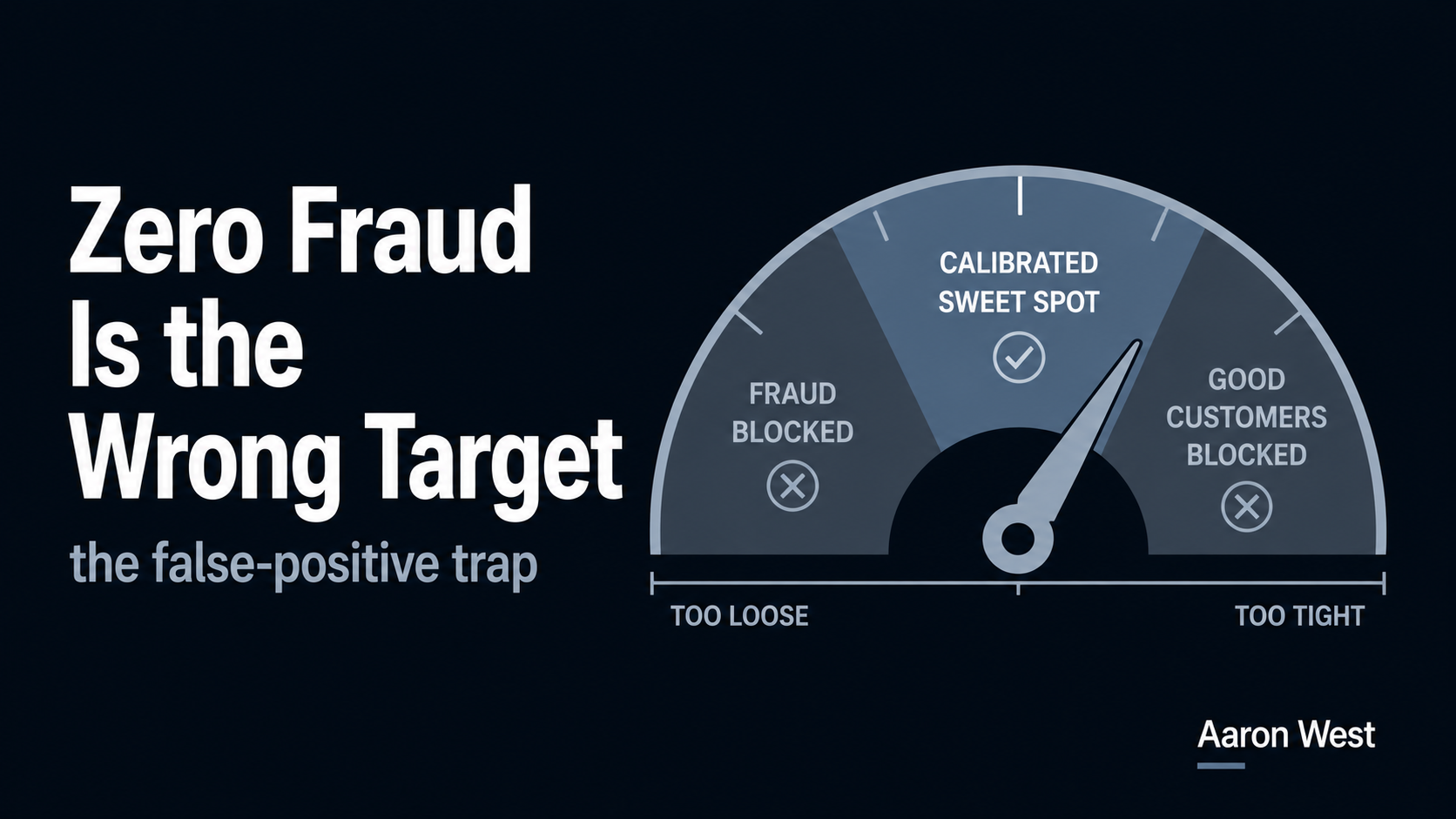
Chargebacks and Payment Fraud: The Defence Most Stores Set Up Too Late
Chargebacks and payment fraud are the risk that turns a "sale" into a loss after you've already shipped the goods, and most stores only build a real defence after the first painful wave has hit. Two very different problems hide under the single word "fraud":…
Continue reading...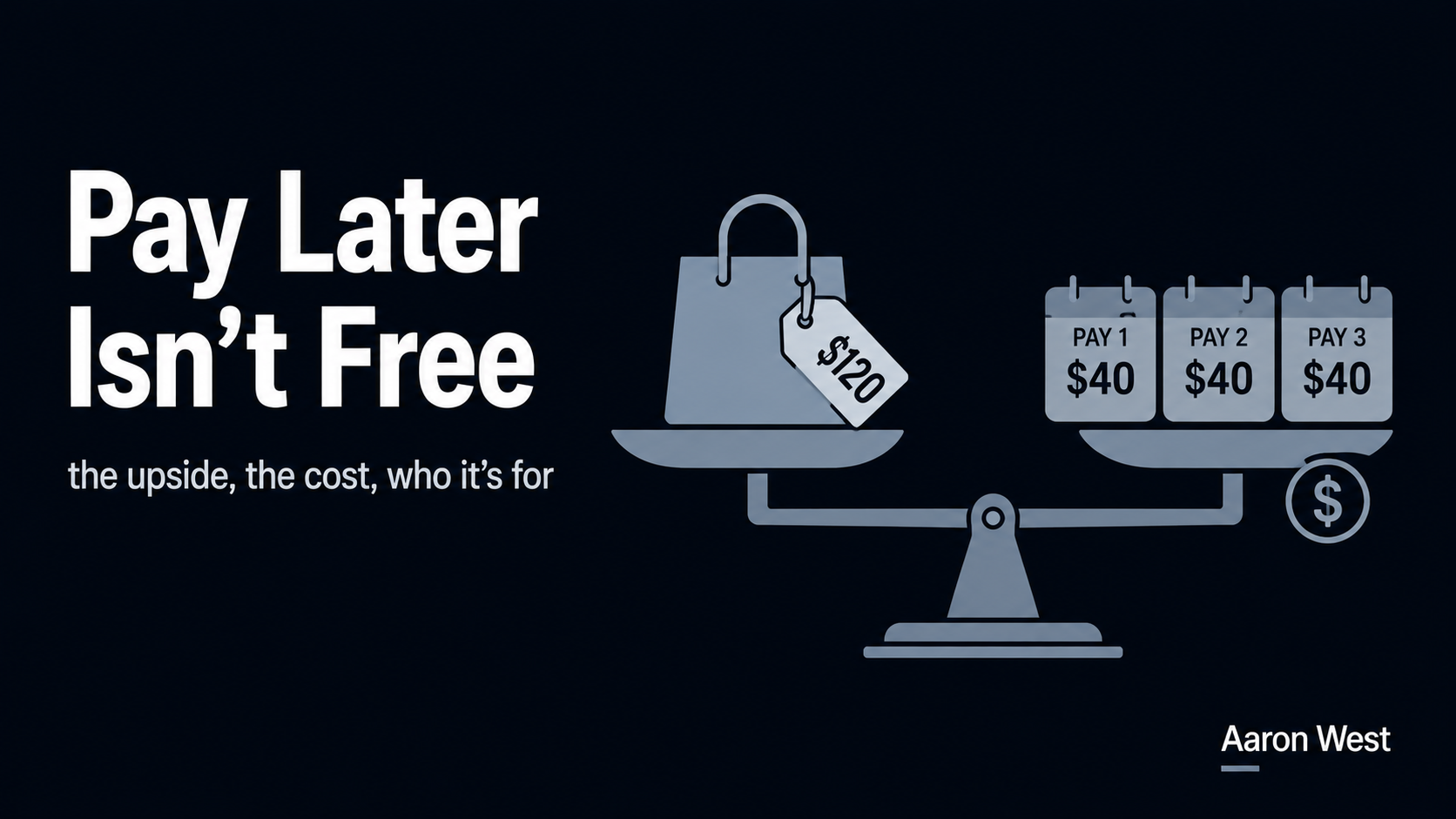
Buy Now, Pay Later: The Upside, the Cost, and Who It's Actually For
Buy now, pay later, the option to split a purchase into installments or defer it at checkout, is sold as a pure conversion win, and it genuinely can lift both conversion and average order value, especially on higher-ticket purchases and with younger shoppers who increasingly…
Continue reading...