Influencers and Creators: How Affiliate Powers Creator Commerce

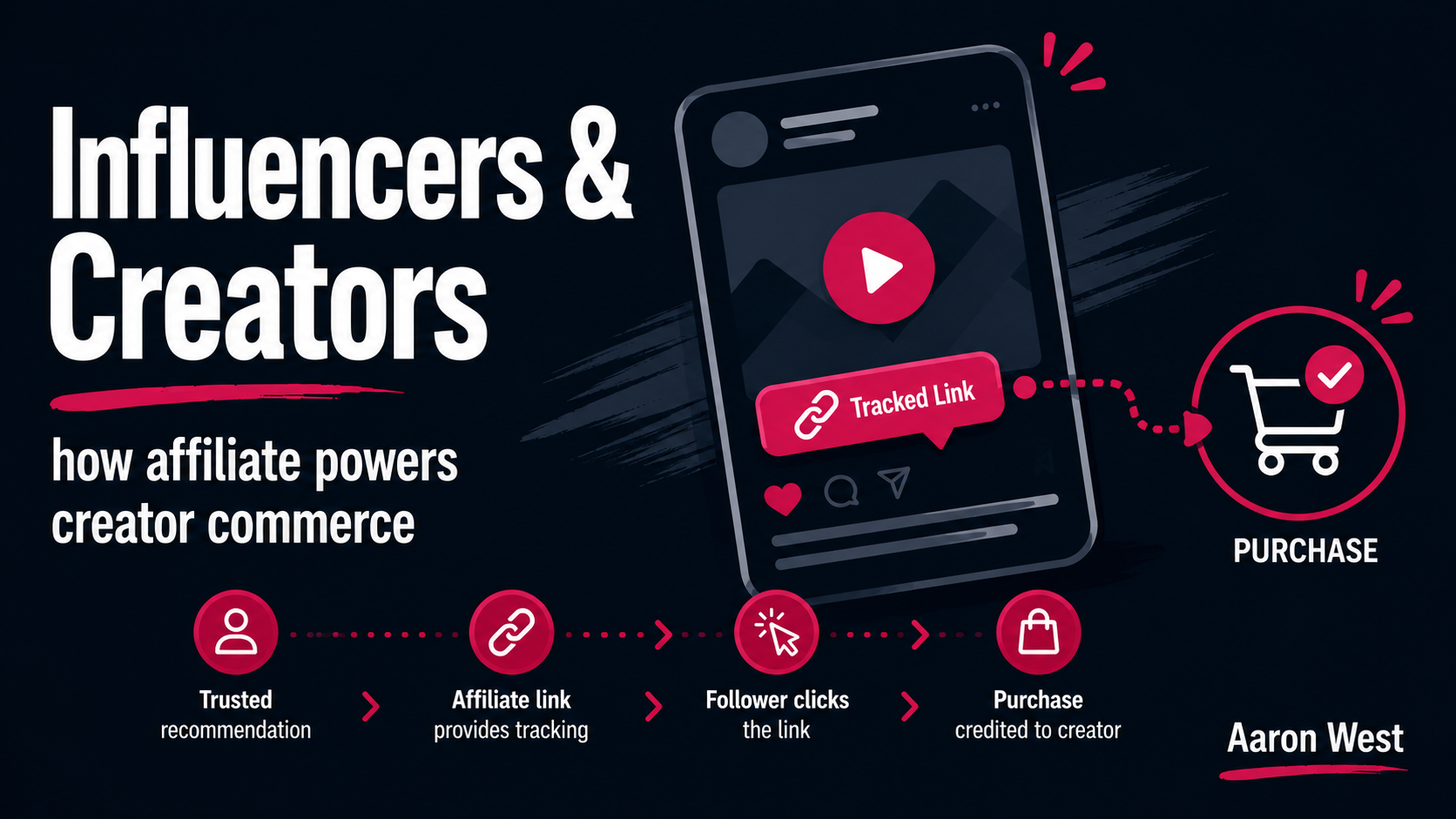
Table of Contents
Influencers and creators are the fastest-growing partner type in affiliate marketing, and the reason is a shift in how they get paid. Traditional influencer marketing meant paying a creator a flat fee upfront for a post, and hoping it worked. Affiliate flipped that: the creator gets a trackable link or code and earns commission on the sales they actually drive, so the brand pays for results, not for hope. That single change, from paying for reach to paying for outcomes, is what turned creators from an advertising line item into a performance channel, and it is reshaping the whole space.
This is a deep-dive within the affiliate publisher landscape, and creators belong in the same family as content and editorial publishers: they are demand creators, partners who introduce products to audiences who were not already shopping, which (as with content publishers) means last-click attribution tends to underrate them. But creators bring their own mechanics, their own payment models, and their own risks. This piece covers how creator affiliate actually works, the platforms enabling it, how the payment models are evolving, the disclosure rules you cannot ignore, and how to value creators properly.
How creator affiliate works (and how it differs from old influencer marketing)
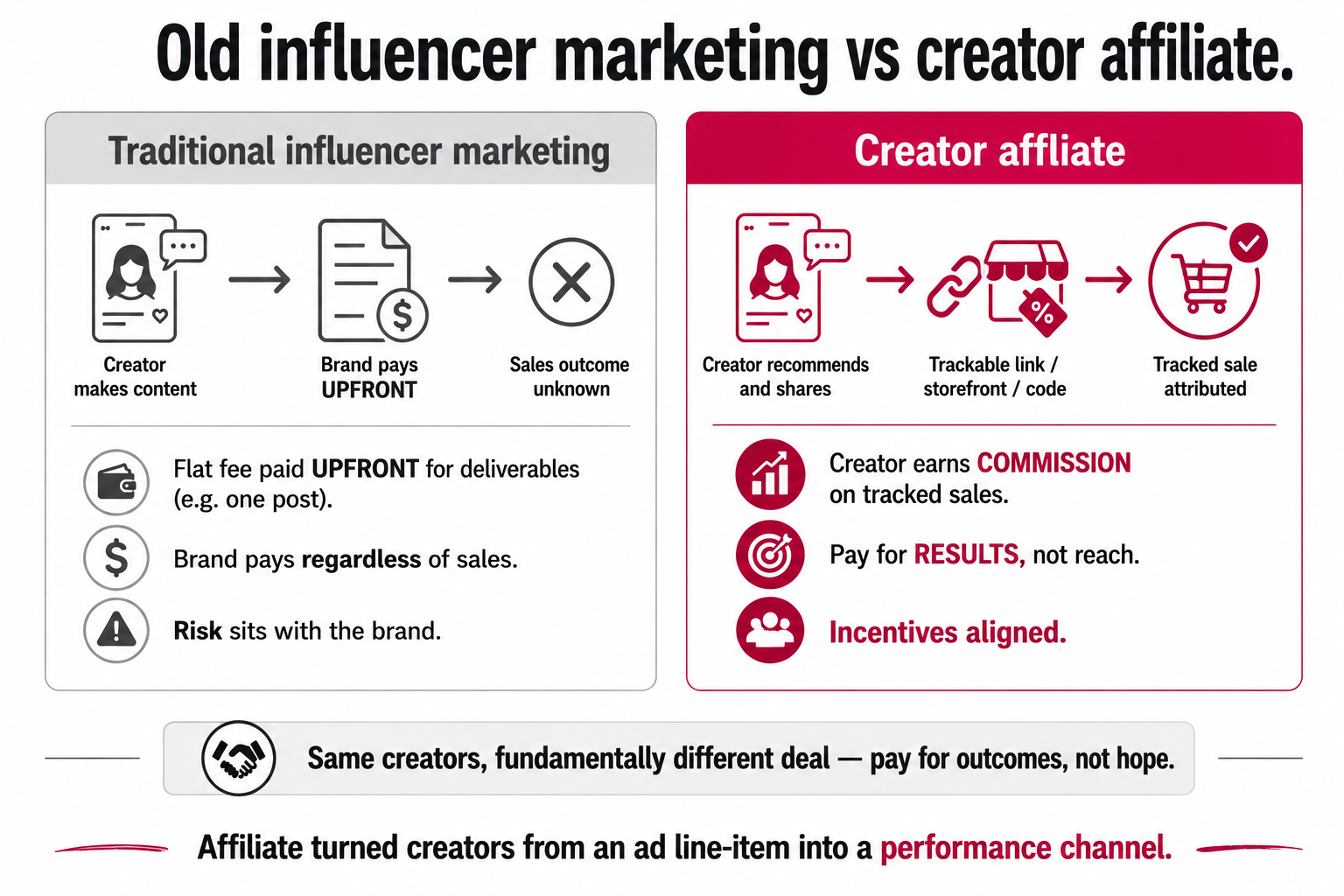
The mechanism is standard affiliate adapted to social platforms. A creator gets a unique trackable link, a personal storefront, or a dedicated discount code, features your product in their content, video, post, livestream, story, and earns commission when their audience buys through it. The defining contrast with traditional influencer marketing is when and why the money changes hands. Old-school influencer deals paid a fixed fee upfront for a set of deliverables, regardless of whether a single sale resulted. Affiliate ties the creator's earnings to actual tracked sales, which aligns incentives, the creator only makes real money if they genuinely move product, and shifts the risk off the brand.
This works because of a trust dynamic similar to content publishers but more personal. A creator has a relationship with their audience; a recommendation from someone you follow and trust carries weight a banner ad never could. When that recommendation comes with a link to buy, the path from "I trust this person" to "I bought the thing" is short. That is the real engine of creator commerce: parasocial trust converted into purchase, measured and paid on performance.
The platforms that made creator commerce explode
What turned this from a niche tactic into the fastest-growing partner type is infrastructure. A wave of platforms made it genuinely easy for creators to monetise recommendations and for brands to run creator affiliate at scale, without bespoke deals for every creator.
Broadly, two kinds of platform matter. First, social commerce built directly into the platform where the content lives, native in-app shopping where the creator tags a product, the viewer taps, and checkout happens without leaving the app, with the creator earning commission on the sale. Collapsing discovery and purchase into a single tap removes almost all the friction between "I want that" and "I bought it." Second, dedicated creator-affiliate platforms that act as intermediaries, letting creators build shoppable storefronts of everything they recommend across many brands, and giving brands a marketplace to find and partner with relevant creators. Some of these are evolving further, into hybrid marketplaces where brands can also propose paid or gifted partnerships on top of pure commission.
The practical upshot for a programme manager is that creator affiliate is now an accessible, scalable channel rather than a series of one-off negotiations, which is exactly why it is growing so fast and why it deserves a deliberate place in your partner mix. (Note that the specific platforms dominating this space shift quickly; the durable point is the two categories, in-platform social commerce and dedicated creator-affiliate marketplaces, not whichever brand names lead them this year.)
How the payment models are evolving
This is where it gets practical, because creator compensation is actively shifting and understanding the direction helps you structure deals well. There are three basic models, and they map onto the broader commission-model thinking in this cluster:
- Flat fee. A fixed payment for agreed content, the traditional model. Predictable for the creator, all-risk for the brand, since you pay whether or not it sells.
- Pure commission (affiliate). The creator earns only on tracked sales. All-risk for the creator, lowest risk for the brand, but harder to attract top creators who want some guarantee for their work.
- Hybrid. A smaller base fee plus commission. This shares the risk, the creator gets paid something for the content work, and earns more if it converts, and it is where the market is clearly heading.
The 2026 direction is unmistakable: away from pure flat fees, toward structured hybrid models. The logic is sound, pure commission underpays creators for genuine content work (and so loses the best ones), while pure flat fees make the brand carry all the risk, so a base-plus-commission hybrid aligns both sides. Alongside this, the centre of gravity is shifting toward micro and nano creators, smaller accounts with highly engaged, trusting niche audiences, rather than a few expensive mega-influencers. The economics increasingly favour many affordable, well-matched creators on smart tiered structures over a handful of costly big names, because engagement and authentic fit convert better than raw reach. For you, that means the winning approach is usually a portfolio: more creators, carefully matched to your niche, on hybrid terms tiered by performance, rather than a few headline names paid flat.
Disclosure is not optional
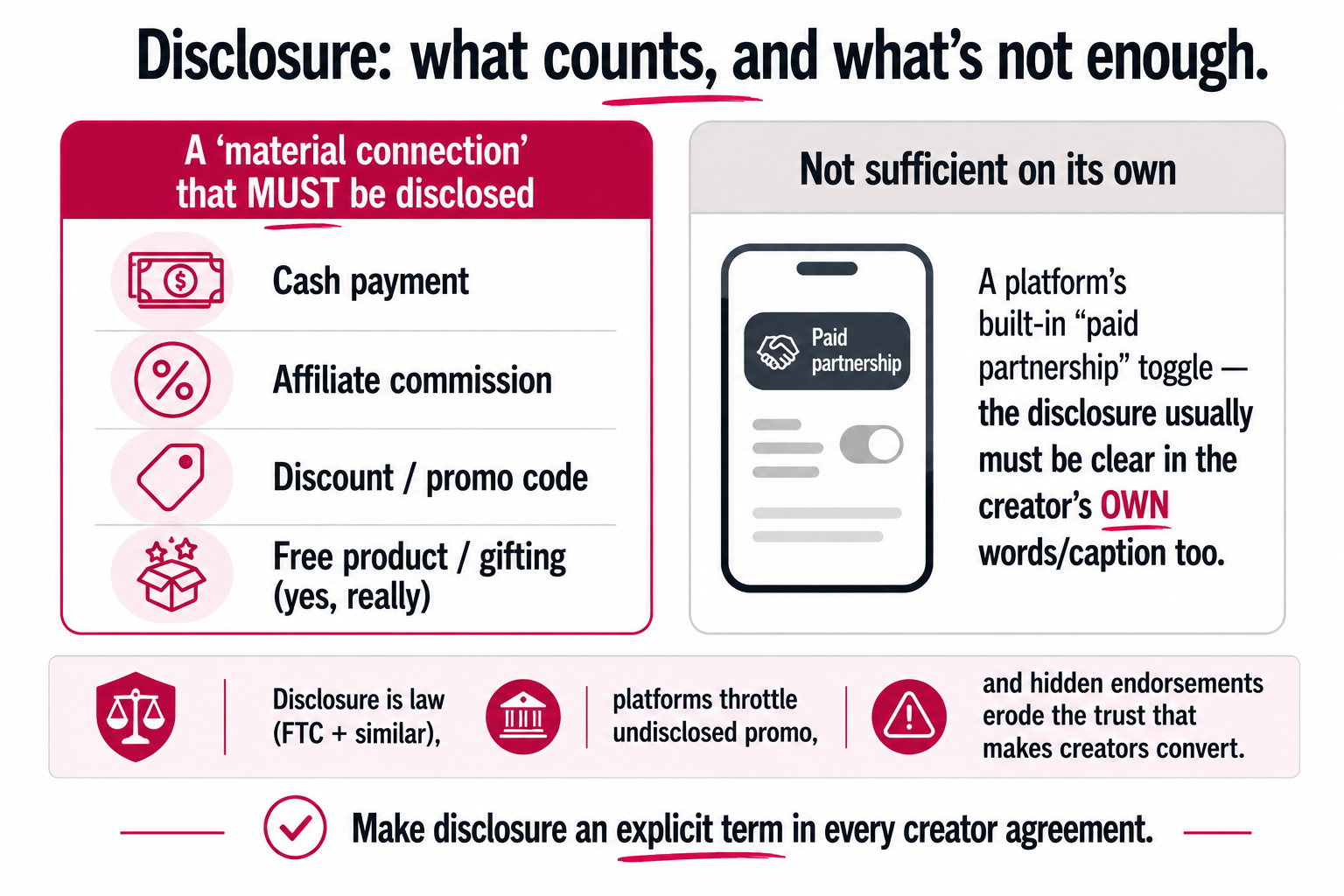
Before anything else about running creators well, one hard rule that is genuinely non-negotiable, because getting it wrong is a legal and reputational risk, not just a best practice. Any creator promoting your product for compensation, commission, flat fee, or free product, must clearly disclose that material connection. This is the law in the US under the FTC's endorsement rules, and similar rules apply in many markets.
Two things commonly trip brands and creators up. First, a platform's built-in "paid partnership" label is often not sufficient on its own, the disclosure typically has to be clear in the creator's own words or caption, not just a platform toggle. Second, "material connection" is broader than people assume: it includes free products and gifting, not just cash. If you send a creator a product expecting a post, that is a material connection that must be disclosed. Platforms increasingly enforce this too, undisclosed promotional content can have its reach throttled, so non-compliance hurts performance as well as inviting regulatory trouble. The practical stance: make disclosure a clear, explicit requirement in every creator agreement, and treat a creator's willingness to disclose properly as a basic sign of professionalism. A creator who hides the relationship is both a legal liability and, as with content publishers, a weaker partner, because hidden endorsements erode the very trust that makes creators convert.
How to value creators properly
Pulling it together, here is the practitioner's approach to creators as an affiliate partner type, and it blends lessons from the rest of this cluster.
Treat them as demand creators, and measure accordingly. Like content publishers, creators mostly work top and middle of the funnel, introducing products to audiences who were not already shopping you. So last-click will tend to underrate them, the viewer discovers your product in a creator's video, then buys later through another route. Judge creators by incrementality and full-funnel contribution, not just the last click, or you will undervalue your best ones. Build a matched portfolio on hybrid terms, favour many well-fitted micro and nano creators on base-plus-commission deals tiered by performance over a few expensive flat-fee names. Mind the code-leakage risk, if you give creators discount codes, the same leakage problem from coupon sites applies, a creator's code can escape to deal aggregators and get used far beyond its audience, so use unique, trackable, condition-bound codes and monitor them. And make disclosure and authenticity non-negotiable, both because it is the law and because a creator's credibility is the asset you are paying for.
The throughline, again, is this cluster's constant theme: value a partner by the demand it genuinely creates, not the last click it wins. Creators are the most personal, fastest-growing expression of that principle, partners whose trusted relationship with an audience can introduce your brand in a way nothing else can, paid fairly on a model that shares risk, measured honestly past the last click, and held to real disclosure. Get that combination right and creator affiliate becomes one of the most powerful growth levers in the modern programme. Get it wrong, chase mega-names on flat fees, judge them on last-click, ignore disclosure, and you will overpay for reach, undervalue your real performers, and expose yourself to risk. The creators are not the variable. How you structure, measure, and govern the relationship is.
A few common questions
How does influencer/creator affiliate marketing work? A creator gets a unique trackable link, a personal storefront, or a discount code, features your product in their content, and earns commission on the sales they drive through it. It differs from traditional influencer marketing, where a brand pays a flat fee upfront regardless of results. Affiliate ties the creator's earnings to actual tracked sales, so the brand pays for outcomes rather than reach, and the creator's incentives align with driving real purchases.
How are creators paid in affiliate programmes? Three models: flat fee (fixed payment for content, all risk on the brand), pure commission (the creator earns only on tracked sales, all risk on the creator), and hybrid (a smaller base fee plus commission, sharing risk). The clear 2026 direction is toward hybrid, because pure commission underpays creators for genuine content work while flat fees make brands carry all the risk. The market is also shifting toward many micro and nano creators on tiered terms rather than a few expensive mega-influencers.
Do influencers have to disclose affiliate links? Yes. Any creator promoting a product for compensation, including commission, a flat fee, or even free product, must clearly disclose that material connection. In the US this is required by the FTC's endorsement rules, and similar rules apply elsewhere. A platform's built-in "paid partnership" label often isn't sufficient on its own; the disclosure usually must be clear in the creator's own words. "Material connection" includes gifting, not just cash, and platforms increasingly throttle the reach of undisclosed promotional content.
How should brands value creator affiliate partners? Treat them as demand creators and measure by incrementality and full-funnel contribution, not just last-click, which underrates them. Build a portfolio of many well-matched micro and nano creators on hybrid (base-plus-commission) terms tiered by performance, rather than a few costly flat-fee names. Use unique, condition-bound, trackable codes and monitor for leakage. And make proper disclosure a non-negotiable term, because a creator's credibility is the asset you're paying for.
You should also read:
Affiliate Fraud: The Types, the Detection Methods, and the Controls
Affiliate fraud is any attempt to earn commissions for results that were not genuinely driven, faked clicks, faked leads, or stolen attribution, and because the whole channel pays for results, it has always attracted people who try to fake results. The defining shift in 2026…
Continue reading...
The Affiliate Marketing Glossary: Every Term, in Plain English
Affiliate marketing is full of acronyms and jargon, CPS, EPC, S2S, dedup, postback, cookie window, that can make a simple channel sound impenetrable. This glossary defines the terms that actually matter, in plain English, grouped so you can see how they fit together. Each definition…
Continue reading...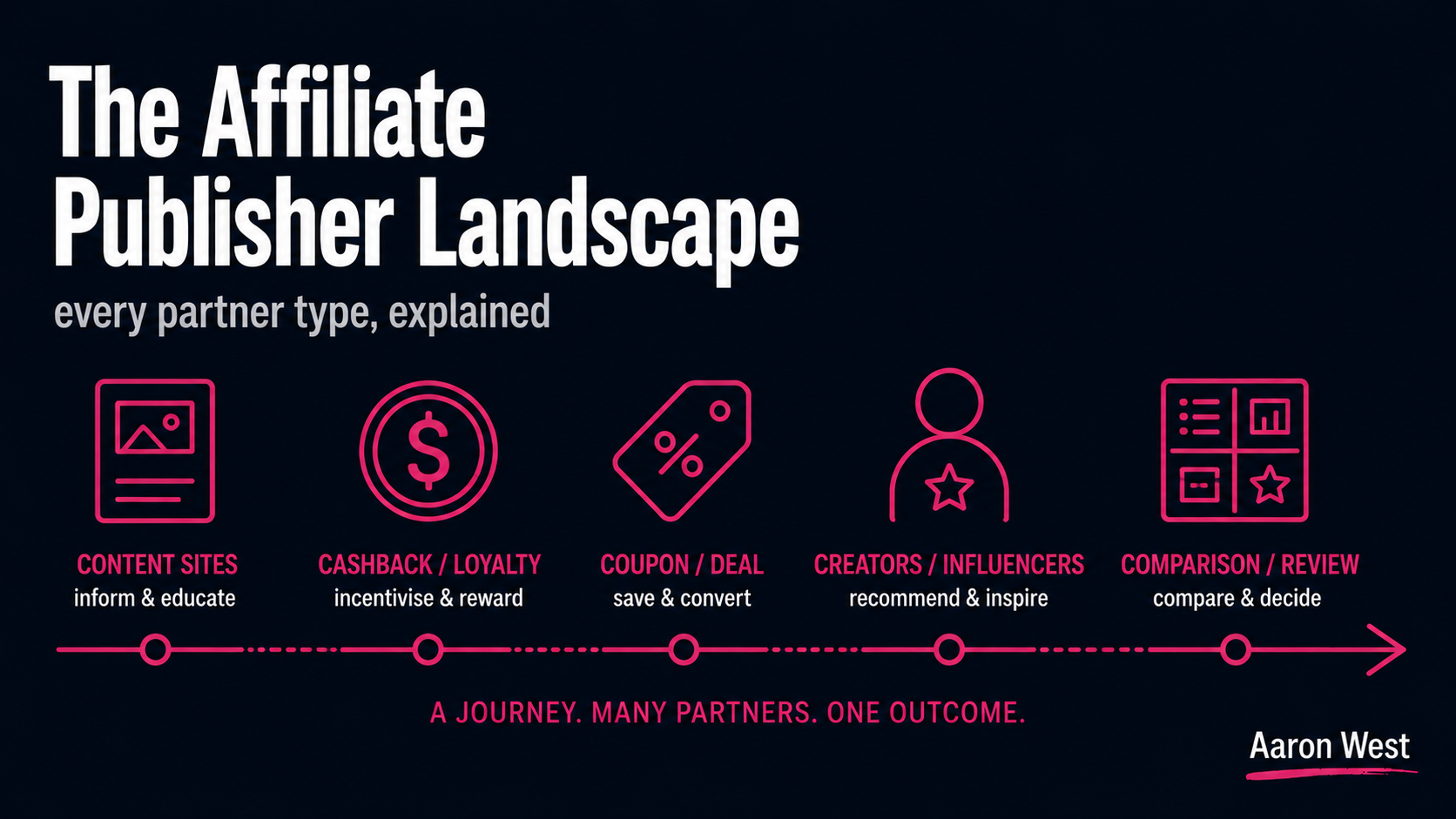
The Affiliate Publisher Landscape: Every Partner Type, Explained
"Affiliate" covers wildly different kinds of partner, content sites, cashback platforms, coupon sites, influencers, comparison engines, and the single most important thing to understand is that they do fundamentally different jobs. Some genuinely introduce new customers to your brand; others mostly intercept customers who were…
Continue reading...