Coupon and Deal Sites: Value Driver or Margin Leak?

Table of Contents
Coupon and deal sites are affiliate partners that promote discount codes and offers, and the honest answer to whether they help or hurt is: both, depending entirely on how well you control them. Run well, with unique codes and clear rules, they bring real volume and reach genuine bargain-hunters you might not otherwise capture. Run carelessly, they become a margin leak that pays them commission, and hands customers a discount, on sales you were already going to make, while your codes spread across the internet and quietly destroy your pricing control. The partner type is not the question. The control is.
This is a deep-dive within the affiliate publisher landscape, and the sibling to cashback and loyalty publishers. The two share a problem, both sit at the bottom of the funnel and both can intercept demand rather than create it, but the mechanism differs: cashback rewards after purchase, coupons discount upfront. That upfront discount is exactly what makes coupon sites both powerful and dangerous. Here is how they really work, the genuine value, the real costs, and how to run them so they drive growth instead of leaking margin.
How coupon and deal sites work
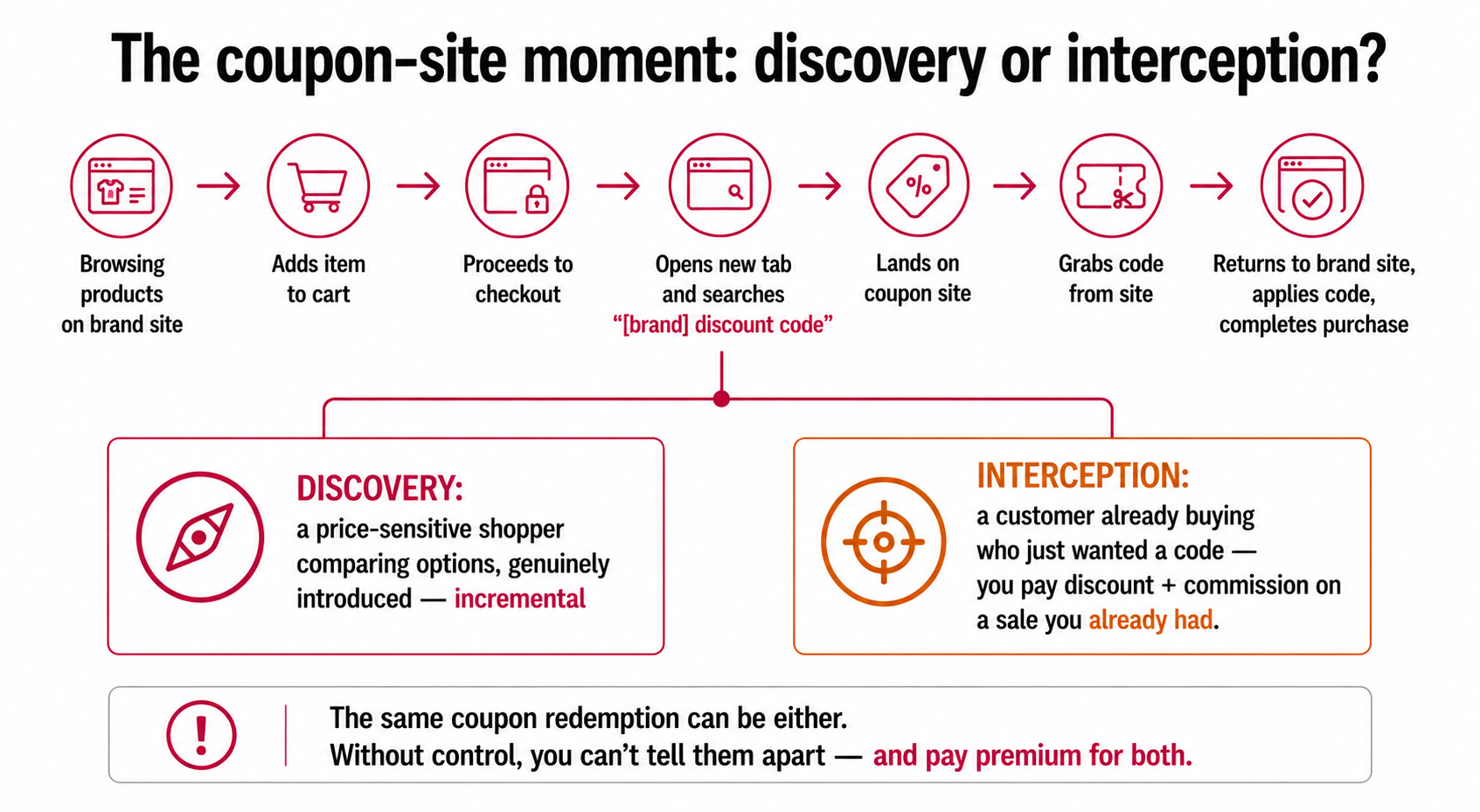
The model is straightforward: coupon and deal sites publish discount codes and offers for merchants, and earn affiliate commission when a shopper uses one of those codes to buy. They attract people who are specifically searching for a discount, the shopper who, before checking out, opens a new tab and types "[your brand] discount code." The coupon site that ranks for that search captures the click, the shopper grabs the code, applies it at checkout, and the site earns its commission.
That behaviour pattern is the key to understanding everything about this partner type. A large share of coupon-site traffic is people who were already buying and went looking for a code at the last moment. The coupon site did not introduce them to you; it intercepted them on the doorstep and handed them a discount, then claimed credit. Under last-click attribution, that interception looks like a driven sale. Whether it actually was one is the entire question, and it is the same incrementality question that haunts cashback, just arriving through a different door.
The genuine value (don't dismiss it)
It would be lazy to write coupon sites off, and the reflexive "coupon sites are just margin leak" take misses real value. So, fairly:
They drive genuine volume, and some of it is genuinely new. Not everyone searching for a deal was already committed to you. A shopper comparing options, or discovering your brand through a deal aggregator's category listing, can be a real new customer the coupon site introduced. They serve a real customer need, a meaningful segment of shoppers are price-sensitive and will hunt for a code before buying; meeting that need can be the difference between a sale and an abandoned cart, especially for first-time buyers nervous about committing. They offer discovery and reach, large deal sites have substantial audiences and good search visibility, putting you in front of bargain-hunters at the moment they are actively shopping your category. And used deliberately, a coupon can be a precise tool, a first-order-only code to convert a hesitant new customer, a win-back offer for a lapsed one, a time-boxed push to clear stock.
The pattern, exactly as with cashback: the sales are real, the audiences are real, and some coupon-driven customers are genuinely incremental. The problem is never that coupon sites are fake. It is that without control, you cannot tell the incremental customers from the intercepted ones, and you end up paying premium for both.
The real costs: pay-twice, leakage, and friction
Now the dangers, because they are specific and they compound.
You pay twice. This is the core economic risk: on an intercepted sale, you give up margin twice, once on the discount the customer redeems, and again on the commission you pay the coupon site, for a purchase that would have happened at full price without either. For a retailer on thin margins, a leaked or over-generous code applied to sales that did not need it can tip the unit economics negative, you are losing money to "win" a sale you already had.
Codes leak, and leakage destroys control. This is the danger unique to coupons, and it is bigger than most merchants realise. A code intended for a specific audience, a staff discount, an influencer's limited code, a one-segment promotion, escapes its intended channel and spreads across coupon aggregators and browser extensions used by millions. Once leaked, it gets applied by customers who were never meant to have it, undermining your pricing strategy and perceived value. It also distorts your analytics: commission gets paid on ineligible orders, your campaigns look less effective than they are, and a chunk of what shows up as "coupon affiliate fraud" is exactly this. Leaked codes are a recognised, significant slice of affiliate fraud, which is why this connects directly to fraud control.
Failed codes create checkout friction, and that one is counterintuitive. When a leaked or expired code is listed on a coupon site but no longer works, customers who try it at checkout hit a failure right at the most fragile moment of the journey. A code that does not work plants doubt, "am I overpaying? is there a better deal I'm missing?", and a meaningful share of those shoppers abandon. So the coupon-site ecosystem can lower your conversion rate even when you are not the one publishing the dead codes, by training customers to expect a discount and then frustrating them at the last step.
How to run coupon sites so they drive growth
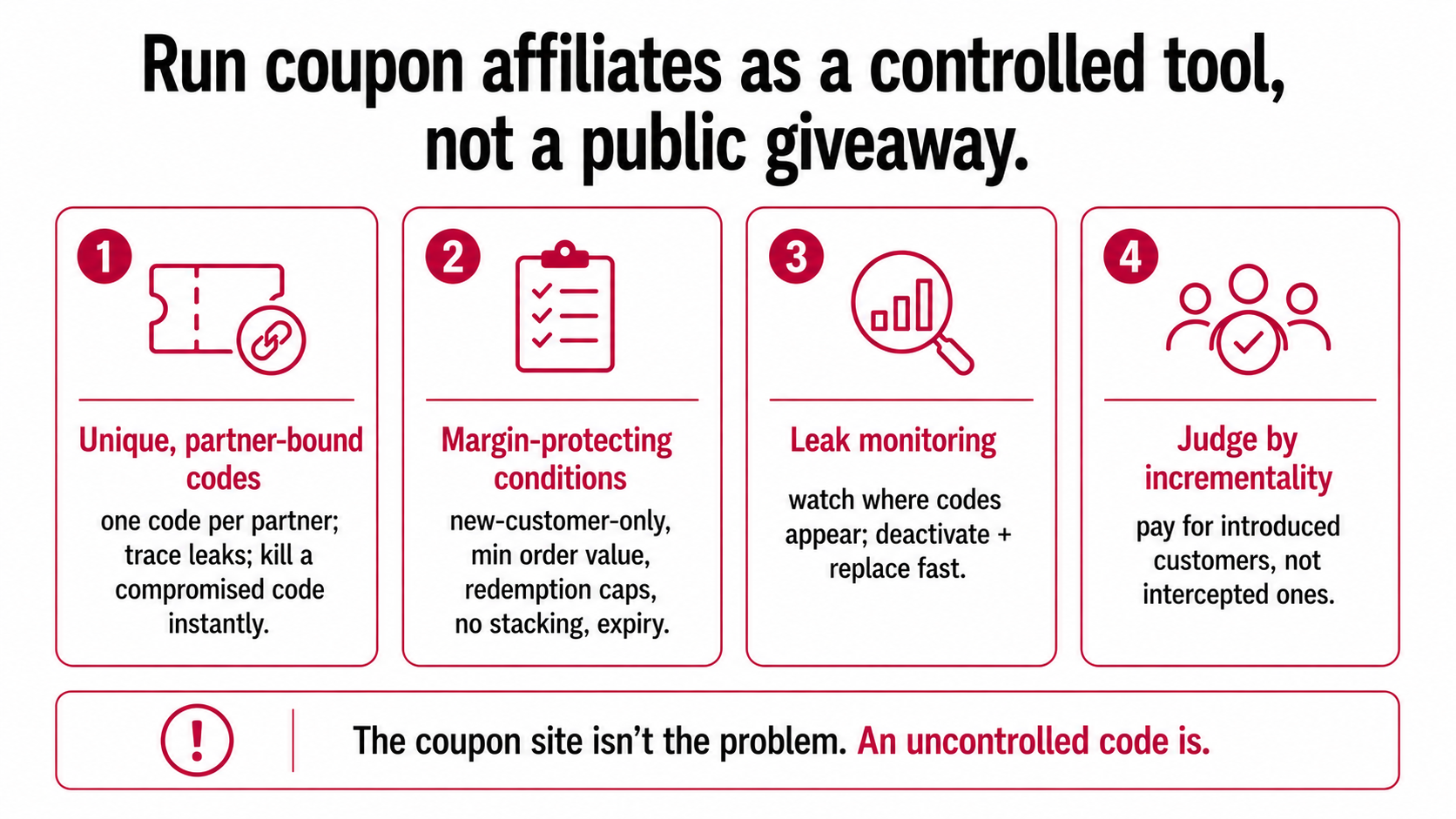
Here is the practitioner's answer, and it is not "ban coupon sites", it is control them, so you keep the genuine value and cut the leakage and interception. The controls that actually work:
- Use unique, partner-bound codes. Give each coupon partner (and influencer) their own trackable code rather than a single public one. You see exactly which partner drove which orders, leaked codes are traceable to their source, and you can kill a compromised code instantly without disrupting everyone else.
- Set conditions that protect margin. Attach rules: new-customer-only, minimum order value, redemption caps, no stacking with other promotions, expiry dates. These ensure a code does the specific job you intended (acquiring a new customer, say) rather than handing margin to existing customers who would have paid full price. This is where coupon strategy meets commission design: pay and discount for the behaviour you actually want.
- Monitor for leaks and act fast. Watch where your codes appear across coupon sites and extensions, and when a code escapes its intended audience, deactivate and replace it quickly. The longer a leaked code lives, the more margin it bleeds.
- Judge coupon partners by incrementality, not last-click volume. The same discipline as everywhere in this cluster: a coupon partner that mostly intercepts checkout-stage customers scores high on last-click and low on real contribution; one that introduces new bargain-hunters earns its place. Test it, and pay accordingly.
The merchants who get coupon affiliates right are not the ones who avoid them, they are the ones who treat a discount code as a controlled tool with a specific job, not a public giveaway. Control the code, control the conditions, watch for leaks, and measure real value.
The verdict: value driver or margin leak?
So, which are they? Whichever you make them. An uncontrolled coupon programme, public codes, no conditions, no leak monitoring, last-click payment, is reliably a margin leak: you pay a discount and a commission on intercepted sales, your codes spread beyond their intended audience, your pricing control erodes, and failed codes nibble at your conversion rate. A controlled one, unique partner-bound codes with margin-protecting conditions, active leak monitoring, and incrementality-based evaluation, is a genuine value driver: it captures real price-sensitive demand, introduces some genuinely new customers, and serves a real shopper need without bleeding margin.
The decision, as with every partner type in this cluster, is not about the category but about the control and the measurement. Coupon and deal sites reward discipline and punish neglect more sharply than almost any other partner type, because the downside is doubled (discount plus commission) and the leakage risk is unique to them. Treat a discount code as a precise, controlled, measured tool and coupon affiliates earn their place. Treat it as a public giveaway and pay everyone on last-click, and you have built an efficient machine for discounting sales you already had. Same partner type, opposite outcome, and the difference is entirely in your hands.
A few common questions
How do coupon and deal affiliate sites work? They publish discount codes and offers for merchants and earn an affiliate commission when a shopper uses one of those codes to buy. They mainly attract people actively searching for a discount, often shoppers who open a new tab to look for "[brand] discount code" right before checkout, capture that click, and claim the sale. The key question is whether those shoppers were genuinely introduced by the coupon site or were already going to buy.
Are coupon sites good or bad for an affiliate programme? Both, depending on control. Run well (unique partner-bound codes, margin-protecting conditions, leak monitoring), they capture real price-sensitive demand and can introduce new customers. Run carelessly (public codes, no conditions, last-click payment), they become a margin leak, you pay a discount and a commission on sales you'd have made anyway, your codes leak across the internet, and failed codes hurt your checkout conversion.
What is coupon/discount code leakage? It's when a restricted promo code (a staff discount, a limited influencer code, a single-segment promotion) escapes its intended audience and spreads across coupon aggregators and browser extensions. Leaked codes get used by customers who were never meant to have them, eroding margin and pricing control, triggering commission on ineligible orders, and distorting campaign analytics. Leaked codes are a recognised, significant share of affiliate fraud.
How do I stop coupon sites from leaking margin? Use unique, partner-bound codes so each partner's usage is traceable and a compromised code can be killed instantly; attach conditions (new-customer-only, minimum order value, redemption caps, no stacking, expiry) so codes do the specific job intended; monitor where your codes appear and deactivate leaks fast; and judge coupon partners by incrementality rather than last-click volume, paying for customers genuinely introduced rather than intercepted.
You should also read:
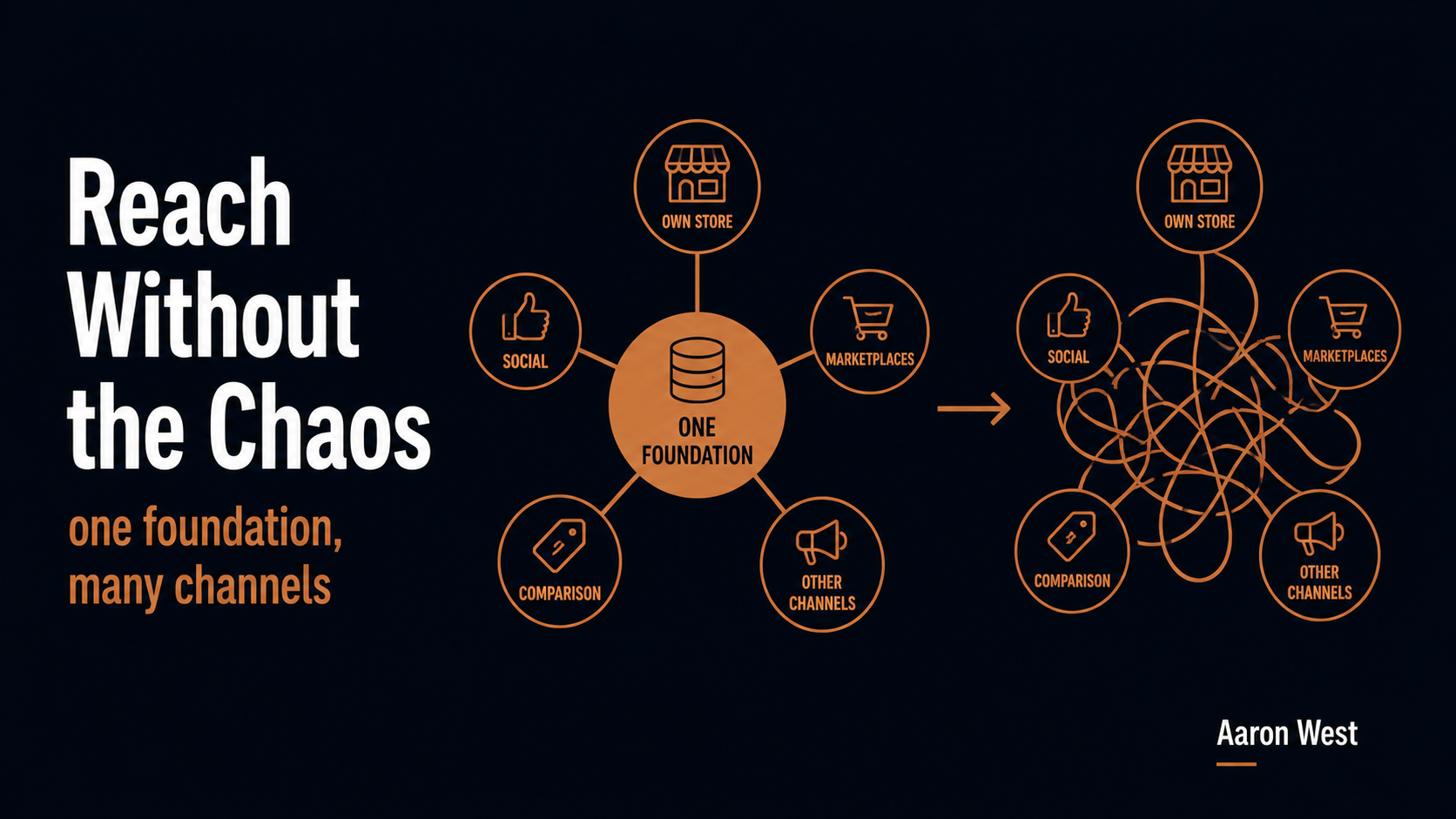
Multichannel Without Losing Your Margin or Your Mind
Selling across multiple channels multiplies your reach and your complexity at the same time, and it goes wrong in two predictable ways. You lose your margin: every channel has different costs and fees, so selling the same product everywhere without per-channel margin awareness quietly bleeds…
Continue reading...
The Free-Shipping Threshold: Psychology Meets Margin Maths
A free-shipping threshold, "free delivery over €50," is one of the most effective levers in e-commerce, because customers dislike paying for shipping out of all proportion to what it actually costs. The prospect of "free" delivery reliably nudges a shopper to add another item to…
Continue reading...
Discounts Are a Loan Against Your Margin
A discount feels free to give, and that is exactly why it is dangerous. It is a loan against your margin, and like any loan it gets repaid: in the margin you hand over, in the reference price you quietly reset, and in the customers…
Continue reading...