Affiliate Program KPIs: The Numbers That Show If It's Actually Working

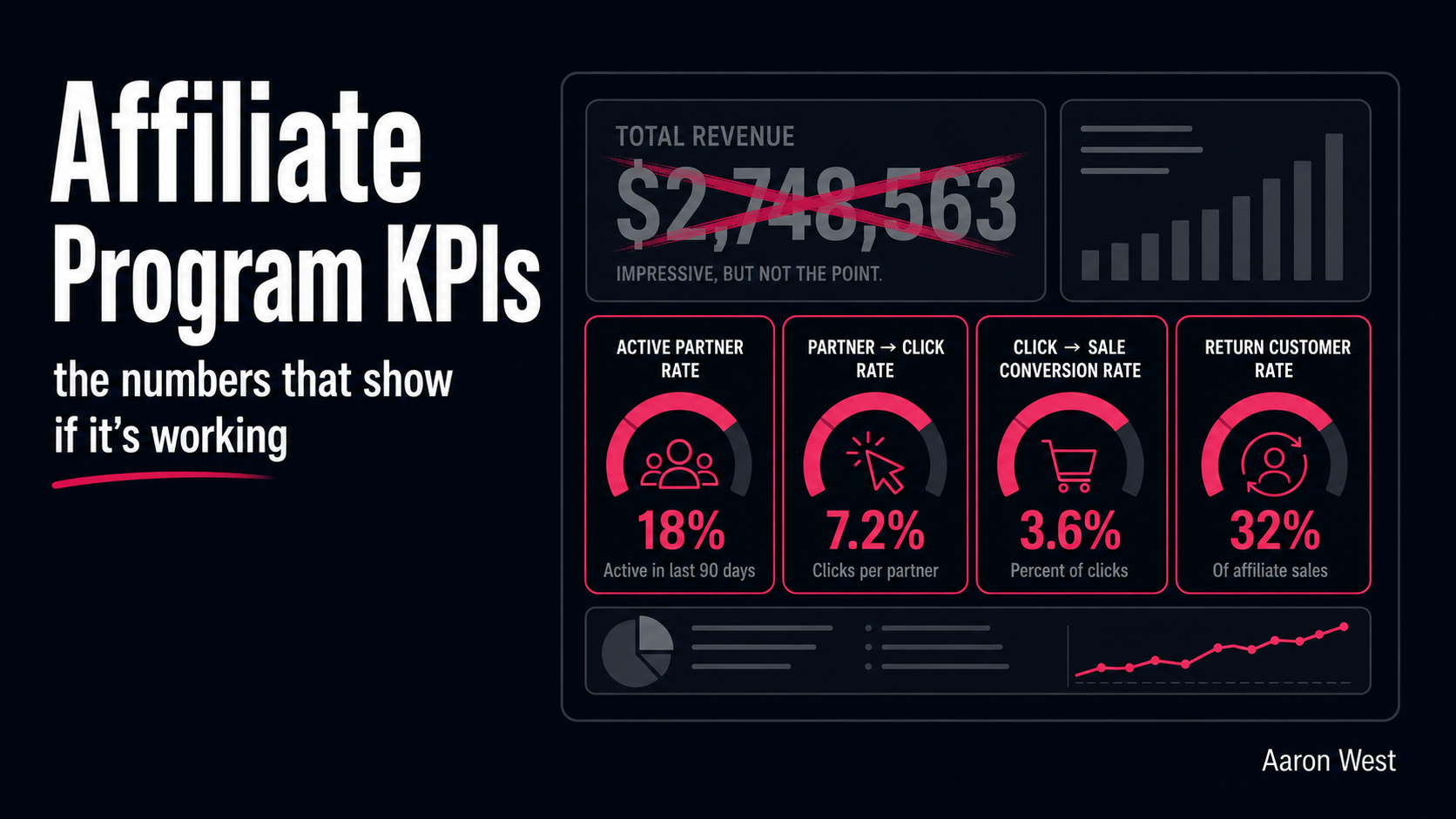
Table of Contents
Most affiliate dashboards proudly display the numbers that mean the least. Total affiliates, total clicks, total revenue: big, reassuring, and almost useless for deciding what to do next. The numbers that actually tell you whether your programme is working, and what to fix, are quieter and rarely on the default screen: your activation rate, your earnings per click, the share of sales going to genuinely new customers, and whether each partner's contribution is incremental or just intercepted. The difference between the two sets of numbers is the difference between watching a programme and running one.
This is the measurement companion to managing publishers like a sales team, because you cannot manage what you do not measure honestly, and most affiliate measurement is not honest, it flatters. It sits in the strategy layer of the affiliate cluster. This piece separates the vanity metrics from the decision metrics, explains what each real KPI actually tells you, covers the 2026 shift toward measuring margin and incrementality rather than volume, and gives you a simple cadence so the numbers drive action instead of decorating a report.
Vanity metrics vs decision metrics
Start with the distinction that reorganises everything, because once you see which of your numbers are vanity and which drive decisions, your reporting changes for good.
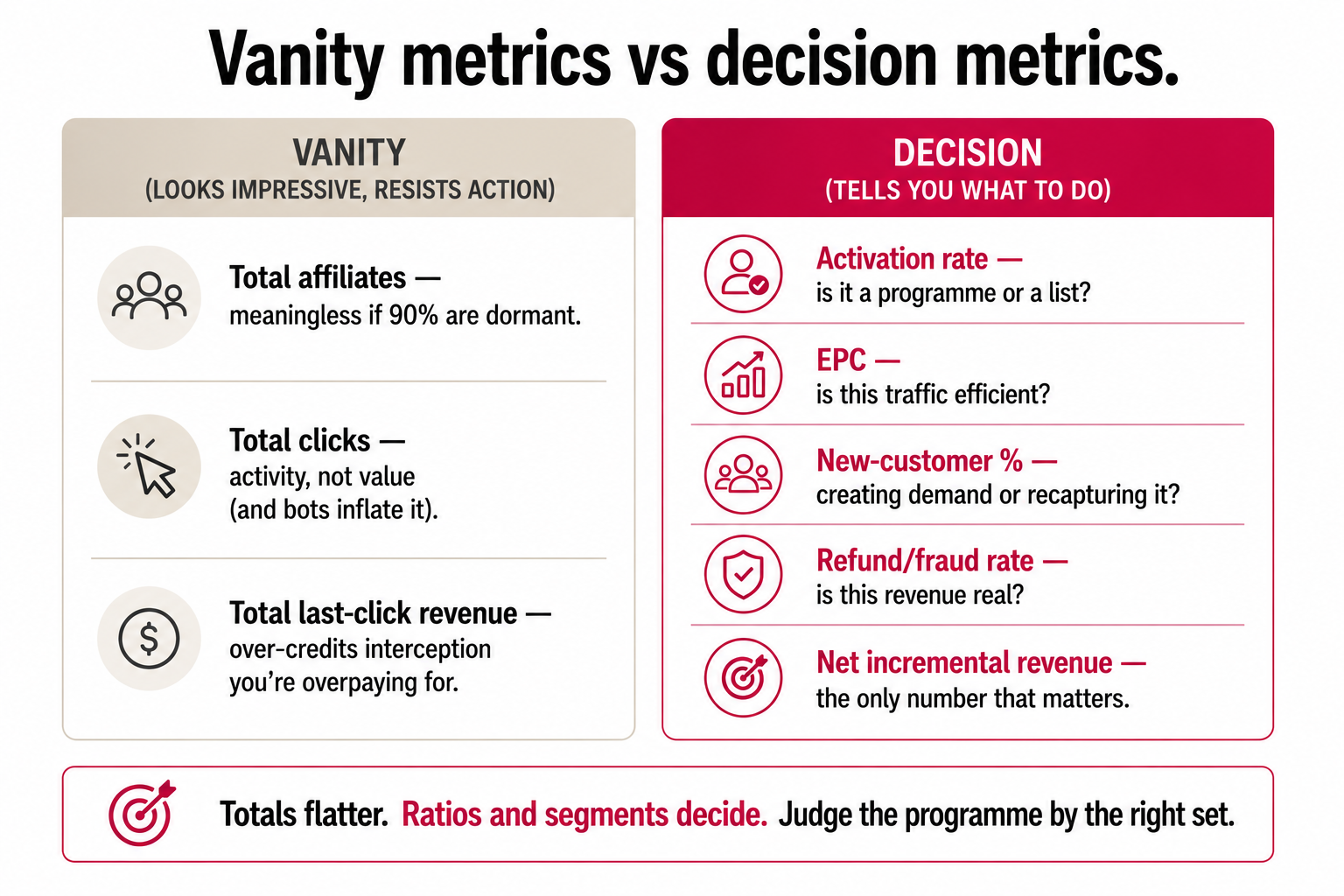
Vanity metrics look impressive and resist action. Total number of affiliates is the worst offender, a thousand affiliates means nothing if ninety percent are dormant, as they usually are. Total clicks shows activity, not value, a flood of low-intent or bot clicks looks like success and is the opposite. Total last-click revenue is the most seductive, because it feels like the bottom line, but as the attribution piece showed, last-click systematically over-credits the partners who intercepted demand and under-credits the ones who created it, so a big last-click number can be mostly interception you are overpaying for. These numbers are not useless, they are fine for spotting trends and sudden drops, but they are baseline indicators, not success metrics, and judging your programme by them leads you to exactly the wrong conclusions.
Decision metrics are the ones that, when they move, tell you specifically what to do. They are usually ratios and segments rather than totals, and they are where a real affiliate manager lives. The rest of this piece is about them.
The KPIs that actually matter
Here are the numbers worth putting on your dashboard, with what each one is really telling you.
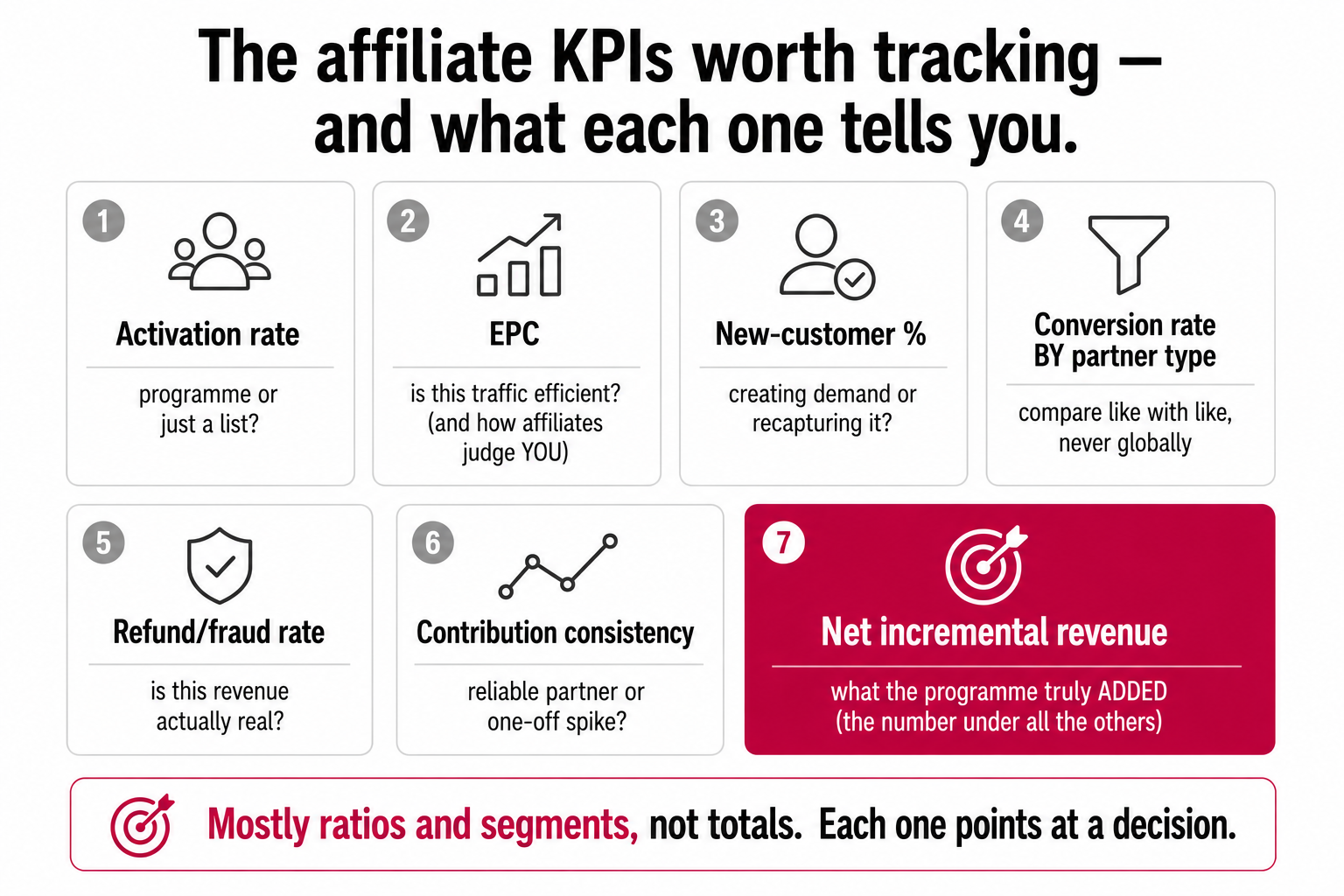
Activation rate. The percentage of approved affiliates who drove a click or sale in a defined window (30, 60, or 90 days). This is the single most revealing programme-health number, because as the management piece argued, it tells you whether you have a programme or a list of names. A low active rate (most programmes run 5 to 20%) is not a failure but a map: it points straight at your biggest cheap-growth opportunity, the dormant majority. Track it monthly and watch whether your activation work is moving it.
Earnings per click (EPC). Average revenue generated per affiliate click, total commissions or revenue divided by clicks. EPC is the cleanest single measure of traffic quality, because it balances volume and conversion in one number: a partner sending fewer, higher-intent clicks can have a far better EPC than one sending a flood of junk. It is also how affiliates themselves judge whether you are worth promoting, so it is the metric where your interests and theirs align. Use it to compare partners and spot efficient traffic early.
New-customer percentage. The share of a partner's sales that come from first-time buyers rather than existing customers. This is one of the most important and most overlooked KPIs, because it cuts straight to incrementality: a partner bringing net-new customers is creating value, while one whose sales are mostly existing customers is often just recapturing demand you already had (the cashback/coupon interception problem in numeric form). Partners who bring new customers deserve higher priority, and higher pay, than those re-capturing existing demand.
Conversion rate, by partner type. The share of clicks that become sales, but the crucial discipline is to compare it within partner types, not globally. A coupon site will always show a higher conversion rate than a content publisher, because it catches people at checkout, comparing them directly tells you nothing useful and flatters the interceptor. Segment first, then compare like with like.
Refund and fraud rate. The share of a partner's tracked sales that get returned, refunded, or flagged as fraudulent. A high refund rate is a warning sign of low-intent or low-quality traffic, and as the fraud piece noted, post-sale behaviour is the best signal of whether conversions are real. A partner whose sales mostly reverse is not the performer their gross numbers suggest.
Contribution consistency. How regularly a partner drives sales month over month. A steady contributor is usually worth more than one with a single viral spike that never repeats, because consistency is what you can plan and build on. This is what separates a reliable partner from a lucky one.
Net incremental revenue. The number under all the others, and the hardest to measure: revenue the programme genuinely added, not revenue it merely claimed. Measured through incrementality testing rather than last-click reporting, it is the only number that ultimately answers "is this programme, and this partner, actually growing the business?" Everything else is a proxy for this.
The 2026 shift: measure margin and incrementality, not volume
Worth naming explicitly, because it is the direction the whole channel is moving and it changes which KPIs sit at the top of your dashboard. For years, affiliate was judged on volume, clicks, conversions, gross revenue. In 2026 the serious programmes judge it on profitability and influence: how much margin the channel actually adds and whether it is creating demand or claiming it.
Practically, that means the metrics that matter most now connect directly to money kept and customers gained, not traffic generated. Revenue per dollar of commission, how much real revenue each commission euro buys, prevents you overpaying partners who lean on heavy discounting. Affiliate customer acquisition cost, commissions paid against new customers gained, tells you what the channel really costs to grow you. And net incremental revenue sits above all of it. The old volume metrics have not become worthless, but they have been demoted: clicks and gross revenue are now baseline activity indicators, while margin and incrementality are the success metrics. If your dashboard still leads with total clicks and gross last-click revenue, it is measuring the programme the way 2019 did, and quietly steering you toward volume over value.
The cadence: measure to act, not to admire
A final, practical point that matters more than the metric list itself: the discipline of acting on the numbers beats the completeness of the dashboard. A beautiful report you glance at monthly is worth far less than two or three numbers you check weekly and actually do something about.
So a workable rhythm, scaled to how fast each thing changes:
- Weekly: revenue, activation rate, EPC, and your top partners' performance, with an eye for any unusual drop or spike. These are the pulse, check them often enough to catch problems early.
- Monthly: the deeper cuts, new-customer percentage, conversion by segment, refund rates, recruitment and retention, time-to-first-sale. This is where you decide who to activate, who to promote, who to pay more, and who to question.
- Quarterly: programme health overall, your top-partner concentration (how dependent are you on a few?), incrementality findings, and whether to reallocate. The strategic view.
And the most important discipline of all: start small. Pick two or three decision metrics, activation rate, EPC, and new-customer percentage are a strong starting trio, track them consistently, and act on them, before adding more. A manager who reliably acts on three numbers every week will build a better programme than one with a forty-metric dashboard they admire and ignore. The goal of measurement is not a complete picture. It is a decision.
That is affiliate measurement done honestly. Stop leading with the vanity totals that flatter, total affiliates, total clicks, gross last-click revenue, and lead instead with the decision metrics that tell you what to do: activation rate, EPC, new-customer share, refund rate, consistency, and net incremental revenue. Judge the programme on margin and incrementality, the 2026 standard, not the volume that mattered in 2019. And measure on a cadence built for action, a few numbers checked weekly and acted on, not a dashboard admired quarterly. The programmes that win are not the ones with the most metrics. They are the ones whose manager knows which three numbers matter this week and does something about them. Measure what you will act on, act on what you measure, and the programme tells you the truth instead of a flattering story.
A few common questions
What are the most important affiliate program KPIs? The decision metrics that tell you what to do: activation rate (the share of approved affiliates actually driving sales), earnings per click (EPC, traffic quality), new-customer percentage (incrementality), conversion rate compared within partner types, refund/fraud rate (is the revenue real), contribution consistency, and net incremental revenue (what the programme genuinely added). These matter far more than vanity totals like total affiliates, total clicks, and gross last-click revenue.
What's the difference between vanity and decision metrics in affiliate marketing? Vanity metrics (total affiliates, total clicks, gross revenue) look impressive but resist action and can mislead, a thousand affiliates means little if most are dormant, and big last-click revenue can be mostly intercepted demand you're overpaying for. Decision metrics (activation rate, EPC, new-customer %, refund rate, net incremental revenue) are usually ratios and segments that, when they move, tell you specifically what to do. Use vanity metrics only to spot trends; judge the programme by decision metrics.
Why measure new-customer percentage in an affiliate program? Because it cuts straight to incrementality, the question of whether a partner is creating value or just claiming it. A partner whose sales are mostly first-time buyers is bringing net-new customers and genuinely growing you; one whose sales are mostly existing customers is often recapturing demand you already had (the interception problem). New-customer percentage tells you which partners deserve higher priority and pay, information that gross revenue hides.
How often should I review affiliate KPIs? On a cadence matched to how fast each changes, and, crucially, in order to act. Weekly: revenue, activation rate, EPC, and top-partner performance (the pulse). Monthly: new-customer %, conversion by segment, refund rates, recruitment and retention (the decisions). Quarterly: overall health, top-partner concentration, incrementality, reallocation (the strategy). Start with just two or three decision metrics you check weekly and act on, two numbers acted on beat forty admired.
You should also read:
Affiliate Fraud: The Types, the Detection Methods, and the Controls
Affiliate fraud is any attempt to earn commissions for results that were not genuinely driven, faked clicks, faked leads, or stolen attribution, and because the whole channel pays for results, it has always attracted people who try to fake results. The defining shift in 2026…
Continue reading...
The Affiliate Marketing Glossary: Every Term, in Plain English
Affiliate marketing is full of acronyms and jargon, CPS, EPC, S2S, dedup, postback, cookie window, that can make a simple channel sound impenetrable. This glossary defines the terms that actually matter, in plain English, grouped so you can see how they fit together. Each definition…
Continue reading...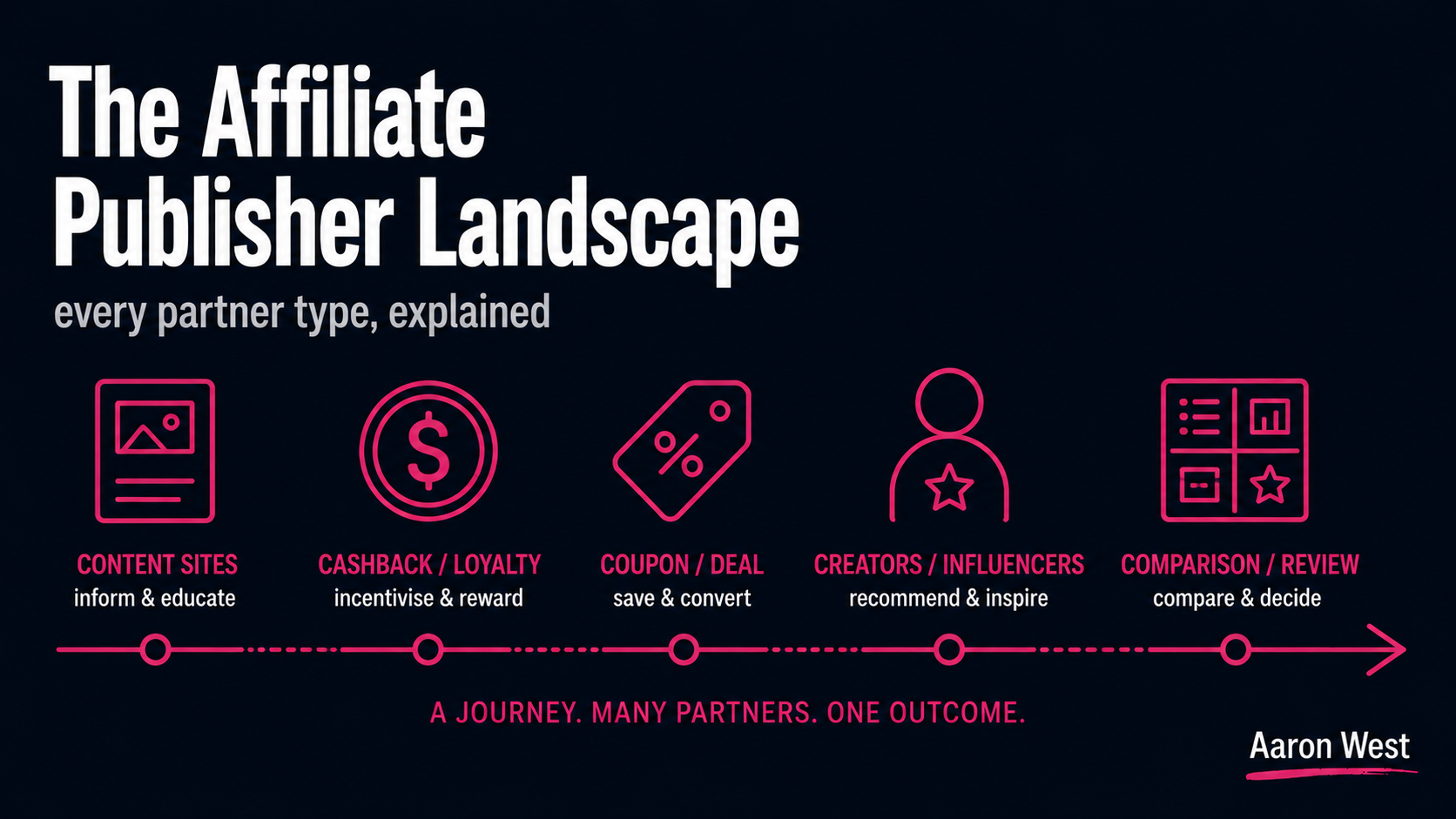
The Affiliate Publisher Landscape: Every Partner Type, Explained
"Affiliate" covers wildly different kinds of partner, content sites, cashback platforms, coupon sites, influencers, comparison engines, and the single most important thing to understand is that they do fundamentally different jobs. Some genuinely introduce new customers to your brand; others mostly intercept customers who were…
Continue reading...