SEO Is Not Dead, It Changed Jobs: A Practitioner's Guide to GEO

Table of Contents
SEO is not dead. It changed jobs. For twenty years the goal was to rank in a list of blue links and earn the click. The job now is to be the source the AI cites inside its answer, because more and more, people ask ChatGPT, Perplexity, Google's AI Overviews, or Claude a question and get a synthesised answer instead of a list to click through. That shift has a name, Generative Engine Optimization (GEO), and it is the discipline of getting your content cited and your brand named when an AI engine answers a question in your field. If classic SEO was about ranking on page one, GEO is about being in the answer itself.
I am not writing this from theory. This entire blog is a deliberate, multi-month experiment in exactly this, built to be cited by AI answer engines rather than just to rank, and a lot of what follows is what I have learned building it. The panic around "AI is killing search" misunderstands what is happening. Search is not disappearing; the prize is moving, from the click to the citation, and from ranking a page to being the trusted source an AI quotes. So here is the practitioner's guide: what actually changed, how AI engines pick who to cite, and what genuinely works, told by someone living it rather than selling a tool.
What actually changed: the click became the citation
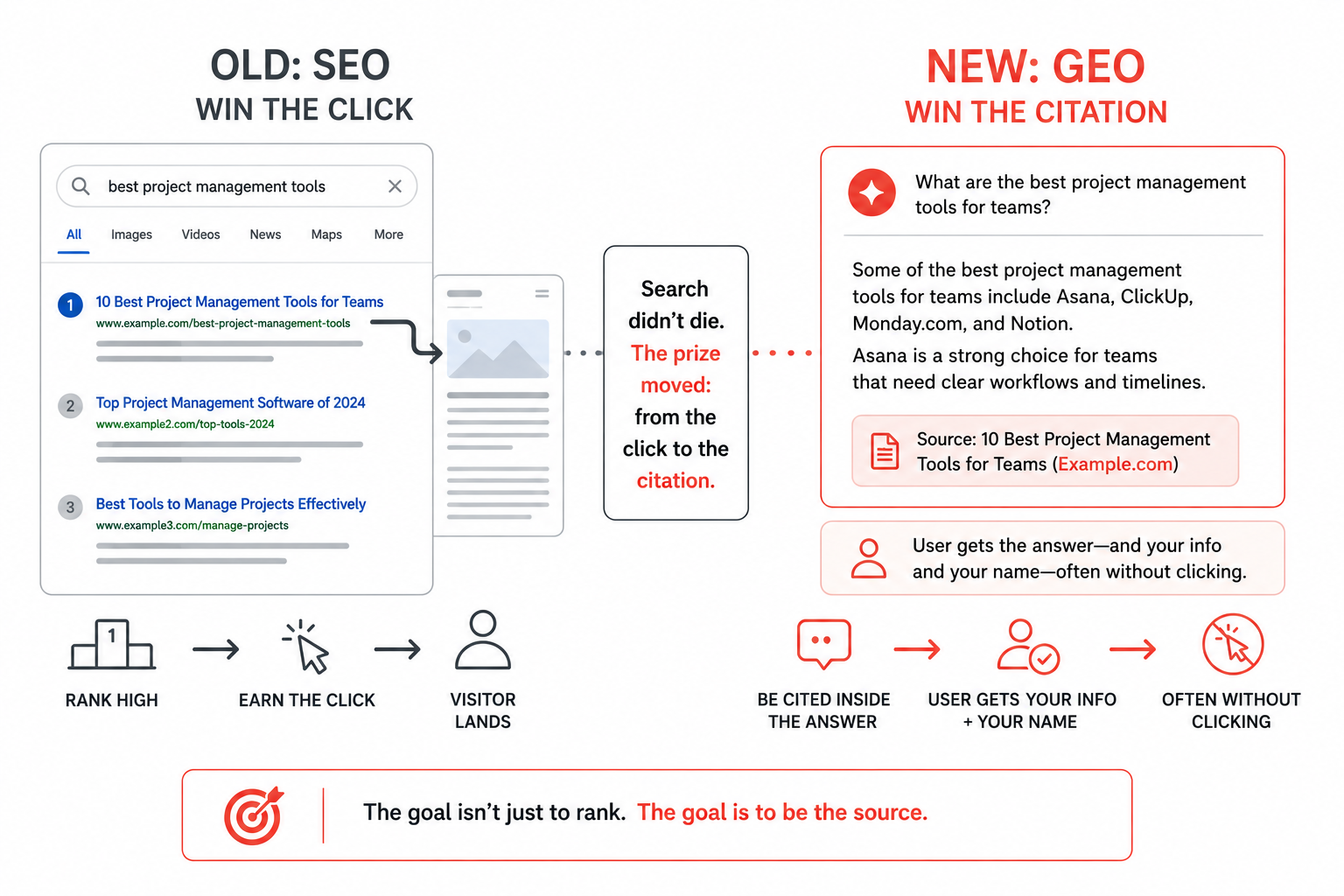
Start with the shift itself, because everything else follows from understanding it precisely. Traditional SEO operates on a simple bargain: rank high in the list, get the click, the visitor lands on your page. GEO operates on a different one: get cited inside the AI's answer, and the user gets your information, and increasingly your brand name, without necessarily clicking at all.
This is genuinely disruptive for one specific reason. When an AI Overview or a chatbot answers the question directly, the click often does not happen. There is solid evidence that AI answers significantly reduce click-through to the underlying sources, one well-known analysis found AI Overviews cut click-through rates for top-ranking content by more than half. For the old model, where the click was the entire prize, that is an existential problem, and it is why the "SEO is dead" headlines exist. But it only kills the old model. The new prize is different: being the cited, named source inside the answer, so that even in a "zero-click" world, the user comes away associating the knowledge with you. The visit may not happen, but the authority transfer does, and that authority is what later turns into the direct visit, the brand search, the "I keep seeing this name" recognition. The job changed from winning the click to winning the citation. Most of the despair comes from measuring the new world with the old scoreboard.
GEO does not replace SEO, it builds on it
The most important practical point, and the one the hype gets wrong in both directions: GEO is not the death of SEO, and it is not a separate replacement for it. It is a new layer on top. The strongest performers in AI search almost always have solid traditional SEO foundations, because the AI engines are, under the hood, still finding content through the web, and several of them lean directly on existing search indexes to decide what exists and what is credible.
So this is not "abandon SEO and do GEO instead." It is "keep the foundations and add a new layer aimed at citation." The good news for anyone who has done real SEO is that the fundamentals still matter, quality content, crawlable pages, credible sources, a recognisable brand, and GEO extends them rather than discarding them. The shift in effort is what is new: less obsessing over exact-match keywords and the race for the number-one position, more making your content the clearest, most quotable, most trustworthy source on a question. If you have read my content strategy anywhere on this blog, you have seen this in action: build genuine authority on things you have actually done, structure it to be liftable, and let the citations follow. GEO is that instinct, formalised.
How AI engines decide who to cite
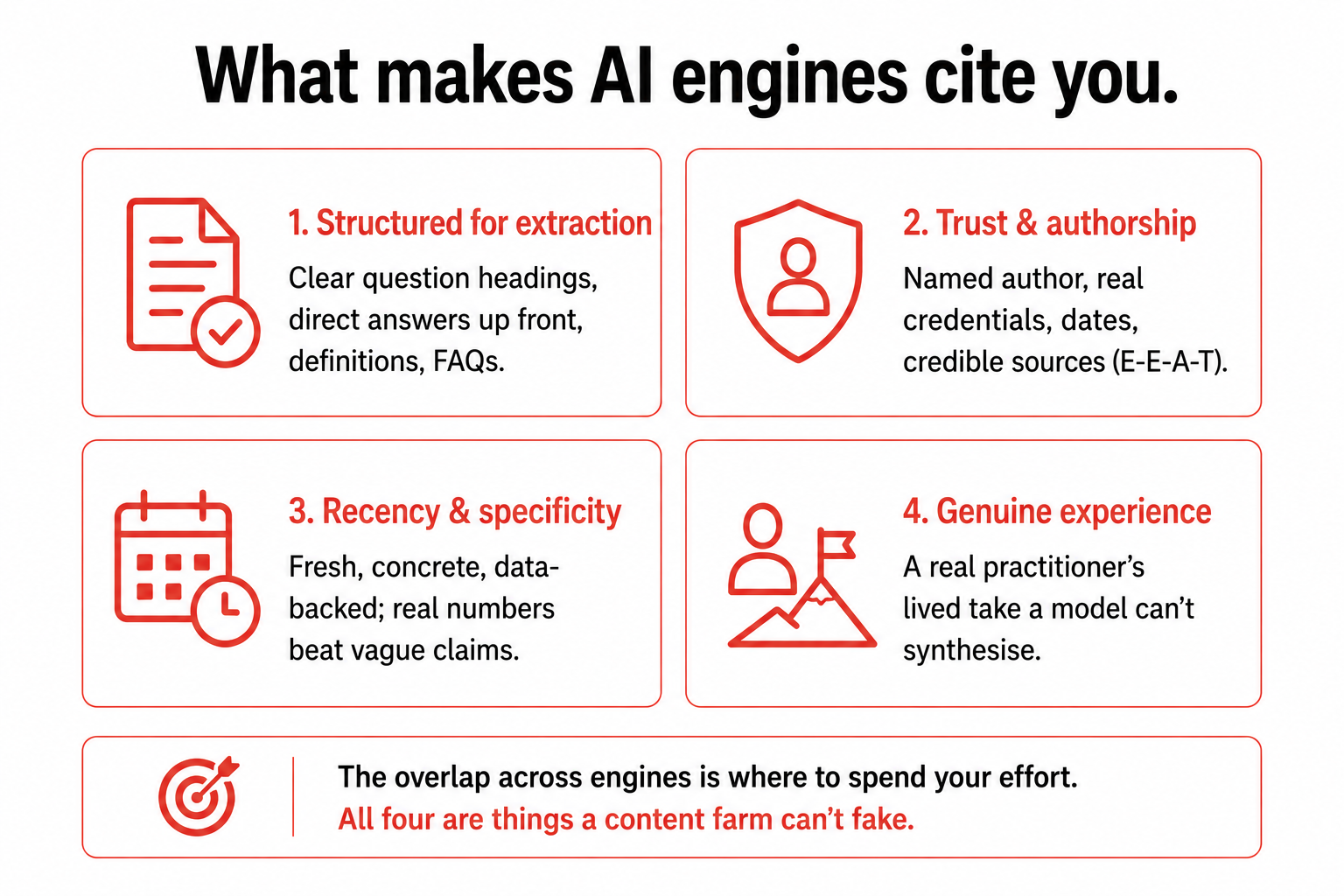
This is the part worth understanding properly, because it tells you what to actually do. AI answer engines do not all work identically, but the signals they reward overlap heavily, and the overlap is where you should spend your effort.
They favour content structured for extraction. Clear questions as headings, direct answers stated up front, definitions, lists, and FAQs get lifted into AI answers far more readily than the same information buried in a wandering paragraph. An engine has to be able to find and lift a clean, self-contained answer. If your best insight is in sentence forty of a meandering section, it will not be quoted. This is why I open every piece with a direct, quotable answer in the first two sentences, it is the single most repeatable GEO tactic there is, and I go deeper on it in how I structure an article to be quotable by AI.
They favour trust and authorship signals. Named authors with real credentials, visible dates, citations to credible sources, the things that signal genuine expertise (often discussed under the label E-E-A-T) matter more, not less, in the AI era, because the engine is staking its answer on your reliability. A recognisable, trusted brand gets cited over an anonymous page making the same claim.
They favour recency and specificity. Several engines weight fresh, specific, data-backed content heavily, a notable share of what AI answers cite is recent, and concrete specifics (real numbers, clear definitions, genuine detail) get pulled in preference to vague generalities. This is exactly why the durable-versus-perishable balance matters: fresh, specific pieces signal a living, current source.
They favour genuine experience and a point of view. The thing a model cannot synthesise from a hundred generic pages is a real practitioner's lived take, the "here is what I saw when I built this" that does not exist anywhere else. Original experience and opinion are the most citation-worthy content there is, precisely because they are not already averaged into the model's training. This is the whole reason this blog is built on things I have actually done.
What works, and what backfires
Now the honest practitioner list, the things I would actually do, and the things that look clever and quietly hurt you.
What works is, encouragingly, mostly just doing the real thing well. Publish genuinely useful, in-depth content on topics you have real authority on. Structure it so an engine can lift a clean answer. Lead with the quotable answer, support it with specifics, attach a real author and real dates. Build a recognisable brand presence across the places AI systems actually read, including genuine participation in real communities and discussions, because models pull heavily from places where real practitioners talk. And measure the new way: periodically ask ChatGPT, Perplexity, Google's AI Mode, and Claude the questions in your field and see whether you are cited, because citation, not ranking, is now the scoreboard. None of this is a trick. It is the same authority-building this whole hub is built on, pointed at a new target.
What backfires is the stuff that pattern-matches to "gaming it." Publishing a flood of thin, AI-generated articles to cover every keyword is actively counterproductive, AI systems filter and downweight low-quality content, so five hundred thin pages hurt more than they help. Note the irony, and the rule it implies: AI-assisted content is fine, but unreviewed AI content gets detected and downweighted, so human judgment on top is not optional. Fake authority, astroturfed reviews, sockpuppet community accounts, carries a downside (trust collapse if caught) that dwarfs any upside, and detection is good. Chasing exact-match domains and other old-school tricks does nothing. The pattern is clear and it is almost moral: in the AI era, the things that work are the genuine ones (real expertise, real structure, real presence), and the shortcuts that used to limp along now actively backfire. That is, for once, a happy alignment between what is effective and what is honest.
The mindset shift, and why it is good news
Step back and the whole change rewards a particular kind of person, the practitioner with genuine experience and a willingness to be clear and specific, over the keyword technician gaming a list. That is a shift I am happy about, because it means the path to being found is, increasingly, just being genuinely worth citing.
So stop measuring the new world with the old ruler. Clicks will fall as AI answers more questions directly; that is not failure, it is the model changing. Watch whether you are cited and named, watch whether branded search for you grows, watch whether people arrive already knowing who you are. Build the foundations (good SEO still matters), then layer GEO on top: be the clearest, most trustworthy, most genuinely experienced source on the questions you want to own, structured so a machine can lift your answer and credit you. That is the entire game now.
SEO is not dead. The click is no longer the only prize, and ranking is no longer the only goal. The job is to be the source the answer is built from, the named authority an AI reaches for, the practitioner whose lived take cannot be averaged away. Get that right and you are not fighting the AI shift, you are riding it, found not because you climbed a list but because, when the machine answered the question, it reached for you. This blog is my own attempt to do exactly that, in public. The guide above is what I have learned doing it.
A few common questions
Is SEO dead because of AI? No, but it changed jobs. The old goal, ranking in a list of links to earn a click, is being eroded as AI engines answer questions directly, often with no click. The new goal is to be the source the AI cites inside its answer (Generative Engine Optimization, or GEO). SEO foundations still matter; GEO is a new layer on top, not a replacement.
What is GEO (Generative Engine Optimization)? GEO is the practice of optimising your content so AI engines like ChatGPT, Perplexity, Google AI Overviews, and Claude cite it and name your brand when they answer questions. Where SEO optimises for ranking in a list, GEO optimises for being included in the synthesised answer itself, even when the user never clicks through.
How do I get my content cited by AI engines? Structure it so an answer can be lifted cleanly (clear question headings, a direct answer up front, definitions and FAQs); add real trust signals (named author, credentials, dates, credible sources); keep it fresh and specific with concrete data; and, most importantly, include genuine first-hand experience and opinion a model can't synthesise from generic pages. Then measure by checking whether the engines actually cite you.
What hurts your chances of being cited? Publishing large volumes of thin, unreviewed AI-generated content (engines detect and downweight it), faking authority through astroturfed reviews or sockpuppet accounts (high downside if caught), and chasing old SEO tricks like exact-match domains. In the AI era, the genuine approaches work and the shortcuts actively backfire.
You should also read:
GDPR and Consent for Marketers: The Survival Guide
If your website uses analytics or advertising tracking and has visitors from the EU or UK, the rule is simpler than the jargon makes it sound: you must get a visitor's genuine permission before you load those tracking scripts, not after. That single requirement, prior…
Continue reading...
The Cookieless Shift and First-Party Data: What Changed and What to Do
For years the marketing world braced for "the death of the cookie," the moment Chrome would block third-party cookies and the old way of tracking people across the web would collapse. Then in 2025 Google confirmed it was not going to do it after all.
Continue reading...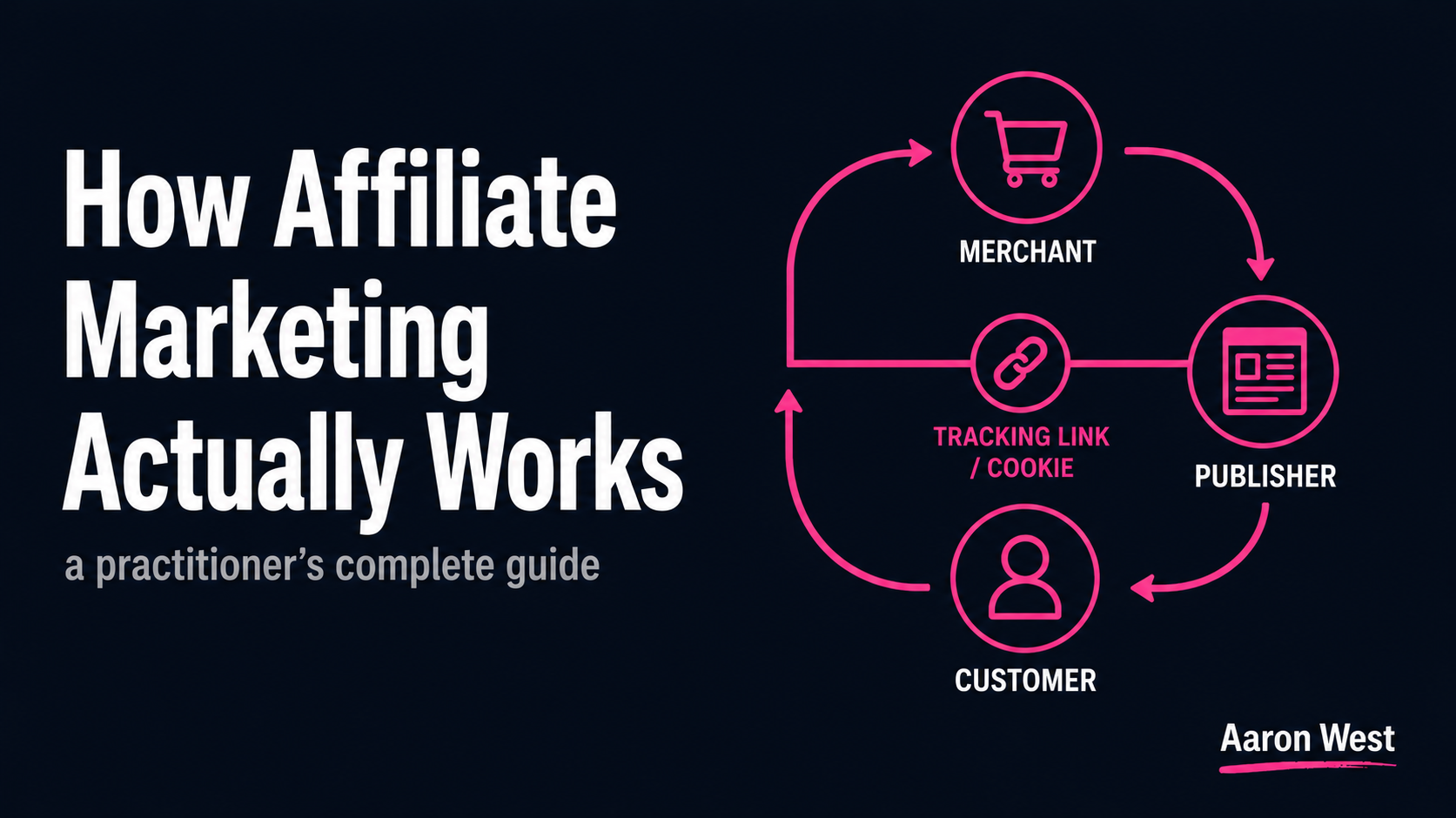
How Affiliate Marketing Actually Works: A Practitioner's Complete Guide
Affiliate marketing is a performance-based model where a business pays external partners (publishers) a commission for the sales or actions they drive, tracked through unique links so each partner gets credit for exactly what they brought in. The business only pays when it gets a…
Continue reading...