GDPR and Consent for Marketers: The Survival Guide

Table of Contents
If your website uses analytics or advertising tracking and has visitors from the EU or UK, the rule is simpler than the jargon makes it sound: you must get a visitor's genuine permission before you load those tracking scripts, not after. That single requirement, prior consent for non-essential tracking, is the heart of what GDPR and the related cookie rules ask of marketers, and the most common violation is also the simplest to picture: a cookie banner asking for consent while the analytics and advertising pixels are already firing in the background. That is not a technicality. It is the exact thing regulators fine people for.
This is the privacy-law piece in the performance marketing pillar, written for marketers rather than lawyers. I am not a lawyer, and this is not legal advice, for your specific situation you need qualified counsel, because the rules vary by country and change over time. What I can give you is the practitioner's map: the two laws that actually apply and how they fit together, what makes consent valid (and what quietly invalidates it), the one mistake nearly everyone makes, and the reframe that turns consent from a compliance chore into something that actually strengthens your marketing. Plain language, no legalese.
Two laws, working together
The first source of confusion is that people talk about "GDPR" as if it were the only rule, when cookie consent actually sits at the intersection of two regulations that do different jobs. Understanding the split makes everything else clearer.
The GDPR (General Data Protection Regulation) governs how personal data may be collected, stored, and processed. It says you need a lawful basis to process someone's personal data, and it defines what counts as valid consent when consent is that basis. It applies to any organisation processing the personal data of EU residents, regardless of where the business is based, which catches far more companies than many outside the EU assume.
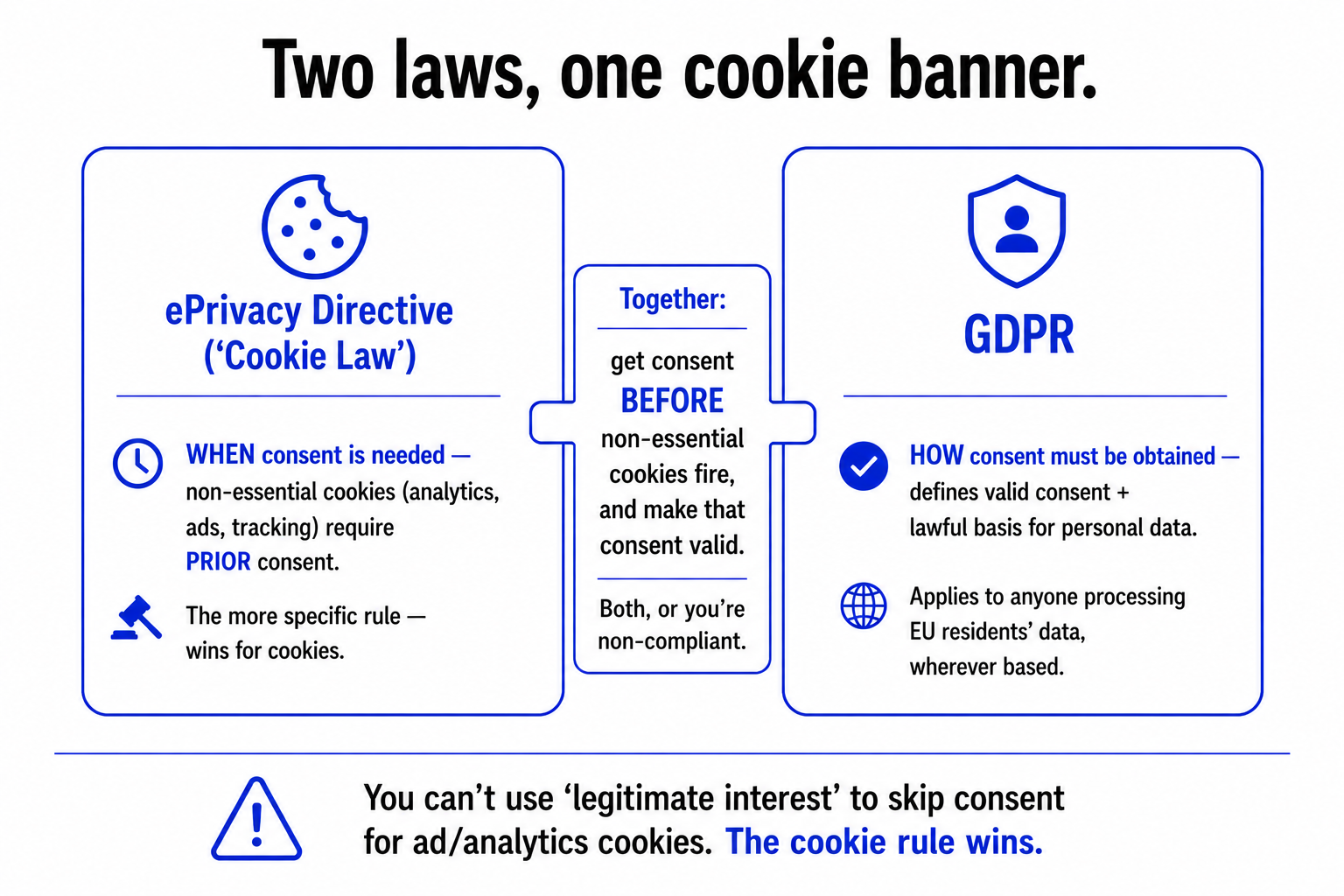
The ePrivacy Directive (often called the "Cookie Law") is the more specific rule about when you need consent for cookies and similar tracking technologies. It is the one that says non-essential cookies require prior consent. Crucially, it is lex specialis, the more specific law that takes precedence on its subject, so for cookies and tracking, the ePrivacy consent requirement applies even in situations where GDPR alone might have allowed another basis. In plain terms: you cannot lean on "legitimate interest" to skip consent for advertising or analytics cookies. The cookie rule wins.
Together they create a layered requirement: the ePrivacy rule tells you when consent is needed (before non-essential cookies fire), and GDPR defines how that consent must be obtained (validly). Get one right and the other wrong and you are still non-compliant. For a marketer, the practical takeaway is simple: treat analytics, advertising, and personalisation cookies as requiring genuine prior consent, full stop, and do not let anyone talk you into a clever legal-basis workaround for them.
What makes consent valid
Here is where a lot of cookie banners fail, because they collect something that looks like consent but does not legally count. Valid consent under these rules has four characteristics, and missing any one invalidates it:
- Freely given. The user must have a real choice. If declining means you block access to the site (a "cookie wall"), or if rejecting is made deliberately harder than accepting, the consent is not free. Rejecting should be roughly as easy as accepting, one click to refuse, not a hunt through sub-menus.
- Specific. Consent must be granular, the user should be able to agree to analytics but not advertising, for instance, rather than one all-or-nothing button. Bundling every purpose into a single "Accept" is not specific consent.
- Informed. The user must know what they are agreeing to: what data is collected, why, and who it is shared with, in clear language, before they decide.
- Unambiguous. Consent requires a clear affirmative action. Pre-checked boxes do not count. Silence or inaction does not count. The user has to actively opt in.
The pattern across all four: consent has to be a real, informed, easy-to-refuse, opt-in choice, not a dark-pattern nudge dressed up as one. Pre-checked boxes, cookie walls, "by continuing you agree" banners, and bundled all-or-nothing buttons are the classic ways consent gets quietly invalidated, and they are exactly what enforcement actions target. And the burden of proof is on you: if challenged, you have to be able to demonstrate that valid consent was given, which means logging it, not just collecting it.
The mistake nearly everyone makes
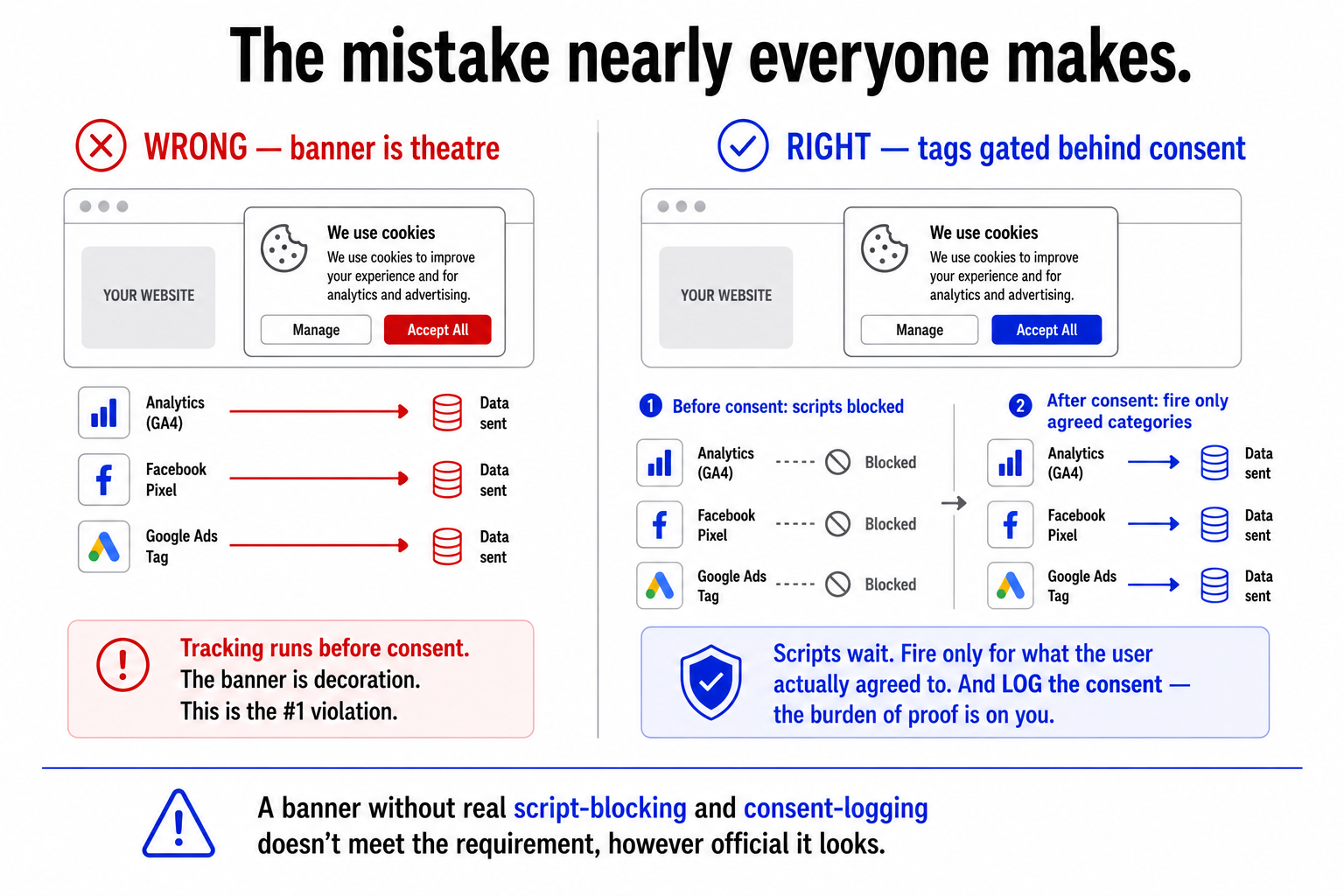
If you fix only one thing after reading this, fix this: do not let any non-essential tracking fire before the user has consented. The single most common technical violation is a cookie banner that displays its request while the analytics script, the advertising pixel, and the third-party tags are already loading and sending data in the background. The banner is theatre; the tracking already happened. That is a clear breach, and it is everywhere, because tracking tends to get added over the years by different people (a developer drops in a pixel, a marketer adds another through a tag manager, an agency layers on their own) and nobody wired it to wait for consent.
The correct behaviour is that non-essential scripts stay blocked until the user opts in, and only fire for the categories they actually agreed to. Practically, this is what a properly configured consent setup does, it gates the tags behind the consent choice, rather than just displaying a banner over tracking that runs regardless. The distinction matters enormously: a banner without genuine script-blocking and consent-logging does not meet the requirement, however official it looks. If you take one action from this piece, audit whether your own site fires analytics or advertising before consent. Most sites, when honestly checked, do. The fines for getting this wrong are not trivial, the statutory maximum runs to tens of millions of euros or a percentage of global turnover, and while most businesses will never see the top of that range, enforcement has been getting more active, not less.
The reframe: consent is not just a cost
Most marketers experience consent as pure friction, a legal tax that shrinks their data and slows their site. That framing is understandable and incomplete, and the better framing actually changes how you treat it. Clean, genuine consent is what makes the rest of your data strategy trustworthy and durable.
Here is the connection. The whole industry is moving toward first-party data, the information customers share with you directly, because third-party tracking is collapsing. But first-party data is only an asset if you have a clear, defensible right to use it, and that right comes from genuine consent. Data collected under a dark-pattern banner is a liability waiting for a complaint; data collected under real, logged, granular consent is a durable asset you can build on without fear. Consent done properly is not the thing standing between you and your data, it is the thing that makes your data yours to keep using. It also pairs directly with server-side approaches, where you enforce consent rules in your own infrastructure rather than hoping a browser banner behaved.
So the mature posture is not "how do I do the minimum to avoid a fine." It is "how do I build a consent process customers actually trust, that makes my owned data clean and usable." Yes, you will measure fewer people than you technically could in a consent-free world, that is real, and it is the subject of the tracking-under-reporting piece. But the data you do gather is consented, defensible, and increasingly the only kind worth building a business on. The regulations are not going to loosen. The marketers who treat consent as a foundation rather than a nuisance are the ones whose data strategy still stands when enforcement tightens and third-party tracking finishes collapsing. Compliance and good marketing are not opponents here. Done right, the same move serves both.
A few common questions
Do I need consent for Google Analytics and advertising pixels under GDPR? Yes, for visitors in the EU and UK. Analytics, advertising, personalisation, and other non-essential cookies require prior consent, only strictly necessary cookies (those essential to basic site function) are exempt. The requirement comes from the ePrivacy Directive (the "Cookie Law"), which says non-essential cookies need consent before they're set, working alongside GDPR, which defines how that consent must be obtained. You generally cannot use "legitimate interest" to avoid consent for advertising or analytics cookies, the cookie rule takes precedence. This is general information, not legal advice; consult qualified counsel for your situation.
What makes cookie consent valid? Four things, and missing any one invalidates it: freely given (a real choice, rejecting roughly as easy as accepting, no cookie walls), specific (granular, the user can agree to analytics but not advertising, not one all-or-nothing button), informed (they know what's collected, why, and who it's shared with, in clear language), and unambiguous (a clear affirmative opt-in, pre-checked boxes and "by continuing you agree" don't count). The burden of proof is on you to demonstrate valid consent was given, which means logging it, not just collecting it.
What's the most common GDPR cookie violation? Firing non-essential tracking before the user consents. Countless sites display a cookie banner asking for permission while the analytics script and advertising pixels are already loading and sending data in the background, the banner is theatre, the tracking already happened. The fix is to keep non-essential scripts blocked until the user opts in, and only fire the categories they agreed to. A banner without genuine script-blocking and consent-logging doesn't meet the requirement, however official it looks. If you audit one thing, audit whether your site tracks before consent, most do.
What's the difference between GDPR and the ePrivacy Directive? They work together but do different jobs. The ePrivacy Directive (the "Cookie Law") governs when consent is needed, specifically, it requires prior consent for non-essential cookies and tracking. GDPR governs how personal data is handled overall and defines what valid consent looks like (freely given, specific, informed, unambiguous). For cookies, ePrivacy is the more specific rule and takes precedence, so you need consent for tracking cookies even in cases where GDPR alone might have permitted another legal basis. In practice: get consent before non-essential cookies fire, and make sure that consent is valid.
You should also read:

How Affiliate Marketing Actually Works: A Practitioner's Complete Guide
Affiliate marketing is a performance-based model where a business pays external partners (publishers) a commission for the sales or actions they drive, tracked through unique links so each partner gets credit for exactly what they brought in. The business only pays when it gets a…
Continue reading...
SEO Is Not Dead, It Changed Jobs: A Practitioner's Guide to GEO
SEO is not dead. It changed jobs. For twenty years the goal was to rank in a list of blue links and earn the click. The job now is to be the source the AI cites inside its answer, because more and more, people ask…
Continue reading...
The E-Commerce Manager's Guide to AWS Without an Engineering Degree
You do not need to understand all of AWS. You need to understand maybe six services and one mental model, and that is enough to make good decisions, ask the right questions, and stop nodding along blankly when your developers or a vendor start talking…
Continue reading...