Why Your Tracking Under-Reports (and How Much)

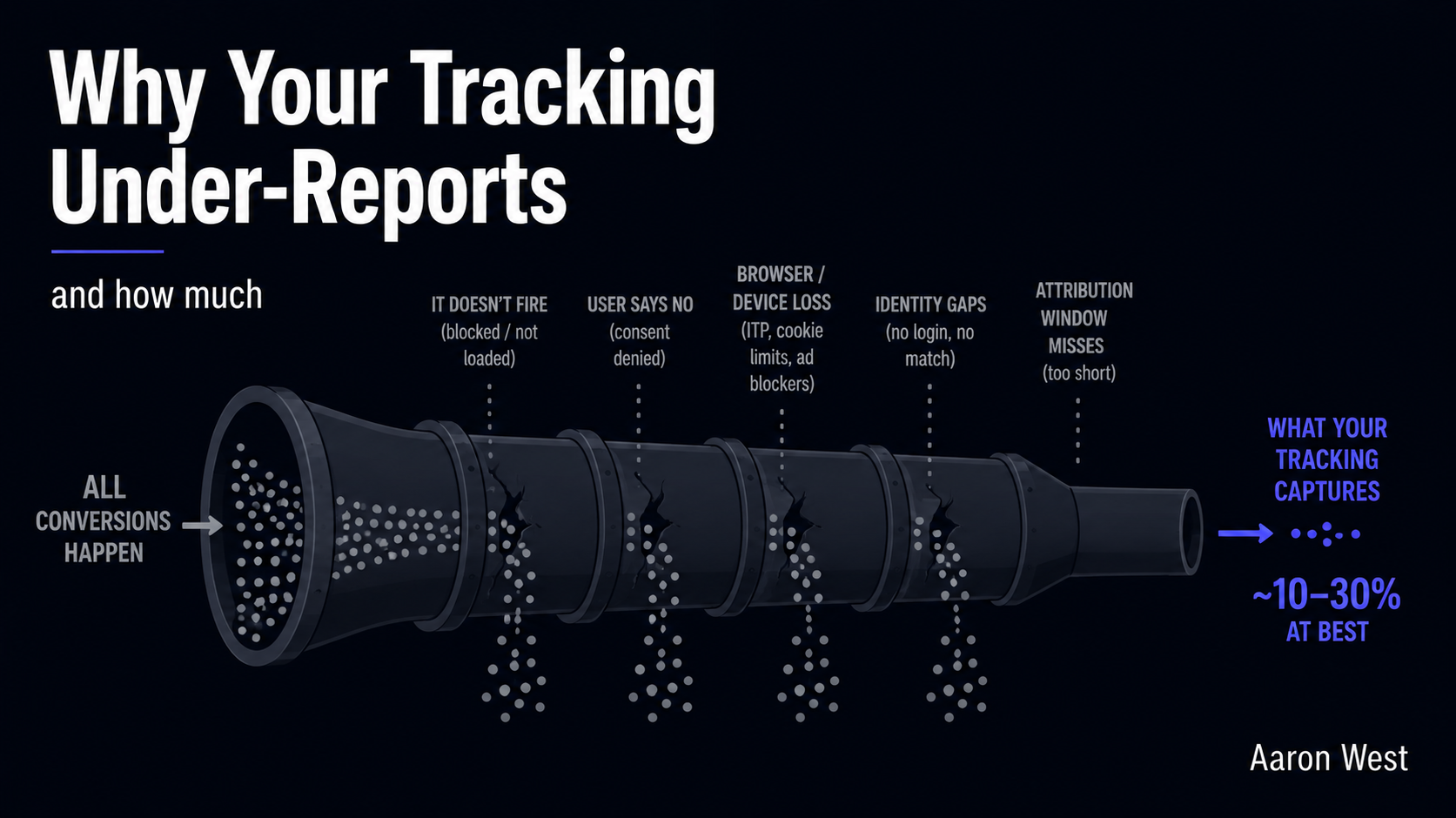
Table of Contents
Your analytics is almost certainly showing you fewer conversions than actually happened, and the gap is bigger than most marketers think. Where the deduplication problem makes your platforms claim more sales than you made, the under-reporting problem is the mirror image: a large slice of real activity, genuine visits, clicks, and purchases, never reaches your tracking at all, because the scripts that record it were blocked, expired, or refused before they could fire. The result is a systematic undercount. And it is not just smaller data, it is biased data, because the people who go uncounted are not a random sample. Understanding this gap, roughly how big it is and which way it leans, is the difference between reading your analytics as the truth and reading it as the floor it actually is.
This is the data-loss piece in the performance marketing pillar, and it is the general version of a problem that shows up everywhere in modern measurement, GA4 running below your real sales, ad platforms losing conversions, the affiliate-specific tracking loss I have covered separately. Here I will explain why the undercount happens, why it skews rather than just shrinks, how to actually measure your own gap rather than guess at it, and what to do about it. Plain language, no false precision about the size, because the honest answer is "it varies, and you should measure yours."
Why the data leaks
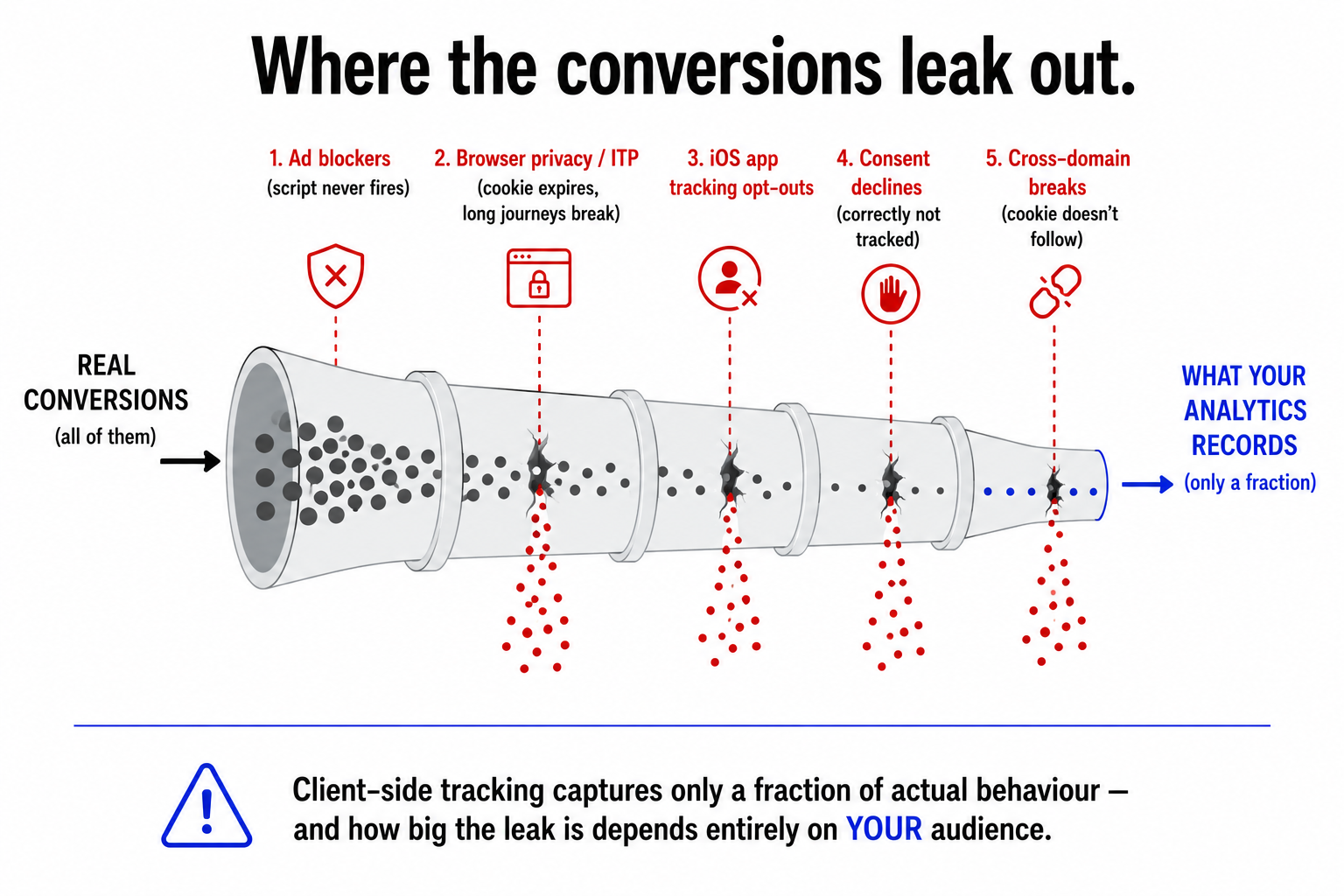
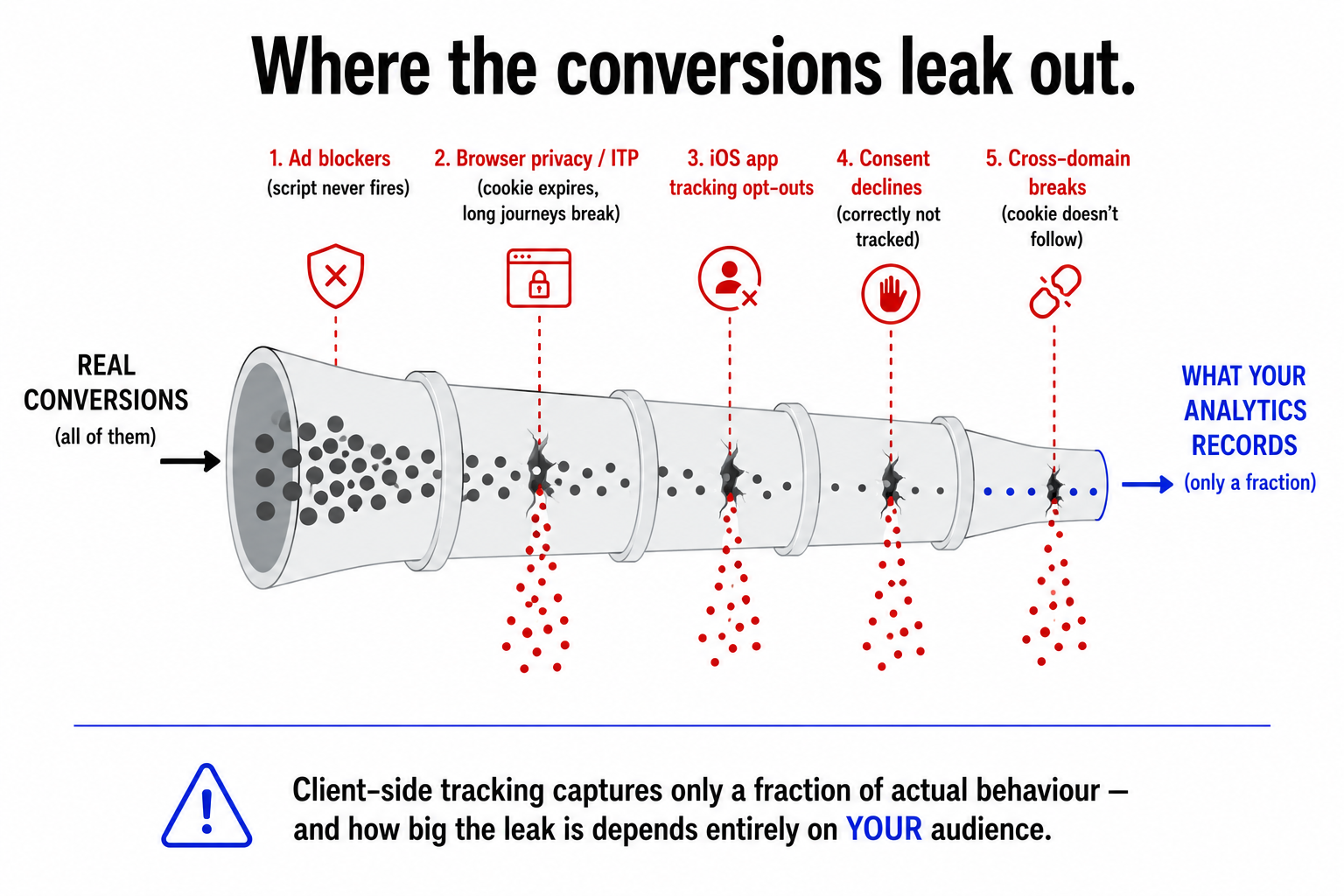
Client-side tracking, the browser-based pixels and scripts that have powered measurement for two decades, depends on a script successfully loading and running in the visitor's browser and on a cookie surviving long enough to connect the visit to the conversion. In 2026, all four of those links are breaking, and each one is a hole the data leaks through:
- Ad blockers. A substantial share of users run ad blockers or privacy extensions that stop tracking scripts from loading at all. When the script is blocked, the visit, the click, and the purchase happen, and your analytics records none of it. This is pure invisible loss.
- Browser privacy features. Safari's Intelligent Tracking Prevention and similar protections in other browsers limit how long the cookies tracking relies on survive, often capping browser-set cookies to a short window. For any purchase journey longer than that window, the customer who comes back to buy looks like a brand-new visitor, and the original source of the visit is lost.
- Mobile app tracking opt-outs. On iOS, apps must ask permission to track users across other apps and sites, and many people decline. For those users, the tracking that connects an ad view to a later purchase simply stops working.
- Consent declines. Under privacy law, non-essential tracking only fires for users who opt in, and a meaningful share decline. Their activity is, correctly, not tracked, which is good for privacy and a real gap in your data.
- Cross-domain breaks. If your funnel spans more than one domain (an ad to a landing page on one domain, then checkout on another), cookies often do not follow across the boundary, and the connection between click and conversion breaks.
Stack these together and client-side tracking now captures only a fraction of actual behaviour. Exactly what fraction depends entirely on your audience, a store with heavy Safari and EU traffic loses far more than one serving mostly logged-in Android users in a market with low ad-blocker use, which is precisely why you should measure your own rather than trust any headline percentage.
It doesn't just shrink, it skews
Here is the part that makes under-reporting genuinely dangerous rather than merely annoying: the data you lose is not a random sample of the data you keep. If tracking lost a clean, even 25% across the board, you could mentally adjust and move on. It does not. The losses concentrate among specific groups, and that bias quietly distorts your conclusions.
Think about who goes uncounted. Privacy-conscious users, the ones running ad blockers and declining consent. Safari and iOS users, hit hardest by browser and app restrictions. People on longer consideration journeys, whose cookies expire before they convert. None of those is a random slice of your customers. So when you read your analytics, you are systematically under-seeing privacy-aware buyers, Apple-device owners, and slow deliberate purchasers, and over-representing the opposite: Android users, fast impulse buyers, people who accept every cookie. Any decision you make from that data tilts toward the customers who happen to be easy to track, not the ones who matter most to your business.
That is the real cost. It is not that your numbers are a bit low, you could live with that. It is that they are low unevenly, in a way that makes some channels, some products, and some customer types look better or worse than they truly are. A channel that brings privacy-conscious Safari users will be systematically undervalued by tracking that cannot see them. Optimise hard on that biased data and you will defund exactly the things your tracking happens to be blind to. The undercount is a measurement problem. The skew is a decision problem, and it is the one that actually costs you.
How to measure your own gap
The good news is you do not have to guess at the size of your gap, and you certainly should not trust a generic percentage from an article. You can estimate it directly, and the method is simple: compare what your tracking reports against a source that counts the truth. Your backend, your actual orders, your CRM, your payment processor, knows exactly how many sales happened. Your analytics and your ad platforms tell you how many they recorded. The difference between the two is your under-reporting, made visible.
Concretely: take a period, count the real orders in your shop's backend for a given traffic source or overall, and compare that to what your analytics attributes. If your backend shows 140 sales from a source and your platform recorded 100, you have a rough 30% tracking gap on that source, and now you know it is real rather than feared. Do the same comparison at different stages, ad-platform clicks versus analytics sessions (a big drop there points at scripts being blocked on arrival), analytics sessions versus recorded conversions, recorded conversions versus actual orders, and you can see roughly where in the journey the data is leaking, not just that it is. This is the same discipline as the dedup piece, anchor to the number that cannot lie (your orders) and treat tracking as a claim to be checked against it, applied to the opposite failure. There the platforms claimed too much; here they capture too little. Both are fixed by the same habit: your backend is the truth, everything else is an estimate to be reconciled against it.
What to do about it
You cannot eliminate the gap, privacy restrictions are permanent and tightening, and chasing perfect tracking is the same losing game as chasing perfect cross-device coverage. But you can shrink it and, more importantly, account for it. Three moves, in order of leverage:
First, shrink the technical loss with server-side tracking, which recovers a meaningful share of the conversions that ad blockers and browser restrictions strip from client-side tracking, because the data is collected on your infrastructure rather than in the hostile browser. This is the single biggest practical lever on the measurable gap.
Second, build on data you own. Every customer who logs in or creates an account becomes a first-party relationship you can measure directly, sidestepping the cookie fragility entirely for that slice of your audience. The more of your customers you can identify directly, the less you depend on the leaky client-side layer.
Third, and most important because it costs nothing, read your analytics as a floor, not the truth. Internalise that your recorded conversions are an undercount, that the undercount is biased toward certain customers, and that your backend, not your analytics, is your revenue truth. That single mental adjustment, holding "this is the minimum, skewed toward easy-to-track users" in your head every time you read a report, protects more decisions than any tool. The marketers who get burned are the ones who treat analytics as gospel; the ones who do well treat it as a useful, biased, incomplete estimate and weight it accordingly. Your tracking under-reports. It always will. The skill is not pretending otherwise, it is knowing roughly how much and in which direction, measuring it against the truth your backend already holds, and reading every number with the undercount built into your judgment. Accurate-feeling data you trust blindly is worse than imperfect data you understand. The whole game is understanding it.
A few common questions
Why does my analytics show fewer conversions than I actually have? Because client-side tracking, the browser pixels and scripts most analytics relies on, systematically under-counts. Ad blockers stop the scripts firing, browser privacy features (like Safari's ITP) expire the cookies it depends on so longer journeys break, mobile app-tracking opt-outs cut off iOS users, consent declines correctly prevent tracking, and cross-domain funnels lose the connection between click and conversion. A large slice of real activity never reaches your analytics. Your backend (actual orders) is the truth; your analytics is an undercount.
How big is the tracking gap? It varies enormously by audience, which is why you shouldn't trust a generic percentage, and should measure your own. A store with heavy Safari, iOS, and EU traffic loses far more than one serving mostly logged-in users in a low-ad-blocker market. Measure it directly: compare the real orders in your backend for a period against what your analytics or ad platforms recorded for the same period, the difference is your gap. Checking at different stages (ad clicks vs analytics sessions vs recorded conversions vs actual orders) shows roughly where the data is leaking.
Why is under-reporting worse than just having lower numbers? Because the data you lose isn't a random sample, it's biased. The uncounted users concentrate among privacy-conscious people, Safari and iOS users, and those on longer consideration journeys, none of them a random slice. So your analytics systematically under-sees those groups and over-represents easy-to-track users (Android, impulse buyers, cookie-accepters). Decisions made on that data tilt toward the customers who happen to be trackable, and channels that bring hard-to-track customers get unfairly undervalued. The undercount is a measurement problem; the skew is a decision problem.
How do I fix tracking under-reporting? You can't eliminate it, but you can shrink and account for it. Shrink the technical loss with server-side tracking, which recovers conversions that ad blockers and browser restrictions strip from client-side tracking. Build on first-party data (logged-in customers you can measure directly, sidestepping cookie fragility). And most important, because it's free: read your analytics as a floor, not the truth, internalise that recorded conversions are a biased undercount and that your backend is your revenue truth. That mental adjustment protects more decisions than any tool.
You should also read:
Conversion Tracking, End to End
Conversion tracking is the system that connects a marketing action to the result it produced, so that when someone clicks your ad and later buys, you can actually say "that sale came from that ad." Without it, you are spending money and guessing. With it,…
Continue reading...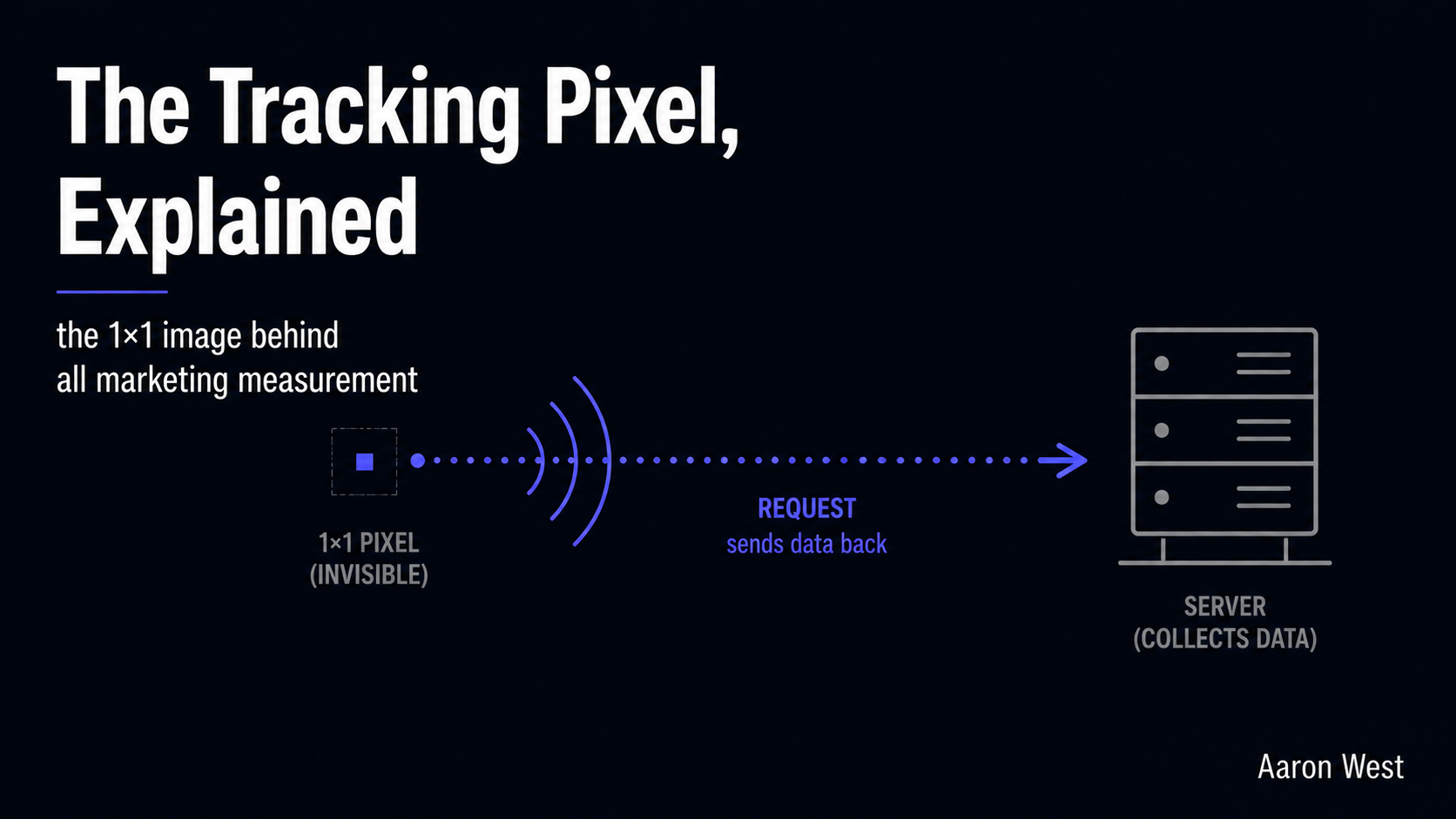
The Tracking Pixel, Explained
A tracking pixel is a tiny, invisible image, usually a single transparent dot one pixel wide, hidden in the code of a web page, email, or ad, and its only job is to quietly report back when something happens. When the page loads, the pixel…
Continue reading...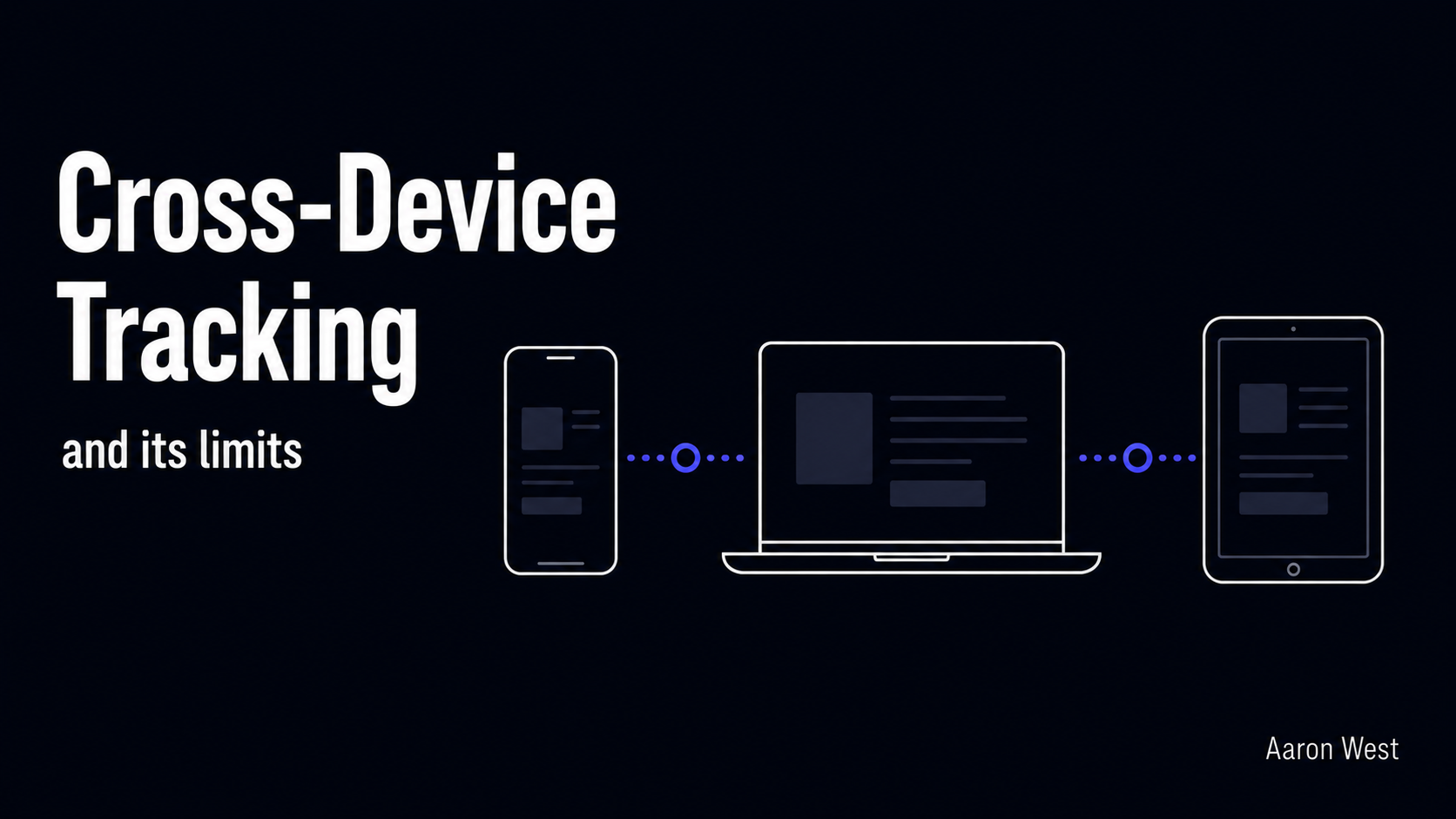
Cross-Device Tracking and Its Limits
You browse for headphones on your phone during your commute, read reviews on your laptop at work, and finally buy on your tablet that evening. To you, that is one shopping journey. To your analytics, with nothing connecting those devices, it looks like three completely…
Continue reading...