Automating the CRM Lifecycle: The Customer Motions That Should Never Be Manual

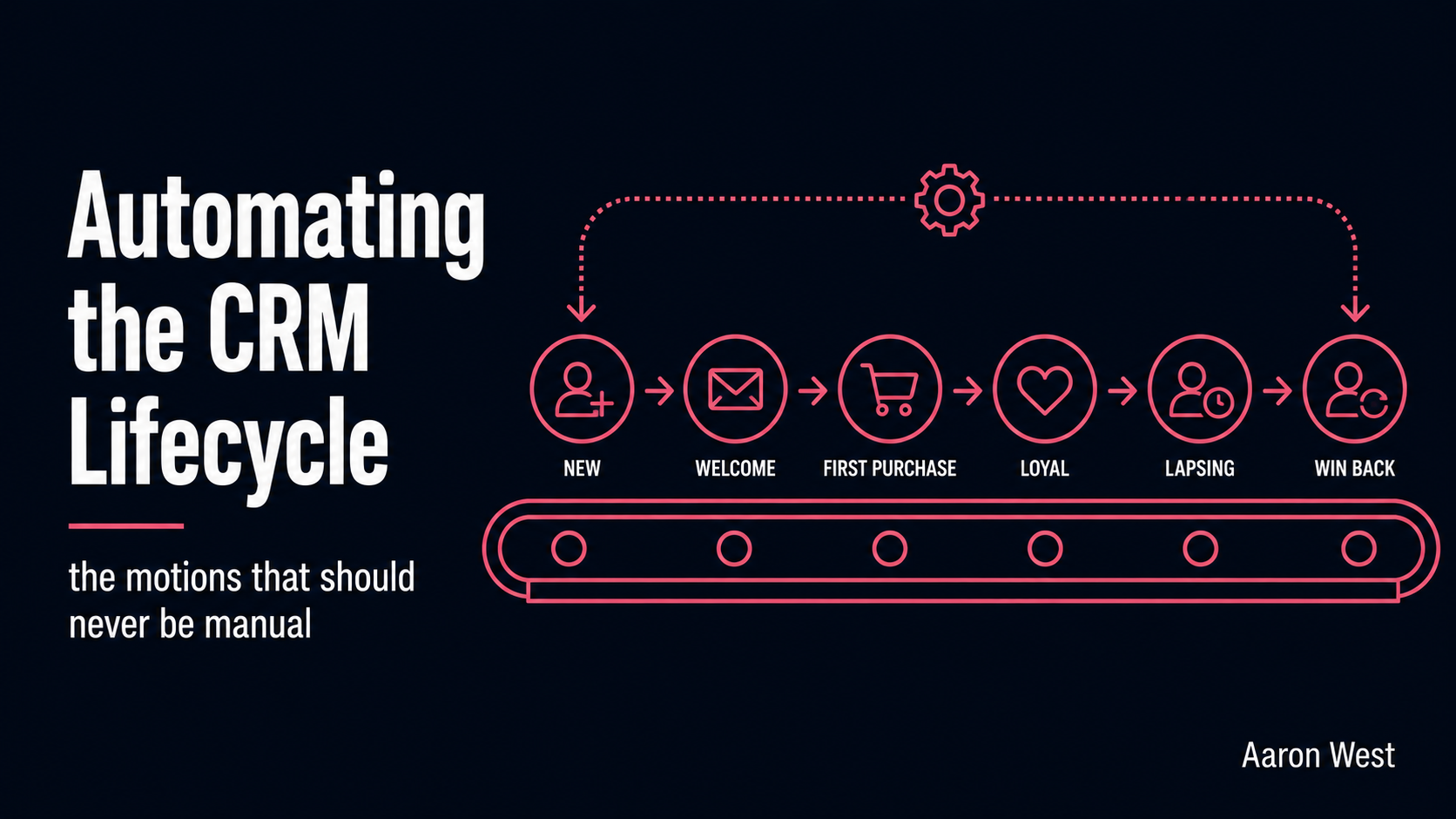
Table of Contents
The cornerstone of this pillar made one demand that quietly does most of the work: decide what should happen next for each kind of customer, and then do it consistently. That word, consistently, is where almost every retention effort falls apart. The welcome that goes out when somebody on the team happens to remember. The nudge toward a second purchase that depends on a human having a free afternoon. The win-back for lapsing customers that, in practice, happens never. None of these fail because the team does not know they matter. They fail because they rely on a person to remember to do them, every time, forever, and people do not. This piece is about the fix, which is automation, and about why these specific motions are the single clearest case for it.
This sits directly under CRM is not software, it's a discipline, and it is where that discipline meets the automation thinking from my automation pillar, because the lifecycle motions are a textbook example of work that should be taken off human hands entirely. I will explain why they qualify, which motions are worth building first, and the one principle that separates real lifecycle automation from a pile of disconnected email flows that quietly turns into spam. Plain language, no platform pitch.
Why these motions are the clearest automation case there is
In my framework for what to automate, the sweet spot is work that is high-frequency, rules-based, and requires no human judgment in the moment, the kind of task where a person is effectively acting as a trigger between an event and a response. The core lifecycle motions fit that description almost perfectly, which is why leaving them manual is such a waste.
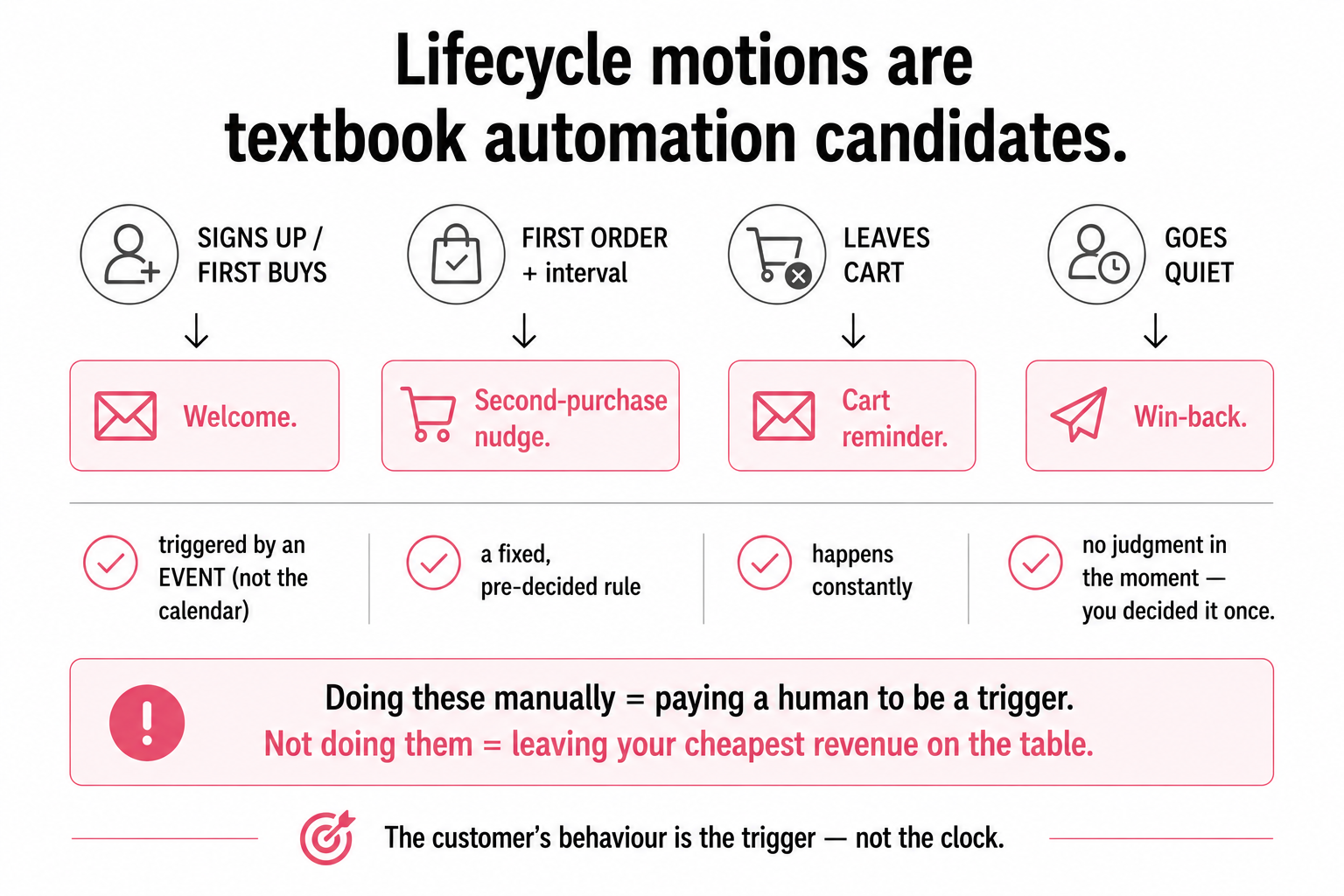
Look at what each one actually is. A welcome message fires when someone signs up or makes a first purchase. A second-purchase nudge fires a sensible interval after that first order. A cart reminder fires when someone leaves items behind. A win-back fires when a customer has gone quiet for longer than usual. Every single one is triggered by a specific event, follows a fixed, decided-in-advance rule, happens constantly across your customer base, and requires no judgment at the moment it runs, you already made the judgment when you designed it. That is the exact profile of work that should be event-driven and automated rather than done by hand. Note the word event. These motions should not run on a calendar (every Tuesday, send something); they should run off what the customer actually did (they bought, so now this happens). The trigger is the customer's behaviour, not the clock.
Doing this work manually is paying a skilled human to sit and watch for events and react to them, which is both expensive and unreliable, because the human gets busy, goes on holiday, or simply forgets, and the motion silently stops. Not doing it at all, which is the more common reality, means leaving the cheapest revenue you have, the second purchase from an existing customer, entirely on the table. Automation is how the discipline the cornerstone described actually becomes consistent: the right thing happening every time an event occurs, without depending on anyone to notice.
The motions worth building, mapped to the customer's life
The lifecycle is just the set of these automated motions, each aimed at a customer at a particular stage, the segments the cornerstone described. You do not need dozens. A handful, built well and aimed at the moments that matter most, does the overwhelming majority of the work. The ones worth building, roughly in order of value:
- The welcome. Fires the moment someone subscribes or makes their first purchase, when their attention and goodwill are at their absolute peak. This is your one chance at a first impression: introduce who you are, set expectations for what is coming, and begin the relationship deliberately rather than going silent until you next want to sell something. A new customer who hears nothing after their first order has been taught, immediately, that you only show up to take.
- The second-purchase nudge. Fires a sensible interval after the first order. This is the most valuable motion in the entire lifecycle, because it targets the single highest-leverage moment in the customer relationship: turning a one-time buyer into a repeat one, where the probability of long-term loyalty bends most steeply. Most stores send a shipping confirmation and then nothing. The discipline is a deliberate, automatic motion designed to make that second purchase happen, a relevant recommendation, a reason to come back, timed to when they would realistically be ready.
- The abandonment catch. Fires when someone adds to cart or reaches checkout and does not finish. These people demonstrated real intent and got interrupted, so a timely, gentle reminder recovers a meaningful share of sales that would otherwise simply evaporate. It is among the highest-return motions precisely because the customer was already most of the way to buying.
- The win-back. Fires when a customer who used to buy has gone quiet for longer than their normal gap. One well-timed message can catch a lapsing customer before they are gone for good. This one deserves its own treatment, and gets it later in the cluster, so I will leave it here as a placeholder in the lifecycle: the motion that addresses the customer drifting away.
Each of these is aimed at a customer in a known state, doing a known job: welcome the new one, convert the first-time buyer, recover the interrupted one, recover the drifting one. That is the lifecycle. Build these few, well, before you even think about anything more elaborate.
The principle that separates a lifecycle from a pile of flows
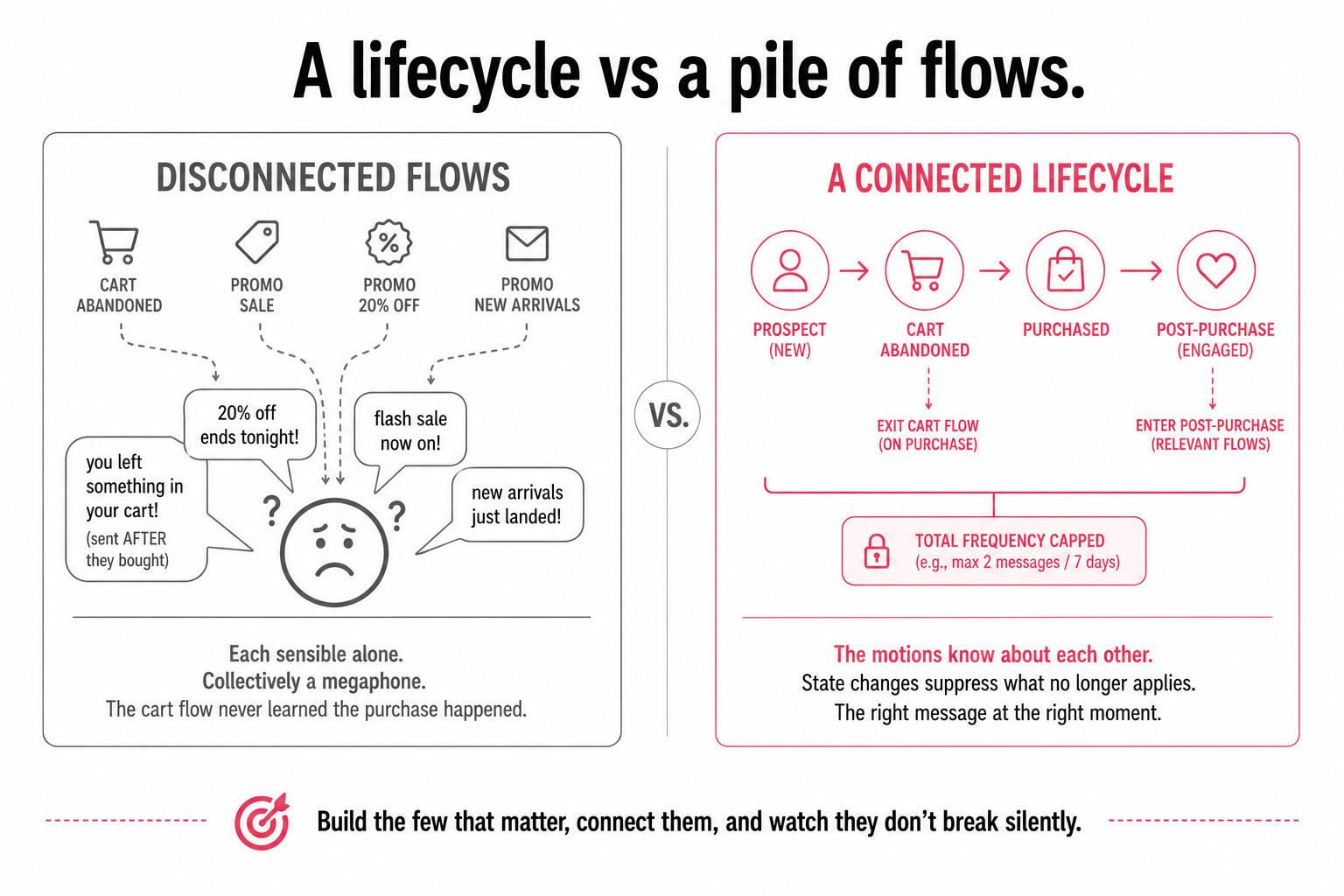
Here is the thing that separates real lifecycle automation from "we set up a few email flows," and it is the difference between a system and a mess: the motions have to know about each other. A genuine lifecycle reflects where each customer actually is, which means the flows must talk, share state, and defer to each other. The classic failure is the store that sets up a cart-abandonment reminder and a post-purchase flow independently, and then sends a customer a "you left something in your cart!" email an hour after they already bought it, because the cart flow never learned the purchase happened. That is not relationship management. That is two robots talking past each other at a confused customer.
So the rule is: when a customer's state changes, the automation has to respond to it, suppressing the motions that no longer apply and moving them into the ones that now do. Someone who completes a purchase exits the cart flow and enters the post-purchase one. Someone who comes back exits the win-back. And, crucially, the motions have to be coordinated on frequency, because here is the trap that catches well-meaning teams: you build a welcome flow, an abandonment flow, a post-purchase flow, a win-back, and a promotional calendar, each sensible on its own, and a single customer who happens to trigger several of them at once gets buried under a pile of simultaneous emails. Independently reasonable, collectively a megaphone, the exact thing the cornerstone warned against. A real lifecycle caps the total noise any one person receives, because the discipline is the right message at the right moment, not the maximum number of messages the system can technically fire.
This is also why two habits from the automation pillar apply directly. First, build in order of value: get the welcome, the second-purchase nudge, and the abandonment catch working and coordinated before you layer on anything fancier, the same discipline of starting with the highest-value work rather than the most exciting. Second, and I cannot say this enough, an automated motion that silently breaks is worse than no automation at all. A welcome flow that quietly stops firing after an integration change, and that nobody notices for three months, has cost you three months of first impressions. So every lifecycle motion needs the same thing every automation needs: a monitor that tells you the moment it breaks. The flow that fails loudly is worth more than the elegant one that fails in silence.
The relationship that runs itself
Pull it together and the lifecycle is simply the cornerstone's discipline made operational. You decided what should happen next for each kind of customer. Automation is how you actually do it consistently, at the scale of every customer who ever buys, without it depending on someone remembering on a busy Tuesday. And it pays back out of proportion to the effort, because these automated, behaviour-triggered motions are a small fraction of the messages you send but generate a large share of the value they produce, for the obvious reason that they are timely and relevant by design, reaching the right person at the moment something actually happened, which is the precise opposite of blasting the whole list the same thing and hoping.
So build the few motions that matter, the welcome, the second-purchase nudge, the abandonment catch, the win-back. Connect them so they reflect where each customer actually is, rather than firing blindly in parallel. Cap the total noise so the system never becomes the megaphone. And monitor them so a silent failure cannot quietly cost you months of relationships. Do that, and the relationship-building the cornerstone asked for stops depending on anyone's memory or free time and starts happening on its own, the right message reaching the right customer at the right moment, around the clock. That is the difference, in practice, between owning a CRM and doing CRM.
A few common questions
Which CRM lifecycle emails should I automate first? Start with the few highest-value motions and get them working before adding anything elaborate: a welcome (fires when someone signs up or first buys, when their attention is highest), a second-purchase nudge (fires a sensible interval after the first order, targeting the highest-leverage moment in the whole relationship), and an abandonment catch (fires when someone leaves a cart or checkout, recovering customers who already showed real intent). A win-back for customers who've gone quiet comes next. These four, built well and coordinated, do the overwhelming majority of the work, dozens of clever flows do not beat a few essential ones done right.
Why automate lifecycle emails instead of sending them manually? Because they're the textbook case for automation: each is triggered by a specific event (a signup, a first order, an abandoned cart, a customer going quiet), follows a fixed rule you decided in advance, happens constantly across your customer base, and needs no human judgment at the moment it runs. Doing that manually means paying a person to watch for events and react, which is expensive and unreliable, they get busy and forget, and the motion silently stops. The cornerstone's demand that the lifecycle run "consistently" is only achievable by automating it, so the right thing happens every time an event occurs, not when someone remembers.
What's the difference between lifecycle automation and just setting up a few flows? The motions have to know about each other. A real lifecycle reflects where each customer actually is: when their state changes, the automation responds, suppressing flows that no longer apply and moving them into ones that do, so nobody gets a "you left something in your cart" email an hour after buying. It also coordinates frequency, because a customer who triggers several independently-reasonable flows at once gets buried under simultaneous emails, which collectively become a megaphone. A pile of disconnected flows blasting in parallel is a mess with extra steps; a lifecycle is a connected system that caps the noise and sends the right message at the right moment.
Should lifecycle emails run on a schedule? No, they should run on events. A scheduled send goes out at a fixed time regardless of what the customer did; a lifecycle motion fires off the customer's actual behaviour, they bought, so now this happens. The trigger is the behaviour, not the clock. The exception is that you still cap total frequency across all motions so a customer who triggers several at once isn't overwhelmed. And whatever you build, monitor it, an automated flow that breaks silently is worse than no automation, because a welcome that quietly stops firing can cost months of first impressions before anyone notices.
You should also read:
Retention Metrics That Actually Predict Growth
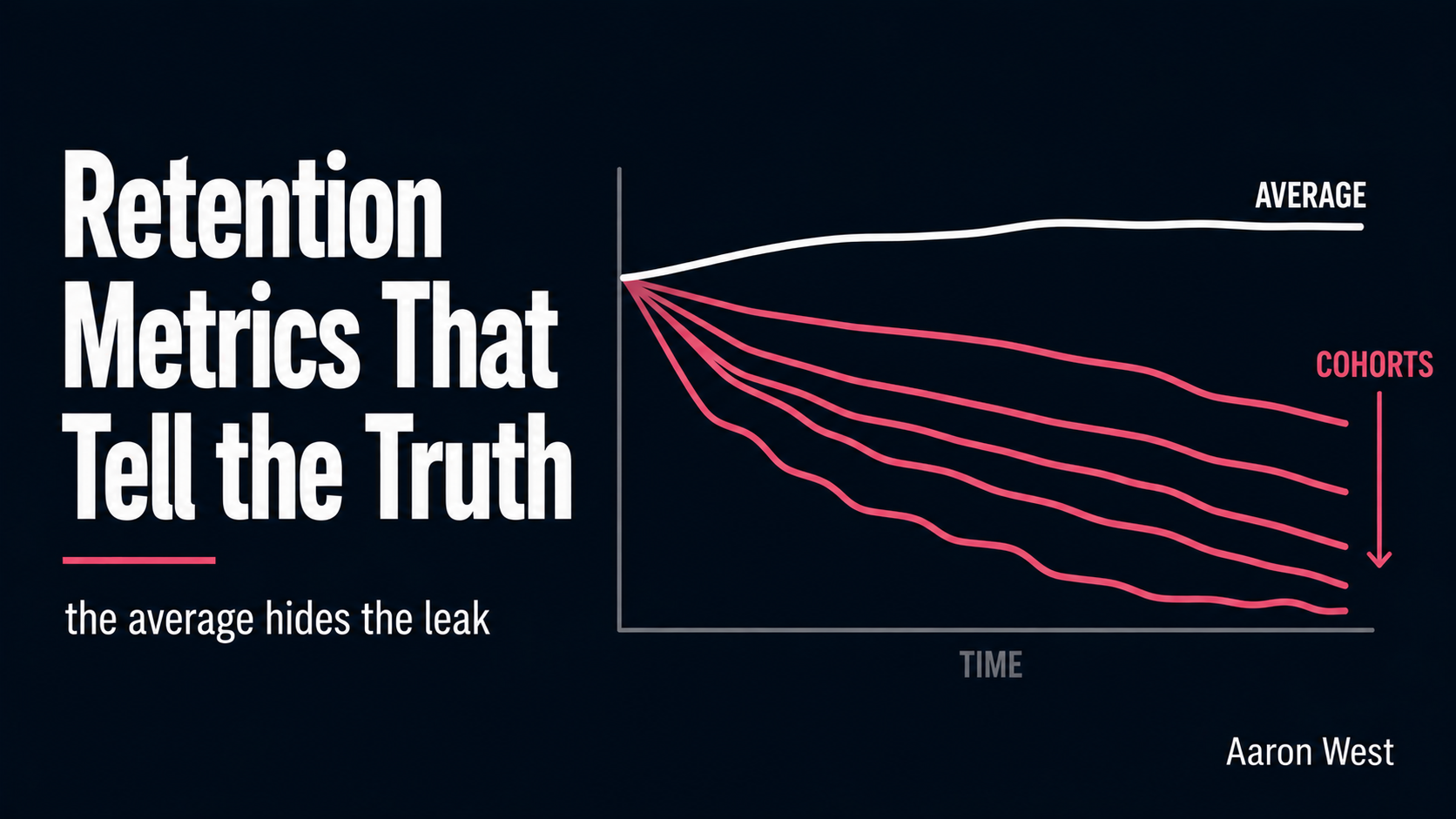
The cornerstone of this pillar ended on a deceptively simple instruction: do the work consistently, and measure it. This is the reference for that last word. Retention has a long list of possible metrics, and most teams fall into one of two traps with them:…
Continue reading...
Everything I Know About Building Chatbots That Actually Work
The hard part of building a chatbot was never the technology. I learned this in 2019, building a natural-language chatbot from scratch for a large hotel group, across dozens of locations and several languages, back when "conversational AI" was a research term and not a…
Continue reading...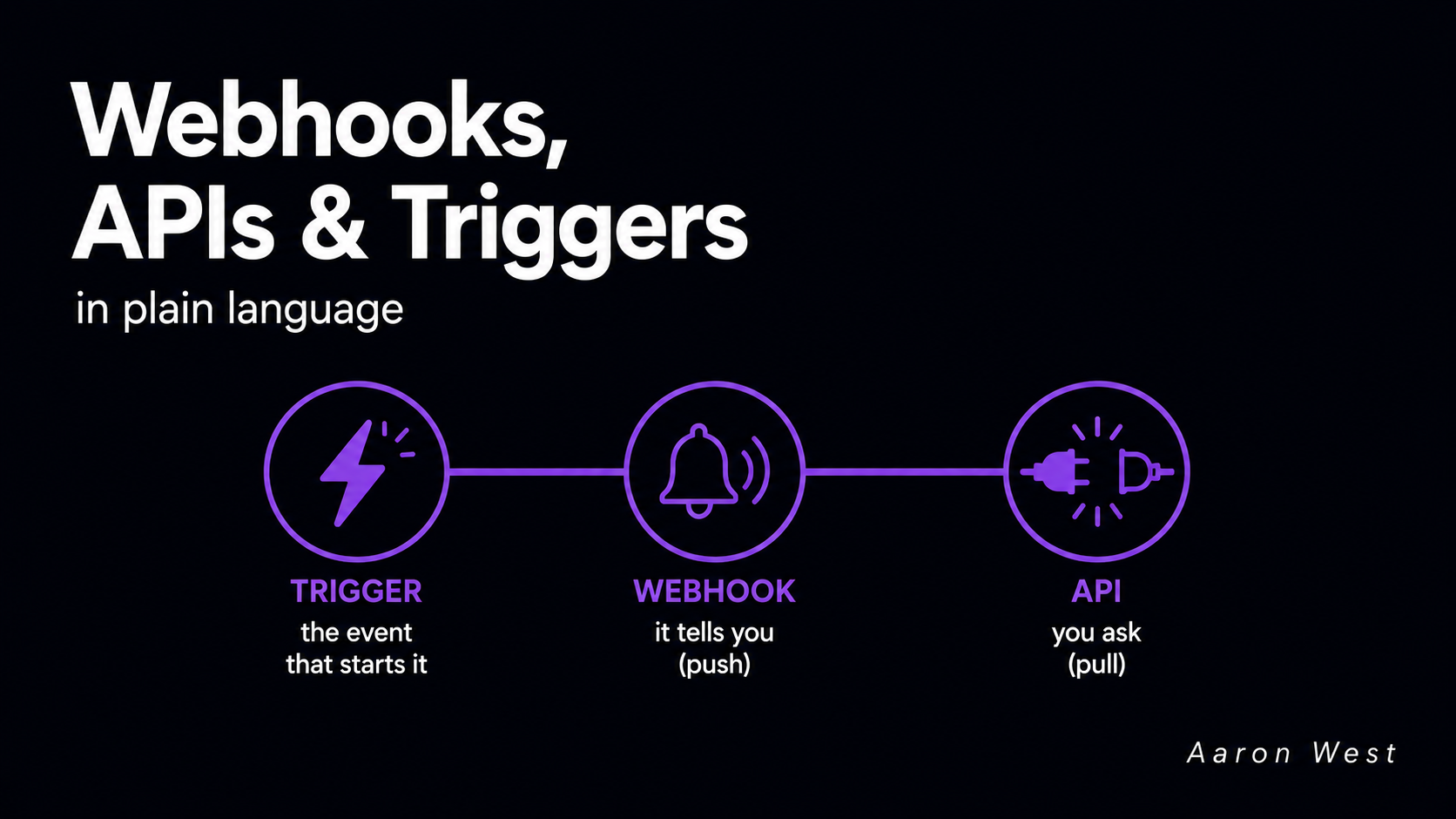
Webhooks, APIs and Triggers: The Three Words You Need Before Automating Anything
If you have ever read an automation tutorial and quietly stalled at the words "webhook," "API," and "trigger," this is for you. These three terms sit underneath almost every automation you will ever build, and the jargon makes them sound far more technical than they…
Continue reading...