The Engagement Trap: Why "More Emails" Is Not a Retention Strategy

Table of Contents
When retention numbers are soft, the most common reflex in the building is also the most damaging: send more emails. More newsletters, more promotions, more "we miss you" nudges, on the theory that more contact means more engagement means more sales. It is intuitive, it feels like doing something, and it is almost exactly backwards. Sending more email to a list that is not responding does not increase engagement. It actively destroys it, and worse, it quietly damages your ability to reach even the customers who do want to hear from you. This is the engagement trap, and it is the megaphone my CRM cornerstone warned about, examined in full.
This piece sits under CRM is not software, it's a discipline, and it is the counterpart to the lifecycle automation piece: that one is about building the right motions, this one is about the discipline of restraint that stops those motions from collectively becoming noise. I will explain the genuinely counterintuitive mechanism by which more email leads to less reach, why "engagement" is the wrong thing most teams optimise, and why a smaller, well-treated list beats a big, blasted one. Plain language, and a conclusion that will feel wrong until you see why it is right.
The counterintuitive part: more email, less reach
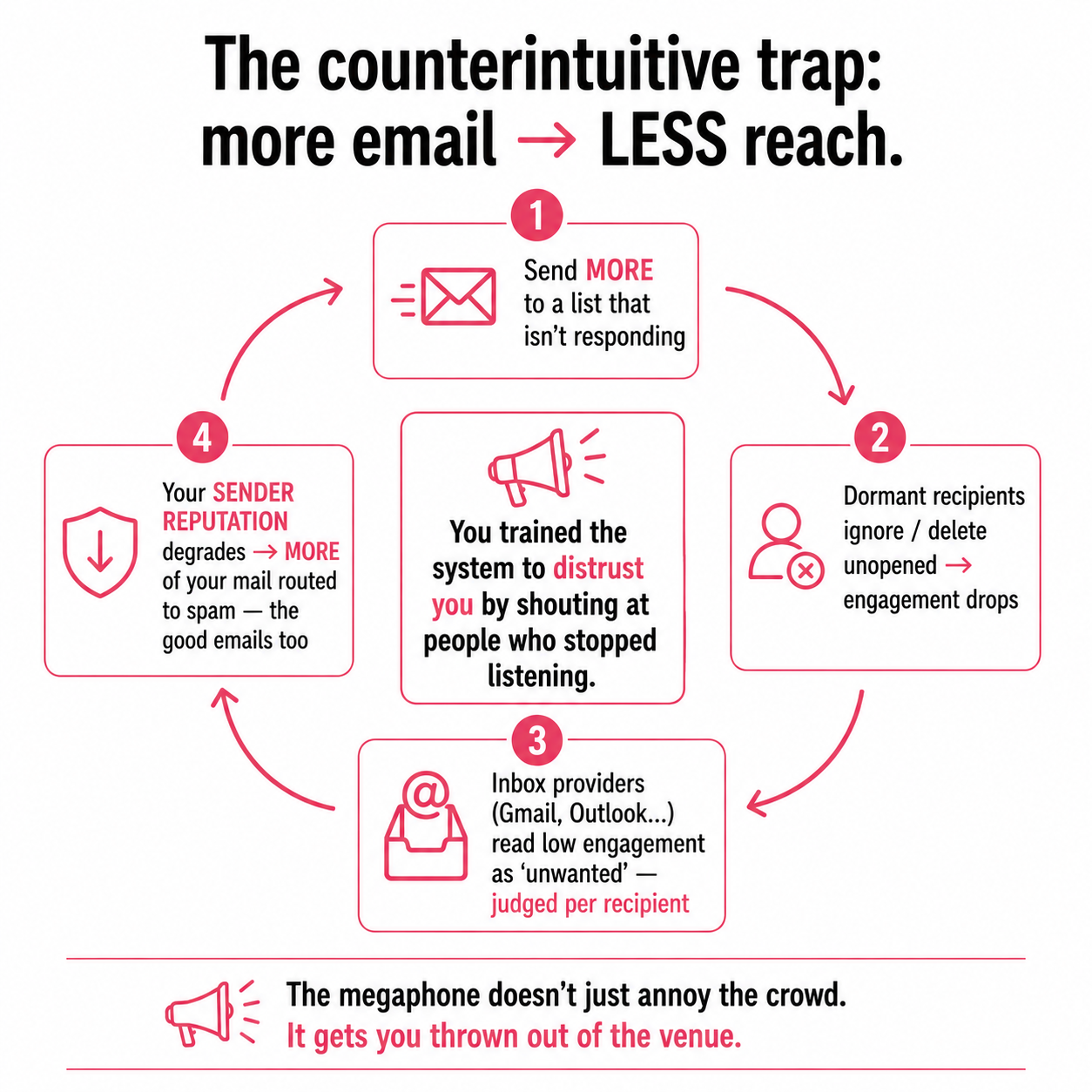
Here is the mechanism almost nobody accounts for, and it is the reason the trap is so dangerous. The major inbox providers, the systems that decide whether your email lands in someone's inbox or their spam folder, no longer make that decision purely on whether you look like a spammer. They make it increasingly on engagement: do the people you send to actually open, read, and interact with your mail? They track this at the level of the individual recipient, and they use it as a verdict on whether your messages are wanted. And here is the sting: sustained sending to people who do not engage tells the provider your mail is unwanted, and that verdict degrades your reputation for everyone you send to, including the people who love your emails.
Sit with that, because it inverts the whole "more is better" instinct. When you blast your entire list, including the large dormant portion who never open anything, you are not just wasting those sends. You are actively teaching Gmail, Outlook, and the rest that your mail is the kind people ignore, and they respond by quietly routing more of your mail to spam, the good and the bad alike. So the welcome that would have charmed a new customer, the win-back that might have recovered a lapsing one, the genuinely useful message your best customers actually want, all of them are now more likely to land in spam, because you trained the system to distrust you by shouting at people who stopped listening. More email did not buy you more reach. It bought you less. The megaphone does not just annoy the crowd. It gets you thrown out of the venue.
"Engagement" is the wrong thing to chase
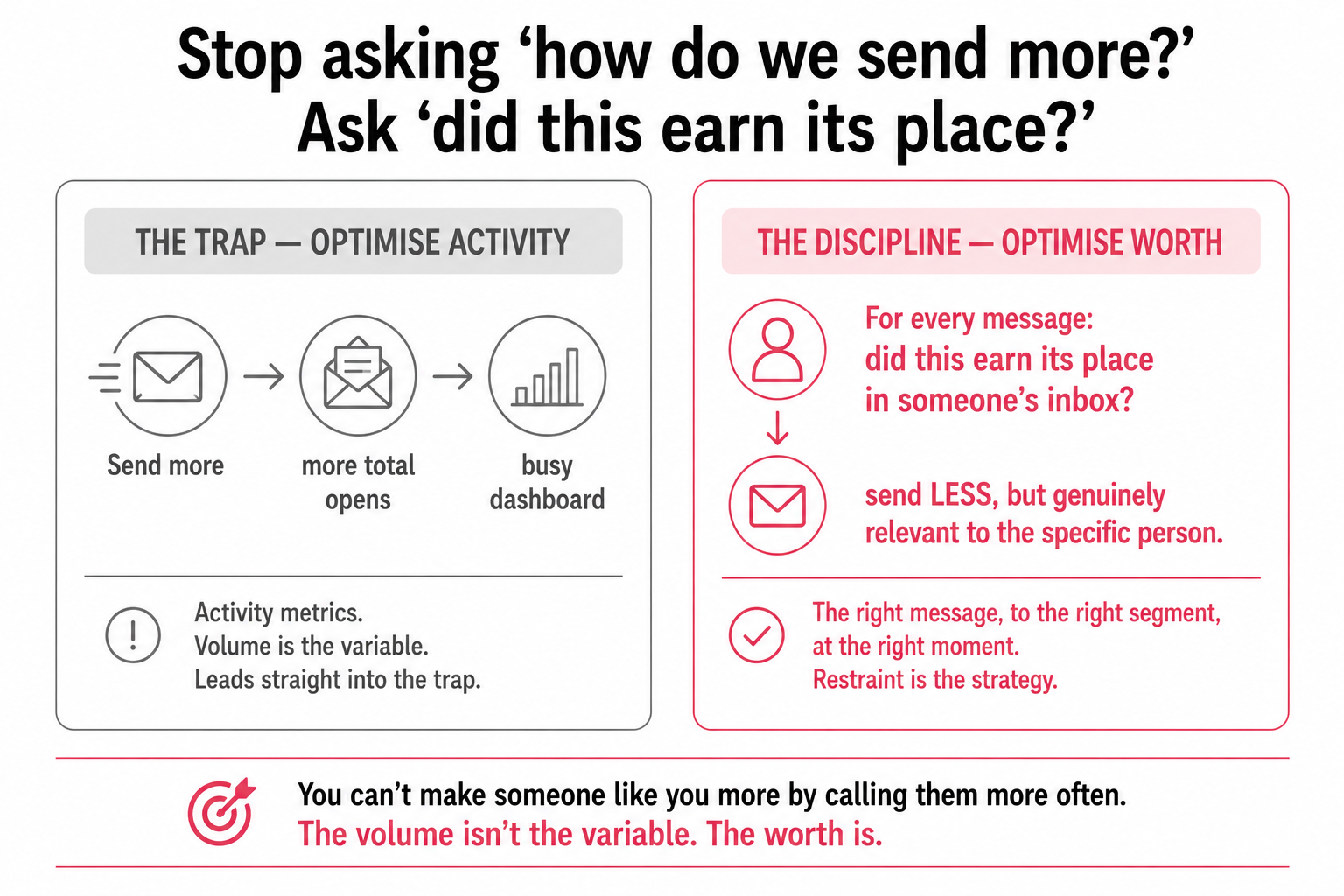
Part of why teams fall into this is that they are optimising the wrong word. "Engagement" gets treated as a thing you generate by sending, more emails, more chances for someone to click, more activity on the dashboard. But engagement is not something you manufacture by increasing volume. It is the customer's response to whether your messages are worth their attention, and you cannot force that by sending more of what they are already ignoring. Chasing "engagement" by raising frequency is like trying to make someone like you more by calling them more often. The volume is not the variable. The worth is.
This connects to a point I have made about measuring the right things: "we sent more emails" and even "we got more total opens" are activity metrics, not outcome metrics, and optimising them leads you straight into the trap. The question worth asking is not "how do we send more?" but, for every single message, "did this email earn its place in someone's inbox?" That is a far harder, far more useful question, and it points in the opposite direction from the reflex. It pushes you to send less, but to make each send genuinely relevant to the specific person receiving it, which is exactly the discipline the cornerstone described: the right message, to the right segment, at the right moment, rather than the same message to everyone whenever there is something to promote. Restraint is not the cautious option here. Restraint is the strategy, because it is the only thing that protects the one asset the whole channel depends on, your welcome in the inbox.
The fatigue mechanism underneath this is simple and worth naming plainly. Over-mail people and they disengage: they stop opening, they delete unread, they start to associate your name with noise. A portion then unsubscribe, and a worse portion mark you as spam rather than bother unsubscribing, and both of those, especially the spam complaints, are direct signals to the inbox providers that compound the reputation damage. Every unwanted email you send is a small bet against your own future deliverability. Send few and relevant, and you stay welcome. Send many and generic, and you slowly make yourself unreachable.
Why a smaller list beats a bigger one
Now the conclusion that feels wrong until the mechanism above makes it obvious: a smaller, engaged list is worth more than a big, disengaged one, and deliberately shrinking your list can improve your results. This sounds like marketing heresy, because list size is the number everyone instinctively wants to grow, but list size is a vanity metric. What actually drives revenue and protects your reach is the engaged portion, the people who open, read, and buy, and the dormant remainder is not a neutral asset sitting in reserve. It is an active liability, dragging down your engagement signals and your deliverability with every send.
Which leads to a genuinely freeing reframe: an unsubscribe from someone who was never going to buy is a gift, not a loss. When a disengaged person removes themselves, they stop dragging down the reputation that determines whether your good customers see you at all. So the disciplined practice is the opposite of the hoard-everyone instinct: identify the people who have gone quiet, make one honest attempt to re-engage them (a real "do you still want to hear from us?"), and then stop emailing the ones who do not respond, suppressing them from your regular sends rather than continuing to shout at a wall and damaging yourself in the process. You are not losing customers by doing this. Those people already left, in every way that matters, the only question is whether you keep paying for their silence with your deliverability. A clean, engaged list that you treat with restraint will out-earn a bloated one you blast, reliably, because the inbox providers reward exactly the behaviour the customer rewards: relevance, restraint, and respect for attention.
That is the engagement trap in full, and it closes the loop with the rest of this pillar. The cornerstone said CRM is the discipline of the right message to the right segment at the right moment. The lifecycle piece said the automated motions must cap their collective frequency so they never become noise. This piece is why both of those matter so much: because the alternative, the megaphone, does not merely fail to build relationships, it actively burns down the channel you would use to build them. The discipline is not about sending more and hoping. It is about earning, and protecting, your place in the inbox, one relevant message at a time. Send less. Mean it more. That is the whole strategy, and it is the opposite of the reflex.
A few common questions
Does sending more emails increase engagement and sales? No, and past a point it does the reverse. Sending more email to a list that isn't responding doesn't manufacture engagement, it destroys it, and it quietly damages your ability to reach even the customers who do want to hear from you. The mechanism is that inbox providers now judge you on per-recipient engagement: sustained sending to people who don't open or click tells Gmail, Outlook, and the rest that your mail is unwanted, which degrades your sender reputation and routes more of your email, the good as well as the bad, to spam. So more email can buy you less reach, not more.
Why does over-mailing hurt deliverability? Because engagement is now a primary signal inbox providers use to decide between inbox and spam, and they track it per recipient. When you blast your whole list including a large dormant portion, those ignored sends teach the provider your mail is the kind people don't want, degrading your reputation for everyone. It compounds when fatigued recipients unsubscribe or, worse, mark you as spam rather than unsubscribe, both of which are direct negative signals. Every unwanted email is a small bet against your own future ability to reach the inbox.
Should I delete inactive subscribers? Usually yes, after one honest re-engagement attempt. A big list is a vanity metric; what drives revenue and protects your reach is the engaged portion, and the dormant remainder is an active liability dragging down your deliverability with every send. So identify the people who've gone quiet, make one genuine "do you still want to hear from us?" attempt, and then suppress the ones who don't respond from your regular sends. An unsubscribe from someone who was never going to buy is a gift, not a loss, they stop dragging down the reputation that determines whether your real customers see you at all. A smaller engaged list reliably out-earns a bloated blasted one.
What should I optimise instead of email volume? Relevance, not activity. "We sent more" and "we got more total opens" are activity metrics that lead straight into the trap. The better question, for every single message, is "did this earn its place in someone's inbox?" That pushes you to send less but make each send genuinely relevant to the specific person, the discipline of the right message to the right segment at the right moment. Restraint isn't the cautious option, it's the strategy, because it's the only thing that protects the asset the whole channel depends on: your welcome in the inbox.
You should also read:
Support Is a Retention Channel, Not a Cost to Minimise
Most companies treat customer support as a cost centre to be minimised: deflect the tickets, cut the handle time, shrink the team, get the cost-per-contact down. That framing is the central mistake in how businesses think about support. Support is a retention channel. It's where…
Continue reading...
Newsletter Strategy: A Newsletter Is a Relationship, Not a Mailing List
A newsletter is a relationship, not a mailing list. Most things called newsletters are just recurring promotions, and they train people to ignore them. The ones that work give the reader a reason to open that isn't "buy something," and that, counterintuitively, is exactly what…
Continue reading...
The Thank-You Page: Where Conversion Ends and Retention Begins
The moment right after someone buys from you is the single highest-trust, highest-goodwill moment you will ever get with that person. They have just said yes. They have handed over their card, their email, their address. Their guard is down and their momentum is forward.
Continue reading...