CRM Is Not Software. It's a Discipline

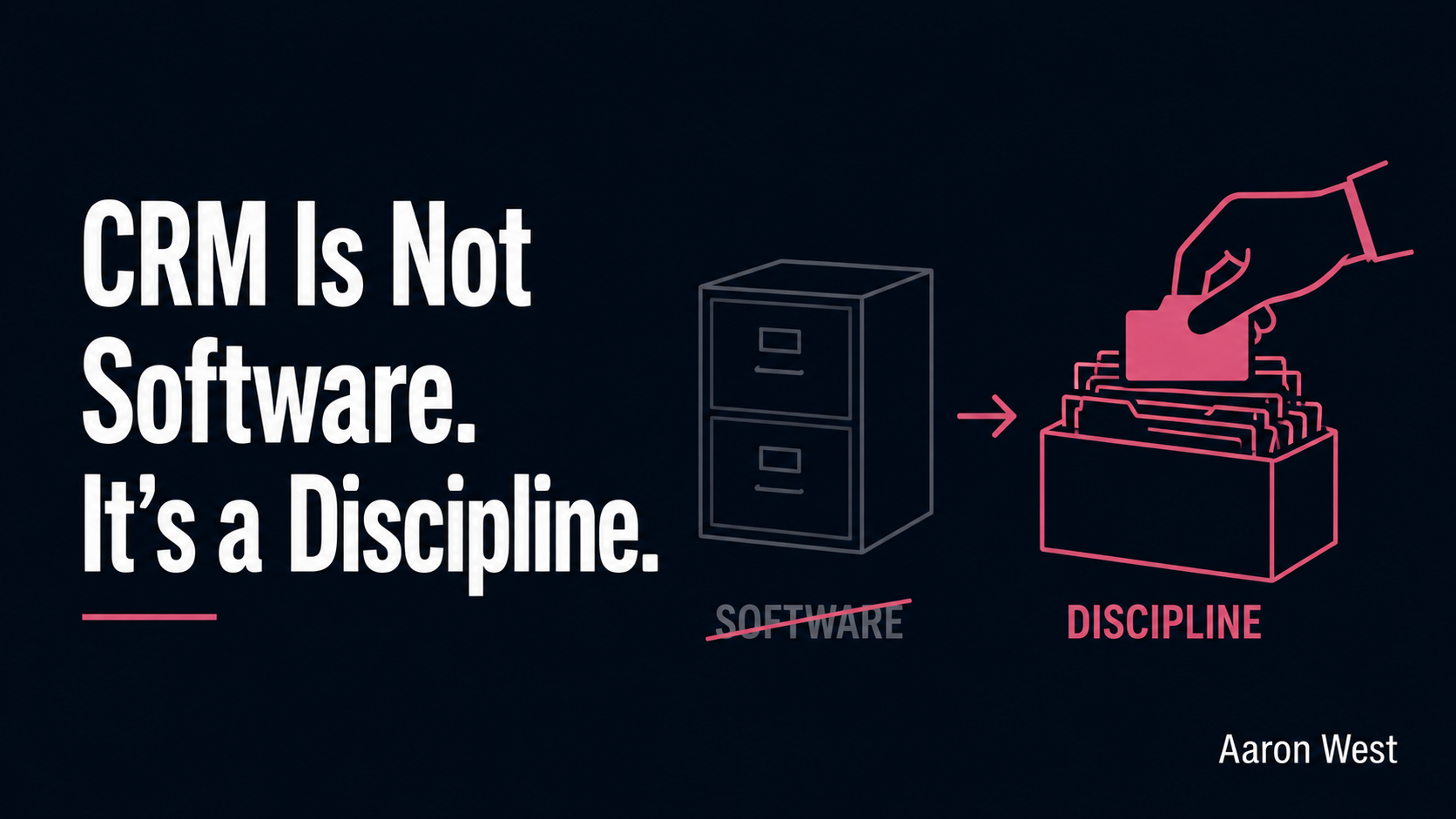
Table of Contents
Here is a scene I have watched play out more than once. A team decides they need to "do CRM." They evaluate platforms, pick one, pay for it, migrate their customer data into it, and tick the box: we have a CRM now. Six months later, ask them which customers are about to stop buying, which lapsed ones are worth winning back, or what is supposed to happen automatically after someone places their first order, and you get blank looks. They have a CRM. They do not do CRM. That gap, between owning the software and practising the discipline, is the most expensive misunderstanding in customer retention, and it is the subject of this entire pillar.
So let me be blunt about the thing the whole industry blurs: CRM is not a piece of software you install. It is a discipline you practise. The letters stand for customer relationship management, and the operative word is management, the deliberate, ongoing, systematic work of managing your relationships with the people who buy from you. The software is a tool that helps you do that work. It is not the work. Confusing the two is like buying a gym membership and believing you are now fit. The membership enables the thing. It is not the thing. This piece is the cornerstone of my CRM and retention writing, and everything else in the cluster, the lifecycle automation, the win-back, the loyalty, the metrics, rests on this one shift in understanding. Get this right and the rest follows. Get it wrong and you will spend money on a platform that quietly stores your customer data while you do nothing useful with it.
Why this distinction is about money, not pedantry
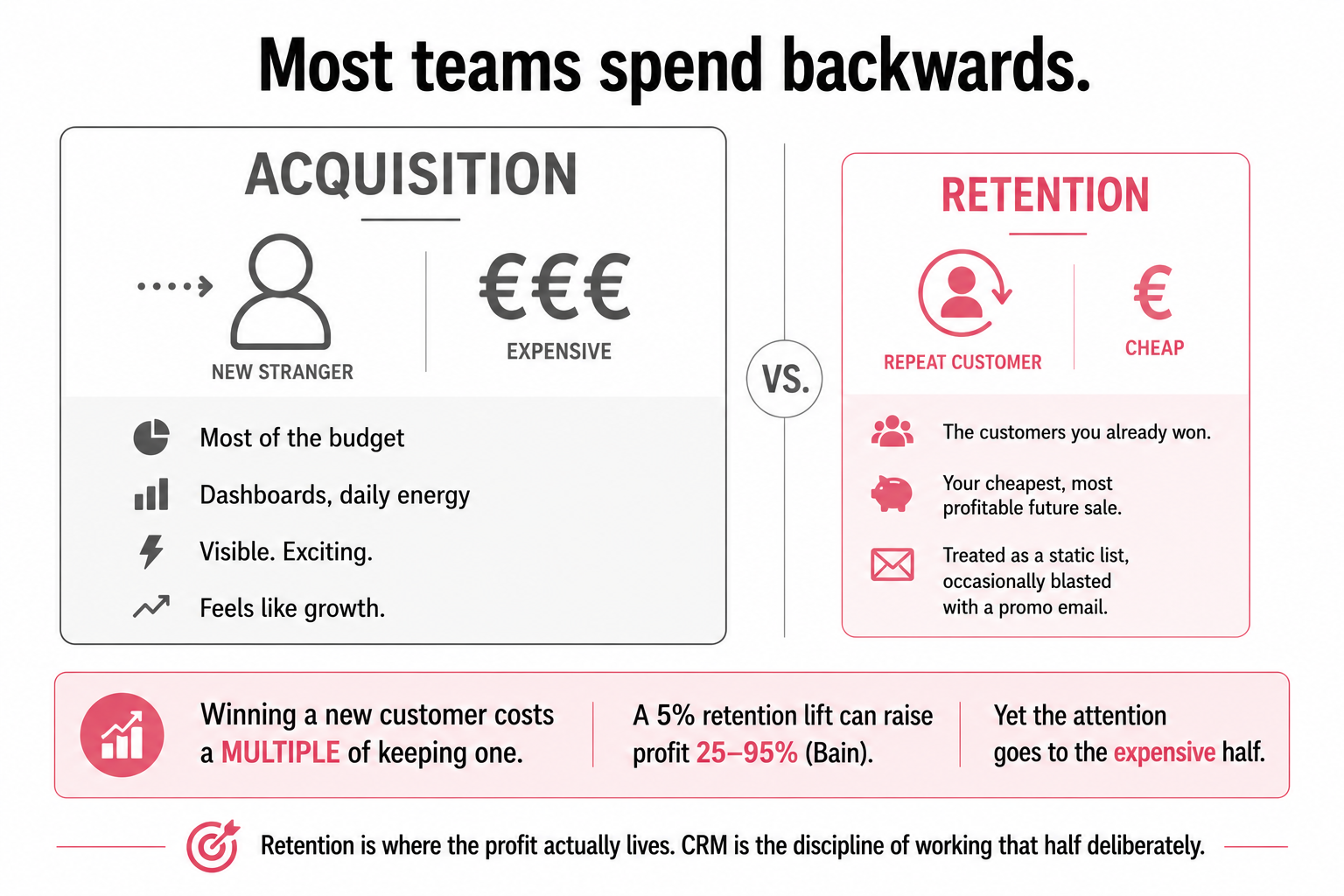
It would be easy to dismiss this as a semantic quibble, so let me ground it in the economics, because the reason the discipline matters is straightforwardly financial. Winning a brand-new customer costs a multiple of what it costs to keep one you already have, this is one of the most durable findings in all of marketing, and it has only become more true as acquisition has got more expensive across nearly every channel. The customers you have already won are, in cold terms, your cheapest source of future revenue, because you have already paid the hard cost of acquiring them. Every additional purchase from an existing customer is dramatically more profitable than a first purchase from a stranger.
And the compounding effect is large. The often-cited research from Bain & Company found that increasing customer retention by as little as five percent can lift profits by anywhere from a quarter to nearly double, depending on the business, a range so striking it has been repeated for decades precisely because the underlying mechanism is real: retained customers buy again, cost less to serve, and refer others, and those effects stack. Retention is not a softer, gentler alternative to growth. For most established stores, retention is where the profit actually lives.
Now hold that against how most teams actually allocate their attention. The budget, the dashboards, the daily energy go overwhelmingly to acquisition, the top of the funnel, the new visitor, the next campaign, because acquisition is visible and exciting and feels like growth. The customers already won get treated as a static list, a database that sits there, occasionally blasted with a promotional email. That is the precise mistake the discipline of CRM exists to correct. You have a base of people who already chose you, whose next purchase is your cheapest and most profitable possible sale, and you are doing almost nothing deliberate with them. The software did not fix that, because the software was never the point. The discipline is.
The single highest-leverage moment: the second purchase
There is a pattern in repeat buying that should shape how you think about the whole relationship, and once you see it you cannot unsee it. The probability that a customer buys from you again climbs sharply with each purchase they have already made. A first-time buyer is, statistically, a coin-flip at best to ever come back, most do not. But a customer who has bought a second time is meaningfully more likely to buy a third, and a third-time buyer more likely still. Loyalty is not a switch that flips, it is a slope that steepens, and each completed purchase moves the customer further up it.
The strategic implication is sharp: the single highest-leverage moment in the entire customer relationship is converting a first-time buyer into a second-time buyer. That is where the probability curve bends most steeply, where a customer goes from "probably gone" to "probably staying." It is worth more deliberate attention than almost anything else you can do, and yet it is the moment most stores leave entirely to chance, they take the first order, send the shipping confirmation, and then go silent, hoping the customer wanders back on their own. The discipline of CRM is, in large part, the practice of engineering that second purchase on purpose rather than hoping for it: knowing who just bought for the first time, deciding deliberately what should reach them and when to make a second purchase likely, and doing it every single time, automatically. Hope is not a retention strategy. A deliberate, repeatable second-purchase motion is.
This is also why retention work compounds in a way acquisition never does. Every customer you successfully move from first to second purchase is not just one extra sale, they are now further up the probability slope, more likely to make a third, a fourth, to become the loyal core that carries the business. Acquisition fills a leaking bucket. The discipline of retention is fixing the leak, and the fixed bucket pays you back for years.
What the discipline actually is
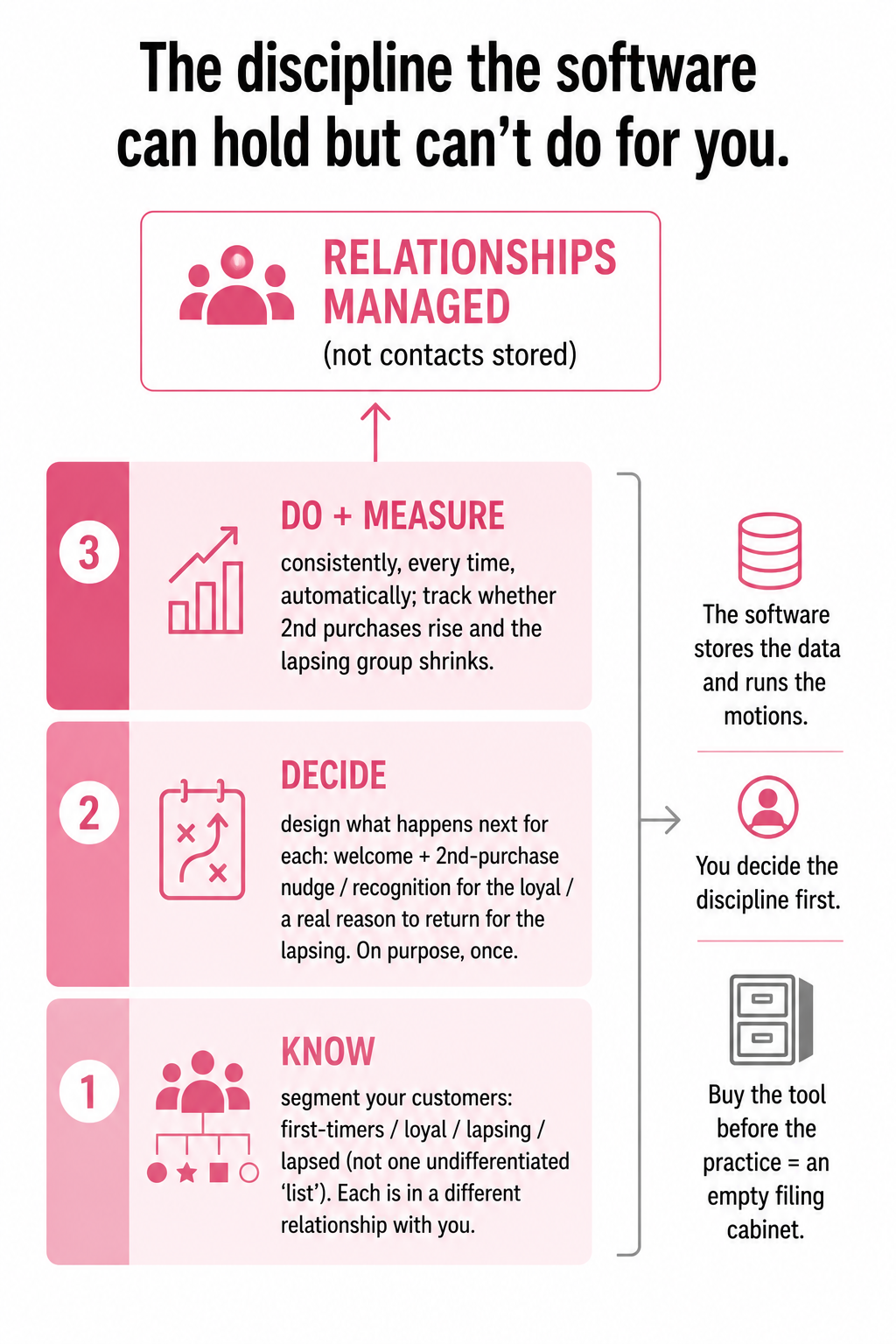
So if CRM is a discipline rather than a tool, what does practising it actually involve? It comes down to three things, none of which the software can do for you, all of which the software can hold once you do them:
- Know your customers, as distinct groups. The opposite of CRM-as-discipline is treating everyone who ever bought as one undifferentiated "list." The discipline starts with segmentation: at minimum, knowing who your first-time buyers are, who your repeat and loyal customers are, who is lapsing (used to buy, slowing down), and who has lapsed (gone quiet entirely). These groups are in completely different relationships with you and need completely different things. A first-time buyer needs a reason to come back. A loyal customer needs to be recognised, not bribed with the same discount you offer strangers. A lapsing customer needs catching before they are gone. One message for all of them is not relationship management.
- Decide what should happen next, for each group. This is the lifecycle: the deliberate set of moments you design for each segment. A welcome and a nudge toward the second purchase for the new buyer. Recognition and early access for the loyal one. A genuine reason to return for the lapsing one. These are decisions you make once, on purpose, and then run consistently, not things you improvise whenever someone remembers the email list exists.
- Do it consistently, and measure it. The "systematic" in the definition is load-bearing. The discipline is doing the right thing the same way every time, for every customer who enters a segment, and tracking whether it works, are second purchases going up, is the lapsing group shrinking, so you can improve it. This is where the software finally earns its place: it stores the data, holds the segments, and runs the automated motions reliably at a scale no human could. But notice the order. You decide the discipline first. The software executes it second. Buy the tool before you have the practice and you have an empty filing cabinet.
The thing that ties all three together is intent. CRM-as-discipline means every customer is in a known relationship with you, and you have deliberately decided what happens next in that relationship. That is the entire difference between managing relationships and merely storing contacts.
The megaphone trap, and why the discipline is the opposite
There is one anti-pattern worth naming directly, because it is what "doing CRM" collapses into when the discipline is absent: the megaphone. Without segmentation and a deliberate lifecycle, "engaging customers" degrades into emailing the entire list the same message whenever there is something to promote. It feels like activity. It feels like using the CRM. But blasting everyone the same thing is not managing relationships, it is shouting through a megaphone at a crowd and hoping the right people hear something relevant, and it actively erodes the relationship it claims to build, because the loyal customer gets the same generic discount as a stranger, the lapsing customer gets noise instead of the one well-timed message that might have brought them back, and everyone slowly learns to ignore you. I will go deep on this elsewhere in the cluster, because "send more emails" is the single most common and most damaging substitute for actual retention work. For now the point is just the contrast: the megaphone is the absence of the discipline. The discipline is the opposite of the megaphone, the right message, to the right segment, at the right moment, decided on purpose.
That is the whole foundation, and every other piece in this pillar builds on it: the post-purchase moment the Conversion work flagged as the most under-served stage, the lifecycle motions that turn first buyers into loyal ones, the win-back of the lapsed, the loyalty that recognises rather than bribes, and the metrics that tell you whether any of it is working. All of them assume the shift this piece is asking you to make: that CRM is something you do, a deliberate practice of developing the relationships you already paid to start, not a product you bought and switched on. The store that internalises this stops treating a hard-won customer as a completed transaction and starts treating them as the opening of a relationship worth managing. The software will sit there contentedly holding ten years of customer history while you do absolutely nothing with it. The discipline is what turns that history into the next purchase. Buy the cabinet if you want one. The filing is the job.
A few common questions
What is CRM, really? Customer relationship management, with the emphasis on management. It is the deliberate, systematic practice of knowing who your customers are, what they have done, and deciding what should happen next in your relationship with each of them. The CRM software most people mean when they say "a CRM" is a tool that helps you do that work, it stores the data and runs the motions, but it is not the work itself. Owning the software and practising the discipline are completely different things, and confusing them is the most common and expensive mistake in retention.
Why does customer retention matter more than acquisition? Because of the economics. Winning a brand-new customer costs a multiple of keeping an existing one, and that gap has widened as acquisition has got more expensive. Existing customers are your cheapest, most profitable source of future revenue, you have already paid to acquire them, so each additional purchase is far more profitable than a first sale to a stranger. The well-known Bain & Company finding that a five percent improvement in retention can raise profits by roughly a quarter to nearly double captures why: retained customers buy again, cost less to serve, and refer others, and those effects compound. For most established stores, retention is where the profit actually lives, yet most attention goes to acquisition because it is more visible.
What's the most important moment in the customer relationship? Converting a first-time buyer into a second-time buyer. The probability that someone buys again climbs sharply with each purchase they have already made, a first-time buyer is roughly a coin-flip to return, but a second-time buyer is meaningfully more likely to buy a third, and so on. So the second purchase is where the loyalty curve bends most steeply, from "probably gone" to "probably staying." It is the highest-leverage moment you have, and the one most stores leave entirely to chance by going silent after the first order. The discipline of CRM is largely about engineering that second purchase deliberately rather than hoping for it.
What does practising CRM actually involve? Three things the software can hold but cannot do for you. First, know your customers as distinct groups, segment them into first-timers, loyal, lapsing, and lapsed, because each is in a different relationship with you and needs something different. Second, decide what should happen next for each group, the lifecycle: a welcome and second-purchase nudge for the new buyer, recognition for the loyal one, a reason to return for the lapsing one, designed on purpose. Third, do it consistently and measure it, the same right action every time, tracked so you can improve it. You decide the discipline first; the software executes it second. The opposite, blasting the whole list the same message, is a megaphone, not relationship management.
You should also read:
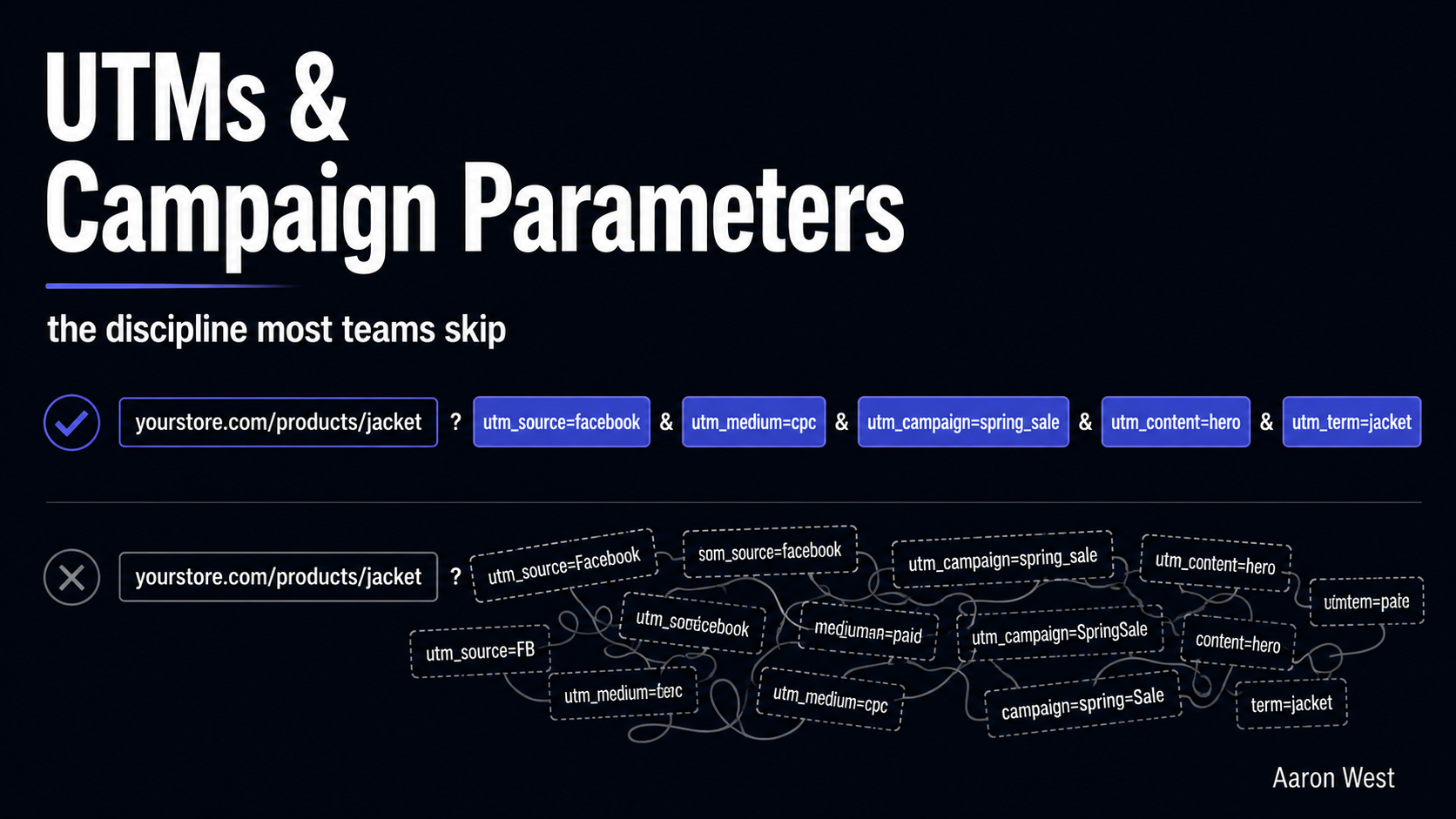
UTMs and Campaign Parameters: The Discipline Most Teams Skip
A UTM parameter is a small tag added to the end of a link that tells your analytics where a visitor came from, and the difference between a team that uses them with discipline and one that does not is the difference between knowing which…
Continue reading...