Reviews Are the One Voice on Your Page a Shopper Trusts More Than Yours

Table of Contents
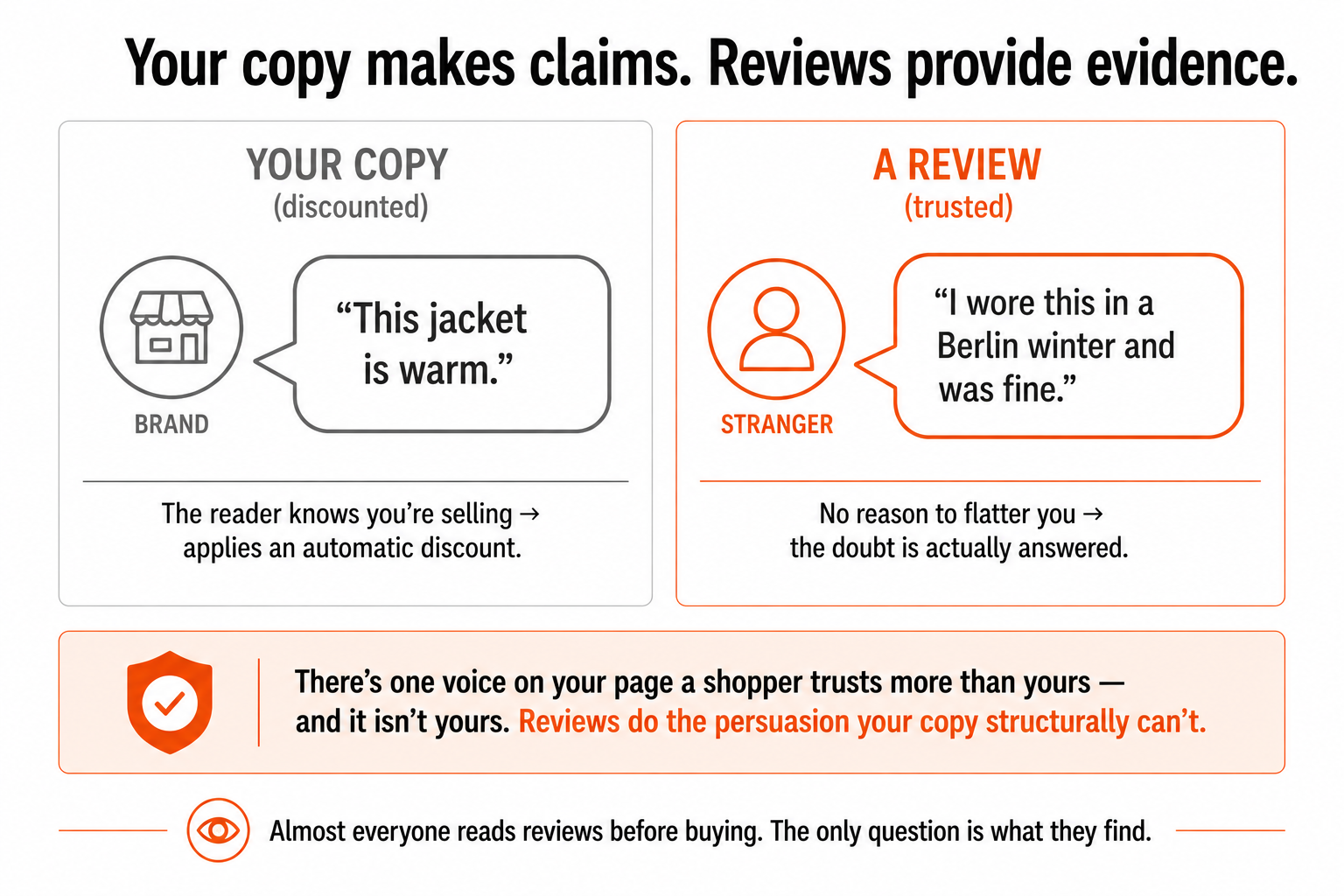
There is exactly one voice on your product page that a shopper trusts more than your own, and it is not yours. It is other customers. Everything you write about your product, however honest, carries an unavoidable discount in the reader's mind, because they know you are the one selling it, and they apply that knowledge automatically. Other buyers carry no such discount. They have nothing to gain, they have used the thing, and the shopper knows it. This is why reviews and social proof are not a decorative add-on to a product page but the single most persuasive element on it: they do the convincing your own copy structurally cannot, no matter how good your copy is. Almost everyone now reads reviews before buying, which means for most shoppers the question is not whether they will consult other customers' opinions, but whether you have made those opinions available, and what they find when they look.
This is the standalone deep-dive on a thread that runs through my product-page and trust pieces, both of which leaned on social proof without giving it a full treatment, and it sits under my cornerstone on where stores lose the sale. I want to make the case for why reviews work, and then make a more uncomfortable argument that most stores get wrong: that the way to get the most out of reviews is to stop trying to look perfect. Plain language, and a genuinely counterintuitive core.
Why reviews persuade when your copy can't
Social proof, the tendency to look at what other people do to decide what is safe or sensible to do ourselves, is one of the oldest and best-documented levers in persuasion, identified decades ago as one of the core principles of how people are influenced, and it remains the most studied conversion lever in online retail for a simple reason: it works, consistently, across products and audiences. But it is worth being precise about why it works in e-commerce specifically, because the mechanism tells you how to use it well.
When a shopper lands on a product page, they arrive carrying doubt, as I described in the product-page piece: is this worth the price, will it actually do what I need, will it fit, is this store even legitimate. Your product copy can address those doubts, but only by making claims, and the reader knows claims from a seller are, by nature, motivated. Reviews answer the same doubts with evidence from people who are not motivated, and that difference is everything. Your copy says "this jacket is warm." A review from a stranger says "I wore this in a Berlin winter and was fine," and the second statement does work the first one simply cannot, because the source has no reason to flatter you. Reviews let your customers answer the questions you are not trusted to answer about yourself. That is the whole mechanism, and once you see it that way, the practical implications fall out cleanly, including one that runs directly against most stores' instincts.
The uncomfortable truth: perfect reads as fake
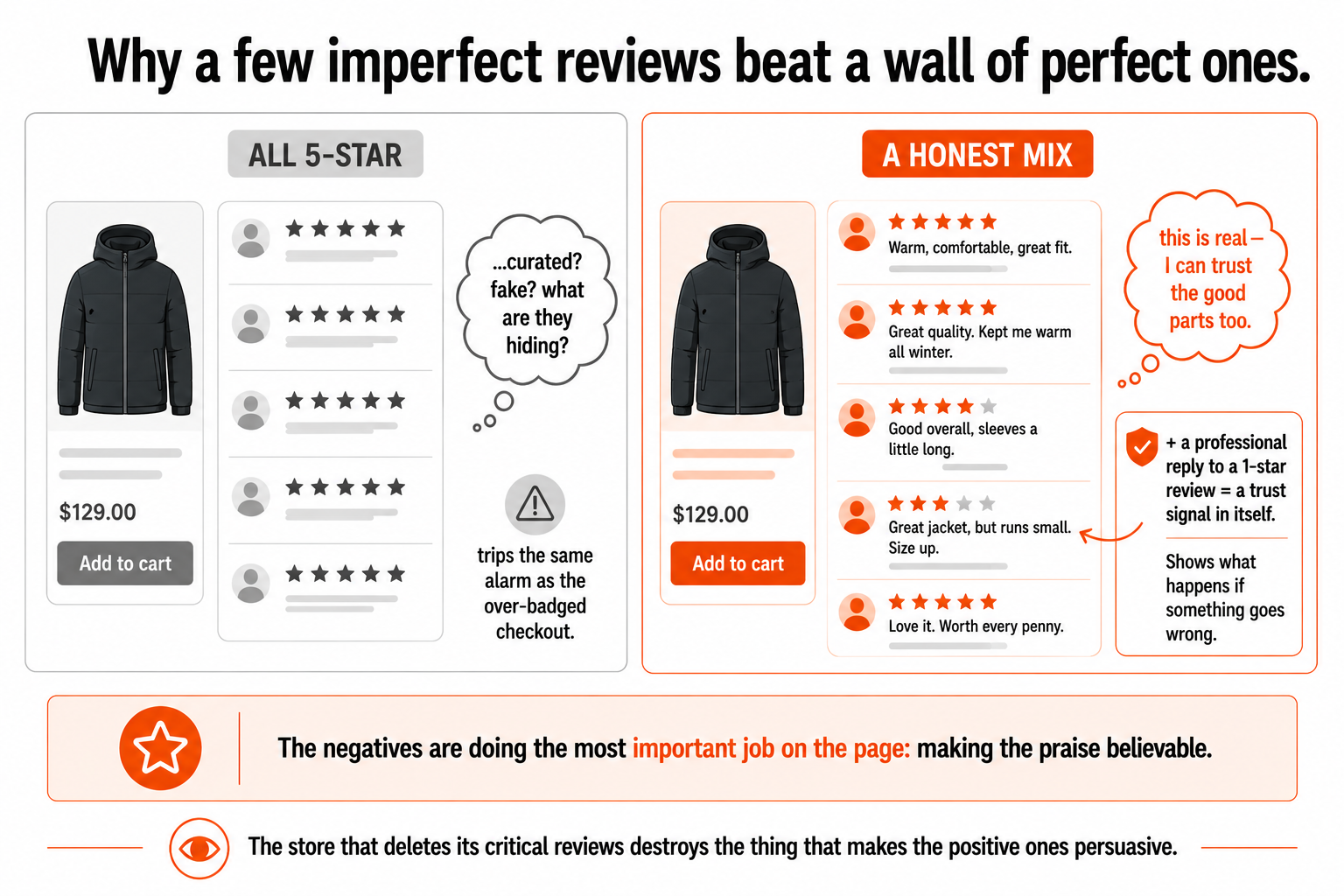
Here is the instinct almost every store has, and it is wrong: show only the glowing reviews, bury or delete the critical ones, present a wall of flawless five-star praise. It feels obviously correct, who would not want to look perfect? But shoppers have grown sophisticated, and a product with nothing but perfect five-star reviews now reads to a lot of people as curated, or fake, exactly the opposite of the reassurance you intended. We have all learned that real things have flaws, that genuine feedback varies, and that a suspiciously spotless record usually means someone is filtering it. The flawless wall trips the same alarm as the over-badged checkout: it is trying too hard, and the effort itself signals something to hide.
The counterintuitive finding, which is well established in the research, is that a mix of positive and negative reviews converts better than only-positive ones. Products with a strong-but-imperfect rating often outperform products with a perfect score, because the imperfection is what makes the praise believable. The handful of three-star reviews, the occasional "great but runs small," the honest "good for the price, not premium," those are not damaging your five-star reviews, they are authenticating them. They tell the reader: this is a real picture, nobody scrubbed it, you can trust what you are seeing, including the good parts. The negatives are doing the most important job on the page, which is making the whole thing credible. Which means the store that nervously deletes its critical reviews is destroying the very thing that makes the positive ones persuasive, and doing it on purpose.
This connects directly to the honesty argument about product information generally: telling people the truth, including the unflattering parts, builds the trust that makes them believe the rest. Reviews are that principle made concrete and handed to your customers. And there is a second-order win hiding in the negatives, which is what you do with them. A critical review is not just feedback to absorb privately, your response to it is visible to every future shopper, and a professional, helpful, accountable reply to a one-star review is itself a powerful trust signal. It shows you stand behind the product, that a problem gets met with service rather than silence, that there is a real, reasonable business on the other side. Handled well, a bad review and a good response together can build more confidence than no bad review at all, because they show the reader exactly what happens if something goes wrong, which is the thing they were quietly worried about.
Getting them, showing them, and not faking them
Three practical things follow, and then one line you should not cross. First, the first few reviews matter most. The steepest jump in persuasive power comes from going from zero reviews to a handful, that initial climb is far more valuable than the difference between, say, five reviews and fifty, because zero reviews is a doubt with no answer at all, a blank where the trusted voice should be. So the priority, especially on newer or lower-traffic products, is simply getting those first few reviews onto every product, even if that means personally asking your earliest customers, following up after delivery, making it genuinely easy to leave one. A product page with no reviews is leaving its most persuasive element switched off.
Second, customer photos and videos beat your professional ones. As the product-page piece argued, real customers' own images, the product on a real person, in a real room, in ordinary light, are trusted more than your polished studio shots precisely because they are unpolished. They answer "what will this actually be like when it arrives" in a way your art-directed photography cannot, because the shopper knows your photos were chosen to flatter and the customer's were not. Authenticity outperforms polish here, reliably, so make it easy for customers to add photos and give that content room to show.
Third, show reviews, do not hide them. A surprising number of stores bury reviews behind a tab nobody clicks, or place them so far down the page that the doubt has already won. Put the star rating up near the product title and price where it is seen immediately, make the review count visible and clickable, and place the reviews themselves where a reader naturally arrives at the moment of doubt, after the description, as they are deciding. Where it is useful, let people filter by rating or by the attribute they care about, fit, durability, whatever varies. And use review structured data so your star ratings can appear in search results, which is social proof doing its work before the shopper has even clicked through to you.
Now the line. There is a real difference between social proof and manufactured pressure, and it is worth being clear-eyed about it, because the tools blur it deliberately. Genuine social proof is earned: real reviews, real customer photos, a real count of real buyers. Manufactured urgency is the other thing, the "someone in Hamburg just bought this!" popups, the countdown timers that reset when you reload, the "only 2 left!" banners that are not true, and that is not social proof, it is a dark pattern wearing social proof's clothes. It can squeeze a short-term click, but shoppers increasingly recognise it, and when they do, it costs you exactly the trust you were trying to build, which is a terrible trade. My position is simple and I will state it plainly: good UX is not manipulation. The genuine version, real proof from real customers, honestly displayed, works better and is the only kind worth building, because it compounds into a reputation instead of eroding one. Earn the proof. Do not fake the pressure.
That is the whole case, and it ends where it began, with honesty as the unlikely engine of persuasion. Reviews are the cheapest and most credible selling you will ever get, your customers doing the convincing your own copy never could, and the counterintuitive truth is that you unlock more of their power by being honest than by curating: by showing the real picture including its flaws, responding like a business that stands behind what it sells, letting real customer photos do their unpolished work, and refusing to fake the parts you cannot earn. The brand that trusts its customers to tell the truth, all of it, is the brand customers end up trusting back. That is not a trick. It is just what trust actually is.
A few common questions
Why are reviews so much more persuasive than my own product copy? Because the source isn't motivated. Everything you write about your product carries an automatic discount in the reader's mind, they know you're the one selling it. Other customers carry no such discount: they have nothing to gain, they've used the product, and the shopper knows it. Your copy can only make claims; reviews provide evidence from a trusted source. So reviews answer the doubts a shopper arrives with, will it fit, will it work, is this store legitimate, in a way your own page structurally cannot, no matter how good your copy is. They're the most persuasive element on the page for that reason.
Should I hide or delete negative reviews? No, and doing so is actively counterproductive. A product with nothing but perfect five-star reviews reads to many shoppers as curated or fake, the same "trying too hard" alarm as an over-badged checkout. Research consistently finds that a mix of positive and negative reviews converts better than only-positive, because the imperfect ones make the praise believable, they prove nobody scrubbed the page. A few honest three-star reviews are authenticating your five-star ones, not damaging them. The only reviews worth removing are spam, abuse, or factually false claims; legitimate criticism should stay. And your professional response to a critical review is itself a trust signal, it shows future shoppers what happens if something goes wrong.
How do I get more reviews, and which matter most? The first few matter most. The steepest jump in persuasive power is going from zero reviews to a handful, far more valuable than going from five to fifty, because zero reviews is a doubt with no answer. So prioritise getting the first few onto every product: follow up after delivery, make leaving a review genuinely easy, and personally ask your earliest customers if you have to. Encourage photos and videos too, customer images are trusted more than polished brand photography because they show the product in real life. A product page with no reviews has its most persuasive element switched off.
Are urgency popups and "someone just bought this" notifications good social proof? They're not social proof, they're manufactured pressure, and I'd steer away from the fake versions. Genuine social proof is earned: real reviews, real customer photos, a real count of real buyers. The "someone in [city] just bought this!" popups, countdown timers that reset on reload, and untrue "only 2 left!" banners are dark patterns wearing social proof's clothes. They can squeeze a short-term click, but shoppers increasingly see through them, and when they do, it costs you the trust you were trying to build. Good UX isn't manipulation, the honest version works better and compounds into a reputation rather than eroding one.
You should also read:
Discounts Are a Loan Against Your Margin
A discount feels free to give, and that is exactly why it is dangerous. It is a loan against your margin, and like any loan it gets repaid: in the margin you hand over, in the reference price you quietly reset, and in the customers…
Continue reading...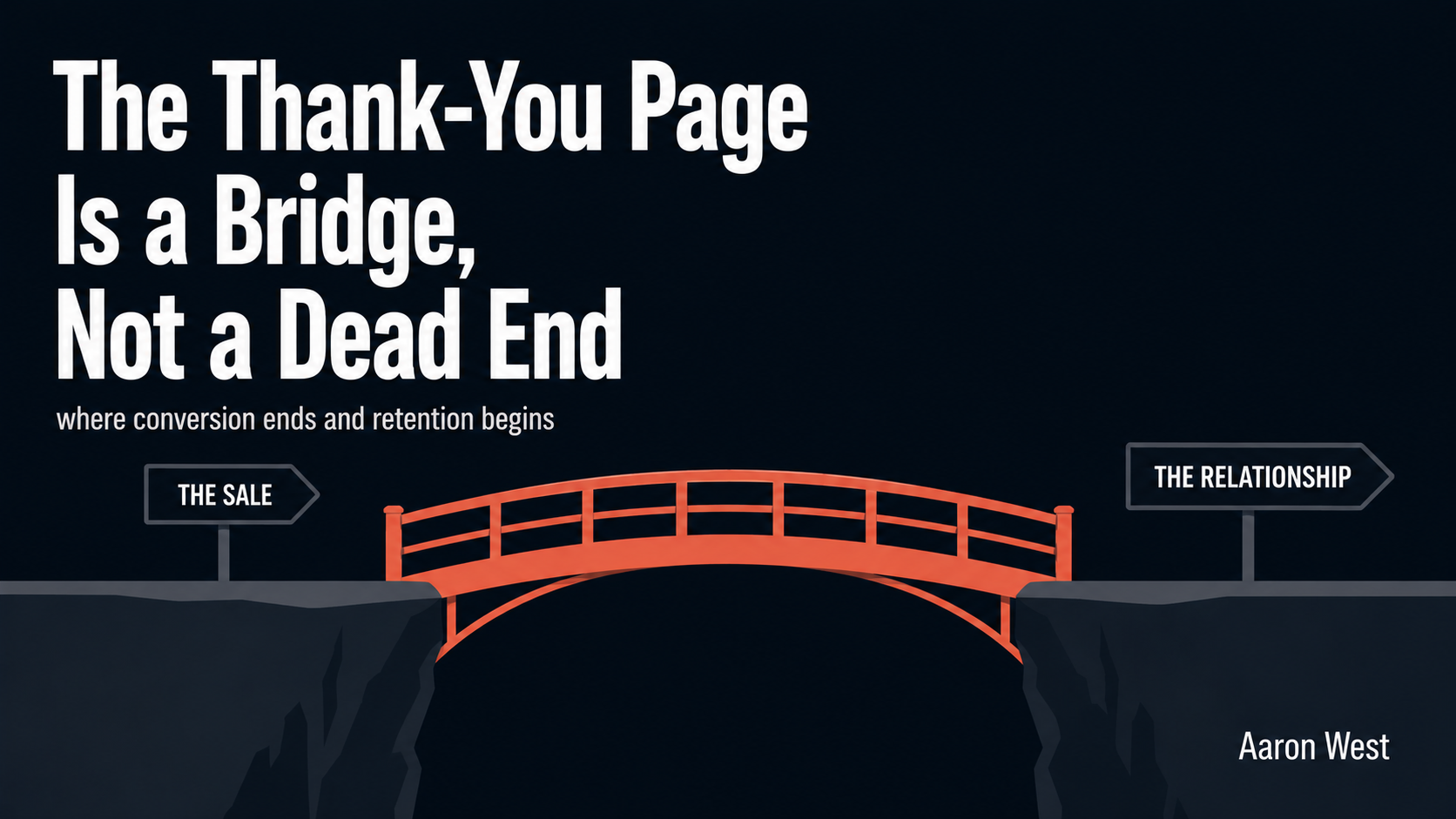
The Thank-You Page: Where Conversion Ends and Retention Begins
The moment right after someone buys from you is the single highest-trust, highest-goodwill moment you will ever get with that person. They have just said yes. They have handed over their card, their email, their address. Their guard is down and their momentum is forward.
Continue reading...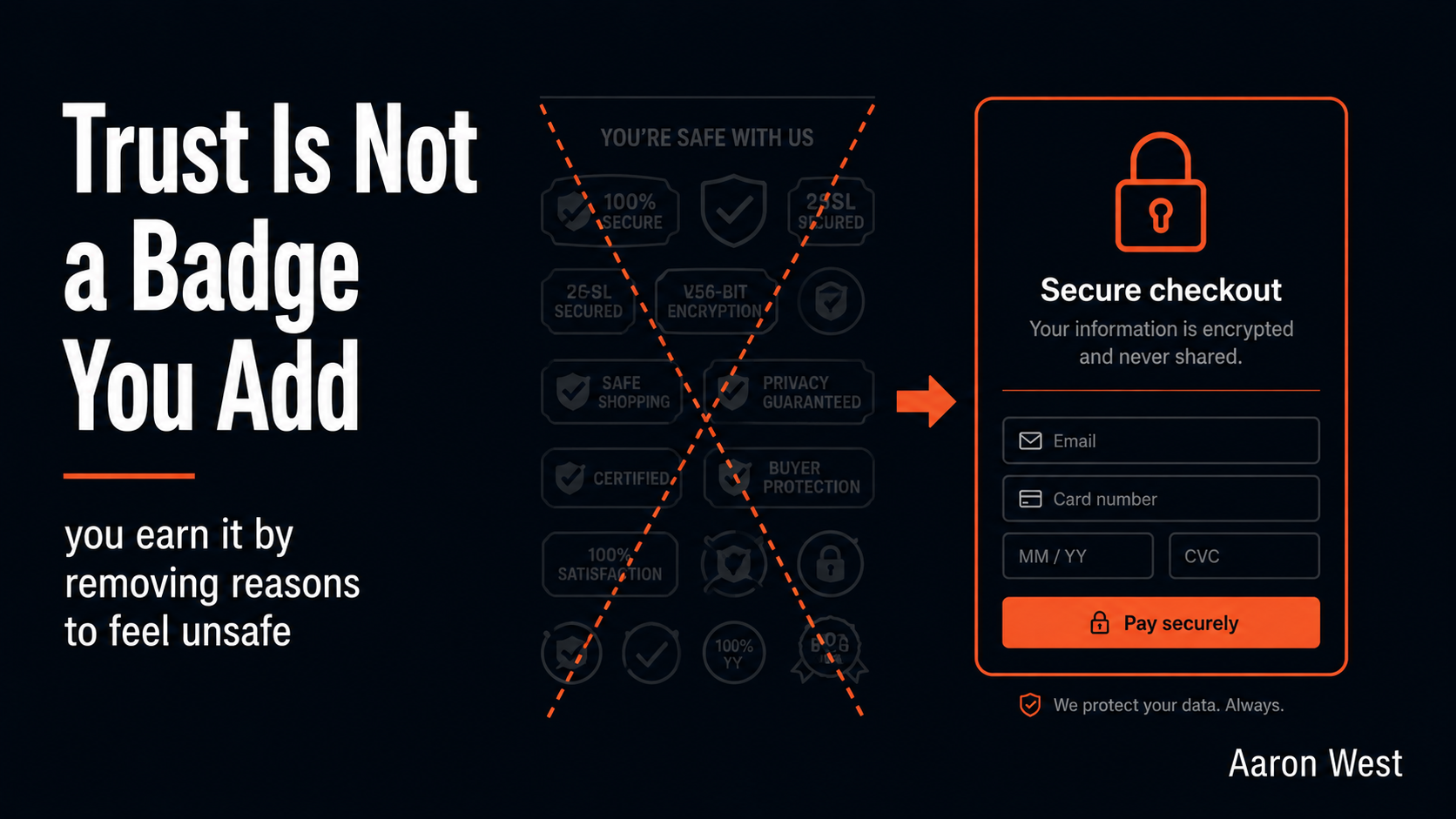
Trust Is Not a Badge You Add to Your Checkout
The moment a customer is about to type in their card number is the most anxious moment in the entire buying journey, and it is where a surprising number of otherwise-willing buyers quietly back out. Around a fifth of shoppers have abandoned a purchase specifically…
Continue reading...