The Zero-Results Page Is a Conversion Opportunity, Not a Dead End

Table of Contents
A zero-results page, the cold "no results found" a customer hits when their search or filter returns nothing, is one of the most under-designed pages in e-commerce and one of the most costly. The customer just told you, with high intent, exactly what they wanted, and you answered with a blank wall. What you put on that page decides whether a ready-to-buy visitor leaves for good or finds something anyway. Almost no store designs it, which makes it one of the cheapest recoveries available.
This is a core of the Merchandising pillar, and it's the failure state of findability, the moment search or filtering comes up empty. It connects directly to on-site search and faceted navigation, because those are the two ways customers most often arrive at it. Here's why the page is so high-stakes, and how to turn a dead end into a detour toward a sale.
Why this page is so high-stakes
Think about who lands on a zero-results page. It's a customer who did something specific and intentional: they typed a precise query, or they stacked filters to find an exact thing. That's not an idle browser; that's one of your highest-intent visitors, the kind most likely to buy, as the search piece argues. And you've met their effort and intent with the single least helpful response a store can give: nothing.
A blank "no results" is, bluntly, the rudest thing a store does to its most engaged customers. A casual browser who drifts off was never that close to buying. A customer who searched for a specific product and got a cold empty page was close, and you actively turned them away. They don't conclude "I should rephrase"; they conclude "they don't have it" and leave, often for a competitor who does. The stakes are high precisely because the customers who reach this page are the ones you could least afford to lose.
Two causes, two different responses
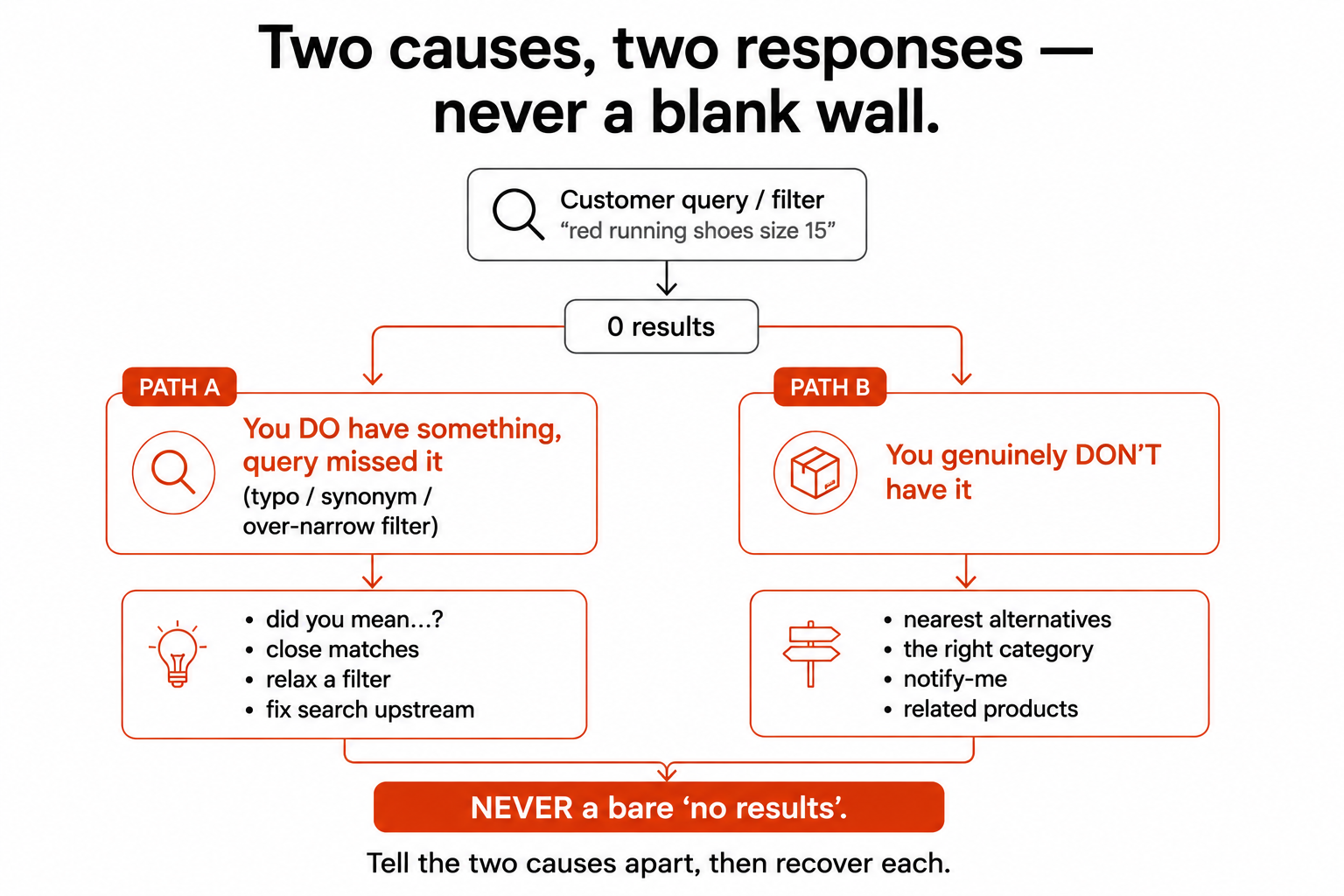
Zero-results pages happen for two fundamentally different reasons, and good recovery depends on telling them apart.
The first cause: you actually have something relevant, but the query missed it. A typo, a synonym mismatch (the customer's "trainers" versus your "sneakers"), or a filter combination narrowed one notch too far. The product is sitting in your catalogue; the search or filter just failed to surface it. This is partly an upstream fix, better synonym handling in search, result counts on filters so people don't over-narrow, but it also needs a recovery page that catches the miss: "did you mean…" spelling correction, close matches, an offer to relax the most restrictive filter, and popular or related items in the meantime.
The second cause: you genuinely don't stock it. Here the honest answer is "we don't have that," but the lazy version of that answer, a blank page, throws away a customer for no reason. Even when you can't sell them the exact thing, you can offer the nearest alternatives, point them to the category it would belong in, let them sign up to be notified if you get it, or show related products they might want instead. The customer came with a need; not having the precise item doesn't mean you can't meet the need with something close.
The shared rule across both causes is simple and absolute: never show a bare "no results." There is always a more useful next step than a blank wall.
What a good zero-results page does
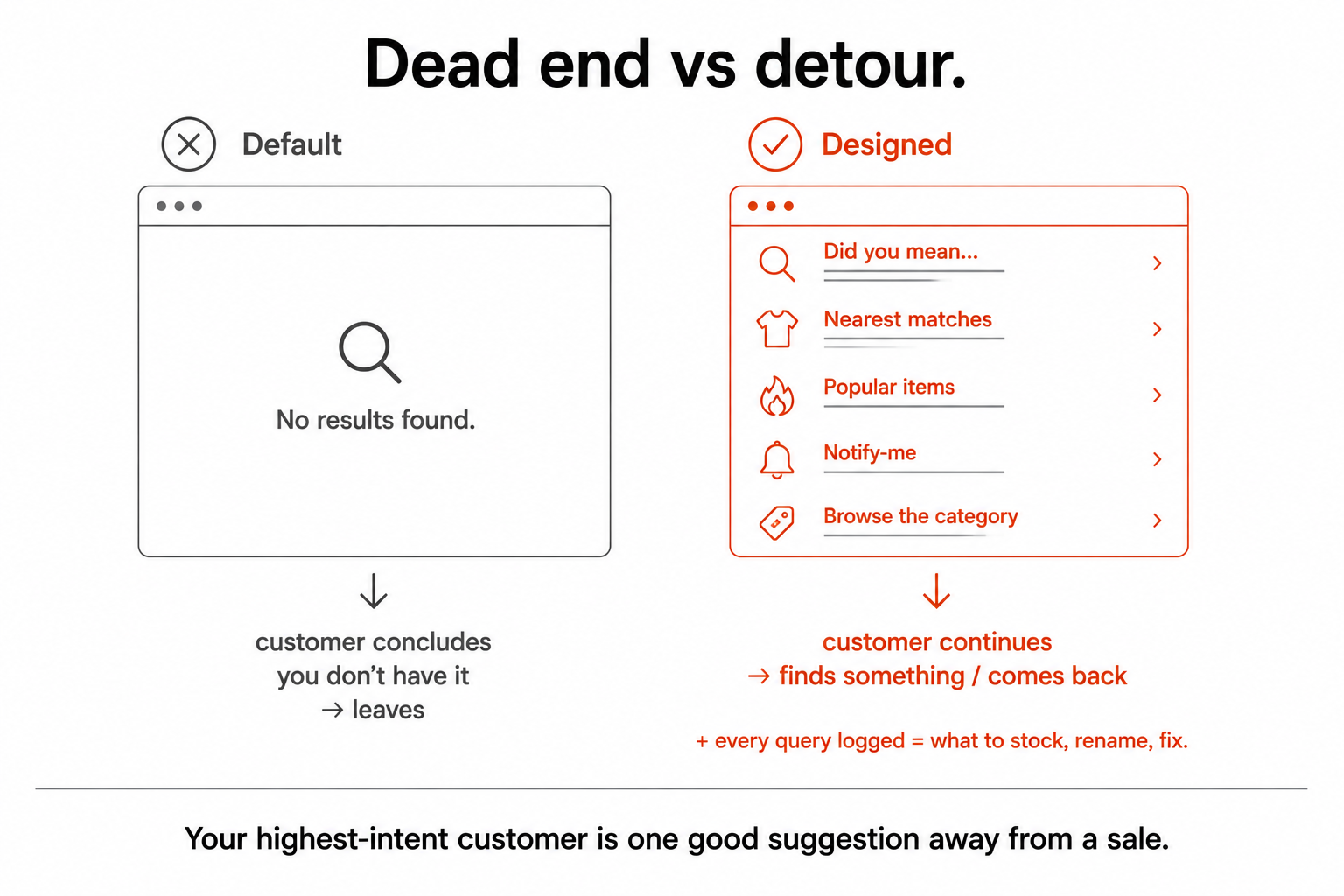
Designing this page is mostly about refusing to dead-end and giving the customer somewhere useful to go:
- Never dead-end. The cardinal rule. Always offer a next step, alternatives, popular items, a way back into a relevant category.
- Show nearest matches and popular items. Even an imperfect set of suggestions beats nothing, and often the customer finds something they're happy with in it.
- Offer to relax the constraint. If they over-filtered or searched too narrowly, suggest removing the most restrictive filter or broadening the search, and ideally show what that would return.
- Help with the query itself. "Did you mean…" spelling correction and synonym suggestions catch the most common, most fixable misses.
- Keep search and navigation present. Don't strand them on a terminal page. Let them re-search or browse without hitting the back button in frustration.
- Capture genuine demand. For products you really don't have, a "notify me" option or, at minimum, logging the query turns a miss into either a future sale or a stocking insight.
None of this is expensive to build. It's a page most stores never thought to design, which is exactly why doing it at all is a competitive edge.
The zero-results page is also a research instrument
Here's the part that pays off beyond the individual recovery. Every zero-results event is a logged signal of unmet demand, a customer telling you, in their own words, what they wanted and couldn't get from you. That's some of the most valuable data your store produces, and it ties directly to treating search as data.
Mine your zero-results queries and they tell you three different things. Where customers searched for products you stock but couldn't find them, you have a naming or synonym problem to fix in search. Where they searched for products you don't stock but clearly want, you have a range-expansion insight, real demand, already quantified by how often it's searched. And where filters routinely combine to nothing, you have a faceting problem to redesign. The zero-results page is both a recovery surface, saving the individual sale, and a research instrument, telling you what to stock, rename, or fix so the page fires less often in the first place. Most stores throw all of that away by treating it as an error nobody reads.
What this comes down to
A customer staring at a zero-results page is not a lost cause. They're one of your most ready-to-buy visitors, sitting one good suggestion away from a sale, at the exact moment your store decided to show them nothing. The difference between losing them and recovering them is entirely in what you choose to put on that page, and almost nobody chooses to put anything there at all.
Answer their miss with alternatives, corrections, and a way forward instead of a blank wall, and the dead end becomes a detour toward something they'll actually buy. Log what they searched for and couldn't find, and the page quietly tells you how to stop failing them next time. It's the cheapest recovery in e-commerce, hiding on the page everyone treats as an error and nobody treats as an opportunity.
A few common questions
Why does the zero-results page matter so much? Because the customers who reach it are among your highest-intent visitors. They searched or filtered for something specific and were ready to buy, and a blank "no results" turns them away at the worst possible moment. A casual browser drifting off costs little; a ready buyer concluding "they don't have it" and leaving for a competitor costs a sale you were close to making.
What should a zero-results page show? Never a bare "no results." Show nearest matches and popular items, offer to relax an over-narrow filter or broaden the search, help with the query through "did you mean" corrections and synonyms, keep search and navigation present so the customer can try again, and for products you don't stock, offer a "notify me" or related alternatives. Always give a useful next step.
Why do customers hit zero results when the product exists? Usually a query or filter problem rather than a stock problem: a typo, a synonym mismatch (the customer's word versus your catalogue's word), or filters narrowed one step too far. The product is in your catalogue; the search or facet just failed to surface it. Those are fixable upstream in your search and filtering, and recoverable on the page itself with corrections and close matches.
Can zero-results data actually be useful? Very. Every zero-results query is a logged signal of unmet demand in the customer's own words. It tells you where naming or synonyms need fixing (products you have but they couldn't find), where to expand your range (products they want but you don't stock, already quantified by search volume), and where filtering dead-ends. The page is both a recovery surface and a research instrument most stores throw away.
You should also read:
Category and Collection Pages: The Most Under-Optimised Pages in E-Commerce
Category and collection pages, the pages that list products in a group like "men's running shoes" or "gifts under fifty," are where most of your browsing customers actually shop, and they're the most under-optimised pages in e-commerce. More real buying decisions happen on a good…
Continue reading...
The Product Page Is Where You Win or Lose the Sale
The product page is where the buying decision actually gets made, which makes it the most important page on your store, and the one most stores treat as an afterthought. Everything before it, the ads, the homepage, the category listings, only does one job: deliver…
Continue reading...
Conversion Tracking, End to End
Conversion tracking is the system that connects a marketing action to the result it produced, so that when someone clicks your ad and later buys, you can actually say "that sale came from that ad." Without it, you are spending money and guessing. With it,…
Continue reading...