On-Site Search: Where Your Highest-Intent Customers Live

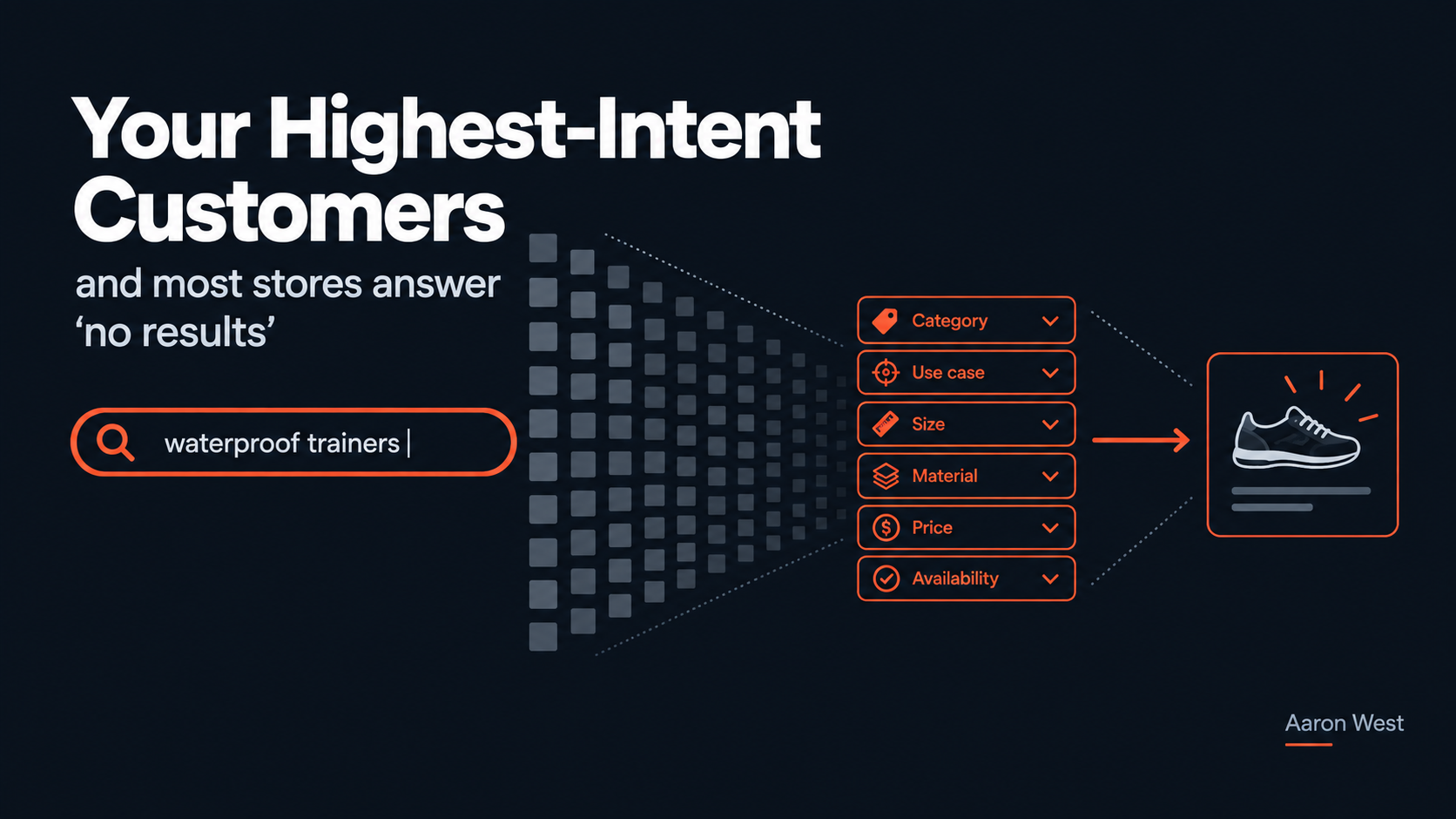
Table of Contents
The customer who uses your on-site search is usually the highest-intent visitor you have. They've told you, in their own words, exactly what they want. Get search right and they convert at a much higher rate than people who only browse. Get it wrong, returning nothing, or returning the wrong things, for a query you actually stock, and you lose a customer who was ready to buy and went out of their way to tell you so. Few features in e-commerce are this high-leverage and this neglected at the same time.
This is a core of the Merchandising pillar, and it's the sharp end of findability: the customer with clear intent, trying to get to a specific product fast. The search box is the most direct line a customer has to your catalogue, and most stores treat it as an afterthought. Here's why searchers matter so much, and what separates search that converts from search that quietly turns ready buyers away.
Why searchers are your best customers
A visitor who uses your search box is different from one who's idly browsing, in three ways that all point the same direction. They have intent: they came with a specific need, not a vague wander. They've self-qualified: by typing a query, they've told you precisely what they're after, which is more than most browsers ever reveal. And they're deep in the funnel: searching is shopping, not window-shopping. Someone typing "waterproof running jacket men's large" is not killing time; they're close to buying.
Put those together and the pattern is consistent: a searcher is worth more than a browser, and converts at a higher rate, provided the search works. That last clause is the whole game. The intent is there, handed to you on a plate. Whether it turns into a sale depends almost entirely on whether your search can take "what the customer typed" and return "the thing they wanted."
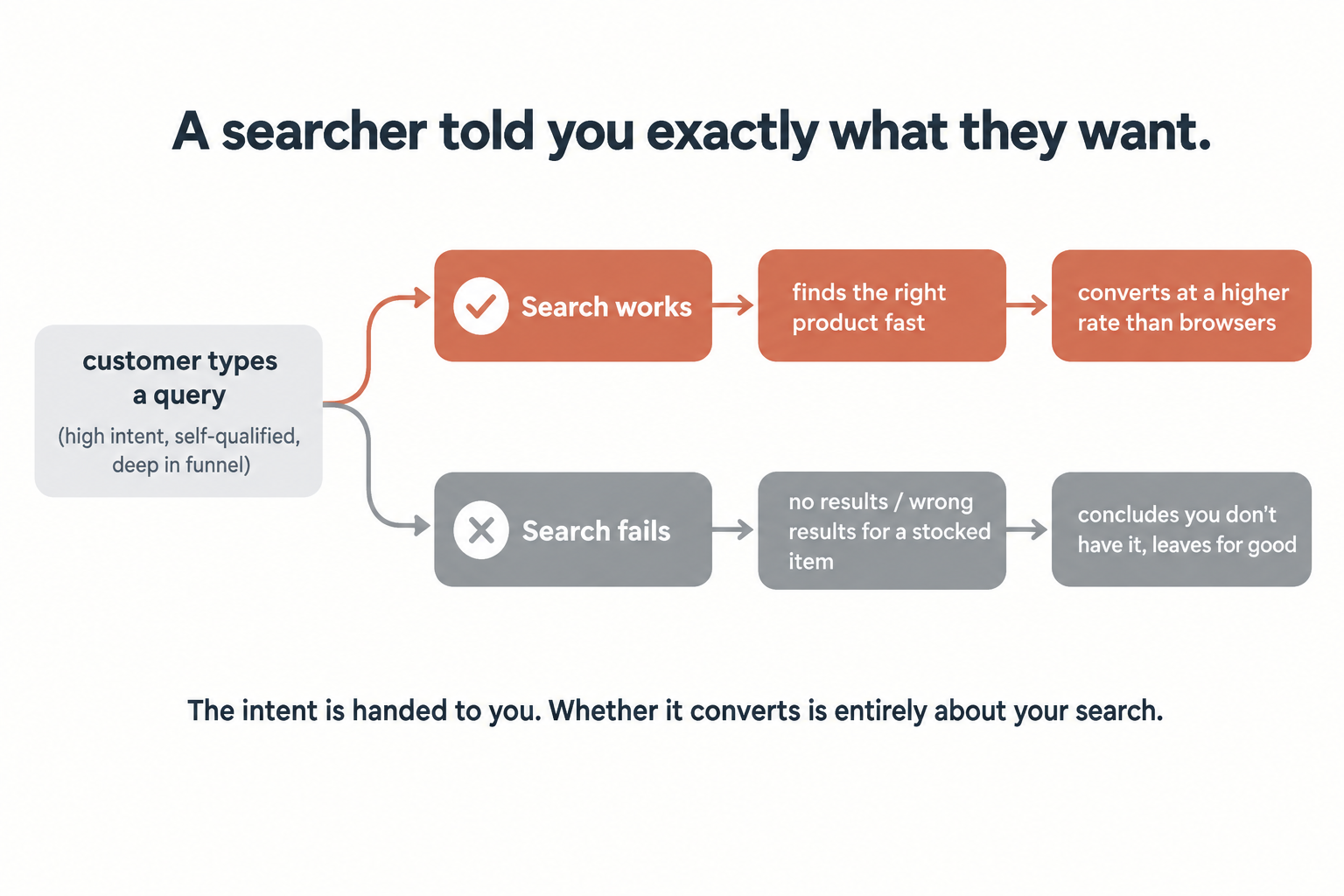
And the downside is just as sharp as the upside. A browser who doesn't find something drifts off, mildly. A searcher who gets "no results" for a product you actually sell doesn't drift; they conclude you don't have it and leave, often for good. You took your most ready-to-buy visitor and actively told them no. That's not a missed opportunity, it's a self-inflicted one.
Why most store search is bad
Here's the neglect. Most stores bolt on whatever search their platform shipped with, switch it on, and never look at it again. Nobody owns it, nobody tests it, and it quietly fails in the most common situations, the ones real humans create every time they type.
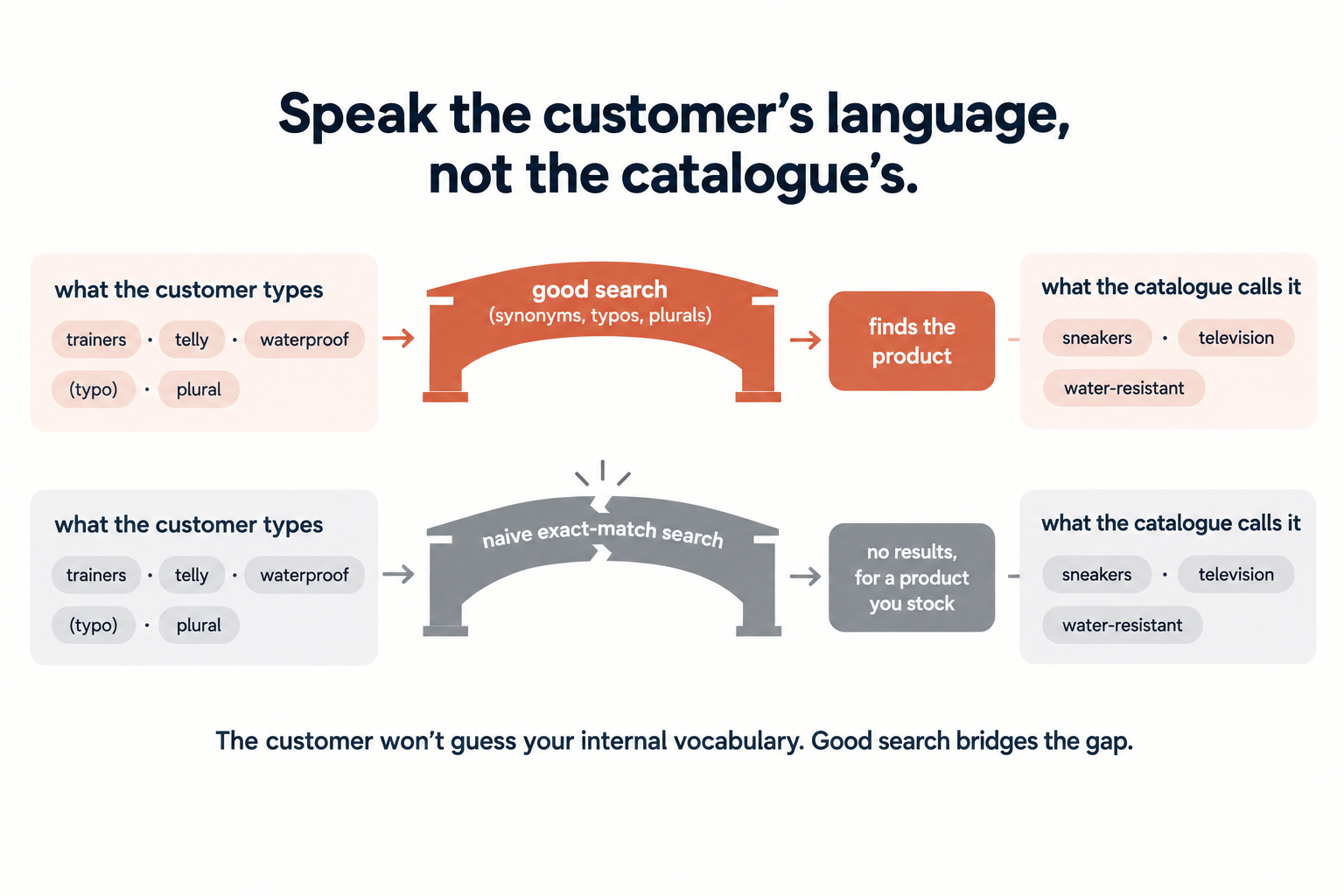
Real search queries are messy. People make typos. They use plurals when your product is listed singular, or vice versa. They use synonyms, the word that means the same thing but isn't the one in your product title. They use their own word for a thing when your catalogue uses the industry word. A customer searches "trainers" and your catalogue calls them "sneakers." Someone types "telly" and you've listed "television." A shopper searches "waterproof" and your product description says "water-resistant." In every one of these cases, a naive search that only matches exact text returns nothing, for a product sitting right there in your inventory.
This is the core failure: search that speaks the catalogue's language instead of the customer's. The catalogue is written by your team, in your team's words, optimised for your team's mental model. The customer doesn't know or care what you called it. They search for what they call it, and a good search bridges that gap. A bad one demands the customer guess your internal vocabulary, and punishes them with "no results" when they don't.
What search that actually works does
Good on-site search isn't exotic, but it requires treating search as something you actively maintain rather than a switch you flip. The essentials:
- Speak the customer's language. Handle typos, plurals, and synonyms, and map the customer's words to your catalogue's words. The customer should never have to guess your internal naming to find a product you stock.
- Never dead-end on zero results. A blank "no results" page is a door slammed in a ready buyer's face. Even when there's no exact match, offer something: close matches, popular alternatives, a path back to a relevant category. This matters enough to be its own piece in the cluster, the zero-results page is a conversion opportunity, not a dead end.
- Rank by relevance. The best match should be first, not buried under an alphabetical or random dump. Most customers never scroll past the first screen of results, so what lands at the top is most of what matters.
- Treat search as data. This is the part stores miss entirely. What people search for, and especially what returns nothing, is the most honest demand signal you have. Customers searching for products you don't stock is a product-range insight. Customers searching for a term that returns nothing because of vocabulary mismatch is a naming fix. Mining your failed searches tells you what to stock, what to rename, and what content to write, straight from the customer's own mouth.
There's a cross-cultural angle here too, and it's one I pay attention to: people search in their own words, and across languages and markets those words and habits differ, which is another reason search has to meet the customer where they are rather than where your catalogue is. It's the same principle as supporting customers in their own language, applied to the search box.
Search is a conversion feature, not an IT feature
The reason store search stays bad is often organisational: it's treated as a technical utility, owned by whoever set up the platform, measured (if at all) on uptime. That framing guarantees neglect, because nobody whose job is conversion is looking at it.
Search is a conversion feature. It should be owned by whoever owns conversion, and measured on whether searchers find what they want and buy, on the conversion rate of searches, the rate of no-results queries, the rate of searches that lead to a purchase. Reframed that way, it stops being plumbing and becomes what it actually is: the highest-intent moment in the whole on-site experience, and one of the cheapest places to win more sales from traffic you've already paid for.
The test is simple and you can run it this afternoon. Go to your own site and search like a frustrated, hurried, real customer. Misspell things. Use the obvious synonym instead of your official term. Search for something you definitely stock using the word a normal person would use. Watch how often you get "no results" or a screen of irrelevance. Then look at your no-results query log, if you even have one, and read what your highest-intent customers asked for and didn't get.
What this comes down to
A searcher is a customer who walked up to the counter and said, out loud, exactly what they want. That's the most valuable thing a visitor can do, and it's an enormous gift of intent. The only question is whether your store answers "right this way" or "we don't have that" when in fact you do.
Answer "no results" to a ready buyer for a product sitting in your catalogue, and you don't just lose that sale. You teach your best customer that searching your site is a waste of time, and you train them not to come back. Get search right and you convert your highest-intent traffic at the rate it deserves. It's one of the cheapest, most ignored wins in the whole store.
A few common questions
Why are customers who use on-site search so valuable? Because they have intent, they've self-qualified, and they're deep in the funnel. By typing a query they've told you exactly what they want, which most browsers never reveal, and searching is shopping rather than window-shopping. As a result searchers convert at a higher rate than browsers, provided the search actually works. The intent is handed to you; whether it converts depends almost entirely on your search.
Why does on-site search fail so often? Usually because it speaks the catalogue's language instead of the customer's. Most stores switch on default platform search and never maintain it, so it returns nothing for typos, plurals, synonyms, and the customer's word for a thing when the catalogue uses a different one (trainers vs sneakers, telly vs television). The product is sitting in inventory, but a naive exact-match search can't find it from the words a real person uses.
What does good on-site search do? It speaks the customer's language (handling typos, plurals, and synonyms), never dead-ends on a blank no-results page, ranks the best match first, and is treated as data. That last point matters most: what people search for, and especially what returns nothing, is the most honest demand signal you have, telling you what to stock, what to rename, and what content to create.
Who should own on-site search? Whoever owns conversion, not just IT. Search is a conversion feature, the highest-intent moment in the on-site experience, and it should be measured on whether searchers find what they want and buy, not on uptime. Treating it as a technical utility guarantees neglect, because nobody focused on conversion is watching the place your most ready-to-buy customers go.
You should also read:
Validation and Order Approval: The Step That Protects Your Margin
Validation is the step where a merchant confirms a tracked affiliate sale is genuine, not returned, cancelled, or fraudulent, before the commission is approved and paid. It is the control that stops you paying for sales that never really stuck, and it works through a…
Continue reading...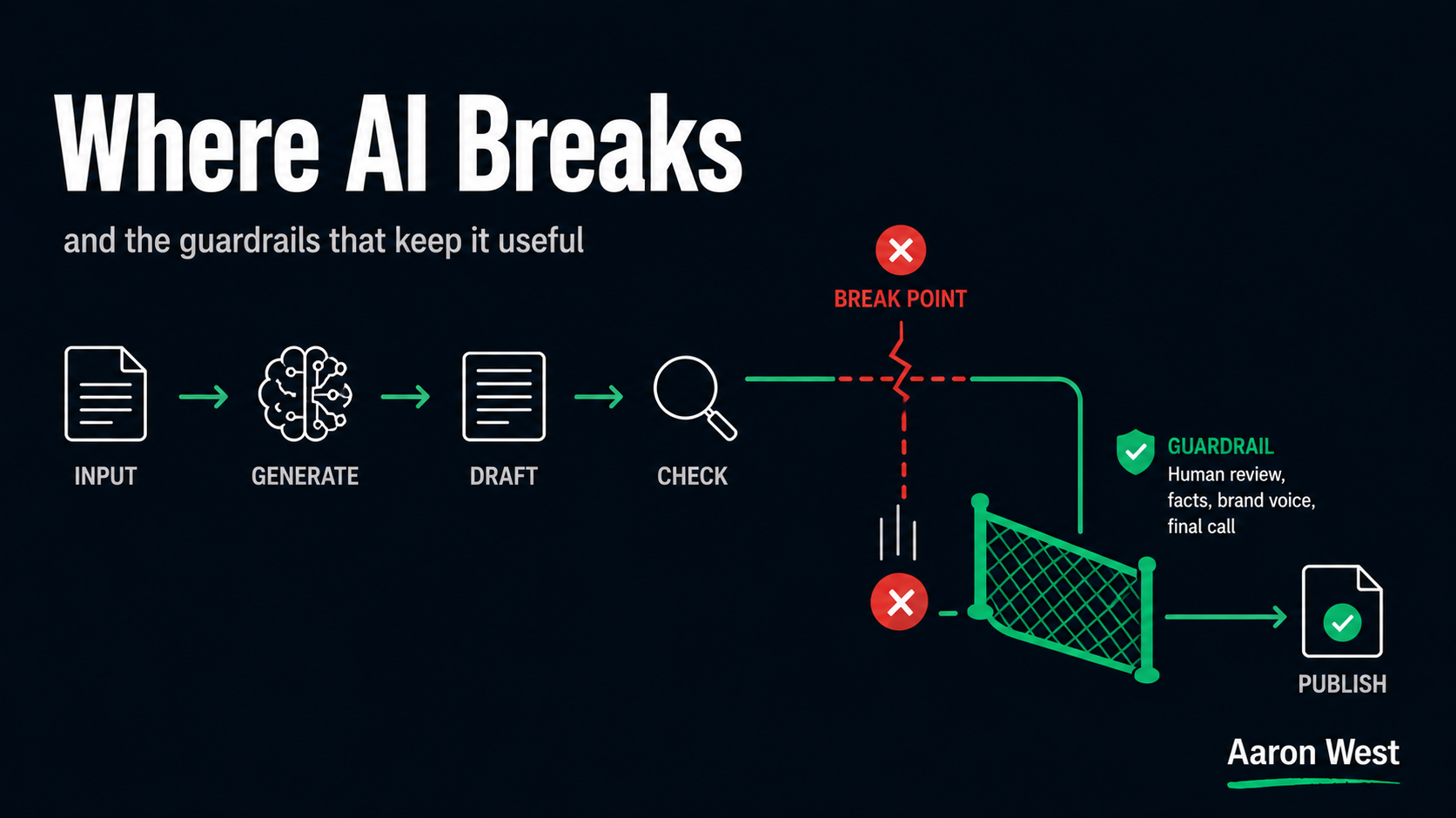
Where AI Breaks in E-Commerce Ops (and the Guardrails That Keep It Useful)
AI does not fail randomly in e-commerce operations. It fails in a handful of specific, predictable ways, and once you know them, you can build the guardrails that let you use AI confidently instead of nervously. The failures are not exotic. They are the same…
Continue reading...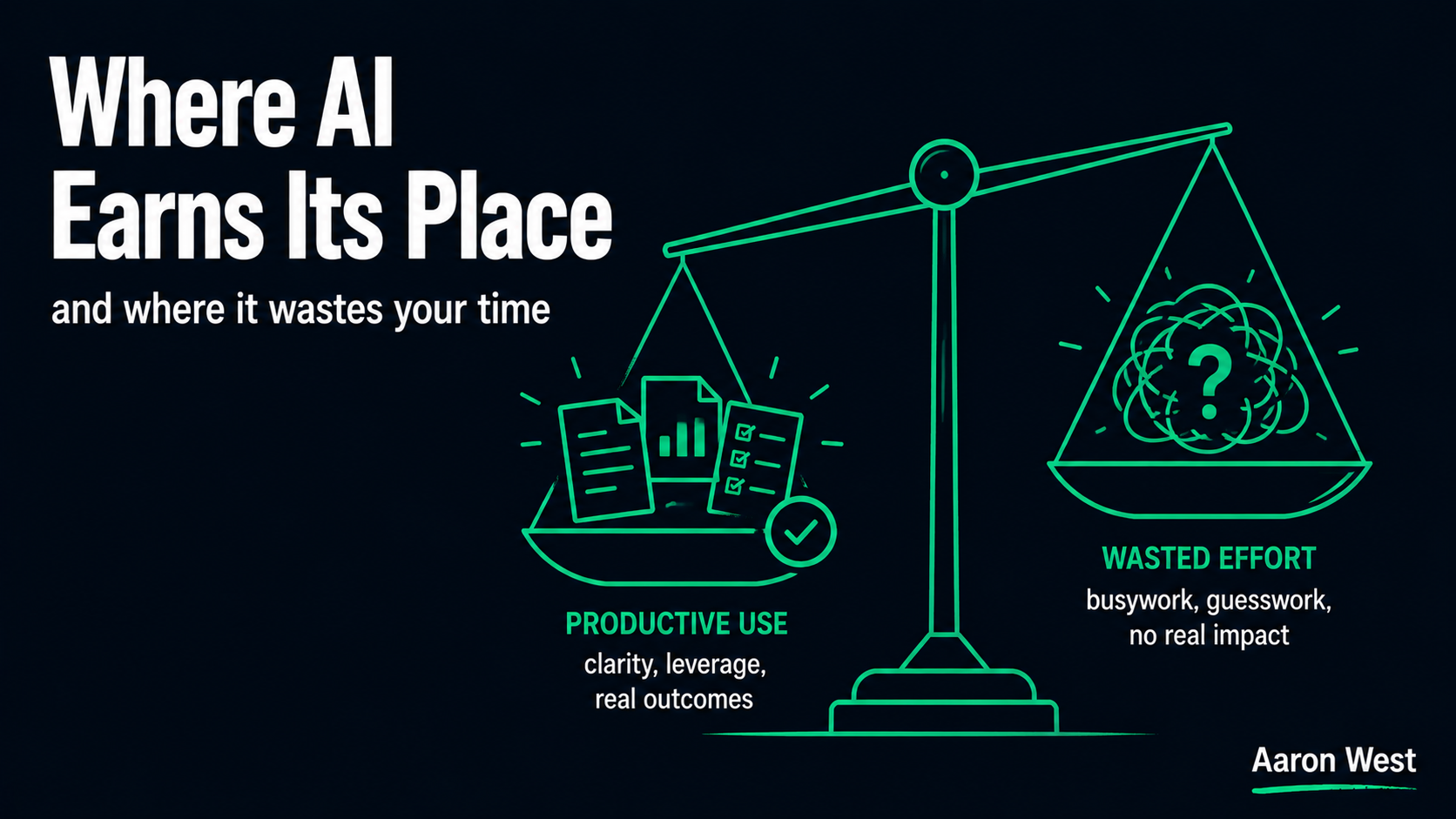
Using AI in Real E-Commerce Work: Where It Earns Its Place and Where It Wastes Your Time
After actually using AI across real e-commerce work rather than reading about it, here is the honest summary: AI is genuinely transformative for a specific, narrow band of tasks, and a confident waste of time for a surprising number of others. The skill in 2026…
Continue reading...