Using AI in Real E-Commerce Work: Where It Earns Its Place and Where It Wastes Your Time

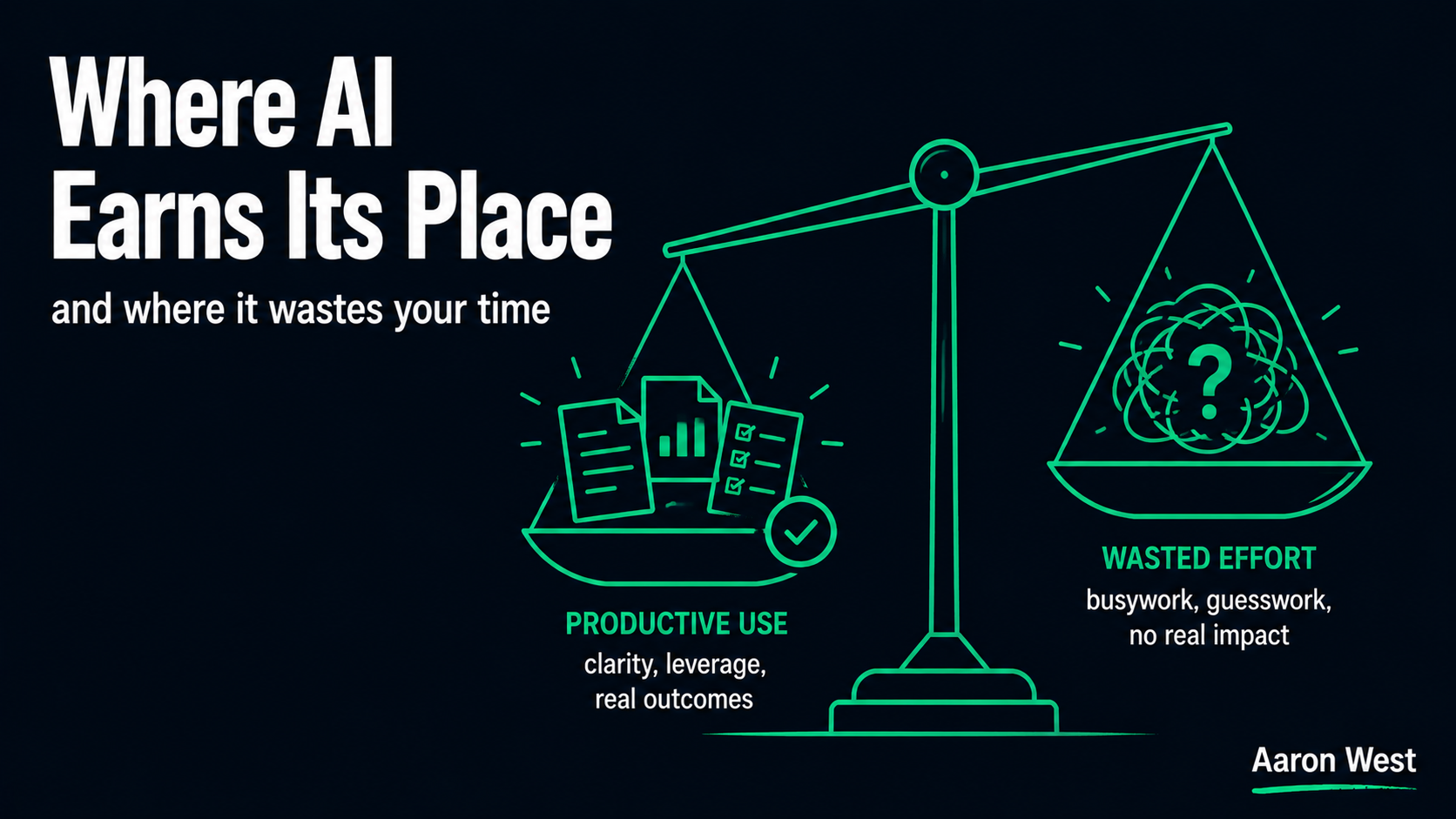
Table of Contents
After actually using AI across real e-commerce work rather than reading about it, here is the honest summary: AI is genuinely transformative for a specific, narrow band of tasks, and a confident waste of time for a surprising number of others. The skill in 2026 is not "adopting AI." Everyone is doing that. The skill is knowing precisely where it earns its place and where it quietly costs you more than it saves, and most of the breathless coverage gets that line wrong because the people writing it are selling the tools.
I am not. I run this stuff in production, and the pattern that has emerged is clear and not what the hype implies. AI's biggest, most reliable wins in e-commerce are unglamorous: content at scale and data cleanup. Its most overhyped uses are the ones where being subtly wrong is expensive and nobody checks. The whole game is matching the tool to tasks that fit its actual strengths, and refusing the ones that don't, which is the same discipline I bring to automation generally. So here is the practitioner's map: where AI genuinely earns its place, where it wastes your time, and the one rule that decides which is which.
First, what AI is actually good at
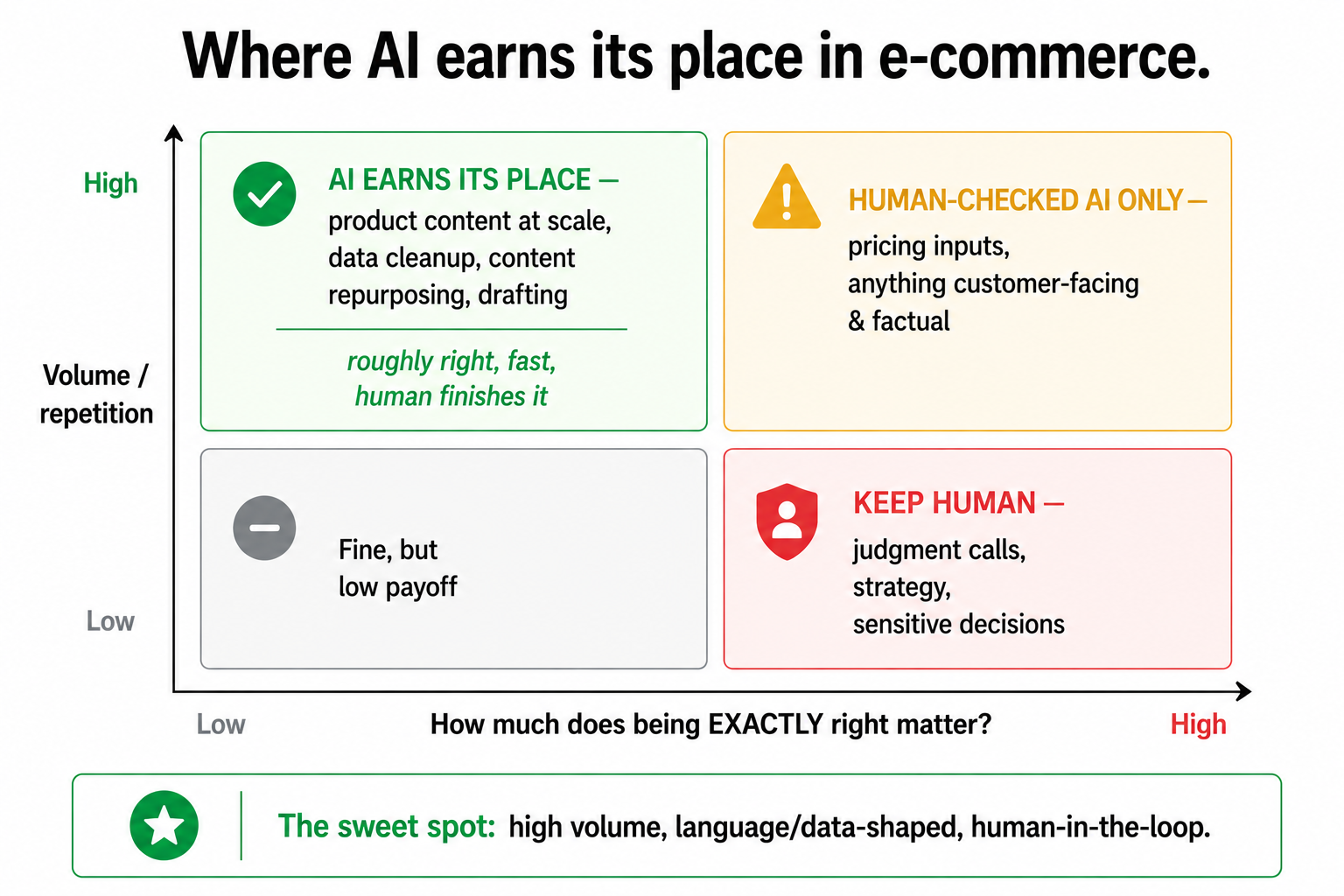
Strip away the marketing and AI, specifically the generative kind built on large language models, has a real and specific superpower: producing and transforming large volumes of language and data quickly, in a way that is roughly right and needs a human to make it exactly right. Hold that phrase, "roughly right, fast, at volume." It explains every place AI genuinely shines and every place it fails.
It is brilliant at first drafts, at handling volume no human could face, at turning structured data into readable language and messy data into structured form, and at the tedious transformations that used to eat hours. It is unreliable wherever the task demands being exactly right with no one checking, genuine judgment, real-world context it cannot see, or true understanding rather than convincing pattern-matching. Every decision about where to use it comes back to that split: is "roughly right, fast, with a human finishing it" a win here, or a disaster? In some tasks it is transformative. In others it is a confident liability. Let me get specific.
Where AI genuinely earns its place
These are the wins I would stake my reputation on, because I have seen them hold up in real operations.
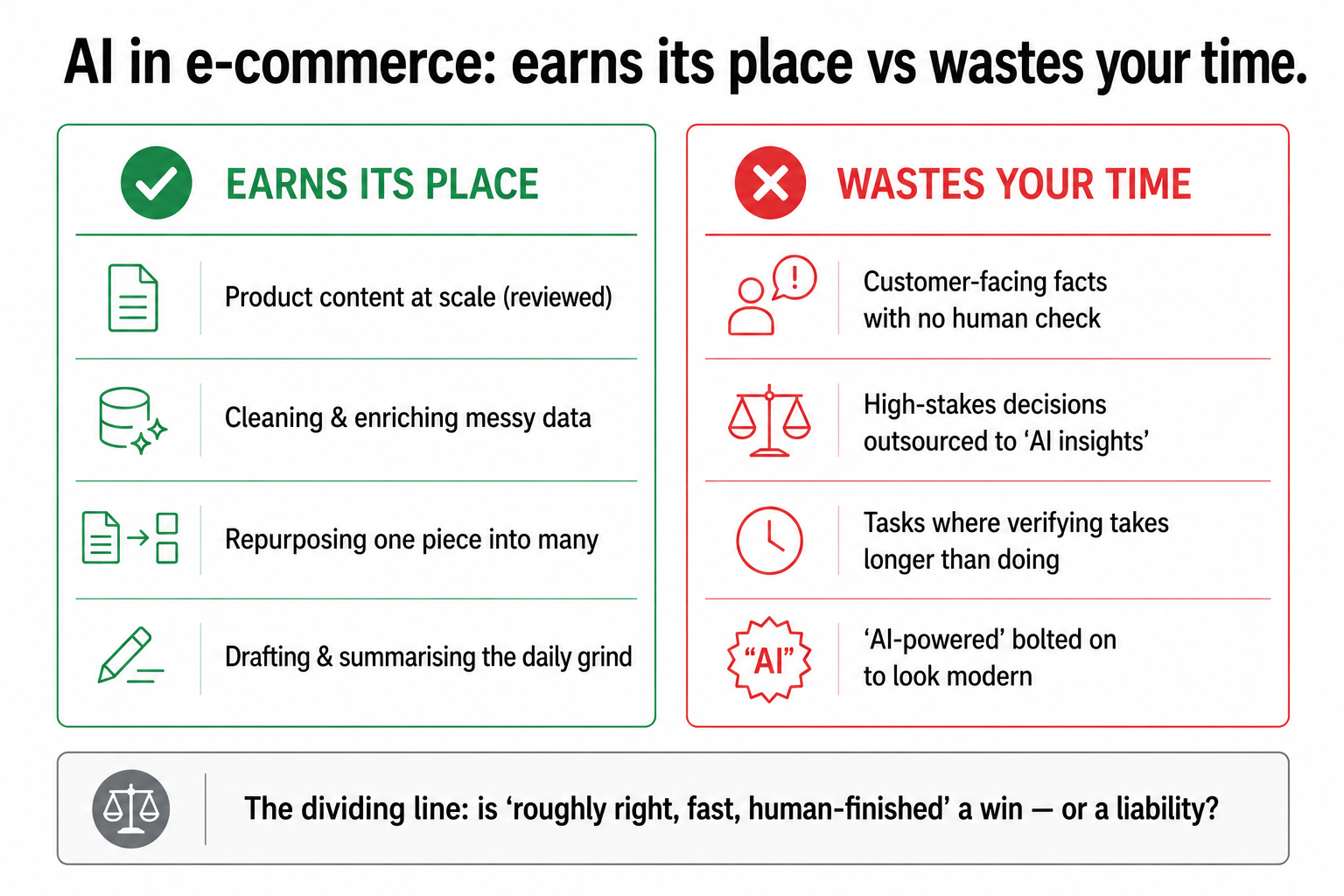
Product content at scale. This is the single biggest, fastest win in e-commerce AI, and it is not close. If you have a large catalogue, writing unique, decent, SEO-aware descriptions and metadata for thousands of products is a project most teams literally never finish. It is soul-destroying, it never ends, and it is exactly the "roughly right, fast, at volume" task AI was made for. Feed it good structured product data and it drafts descriptions, metadata, and FAQs across the whole catalogue in a fraction of the time. The crucial part, and the part that separates success from embarrassment, is that the human job does not disappear, it shifts, from writing from scratch to reviewing and editing for brand voice and accuracy. That review step is non-negotiable, and I cover the how in AI for product descriptions that don't sound generic and processing product assets at scale. But the leverage is enormous: a job that was effectively impossible becomes a review queue.
Cleaning and enriching messy data. The other great unglamorous win. Every store accumulates a mess: inconsistent product attributes, miscategorised items, missing fields, duplicates. AI is genuinely good at the pattern-recognition grind of spotting inconsistencies, suggesting categories, filling gaps from existing data, and turning a chaotic catalogue into a clean one. This is high-value precisely because it is the work nobody wants to do and bad data quietly costs you, in discoverability, in conversion, and increasingly in whether AI shopping assistants surface your products at all. Done with a human checking the edge cases, it turns data hygiene from a doomed one-off project into something maintainable.
Repurposing and transforming content. AI is excellent at taking one piece of content and adapting it into many forms, a long article into social posts, a product page into ad variations, a English description into a first-pass translation. Again: drafts, fast, at volume, finished by a human. The one-to-ten content workflow is one of the most practical everyday uses there is.
Drafting and summarising in the daily grind. The quiet, cumulative win nobody puts in a case study: first drafts of emails, summaries of long reports, reformatting, brainstorming angles. Individually small, collectively a real chunk of time back, and low-risk because you are reviewing everything anyway.
Notice the thread through all four: high volume, language-or-data-shaped, and a human stays in the loop to make it exactly right. That is the zone where AI is not hype. It is a genuine force multiplier.
Where AI wastes your time (or worse)
Now the half the vendors skip. These are the places I have watched AI cost more than it saves, in time, in trust, or in cleanup.
Anything customer-facing and factual, with no human check. This is the big one. The moment AI states something as fact to a customer, a policy, a product detail, a promise, you are exposed to its core failure: it generates plausible text, not verified truth, so it can be confidently, fluently wrong. An invented return policy or a hallucinated product spec does not save time, it creates an angry customer and a cleanup job. The fix is not to avoid AI here, it is to never let it speak to customers ungoverned: ground it in your real data with retrieval and keep a human or a hard rule on anything that must be exactly right.
High-stakes decisions dressed up as AI "insights." AI will happily produce a confident recommendation about pricing, inventory bets, or strategy. It sounds authoritative. But it is pattern-matching on what it was given, without the market context, the relationships, and the judgment a real decision needs, and it cannot tell you how confident it actually is. Use it to gather and summarise the inputs to a decision. Do not outsource the decision. The confident tone is not competence.
Tasks where verifying the output takes longer than doing it yourself. A subtle, real trap. For some work, especially anything requiring specialist accuracy you would have to fact-check line by line, the review burden swamps the time AI saved drafting. If you cannot trust the output and checking it is as slow as creating it, AI has not helped, it has added a step. Be honest about when this is the case.
"AI-powered" everything, adopted to look modern. The most expensive waste is bolting AI onto a process that did not need it, to seem current. That is automating-for-its-own-sake with a fashionable label, and it is the exact mistake I warn about in automation: a flawless solution to a problem you did not have. AI is a tool, not a strategy. If you cannot name the specific painful task it solves, you are not ready to use it there.
The pattern under all four mirrors the wins exactly: AI wastes your time wherever being subtly wrong is expensive and nobody is checking, wherever real judgment or unseen context is required, or wherever it is adopted for appearance rather than a real job.
The one rule that decides every case
If you take one thing from this, take the test I actually use, because it collapses every decision above into a single question. Before using AI for any task, ask: what is the cost of it being subtly wrong, and who checks?
If being slightly wrong is cheap and a human reviews the output anyway, drafting a description, cleaning a data field, summarising a report, use AI freely; that is its home turf, and the human-in-the-loop catches what slips. If being wrong is expensive and nobody is checking, a fact shown straight to a customer, a number feeding a real decision, keep it human or keep it hard-gated. Almost every good and bad AI decision in e-commerce falls cleanly on one side of that question. It is the same risk-based logic that runs through how I think about automation, because it is the same underlying judgment: match the tool to the task by the cost of failure, not by the excitement of the technology.
There is a second, quieter rule that saves people from the most common failure: start narrow. The teams that get value pick one high-volume, painful, well-bounded task, product descriptions, data cleanup, support triage, do that one brilliantly, prove it, then expand. The teams that fail try to "become an AI company" across everything at once and drown. This too is the automation lesson wearing new clothes: depth on one real problem beats a thin layer of AI smeared across all of them.
So that is the honest map. AI in e-commerce is a genuine force multiplier for high-volume, language-and-data-shaped work where a human stays in the loop, content at scale, data cleanup, repurposing, drafting, and a confident liability for customer-facing facts, real decisions, and anything adopted to look modern rather than to solve a named problem. The dividing line is one question: what does being subtly wrong cost, and who checks? Get that right, start narrow, keep the human where being wrong is expensive, and AI stops being either a miracle or a disappointment and becomes what it actually is: a very powerful tool that is transformative exactly where it fits and a waste exactly where it doesn't. Knowing the difference is the whole skill.
A few common questions
Where does AI actually add value in e-commerce? In high-volume, language-and-data-shaped work where a human reviews the output: drafting product descriptions and metadata across a large catalogue, cleaning and enriching messy product data, repurposing one piece of content into many, and drafting or summarising in the daily grind. The common thread is "roughly right, fast, finished by a human."
Where does AI waste time or cause problems in e-commerce? Wherever being subtly wrong is expensive and nobody checks: customer-facing facts (policies, product details) stated by ungoverned AI, high-stakes decisions outsourced to confident "AI insights," tasks where verifying the output takes longer than doing it yourself, and anything "AI-powered" bolted on to look modern rather than to solve a real problem.
What's the single rule for deciding whether to use AI on a task? Ask: what does it cost if the output is subtly wrong, and who checks it? If being wrong is cheap and a human reviews it anyway, use AI freely. If being wrong is expensive and nobody is checking, keep it human or hard-gate it. This one question resolves almost every case.
How should a store start with AI without wasting money? Start narrow. Pick one high-volume, painful, well-defined task (product descriptions or data cleanup are the usual best first wins), do it well, prove the value, then expand. Teams that try to apply AI everywhere at once tend to fail; depth on one real problem beats a thin layer across all of them.
You should also read:
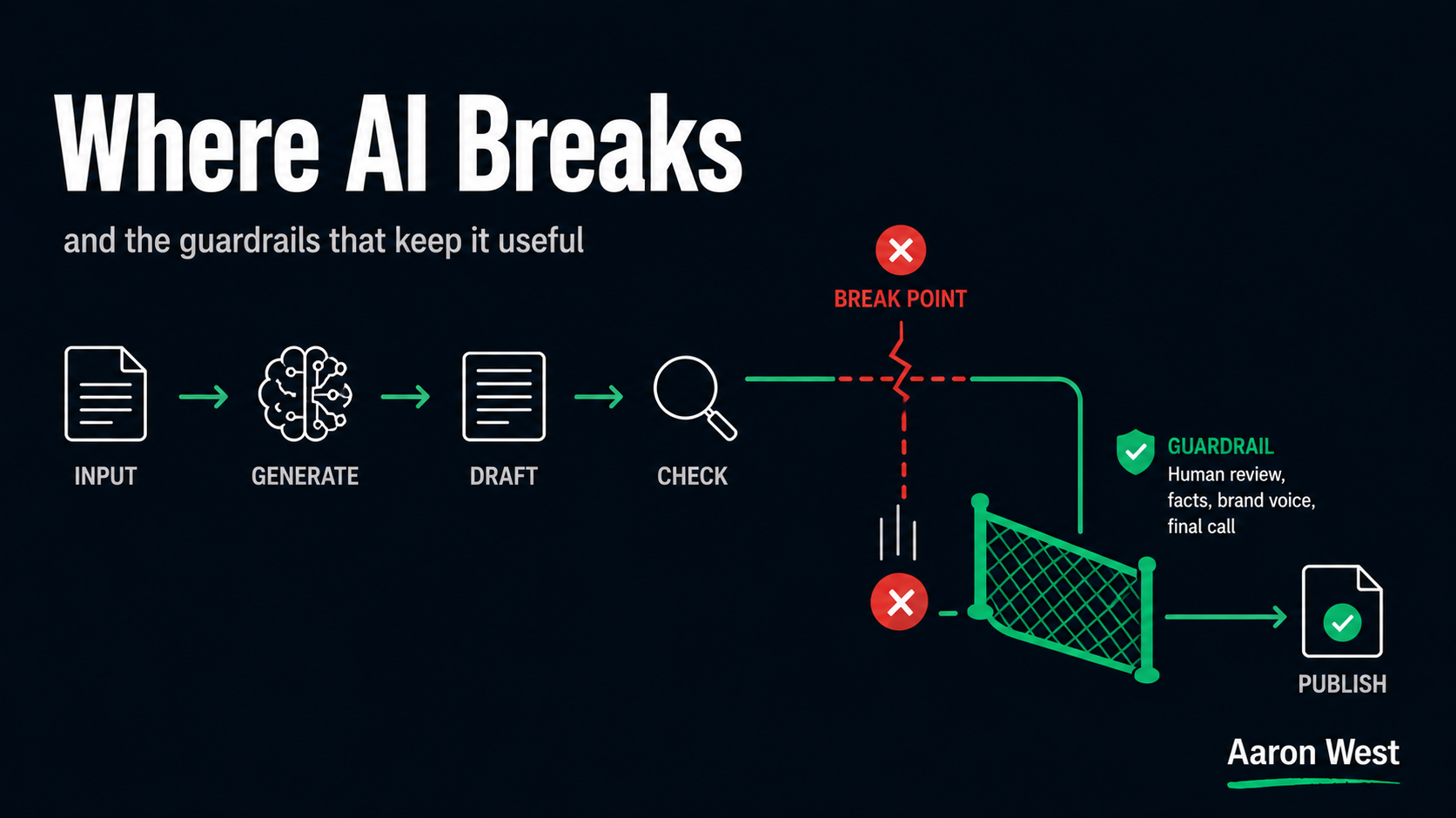
Where AI Breaks in E-Commerce Ops (and the Guardrails That Keep It Useful)
AI does not fail randomly in e-commerce operations. It fails in a handful of specific, predictable ways, and once you know them, you can build the guardrails that let you use AI confidently instead of nervously. The failures are not exotic. They are the same…
Continue reading...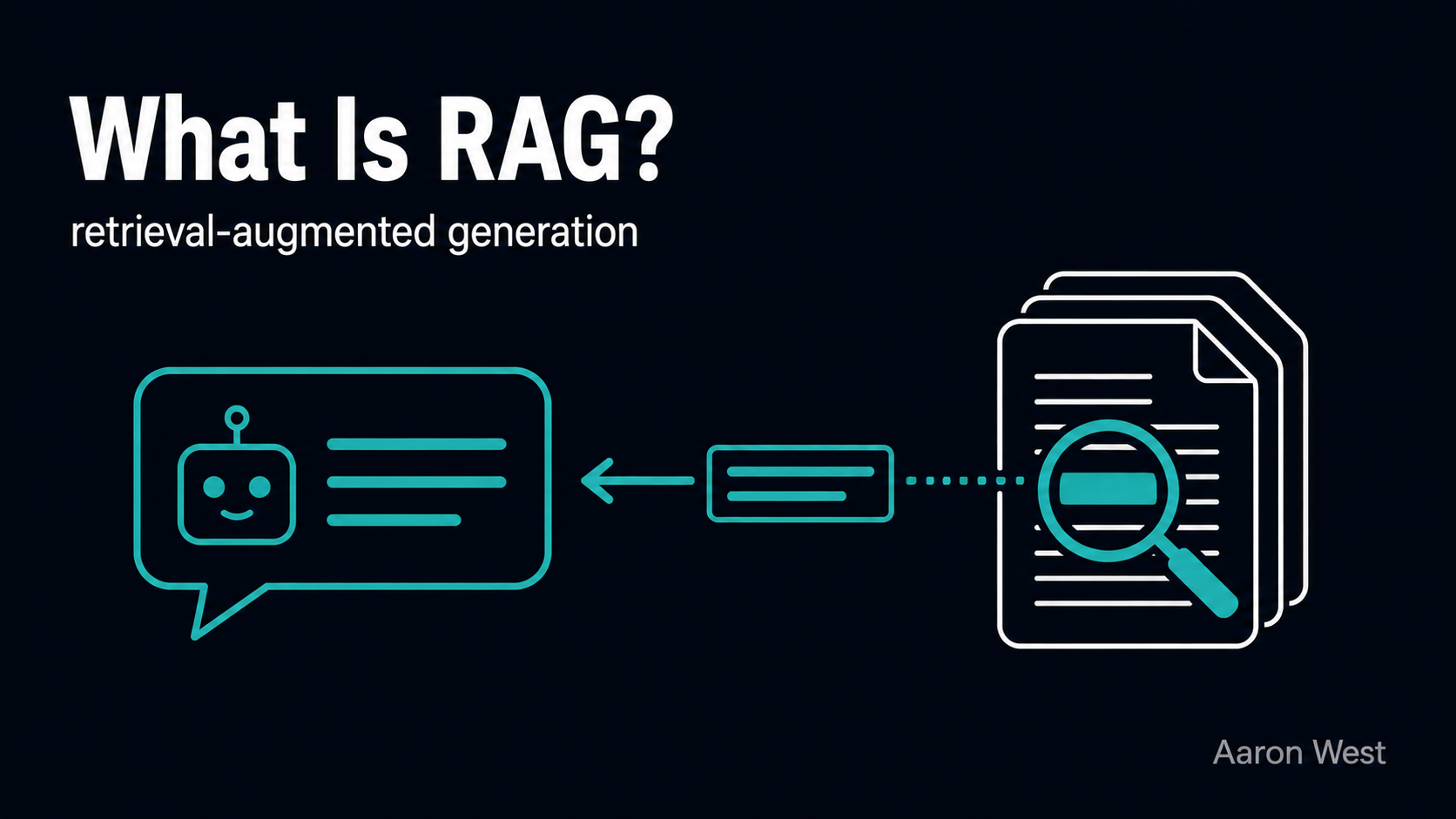
What Is RAG (Retrieval-Augmented Generation), and Why Everyone Is Using It
RAG, retrieval-augmented generation, is a way of making an AI model answer from a specific, trusted set of documents instead of relying only on what it absorbed during training. Before the model writes its answer, the system goes and fetches the most relevant material from…
Continue reading...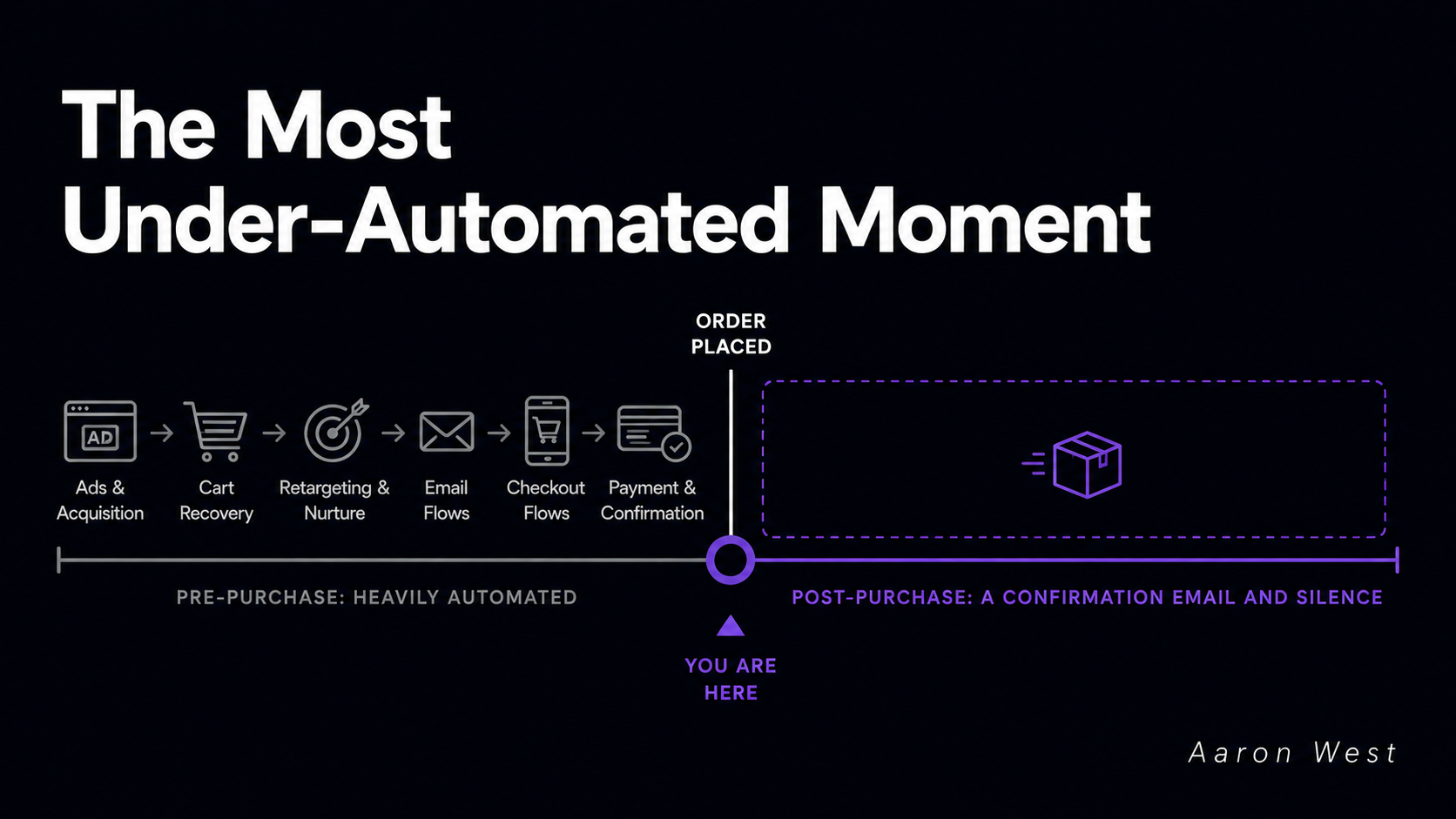
Post-Purchase Is the Most Under-Automated Moment in E-Commerce
Almost every store pours its automation budget into the moment before the sale and abandons the customer the moment after it. Cart recovery, retargeting, checkout nudges, all heavily automated. Then the order goes through, and the experience falls off a cliff into a generic "thanks…
Continue reading...