Post-Purchase Is the Most Under-Automated Moment in E-Commerce

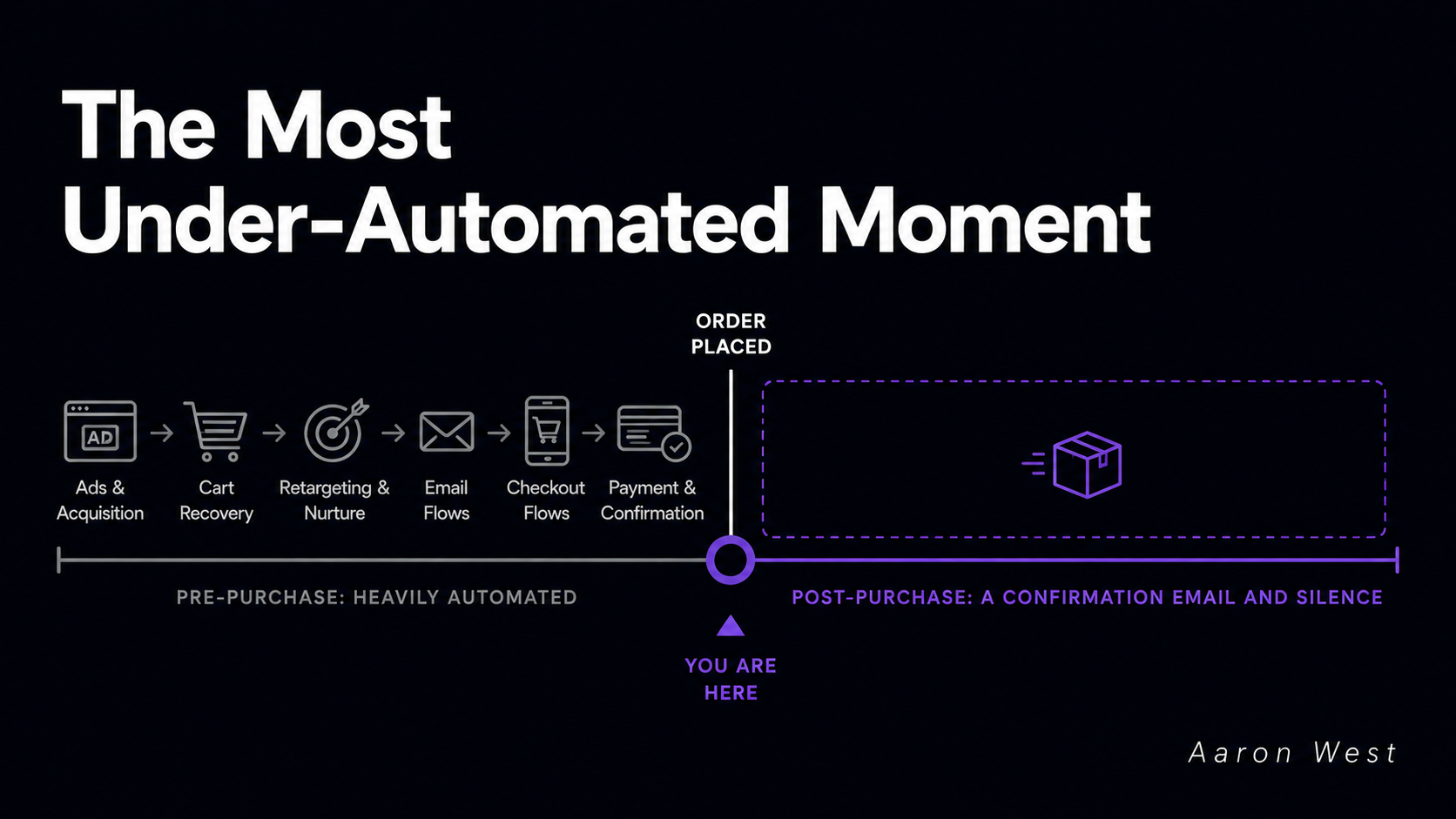
Table of Contents
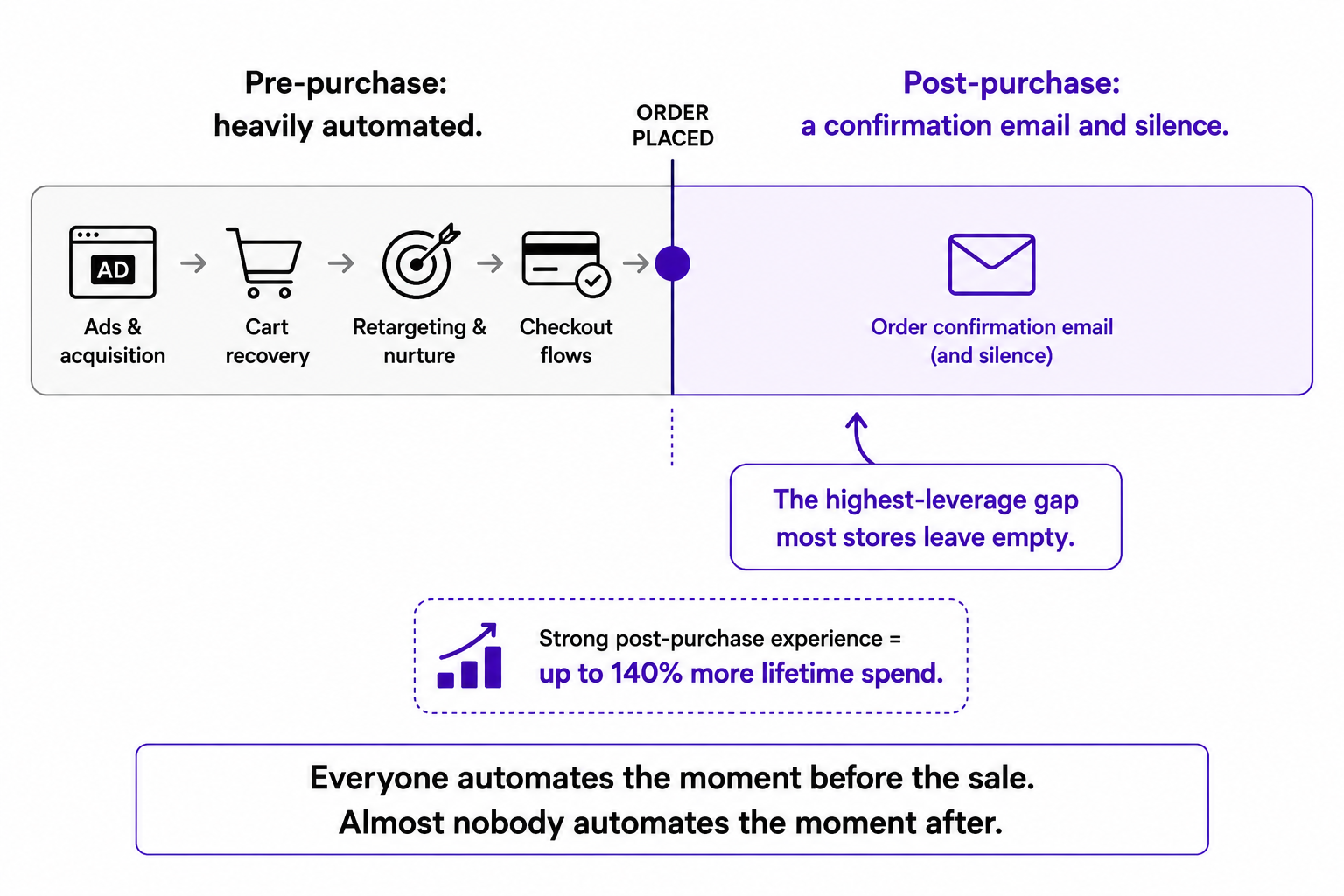
Almost every store pours its automation budget into the moment before the sale and abandons the customer the moment after it. Cart recovery, retargeting, checkout nudges, all heavily automated. Then the order goes through, and the experience falls off a cliff into a generic "thanks for your order" email and silence until the box arrives. That gap, between "order placed" and "order delivered," is the most under-automated moment in e-commerce, and it is the one with the clearest link to whether the customer ever comes back.
Here is the number that should change how you think about it. Customers who have a strong post-purchase experience spend significantly more over their lifetime than those who have a poor one, with some 2026 analyses putting the difference as high as 140%. Meanwhile the average repeat-purchase rate in e-commerce sits around 28%. Most of your customers buy once and vanish, and the window where you lose them is the one almost nobody automates well.
Let me explain why this gap exists, what belongs in it, and where the line sits between automation that builds loyalty and automation that quietly erodes it.
Why the post-purchase gap exists
The neglect is not random. It comes from how most teams think about the funnel. Acquisition is exciting and measurable: you spend on ads, you watch conversions, the loop feels tight. Once the money is collected, attention moves to the next sale. The post-purchase period feels like fulfilment's problem, a logistics matter, not a marketing one. So it gets a transactional confirmation email and nothing else.
That framing was always shortsighted, and in 2026 it is expensive. Acquisition costs have risen to the point where buying the next new customer is far more expensive than keeping the one you just won. The whole industry has shifted from growth-at-all-costs toward retention-first, because the maths stopped working the other way. The post-purchase window is where retention is won or lost, which makes it some of the highest-leverage automation real estate you own. And it is sitting largely empty.
There is also a customer-anxiety angle that teams miss. The period right after someone gives you money is when they feel most exposed. They have paid, and now they are waiting, with no visibility, hoping it goes well. Silence in that window does not read as calm. It reads as risk. Every "where is my order?" email you receive is a customer whose anxiety you left unmanaged, and each of those costs you support time on top of the trust it quietly drains.
What actually belongs in the gap
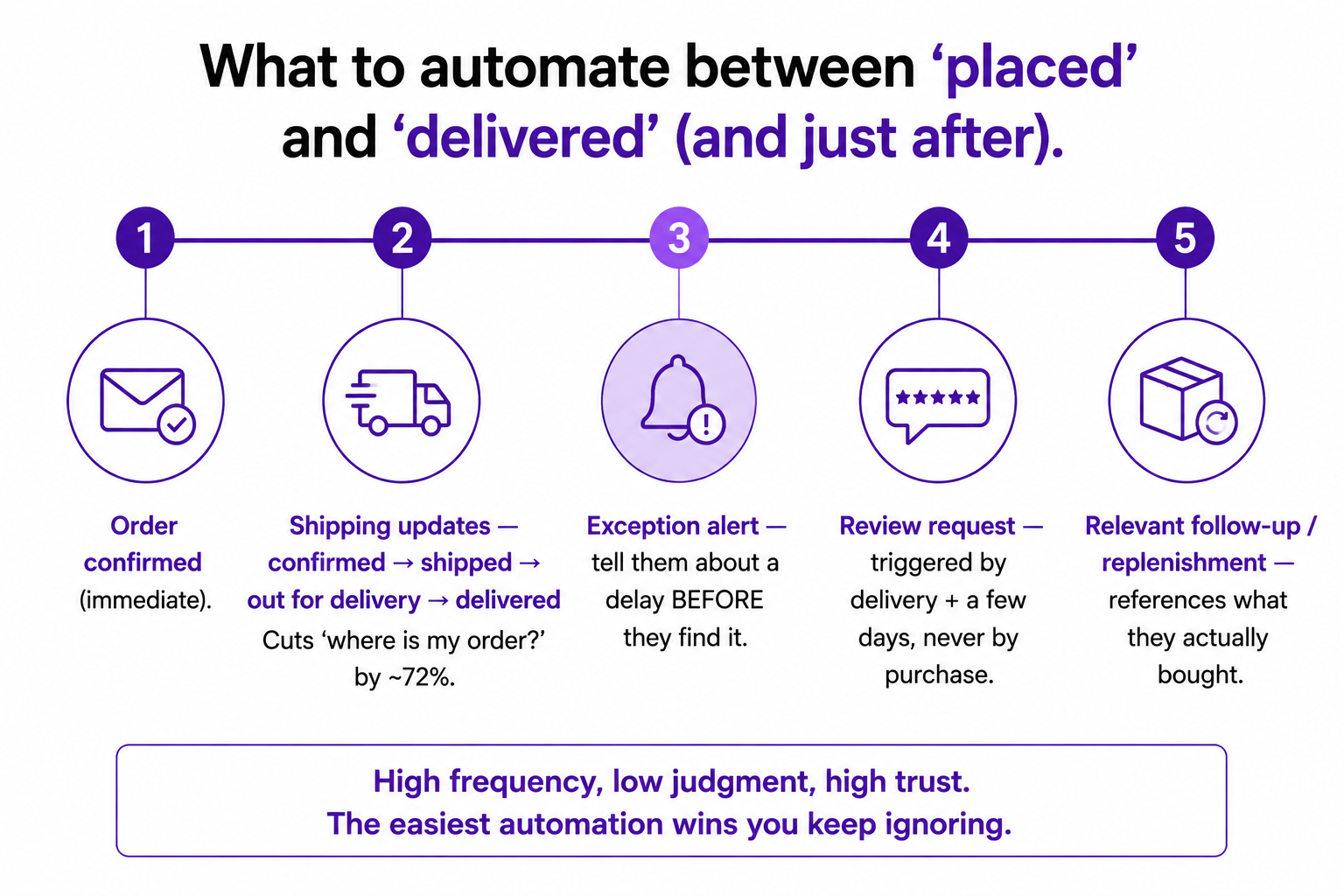
The good news is that filling this gap is mostly straightforward automation, the high-frequency, low-judgment kind that belongs at the top of any automation list. Four things, roughly in order of impact.
Proactive shipping and delivery updates. The single highest-value thing you can automate here. A clear sequence of branded notifications, order confirmed, shipped, out for delivery, delivered, with a working tracking link, does two jobs at once. It calms the customer's anxiety, and it eliminates the "where is my order?" contact before it happens. Branded tracking experiences have been shown to cut those WISMO inquiries by around 72%. That is a support-cost saving and a trust gain from the same automation.
Proactive exception handling. This is the one that separates a good post-purchase setup from a great one. Do not wait for the customer to discover that their parcel is stuck. Detect the delay and tell them first, in your own voice, before they have to chase you. A customer who hears "your delivery is running a day late, here is the new estimate" from you is reassured. A customer who finds out by checking a silent tracking page that has not moved in three days is already drafting a complaint. Same delay, opposite outcome, decided entirely by who spoke first.
The review request, timed correctly. Automate a review request triggered by confirmed delivery, not by purchase, then waited a sensible few days so the customer has actually used the product. This turns your satisfied buyers into the social proof that converts the next visitor, automatically. The trigger matters: asking for a review of something that has not arrived is the kind of tone-deaf misfire automation makes efficiently if you wire it to the wrong event.
Replenishment and relevant follow-up. For consumable products, a reminder timed to when the customer is likely running low is genuinely useful, not pushy. For everything else, a follow-up that references what they actually bought beats a generic "here are some products" blast. This is where post-purchase automation starts shading into CRM and lifecycle marketing, which is a deeper topic, but the entry point is simple: make the follow-up relevant to the specific purchase.
Where the line is: automate the logistics, not the relationship
This is a post-purchase piece, but it is still governed by the same rule as everything else I write about automation: automate the work, never the judgment. The post-purchase window has a clear version of that line, and crossing it is a common, costly mistake.
Automate the informational layer without hesitation. Shipping status, delivery windows, tracking, the review prompt, the replenishment nudge. These are high-frequency, low-judgment, and the customer genuinely wants them. There is no relationship cost to automating a "your order shipped" message, only a benefit.
Do not automate the emotional layer. When something goes wrong in a way that matters, a damaged item, a lost parcel, a customer who is upset, that is the moment to route to a human, not to send a smoother automated apology. I made the fuller case for this in the five things you should never automate, and post-purchase is exactly where the temptation is strongest, because the volume is high and the automation looks like it is coping. It is coping right up until the moment a real person needed a real person and got a workflow instead.
There is a subtle trap worth naming: the "personalised" post-purchase message that is obviously templated. A video or note that uses the customer's name but plainly came off a production line can read as more hollow than no message at all, because it performs intimacy without meaning it. Use automation to make sure the right moment is not missed. Where the moment calls for something genuinely personal, let a human supply the actual substance.
Why this is the easiest win you are not taking
Step back and look at the shape of it. The post-purchase gap is high-frequency: it happens on every single order. It is low-judgment for the informational layer: the messages are rules-based and predictable. And it is high-stakes when neglected: it is where repeat-purchase rate, and therefore the economics of your whole business, is quietly decided. High frequency, low judgment, high downside when ignored. That is the exact profile of the work that should be automated first, which I laid out in how I think about automation.
Yet most stores have a fully-built pre-purchase automation stack and a near-empty post-purchase one. It is the clearest mismatch between effort and opportunity I see in e-commerce operations. The pre-purchase work is more crowded, more expensive, and more competitive. The post-purchase work is cheaper to build, less contested, and more directly tied to the retention that 2026's economics reward.
If you have already built the core automation workflows and you are looking for the next highest-value thing to automate, it is almost certainly sitting in the gap between "order placed" and "order delivered." Fill it with information and reassurance, keep a human ready for the moments that need one, and you turn the most neglected window in e-commerce into the one that brings people back.
The sale is not the finish line. For most of your revenue, it is the starting line. Automate accordingly.
A few common questions
What is the post-purchase experience in e-commerce? Everything that happens after a customer clicks buy: order confirmation, shipping updates, delivery, exception handling, returns, the review request, and follow-up communication. It is where repeat-purchase rate and loyalty are mostly decided.
Why does the post-purchase experience matter so much? Because retention is cheaper than acquisition, and the post-purchase window is where retention is won or lost. Customers with a strong post-purchase experience have been shown to spend substantially more over their lifetime, while the average e-commerce repeat-purchase rate is only around 28%.
What should I automate in the post-purchase period? The informational layer: branded shipping and delivery notifications, proactive delay alerts, a review request triggered by confirmed delivery, and relevant follow-up or replenishment reminders. Branded tracking alone can cut "where is my order?" inquiries by around 72%.
What should I not automate after the sale? The emotional moments. When a parcel is lost or damaged or a customer is upset, route to a human rather than sending a polished automated apology. Automate the logistics, keep the relationship human.
You should also read:
S3 + CloudFront for E-Commerce: A Non-Technical Introduction
If you want a fast, cheap, reliable way to serve your website's files, images, pages, assets, to customers anywhere in the world, the combination of two AWS services does almost all of the work: S3 stores the files, and CloudFront delivers them fast to every…
Continue reading...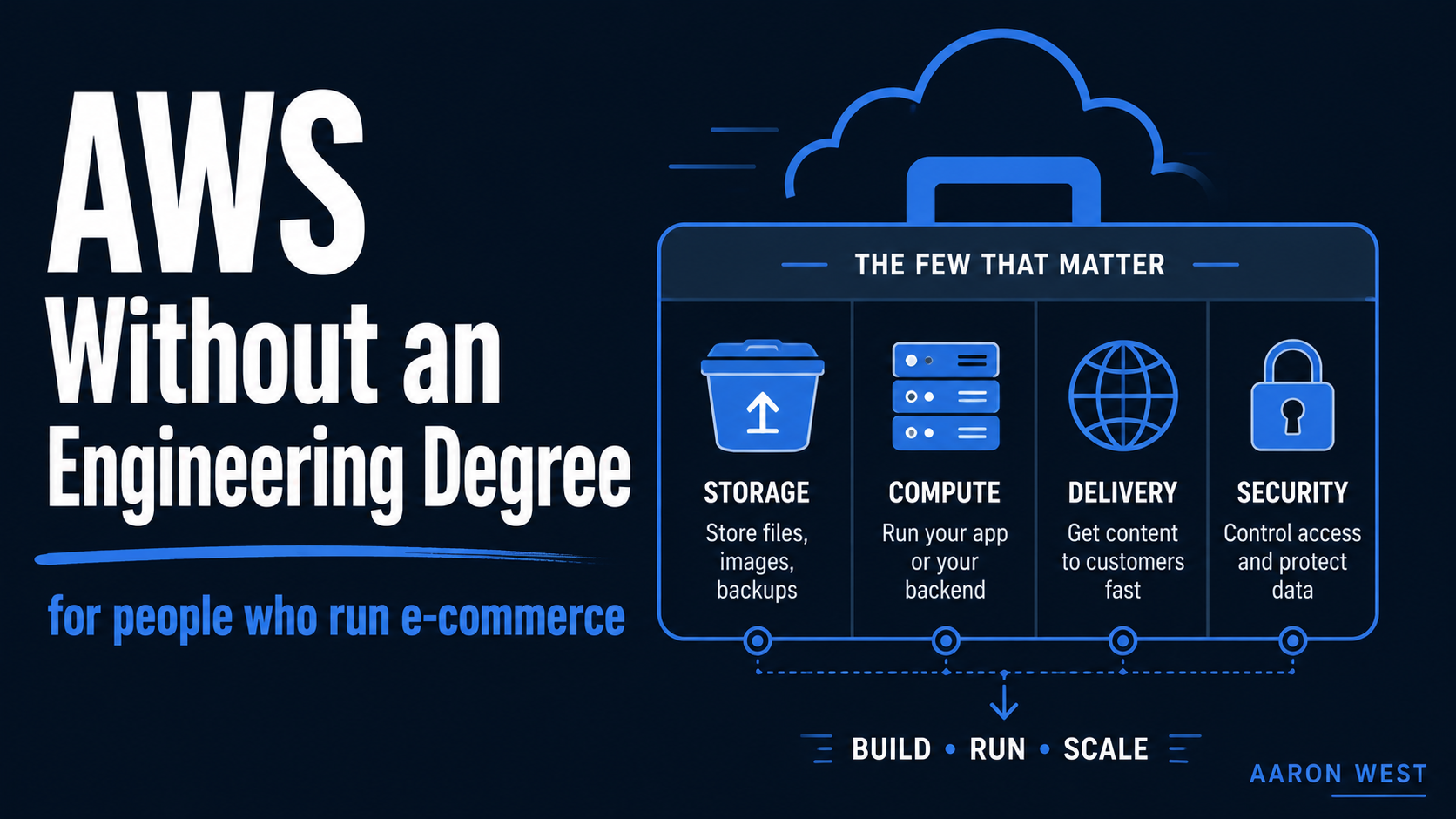
The E-Commerce Manager's Guide to AWS Without an Engineering Degree
You do not need to understand all of AWS. You need to understand maybe six services and one mental model, and that is enough to make good decisions, ask the right questions, and stop nodding along blankly when your developers or a vendor start talking…
Continue reading...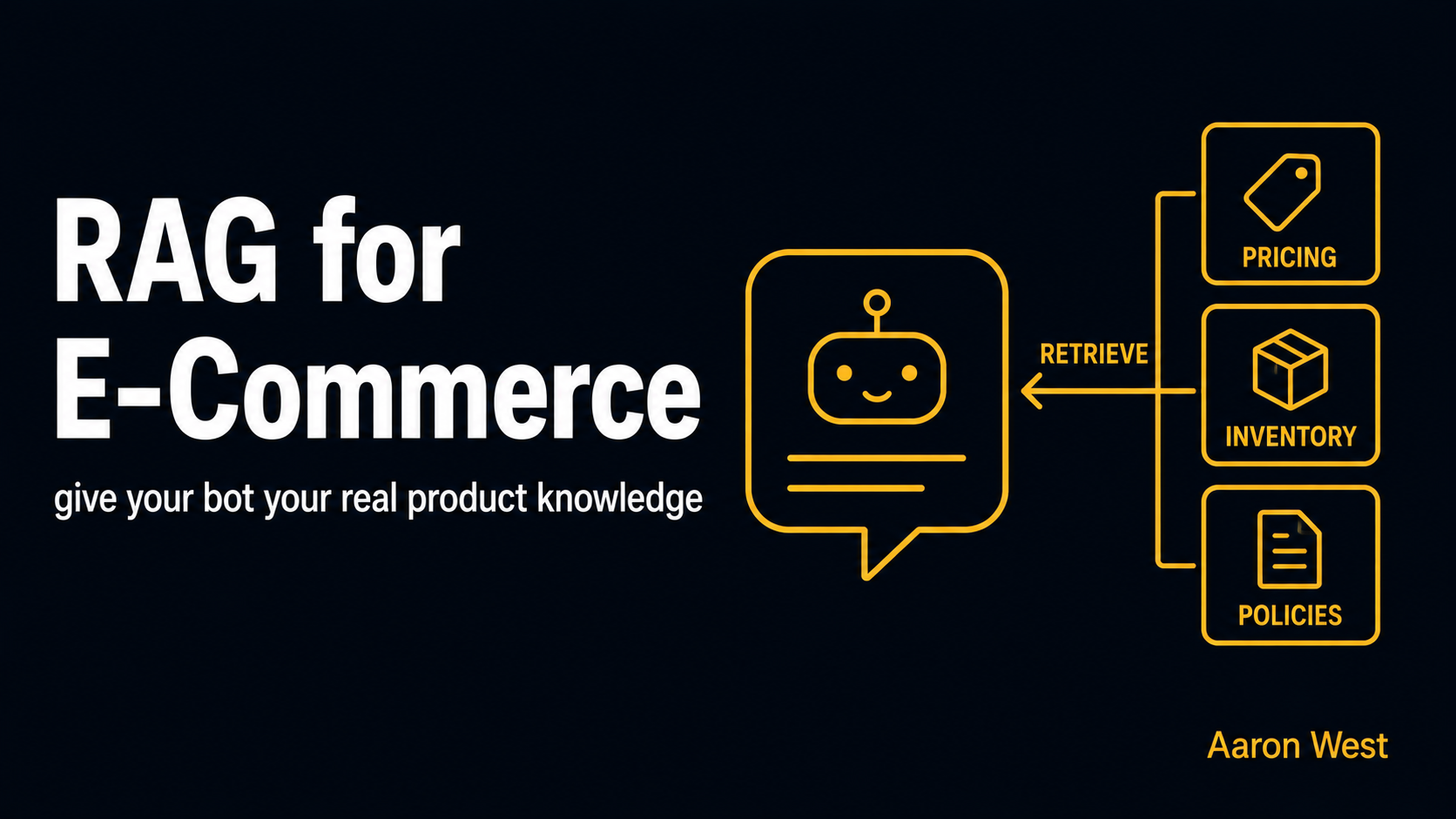
RAG Explained for E-Commerce: Giving a Bot Your Product Knowledge Without Retraining It
If you want an AI assistant that actually knows your store, your real products, your current prices, your live stock, your specific return policy, the technique you need is RAG, retrieval-augmented generation. It connects the AI to your live business data so it answers from…
Continue reading...