RAG Explained for E-Commerce: Giving a Bot Your Product Knowledge Without Retraining It

Table of Contents
If you want an AI assistant that actually knows your store, your real products, your current prices, your live stock, your specific return policy, the technique you need is RAG, retrieval-augmented generation. It connects the AI to your live business data so it answers from your actual catalogue and policies instead of from generic training or, worse, from confident guesswork. For e-commerce specifically, this is the difference between a chatbot that is a liability and one you can put in front of customers.
I have written a general explainer on what RAG is and how it works, so I will keep the mechanics brief here and focus on the part that matters to anyone running a store: what RAG actually does for e-commerce, the specific problems it solves that nothing else does well, and how to approach it without over-engineering. This is the applied version.
The thirty-second recap of how RAG works
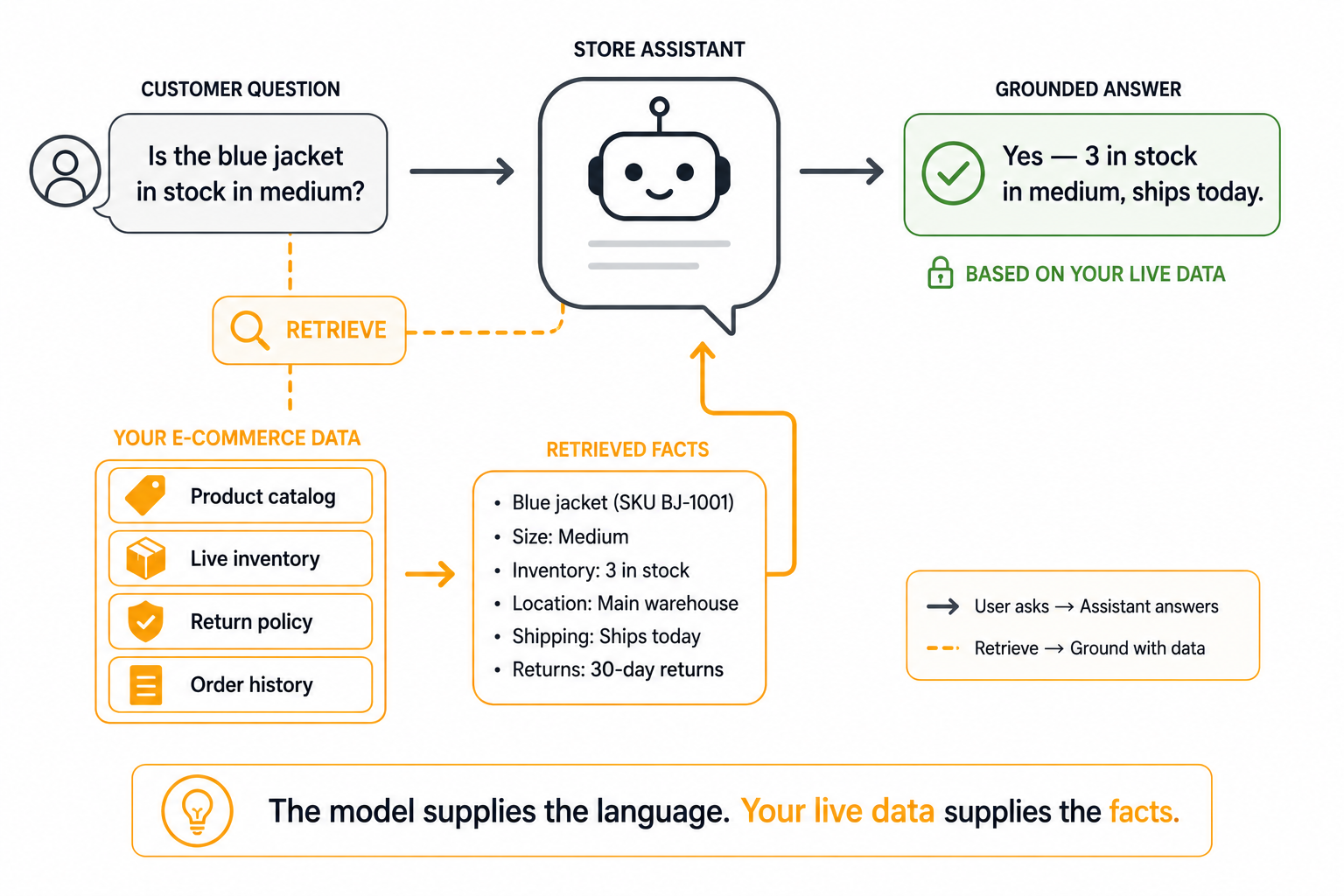
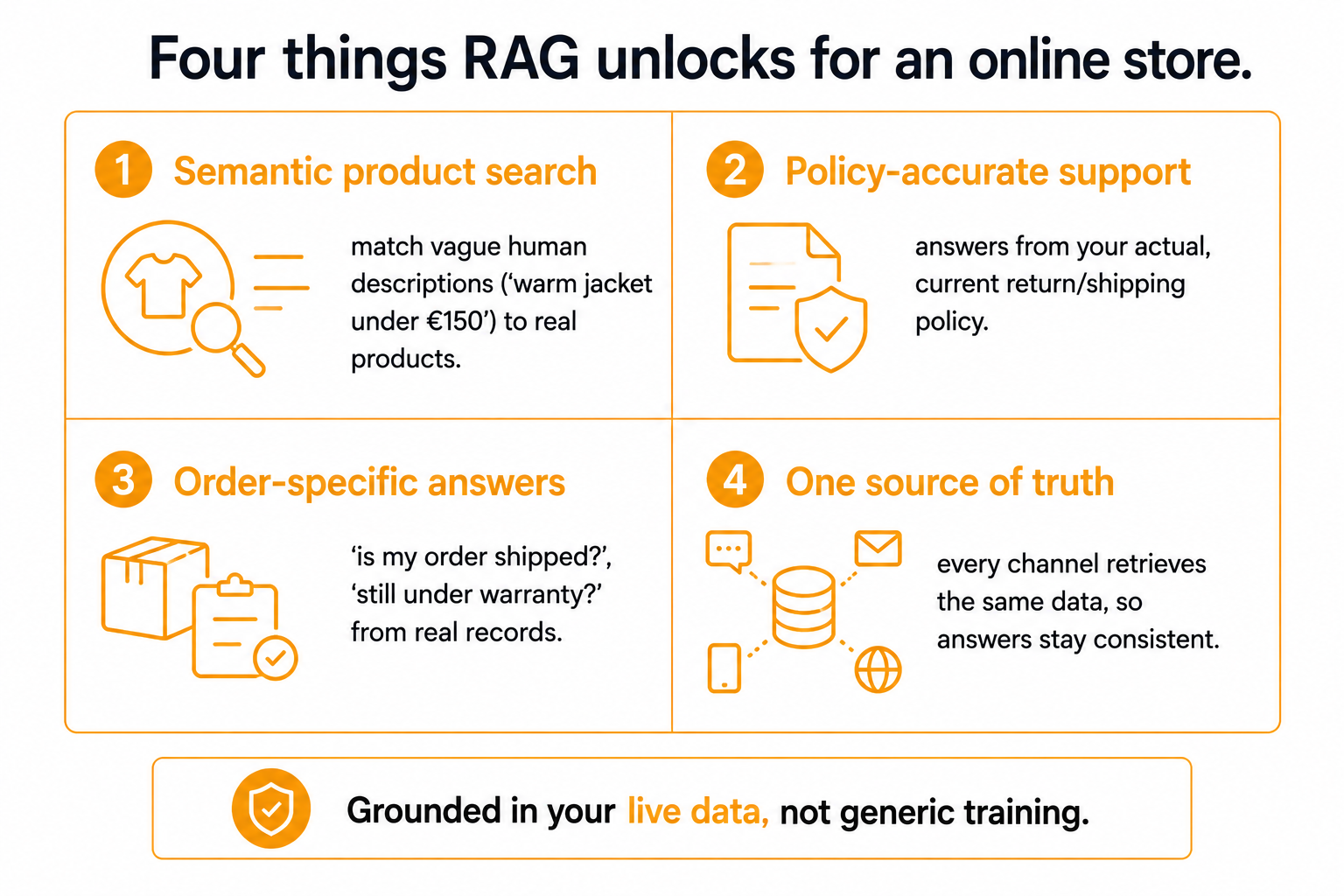
In one paragraph: a plain language model only knows what it absorbed in training, which means it has never seen your catalogue and will happily invent a confident, wrong answer about your products or policies. RAG fixes this by adding a retrieval step. When a customer asks something, the system first searches your own data, products, FAQs, policies, order records, for the relevant pieces, then hands those to the model along with the question, so the answer is grounded in your real information. Retrieve first, then generate. The model supplies the language; your data supplies the facts.
The reason this matters more in e-commerce than almost anywhere else is that e-commerce data changes constantly. Prices move, stock runs out, policies get updated, new products launch. A model's training is frozen, but your store is not. RAG is what lets an AI assistant stay current with a business that changes by the hour, because the knowledge lives in your data, which you update normally, not baked into a model you would have to rebuild. That single property is why it has become baseline infrastructure for serious retail AI.
The four things RAG does for e-commerce that nothing else does well
Forget the generic benefits for a moment. Here is what RAG specifically unlocks for a store, the use cases where it genuinely beats the alternatives.
Product search that understands meaning, not just keywords. Customers often do not know the product name. They search the way they think: "a warm jacket for hiking under 150 euros," "a smartphone with a good camera that isn't huge." Traditional keyword search chokes on this, it is matching words, not meaning. RAG retrieves by semantic understanding, so it can match a vague, human description to the right products in your catalogue. That is a fundamentally better search experience, and it directly affects whether a browsing customer finds something to buy.
Support that answers from your real, current policies. "What's your return window for sale items?" "Can I change my delivery address after ordering?" A generic bot guesses, and a wrong guess about a policy is the kind of confident error that costs you a chargeback or a furious customer. A RAG-grounded bot answers from your actual policy documents, and stays correct when you update them. This is the use case that makes a customer-facing bot safe to deploy at all.
Order- and customer-specific answers. This is the one that feels like magic to customers. "Is my order shipped yet?" "Is my laptop still under warranty?" By retrieving from order history and warranty records, a RAG system answers questions about that specific customer's situation, not generic information. Pulling the order and the warranty terms to answer "is my purchase still covered?" precisely is exactly the kind of personalised, accurate support that generic bots cannot touch.
One source of truth across every channel. As you add channels, website, app, WhatsApp, email, keeping answers consistent becomes a real problem. If every channel's bot retrieves from the same central data, they all give the same correct answer. RAG centralises the knowledge so consistency is automatic rather than something you maintain by hand in five places.
The catch nobody puts on the sales page
Now the honest part, because RAG is sold as a fix-all and it is not. A RAG system is only as good as the data you feed it. This is the rule that governs everything: point it at an outdated catalogue, inconsistent product attributes, or a messy pile of conflicting policy documents, and you get confident answers built on bad data. The model retrieves what you give it. Garbage in, garbage out applies with full force.
This is why the real work of an e-commerce RAG project is not the AI, it is the data. Before any model retrieves anything, your catalogue needs clean, consistent attributes, your policies need to be current and non-contradictory, and your taxonomy needs to be tight enough that retrieval finds the right thing. I cannot overstate how much this mirrors the chatbot lesson from the cornerstone: the technology is the easy part, and the unglamorous groundwork around it is what decides success. With RAG in e-commerce, the groundwork is your data hygiene. A brilliant retrieval system on top of a messy catalogue is a brilliant way to be confidently wrong at scale.
And one boundary worth keeping from my broader view on automation: RAG makes a bot's answers trustworthy, but it does not by itself make its actions safe. Retrieving the correct refund policy is one thing; actually issuing the refund is a higher-stakes step that should stay governed by deterministic rules and, for anything irreversible, a human check. Grounding the words is not the same as trusting the bot to act.
How to start without over-engineering
The mistake I would steer you away from is the giant all-in-one project, the attempt to RAG-enable your entire operation at once. That is how these efforts stall. The proven approach is the opposite: pick one high-impact, low-complexity use case and do it well.
Concretely, that usually means starting with support, grounding a bot in your return, shipping, and warranty policies plus your product catalogue, because the questions are high-volume, the data is relatively contained, and the payoff (fewer tickets, accurate answers) is measurable. Get that working, clean the data it depends on, prove the value, then expand to semantic product search or order-specific queries once you have the foundation and the confidence. Start with the data you already have, clean it, map it to one clear use case, and grow from there. The store assistant that actually works was almost never built in one heroic project. It was built one well-grounded use case at a time.
So that is RAG for e-commerce: connect the model to your live catalogue, policies, and order data so it answers from real, current facts rather than guesswork; use it for semantic search, policy-accurate support, order-specific answers, and cross-channel consistency; respect that it is only as good as your data; and start small. Done right, it is what finally turns a chatbot from a thing customers tolerate into one they actually trust, because for once it knows what it is talking about.
A few common questions
What is RAG in e-commerce? An AI architecture that connects a language model to your live business data, product catalogue, inventory, policies, order history, so it generates answers grounded in your real, current information instead of generic training data or guesswork. It is what lets an AI assistant actually know your specific store and stay accurate as prices, stock, and policies change.
What can RAG do for an online store? Four main things: semantic product search (matching vague descriptions like "warm jacket under 150 euros" to real products), customer support that answers from your actual current policies, order- and customer-specific answers ("is my order shipped?", "still under warranty?"), and consistent answers across every channel by retrieving from one central source of truth.
Why not just retrain the AI on my store's data? Because retraining is expensive and slow, and your store changes constantly, prices, stock, and policies move daily. RAG keeps the knowledge in your normal data, which you update as usual, so the bot stays current with no retraining. The knowledge lives outside the model where you can edit it freely.
What's the catch with RAG for e-commerce? It is only as good as the data you feed it. Point it at an outdated catalogue or messy, contradictory policies and you get confident wrong answers. The real work is data hygiene, clean attributes, current policies, tight taxonomy, before the AI. Start with one focused use case rather than trying to RAG-enable everything at once.
You should also read:
Why Your Product Images Are Slowing Down Your Conversion Rate
The single biggest thing slowing down your online store is almost certainly the very thing you put there to sell the product: the images. On a typical e-commerce page, images make up more than half of everything the browser has to download, and unoptimised product…
Continue reading...
S3 + CloudFront for E-Commerce: A Non-Technical Introduction
If you want a fast, cheap, reliable way to serve your website's files, images, pages, assets, to customers anywhere in the world, the combination of two AWS services does almost all of the work: S3 stores the files, and CloudFront delivers them fast to every…
Continue reading...
The E-Commerce Manager's Guide to AWS Without an Engineering Degree
You do not need to understand all of AWS. You need to understand maybe six services and one mental model, and that is enough to make good decisions, ask the right questions, and stop nodding along blankly when your developers or a vendor start talking…
Continue reading...