Don't Build Your Audience on Rented Land

Table of Contents
If your audience lives entirely on a platform you don't own, you don't have an audience. You have a lease, and the landlord can change the terms overnight, without warning and without explanation. I was reminded of this last week in the bluntest possible way, and the lesson turned out to have almost nothing to do with the platform that taught it to me.
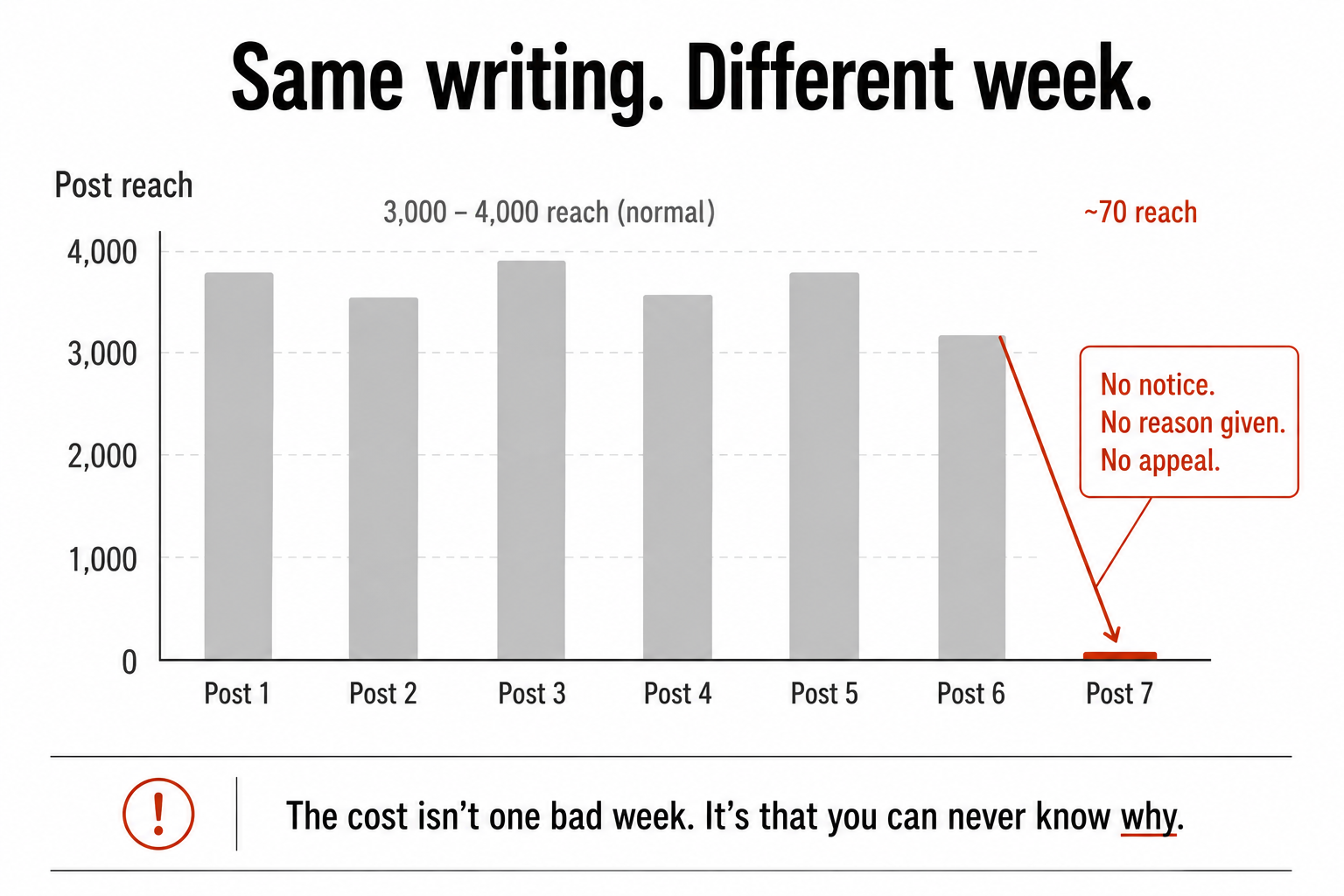
Here's what happened. One of my posts reached about seventy people. The posts before it had been reaching three to four thousand. Nothing about how I write had changed. The one thing that had changed, as far as I can tell, is that I'd used a dismissive nickname for a large tech company a few times in the comments. ("Microslop," if you want the word.) Did that cause my reach to fall off a cliff? I genuinely cannot tell you. And that, it turns out, is the entire point.
The problem isn't the suppression. It's the opacity.
Notice what I just had to write: as far as I can tell, I cannot tell you. I'm not even certain I was throttled. Maybe it was the word. Maybe the post simply didn't resonate. Maybe the algorithm shifted that week for reasons that have nothing to do with me. I can't know, because nobody will tell me.
There is no dashboard that says "reach reduced, reason: X." No notification. No appeal. No explanation. You are quietly shown to far fewer people, and left to reverse-engineer why from a sample size of your own paranoia. That is the actual cost, and it is much bigger than one bad week of numbers.
You cannot follow rules you cannot see. That's the real problem with building on someone else's platform. It isn't that the rules are strict. It's that they're invisible, they change without notice, and they apply without recourse. You're playing a game where the referee won't tell you the fouls, won't show you the replay, and won't hear your case. You can be the most careful player in the league and still get sent off for something you'll never get to understand.
This is rented land
Strip the emotion out of it and here's the structural truth: when you build your audience on a platform, you are building on land you rent from a company whose goals are not your goals.
The platform optimises for the platform. Your reach is a side effect of its priorities, and those priorities change every quarter, with the strategy deck you'll never see. One quarter it rewards one kind of post, the next quarter another. You adapt or you disappear, and you never get a vote. That's not a complaint about any single company. It's just what renting is. The landlord owns the building, and you live there on terms you didn't write and can't renegotiate.
This is the same logic I keep coming back to in e-commerce, where the difference between owning the customer relationship and renting it from a marketplace decides how fragile your business is. An audience you rent from a platform is exactly that fragile. It feels like yours right up to the morning it doesn't.
Why I'm oddly grateful this happened
Here's the part that surprised me: under the irritation, I felt something closer to relief. Because the whole reason I built my own site in the first place was to not be at the mercy of a week like this one.
On ground I own, no algorithm decides who gets to see my work. The piece you're reading lives on a domain I control, on infrastructure I control, indexed on the open web where it can be found and cited for years rather than buried in an afternoon. That open-web discoverability is the entire bet behind how I think about being found in the AI era: a platform feed is a river that carries your work past people once and is gone, while a page you own is a place people and machines can return to. And the relationship that matters, the people who actually want to read what I write, is one I can own directly rather than rent, through a channel no third party can throttle to seventy because of a word in a comment.
None of that is glamorous. It's a static site and a domain name. But nobody can change its terms overnight, and nobody has to explain anything to me, because there's nothing to explain. It does exactly what I tell it to.
The mistake isn't using the platform. It's depending on it.
I want to be careful here, because the lazy conclusion is "quit LinkedIn," and that would be wrong. Platforms are genuinely good at something my blog is bad at: putting work in front of people who have never heard of me. Reach, discovery, the chance encounter, that's what they're for, and that's real value.
The mistake is never the platform. It's making the platform the foundation instead of a channel.
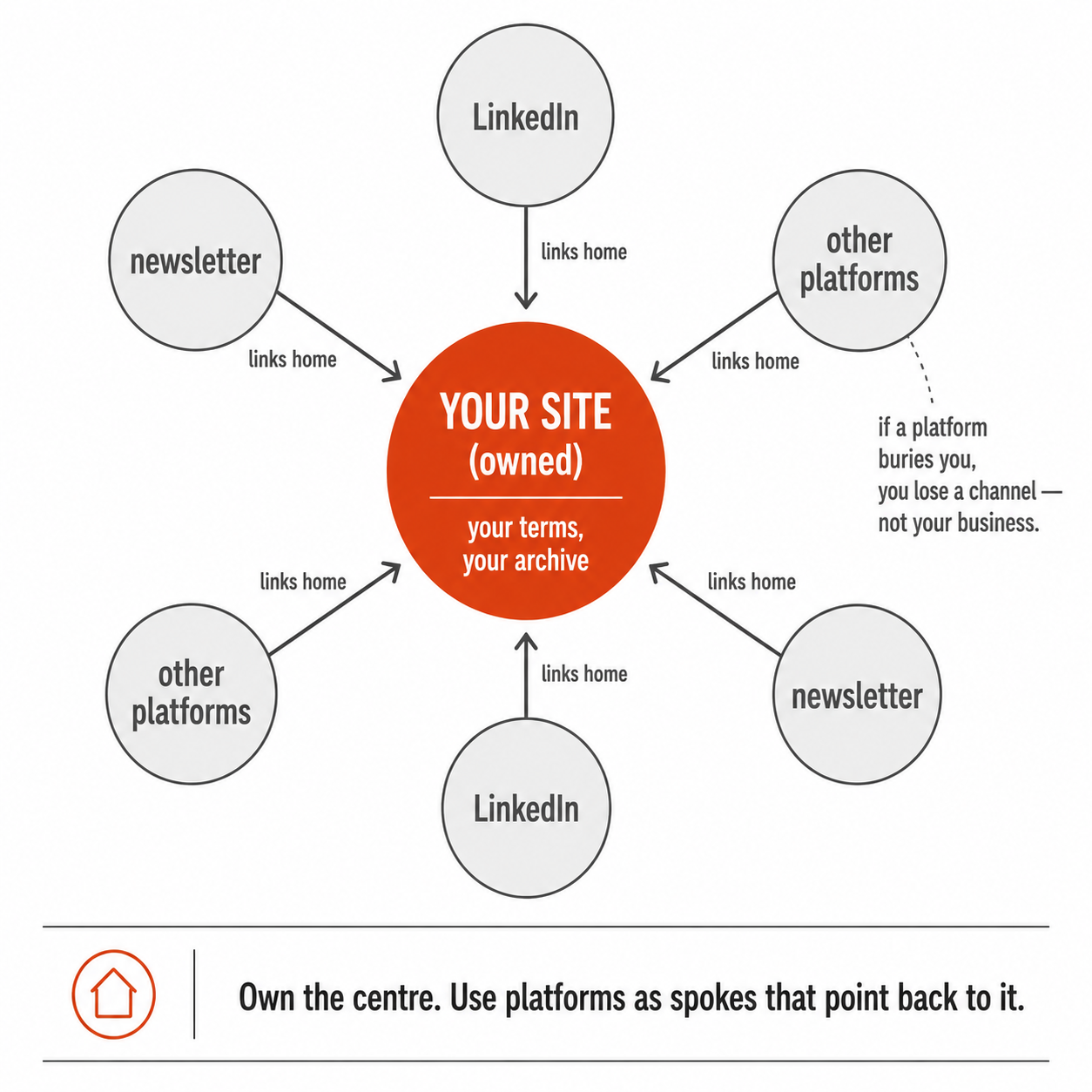
Get the architecture right and the whole problem shrinks. Own the centre, your site and a direct line to your audience, and use the platforms as spokes that point back to it. Publish on ground you own, then syndicate out with a link home. Do it that way and a bad reach week stops being a crisis. If a platform buries you, you lose a channel for a while. You don't lose your business, your archive, or your audience, because those were never living on rented land in the first place.
The lesson under the anger
I'm still annoyed, to be honest. Opacity is a frustrating thing to argue with, precisely because it won't argue back. But the useful version of the anger is the reminder, not the grievance.
A platform can bury your post overnight and never tell you why. It cannot touch the site you own. So build there first, put your best work on ground that's actually yours, and let the rented land do the one thing rented land is good for: sending people back to the place that belongs to you.
A few common questions
Should I stop posting on LinkedIn or other social platforms? No. That's the overcorrection. Platforms are excellent at discovery, putting your work in front of people who've never heard of you. The fix isn't to leave; it's to stop treating the platform as your foundation. Use it as a channel that points back to something you own.
My reach suddenly dropped. How do I find out why? Often, you can't, and that's the uncomfortable truth. Platforms rarely explain reach changes, there's usually no notification and no appeal, and the rules can shift without notice. The inability to know is exactly why depending entirely on a platform is a structural risk, not just an occasional annoyance.
What does "owning your platform" actually mean? Two things you control and no third party can switch off: a website on a domain you own (where no algorithm decides who sees your work), and a direct audience channel such as an email list (a relationship you own rather than rent). Together they're the centre; everything else is a spoke.
Is running your own blog really worth the effort? As the durable home, yes. Platforms come and go and change their rules; a site you own compounds quietly for years, gets found and cited on the open web, and never gets throttled because of something you can't see. It's the one piece of your presence that's genuinely yours.
You should also read:
Using AI in Real E-Commerce Work: Where It Earns Its Place and Where It Wastes Your Time
After actually using AI across real e-commerce work rather than reading about it, here is the honest summary: AI is genuinely transformative for a specific, narrow band of tasks, and a confident waste of time for a surprising number of others. The skill in 2026…
Continue reading...
Why Your Product Images Are Slowing Down Your Conversion Rate
The single biggest thing slowing down your online store is almost certainly the very thing you put there to sell the product: the images. On a typical e-commerce page, images make up more than half of everything the browser has to download, and unoptimised product…
Continue reading...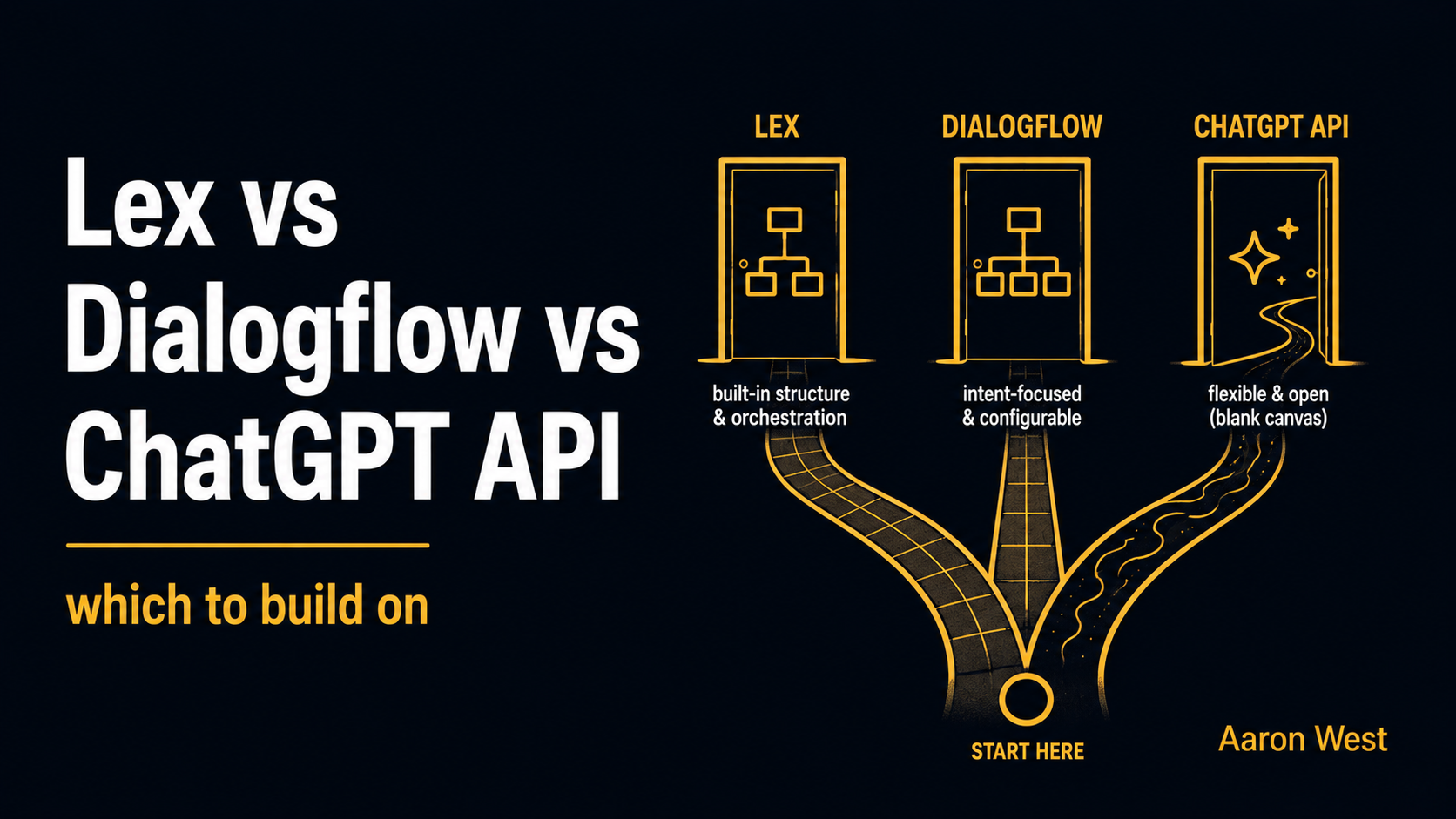
Amazon Lex vs Dialogflow vs the ChatGPT API: Which to Build On
The real choice when you build a chatbot in 2026 is not "which of these three platforms." It is a choice between two fundamentally different approaches, and the three options split cleanly across that line. Amazon Lex and Google Dialogflow are managed conversational-AI platforms: they…
Continue reading...