Amazon Lex vs Dialogflow vs the ChatGPT API: Which to Build On

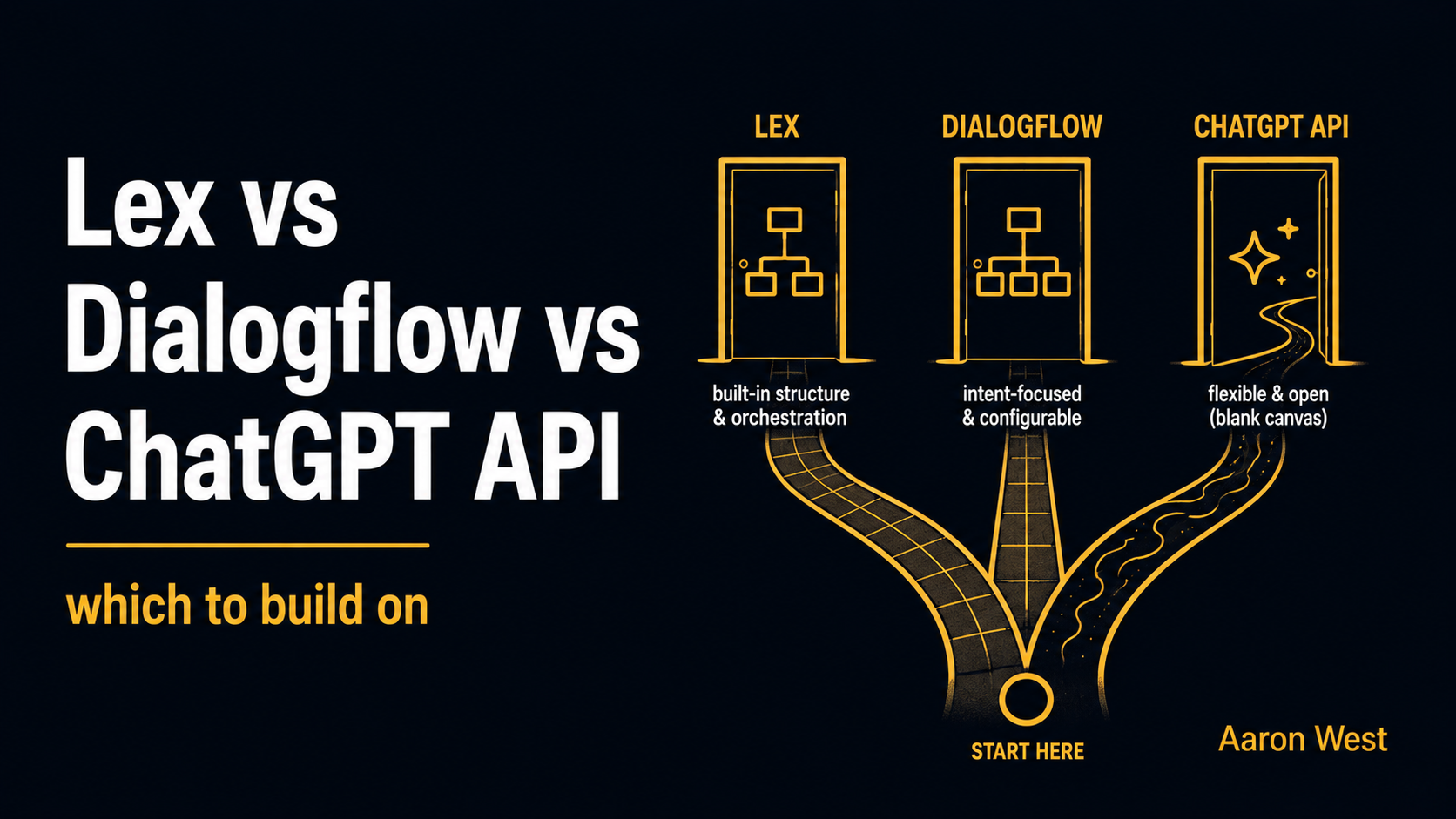
Table of Contents
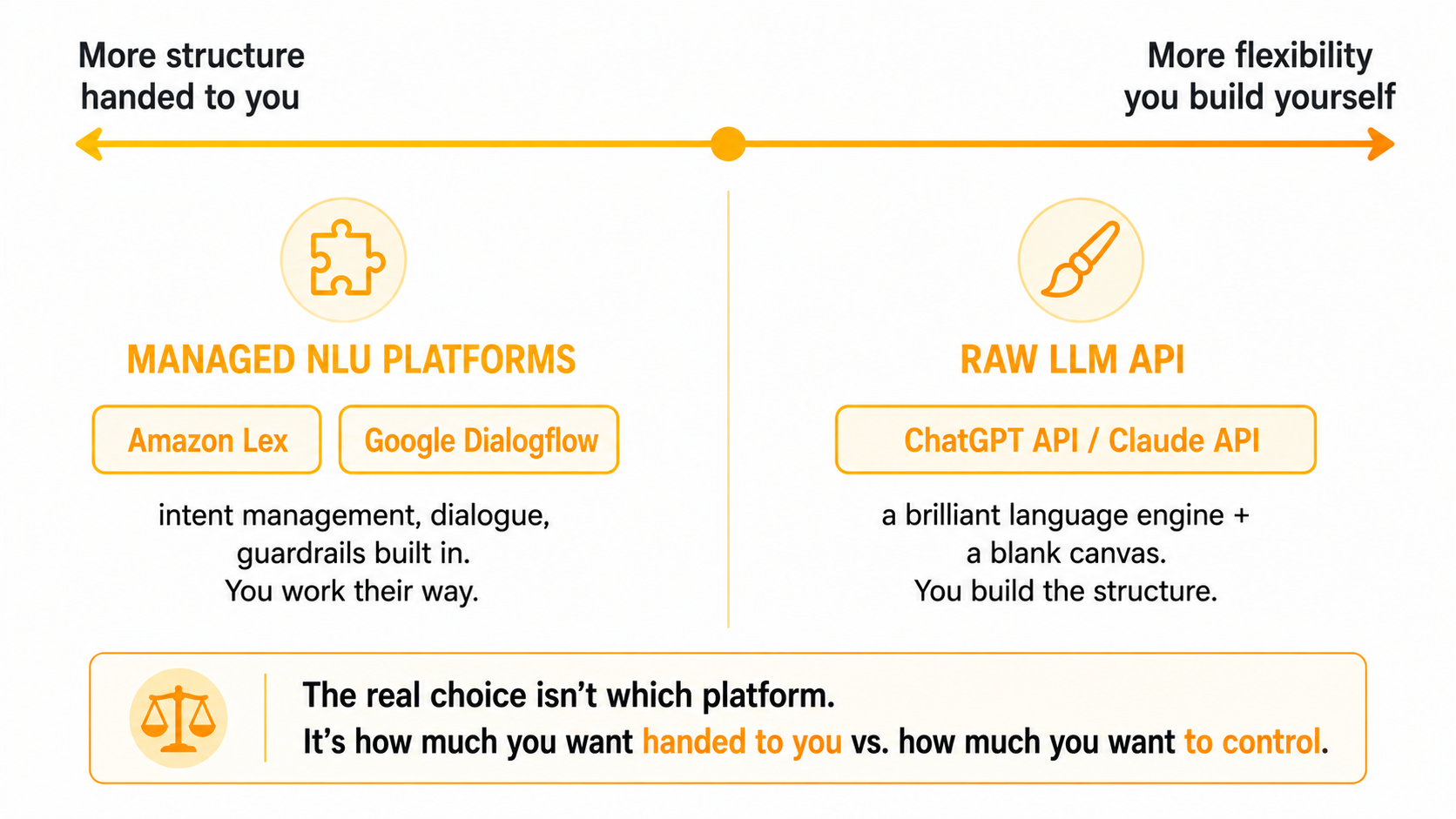
The real choice when you build a chatbot in 2026 is not "which of these three platforms." It is a choice between two fundamentally different approaches, and the three options split cleanly across that line. Amazon Lex and Google Dialogflow are managed conversational-AI platforms: they hand you structure, intent management, and guardrails out of the box. The ChatGPT API (and its peers like the Claude API) is a raw large language model: enormous flexibility, and almost none of the conversation scaffolding built in. Pick the wrong side of that line for your situation and you will either fight a rigid platform or rebuild scaffolding that a platform would have given you for free.
So this is not a feature-by-feature scorecard, those date instantly anyway. It is a decision guide built around the question that actually matters: how much structure do you want handed to you, versus how much flexibility and control do you want to build yourself? Here is how the three options sit, what each is genuinely good at, and how I would choose. (Prices and product details below are current as of mid-2026 and these platforms change constantly, so verify on the providers' own pages before committing.)
The two camps, and why the line matters
Start with the distinction, because everything else follows from it.
A managed NLU platform (Lex, Dialogflow) is built specifically for conversation. It gives you a structured way to define intents, manage a multi-turn dialogue, collect required information, and connect to backend systems, the scaffolding of a working bot, pre-built. You work within its model, which is its strength (you get a lot for free, and predictable behaviour) and its limit (you do things its way).
A raw LLM API (ChatGPT, Claude) gives you a brilliant language engine and a blank canvas. There is no built-in concept of an intent or a dialogue state, you build all of that yourself. In return you get flexibility a managed platform cannot match: the bot can handle almost any phrasing and generate genuinely natural responses without you scripting flows. The cost is that you are responsible for the structure, the guardrails, and stopping it confidently making things up.
This maps exactly onto the intent-based vs generative distinction at the heart of this cluster. Managed platforms grew up in the intent-based world (and are now bolting on generative features); the raw LLM API is the generative approach in its purest, least-structured form. The line between the camps is the same line, just expressed as a build decision.
Amazon Lex: the right call if you live in AWS
Amazon Lex is AWS's managed service for building text and voice bots, powered by the same technology line as Alexa. Its defining characteristic is that it is deeply, deliberately woven into the AWS ecosystem. It connects naturally to Lambda for your business logic, to Amazon Connect for call centres, and to the rest of the AWS stack, and it uses intents and slots (the structured "what does the user want, and what details do I need to collect" model) as its core.
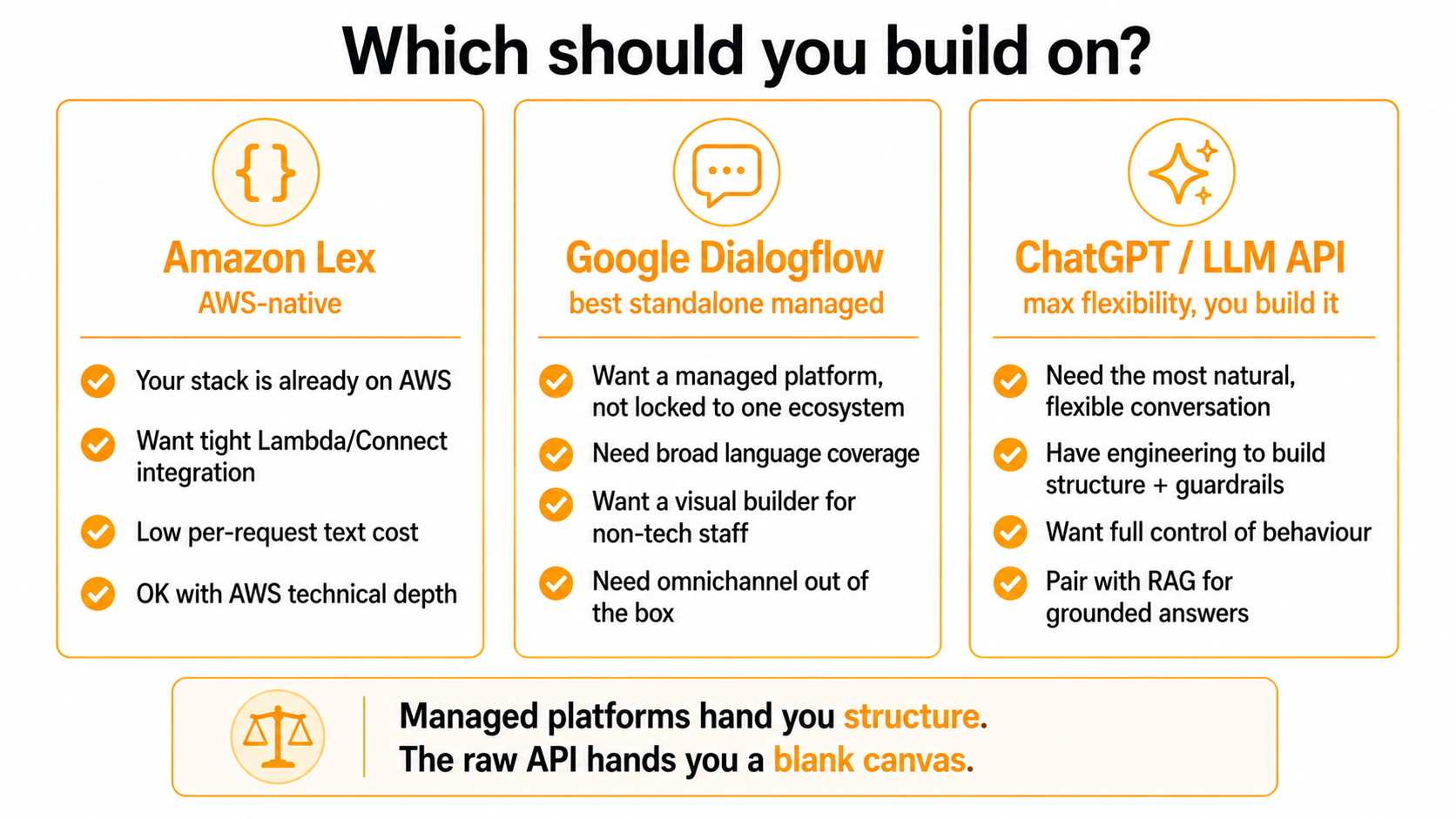
Lex is the right choice when your infrastructure already lives in AWS and you want a bot that slots into it cleanly. For an AWS-native team, the integration is a genuine advantage and the per-request text pricing is low (on the order of a fraction of a cent per text request as of mid-2026, verify current rates). The flip side is the mirror image: outside the AWS world, Lex is the most awkward of the three. Its native non-AWS channel support is limited, connecting it elsewhere means building custom webhook integrations, and getting real generative capability out of it generally means wiring in other AWS services like Bedrock. It also asks for more AWS technical knowledge than a non-technical team will comfortably have. Lex rewards commitment to AWS and punishes the lack of it.
Google Dialogflow: the most polished standalone platform
Google Dialogflow (recently rebranded toward "Conversational Agents," and now Gemini-powered) is the most mature and flexible of the managed platforms as a standalone product. It comes in two editions, and the split matters: a simpler edition for straightforward agents with a generous free tier for low volume, and a more advanced enterprise edition with a visual flow builder and "generative playbooks" that blend scripted structure with generative responses. It supports far more languages natively than Lex (dozens versus a handful) and connects to many deployment channels out of the box rather than requiring you to build them.
Dialogflow is the right call when you want a powerful managed platform without tying yourself to one cloud's whole ecosystem, when you need broad language coverage (relevant to anyone building genuinely multilingual bots), or when you want a visual builder that less-technical team members can work in. The trade-offs: the advanced edition's per-request pricing is meaningfully higher than Lex's text pricing (several times higher, last I checked, so model your real volume), and as with any managed platform you are still working within Google's model and Google's cloud gravity. For most teams building a serious standalone bot, though, Dialogflow is the most balanced managed option.
The ChatGPT API (and Claude): power and a blank canvas
Building directly on a raw LLM API is the newest option and, increasingly, the most capable one for natural conversation, with a catch worth taking seriously. What you get is a language engine that understands messy input and generates genuinely natural, flexible responses with no flow-scripting at all. No fighting a rigid intent model when a user phrases something unexpectedly. For sheer conversational quality and adaptability, nothing a managed platform offers matches a current frontier model used well.
What you do not get is everything else. There is no built-in dialogue management, no native intent structure, no guardrails, no out-of-the-box channel connectors. You build all of that, and critically, you are on the hook for keeping the model from hallucinating, which on a customer-facing channel means grounding it in your real data with retrieval and adding your own guardrails. The pricing model is different too, you pay per token of input and output rather than per request, which can be cheaper or much more expensive depending on how long your conversations run, so it needs real modelling against your expected usage.
So the raw API is the right call when conversational quality and flexibility matter most, when you have the engineering capacity to build (and maintain) the scaffolding a managed platform would have provided, and when you want full control over the bot's behaviour. It is the wrong call if you want a working bot quickly with structure handed to you, that is exactly what the managed platforms are for.
How I would actually choose
Strip it to a short decision path. First, are you committed to AWS? If your infrastructure lives there and you want a bot that integrates cleanly, Lex is the path of least resistance, and trying to force a more "neutral" option would mean giving up the integration that is its whole advantage.
If you are not AWS-bound and you want a capable managed platform, structure handed to you, a visual builder, broad language support, without building scaffolding from scratch, Dialogflow is the strongest balanced choice. For a lot of teams this is the sensible default.
Go to the raw LLM API when conversational quality and flexibility are the priority and you have the engineering to build and maintain the structure yourself, ideally grounding it in your own data so it stays accurate. And note the genuinely modern pattern: it is increasingly common to combine them, using a managed platform or your own deterministic rules for the structured, high-stakes parts and an LLM for the natural-language understanding and generation, which is the hybrid architecture this cluster keeps coming back to.
The honest meta-point: do not over-index on today's feature and price tables, because they change every quarter, and the platforms are all racing to copy each other's best ideas (the managed platforms are adding generative features; the model providers are adding structure and tooling). Choose on the durable question, how much structure do you want handed to you versus how much do you want to build, because that fits your team and your situation in a way a pricing table never will. Get that right and any of the three can produce a bot that works. Get it wrong and the best platform on paper will be the one you are fighting every day.
A few common questions
Should I use Amazon Lex, Dialogflow, or the ChatGPT API for my chatbot? It depends on how much structure you want handed to you. Choose Lex if your infrastructure is on AWS and you want tight integration. Choose Dialogflow for the strongest standalone managed platform with broad language support and a visual builder. Choose a raw LLM API (ChatGPT, Claude) when conversational flexibility matters most and you have the engineering to build the structure and guardrails yourself.
What's the difference between a managed platform and using an LLM API directly? A managed platform (Lex, Dialogflow) gives you conversation scaffolding, intent management, dialogue state, guardrails, out of the box, so you work within its model. A raw LLM API gives you a flexible language engine and a blank canvas: more natural conversation and full control, but you build the structure and prevent hallucination yourself.
Is Dialogflow or Lex cheaper? As of mid-2026, Lex's per-text-request pricing is lower than Dialogflow's advanced edition, while Dialogflow's simpler edition has a generous free tier for low volume. But pricing models differ and change often, and the LLM APIs charge per token rather than per request, so model your real expected usage against current published rates before deciding.
Can I combine a managed platform with an LLM? Yes, and it's increasingly the standard approach. Use deterministic rules or a managed platform for the structured, high-stakes parts (eligibility, verification, actions) and an LLM for understanding messy input and generating natural replies. This hybrid gets you reliability where you need it and flexibility where you want it.
You should also read:
Retail Media and Amazon Ads: Advertising Where People Are Already Buying
Retail media is advertising placed on a retailer's own digital shelf, right where people are already shopping and ready to buy. Its strength is obvious: you reach shoppers at the moment of purchase, with the retailer's real purchase data behind both the targeting and the…
Continue reading...
Don't Build Your Audience on Rented Land
If your audience lives entirely on a platform you don't own, you don't have an audience. You have a lease, and the landlord can change the terms overnight, without warning and without explanation. I was reminded of this last week in the bluntest possible way,…
Continue reading...
Everything I Know About Building Chatbots That Actually Work
The hard part of building a chatbot was never the technology. I learned this in 2019, building a natural-language chatbot from scratch for a large hotel group, across dozens of locations and several languages, back when "conversational AI" was a research term and not a…
Continue reading...