The Multilingual Chatbot Problem Nobody Warns You About

Table of Contents
Here is the trap almost every multilingual chatbot project falls into: treating "support more languages" as a translation task. You build the bot in one language, get it working, then hand the whole thing to a translation step and assume you are done. You are not done. You have built one good chatbot and a set of grammatically correct copies that answer the wrong questions. I learned this building a chatbot across several languages for a hotel group, and it is the single most underestimated part of conversational AI.
The reason it catches people out is that translation is the visible part of the problem, so it looks like the whole problem. And in 2026, translation is genuinely close to solved, modern language models handle word-for-word conversion between major languages remarkably well. Which is exactly why this matters more now, not less. With translation handled, what is left is everything that was never a translation problem in the first place, and that is the part nobody warns you about. Let me walk through what it actually is.
People in different languages ask different questions
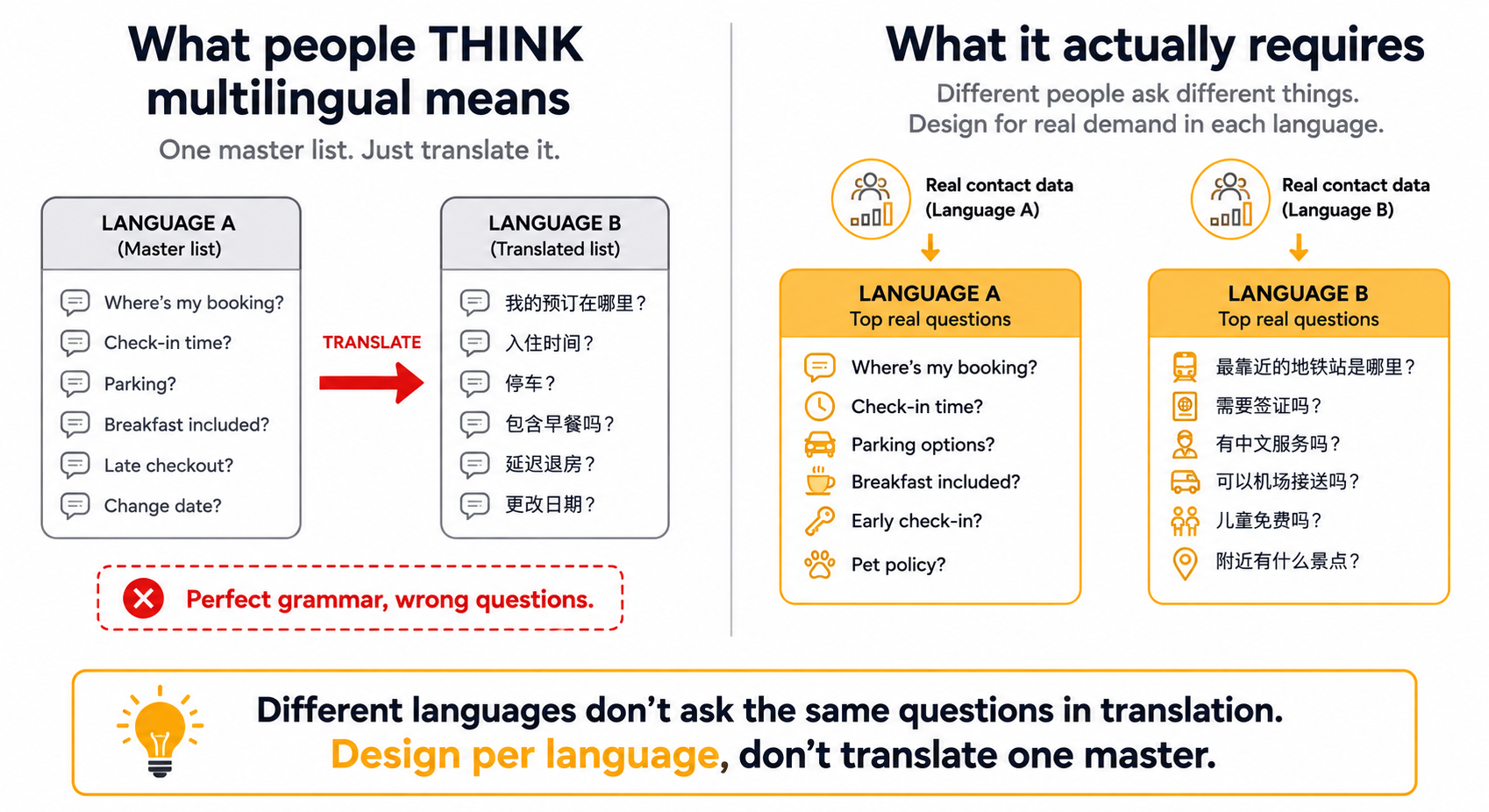
The deepest issue is not how things are said. It is what gets asked at all. Speakers of different languages, in different markets, do not ask the same questions in translation. They ask genuinely different questions, shaped by different assumptions about how the service works, different concerns, different defaults.
A concrete version from the hotel work: guests from one market would routinely ask about one set of things, parking, arrival logistics, particular payment methods, while guests from another market barely mentioned those and instead asked about things the first group took for granted. The questions were not translations of each other. They reflected what each group actually worried about and what each assumed was already obvious. If you build your intent set in one language and translate it, you get perfect coverage of the first group's concerns and blind spots exactly where the second group's real questions live. The bot understands flawlessly translated versions of questions nobody in that language is actually asking, and misses the ones they are.
This is why the right mental model is not "translate the bot" but "design the bot for each language's real usage." You go back to the same starting point the cornerstone insists on, find out what people actually ask, except you do it per language, against each market's real contact data. The questions that make up the high-frequency head are not the same head in every language. Miss that, and no amount of translation quality saves you, because you are translating the wrong things beautifully.
The same words carry different weight
Even where the questions overlap, how you answer is not a translation either. Tone, formality, and directness do not map one-to-one across languages, and getting this wrong makes a technically correct bot feel subtly wrong to the person reading it.
I think about this constantly because I work across German, English, and Arabic, and they simply carry politeness and directness differently. German service language has a formal and an informal register, and choosing the wrong one is not a small slip, it changes the entire relationship the bot is signalling. A cheerfully informal tone that works perfectly in one language can read as presumptuous or unprofessional translated literally into another, and a formal tone that signals respect in one can feel cold and distant in another. The words can be a flawless translation and the message still lands wrong, because the politeness, the register, the directness did not come along with the words.
This is what people mean when they say localization rather than translation, and it is more than a slogan. It means each language's version of the bot needs a tone deliberately chosen for that language's norms, not inherited from whichever language you happened to build first. The current best practice says the same thing in colder terms, adapt the bot's persona and communication style to each culture, do not run one personality through a translator. I would put it more simply: a translated bot speaks your language. A localized bot speaks like someone from your reader's world. Only the second one earns trust.
The messy realities: mixing, dialects, and the long tail
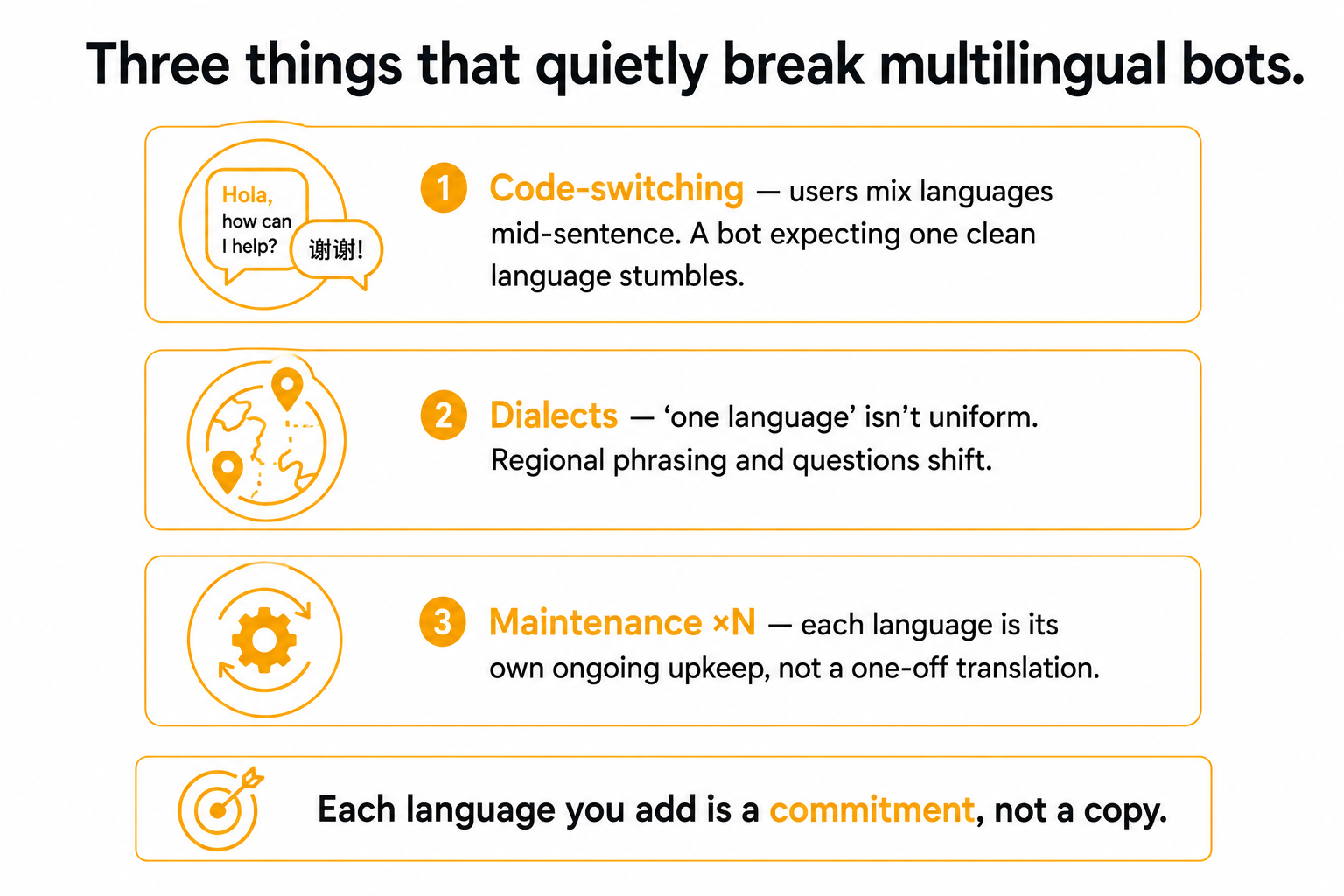
Three practical problems compound all of this, and they are the ones that quietly break bots in production.
First, people mix languages mid-sentence. Code-switching, dropping an English word into a German sentence, or flipping between languages within one conversation, is completely normal for multilingual users, and a bot built to expect one clean language per message stumbles on it. If you serve genuinely multilingual users, you have to decide deliberately whether to handle mixed input, and test for it, because it will happen whether you planned for it or not.
Second, dialects and regional variation are real and they matter. "The same language" is not uniform. The phrasing, vocabulary, and even the questions shift across regions that nominally share a language, and a bot trained only on one standard variety degrades for everyone outside it. Arabic is the extreme example I know well, the gap between formal written Arabic and the spoken dialects of different countries is wide enough that treating them as one thing guarantees you will misunderstand real users.
Third, every one of these problems multiplies your maintenance, not just your build. This is the part that wrecks timelines. Each language is not a one-off translation cost, it is an ongoing commitment, its own intent set to refine, its own logs to review, its own "not understood" queries to learn from, its own tone to keep consistent as the bot evolves. Three languages is not one bot's worth of upkeep. It is closer to three. Budgeting for the build and forgetting the maintenance is how multilingual bots slowly rot in the languages nobody on the core team speaks.
What modern AI fixed, and what it didn't
It is worth being precise about how 2026 changes this, because the temptation is to assume the latest models make the whole problem disappear. They do not, but they genuinely help with one layer of it.
What modern language models fixed: the raw mechanics. Understanding messy input across languages, generating fluent natural responses rather than stilted machine translation, even handling some dialect and mixed input far better than the systems I worked with years ago. The "the translation sounds robotic" problem that plagued early multilingual bots is largely behind us. That is real progress and it removes a category of pain.
What they did not fix, and cannot, because it was never a language problem: knowing what each market actually asks, choosing the right tone for each culture, deciding how to handle code-switching, and committing to maintain every language properly. Those are product and design and operational decisions, and a more fluent model makes the output smoother without making any of those decisions for you. In fact, fluency raises the stakes, because a bot that now sounds perfectly natural while answering the wrong question, or in the wrong register, is more convincing and therefore more quietly damaging than an obviously clunky one. The better the translation gets, the more the real multilingual problem is exposed as what it always was, a localization and design problem wearing a translation costume.
So if you take one thing from this: when you plan a multilingual chatbot, budget for multiple designs, not one design and a translator. Go to each language's real users and real questions. Choose each language's tone on purpose. Plan for mixing and dialects. And commit to the maintenance of every language you launch, or do not launch it. Translation was always the easy part. The hard part is everything translation was hiding, and it is still there waiting, more exposed than ever now that the easy part is solved.
A few common questions
Why isn't a multilingual chatbot just a translation problem? Because the hardest parts were never about language conversion. Different markets ask genuinely different questions, expect different tones and levels of formality, mix languages, and use regional dialects. Translating one master bot gives you grammatically correct coverage of the wrong questions in the wrong tone. The real work is designing for each language's actual usage.
Do modern AI models solve multilingual chatbots? They solve the mechanics, understanding messy input and generating fluent, natural responses, which is real progress. They do not solve knowing what each market asks, choosing the right cultural tone, handling code-switching, or maintaining each language. Better fluency can even raise the stakes, because a wrong answer now sounds perfectly natural.
What is the difference between translation and localization for chatbots? Translation converts words from one language to another. Localization adapts the whole experience, the questions handled, the tone and formality, cultural references, and communication style, to each language's real-world norms. A translated bot speaks your language; a localized bot speaks like someone from your reader's world.
What's the most overlooked cost of a multilingual chatbot? Maintenance. Each language is not a one-off translation but an ongoing commitment: its own intent set, its own logs to review, its own unhandled queries to learn from, its own tone to keep consistent. Three languages is closer to three bots' worth of upkeep than one. Budget for it or don't launch the language.
You should also read:
The Down-Sell Nobody Offers (and Why It Saves the Sale)
Almost every online store has an upsell. Almost none have a down-sell. We pour energy into getting customers to spend more, the upgrade, the add-on, the bundle, and we completely ignore the move that saves the sale when a customer is about to spend nothing.
Continue reading...
Why Most Chatbot Projects Fail Before a Single Line of Code
Most chatbot projects are lost before anyone opens a tool. By the time the building starts, the decisions that decide success or failure, what the bot is for, what it will handle, how it will be measured, who will maintain it, have usually already been…
Continue reading...
Everything I Know About Building Chatbots That Actually Work
The hard part of building a chatbot was never the technology. I learned this in 2019, building a natural-language chatbot from scratch for a large hotel group, across dozens of locations and several languages, back when "conversational AI" was a research term and not a…
Continue reading...