Why Most Chatbot Projects Fail Before a Single Line of Code

Table of Contents
Most chatbot projects are lost before anyone opens a tool. By the time the building starts, the decisions that decide success or failure, what the bot is for, what it will handle, how it will be measured, who will maintain it, have usually already been made badly, or not made at all. The technology then gets blamed for a failure that was baked in at the planning stage. The numbers bear this out: industry analysts put the share of chatbot projects that miss their original goals at well over half, and the consistent finding is that the cause is strategic, not technological.
I find this oddly reassuring, because it means the failures are predictable, and predictable means preventable. Having built a chatbot from scratch for a hotel group, and watched plenty of other projects up close, I can tell you the fatal mistakes cluster into a handful of pre-build decisions. None of them are about the model. All of them happen before a single line of code. Here are the ones that kill projects, and how to not make them.
Failure 1: building a chatbot to "have a chatbot"
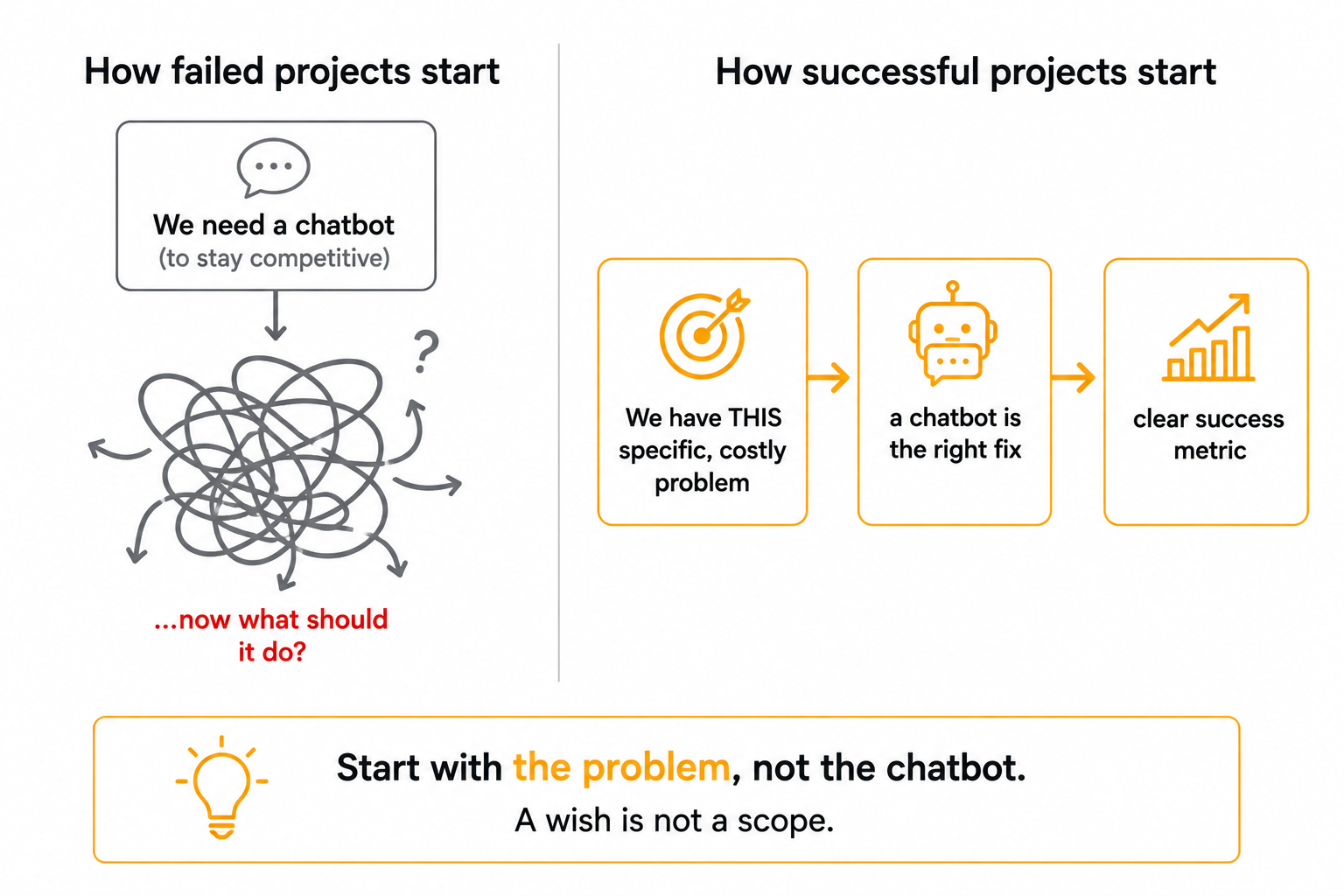
The most common root cause is the vaguest. A team decides it needs a chatbot to stay competitive, or because a competitor launched one, or because leadership read an article. The goal is "have a chatbot," not "solve this specific, painful, measurable problem." And a project with no precise problem to solve cannot succeed, because there is no definition of success to hit.
This sounds obvious, but it is the single most documented reason these projects fail. The teams that succeed start the other way around: they name a real, costly, specific pain, this exact set of repetitive questions is eating our support team's time, this particular drop-off is losing us sales, and then ask whether a chatbot is the right fix. The bot is the answer to a defined question, not a thing you acquire and then look for uses for.
The test I would apply before approving any chatbot project: can you state, in one sentence, the specific problem it solves and the number that will move if it works? "Reduce the time our team spends answering the same booking questions" is a real answer. "Improve customer experience with AI" is not an answer, it is a wish, and wishes do not survive contact with a real user. If you cannot fill in that sentence, you are not ready to build, and no amount of clever technology will rescue you from not knowing what you are building for.
Failure 2: no honest scope, so it tries to do everything
The second killer follows from the first. With no specific problem, the bot's scope balloons to "answer anything a customer might ask." That ambition guarantees a bot that does a hundred things poorly instead of ten things well, and users abandon a bot that is vaguely unhelpful far faster than they forgive one that is narrow but reliable.
The cornerstone of how I think about chatbots is built on this point, so I will keep it short here: real success comes from scoping the bot to the high-frequency questions that make up most of your actual contact, handling those brilliantly, and cleanly handing off everything else. The pre-build failure is not drawing that line. Teams treat "what should the bot handle?" as a question to answer later, during build, by whoever is wiring it up. By then it is too late. Scope is a strategic decision made from real contact data before you build, or it is a mess discovered after you ship.
A related trap hides inside this one: the thin knowledge base. A bot scoped to answer questions it has not actually been given good answers to will produce vague, useless replies, and users bail within seconds. Deciding what the bot covers and ensuring it genuinely has the content to cover it well are the same pre-build job. Skip it and you ship a confident bot with nothing real behind it.
Failure 3: no plan for the handoff and the uncertainty
Here is the failure that turns a merely disappointing bot into an actively harmful one. Every bot hits questions beyond its scope, and questions it is not sure about. If there is no plan for those moments, the bot does the worst possible thing: it traps the user in a loop, or answers confidently and wrongly, and the customer leaves angrier than if the bot had never existed.
This is not a build-time detail. It is a pre-build decision about what happens at the edges, and it is exactly where the hallucination problem does its damage on a customer-facing channel. You have to decide, before building, how the bot behaves when it is unsure (ask, clarify, admit it) and how it escalates to a human when it should (quickly, with context attached, not as a dead end). Projects that treat escalation as an afterthought ship bots that fail loudly at precisely the moments that matter most, when a real customer has a real problem the bot cannot solve.
And this connects to the failure most teams never see coming.
Failure 4: the bot that multiplies work instead of reducing it
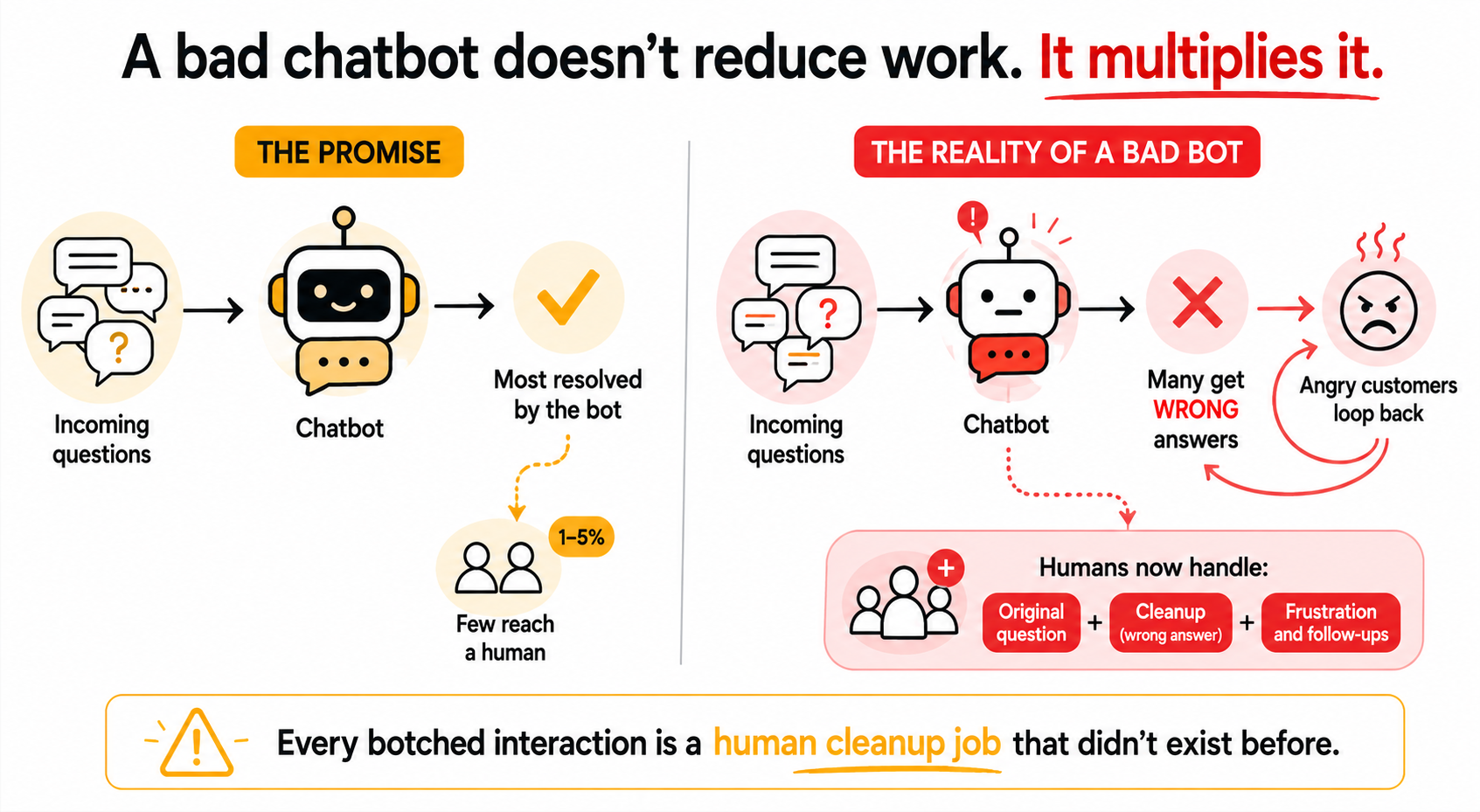
The whole justification for a chatbot is usually that it will reduce the team's workload. Done badly, it does the exact opposite, and this is the counter-intuitive failure worth burning into memory. A bad bot does not quietly handle nothing. It actively creates work. Customers get wrong answers and come back angrier, so agents now spend time both undoing the bot's mistakes and answering the original question. Conversations the bot mishandles still land on a human, except now pre-soured. The workload does not decrease. It shifts, and grows, because every botched bot interaction is a human cleanup job that did not exist before.
I have seen this dynamic up close, and it is brutal precisely because it is invisible in the project plan. On paper the bot is "handling" thousands of conversations. In reality it is generating a second queue of frustrated customers and cleanup work, while leadership counts the handled conversations as a win. Which is the perfect setup for the last failure.
Failure 5: no definition of success, so nobody can steer
The last pre-build failure is measuring the wrong thing, or nothing. Teams that never defined the problem also never defined success, so they fall back on vanity metrics: conversations handled, messages sent. These numbers feel like progress and tell you nothing. A bot can "handle" thousands of conversations and be terrible if most of them end with an unsatisfied customer.
The metrics that actually matter are decided before launch and tell you whether the bot is doing its job: resolution rate (how many conversations it genuinely resolves without a human), customer satisfaction, abandonment rate (how many people give up mid-conversation, which is your quality red flag), and escalation rate (and whether it is escalating when it should). Without these defined up front, you have no way to tell a working bot from a failing one, no way to improve it, and no way to defend it when someone asks whether it was worth the money. And that ties to the quiet failure underneath all five: nobody is assigned to own and improve the bot after launch. A chatbot is not a project you finish. It is a system you run, learning from its logs, fixing what it gets wrong, keeping its content current. Ship it and walk away, and it decays into exactly the useless bot everyone warned about.
So before you build anything, answer these, honestly: what specific, costly problem does this solve, and what number moves if it works? What is the narrow set of things it will handle brilliantly, and does it have real content behind them? What happens when it is unsure or out of its depth? And who owns it after launch? Get those right and the build is almost an implementation detail. Get them wrong and the most sophisticated model on the market will fail confidently, on schedule, for entirely predictable reasons. The technology was never the hard part. The honesty before the build is.
A few common questions
Why do most chatbot projects fail? Not because of the technology. Industry analysts put the failure rate above half, and the consistent cause is strategic: building a bot to "have a chatbot" rather than to solve a defined problem, never scoping it honestly, having no plan for uncertainty and escalation, and never defining what success means. These are pre-build decisions, made badly or skipped entirely.
What should you decide before building a chatbot? Four things, before any tool: the specific, costly problem it solves and the metric that proves it works; the narrow set of questions it will handle brilliantly (with real content behind them); how it behaves when unsure and how it escalates to a human; and who owns and improves it after launch.
How can a chatbot make customer service worse? By multiplying work instead of reducing it. A bad bot gives wrong answers, so customers come back angrier and agents spend time both fixing the bot's mistakes and answering the original question. Mishandled conversations still reach a human, now pre-soured. The workload doesn't drop, it shifts and grows.
What metrics actually measure chatbot success? Resolution rate (conversations genuinely resolved without a human), customer satisfaction, abandonment rate (people giving up mid-conversation, a key quality red flag), and escalation rate. Avoid vanity metrics like "conversations handled" or "messages sent," which feel like progress but say nothing about whether the bot is helping.
You should also read:
The Multilingual Chatbot Problem Nobody Warns You About
Here is the trap almost every multilingual chatbot project falls into: treating "support more languages" as a translation task. You build the bot in one language, get it working, then hand the whole thing to a translation step and assume you are done. You are…
Continue reading...
Everything I Know About Building Chatbots That Actually Work
The hard part of building a chatbot was never the technology. I learned this in 2019, building a natural-language chatbot from scratch for a large hotel group, across dozens of locations and several languages, back when "conversational AI" was a research term and not a…
Continue reading...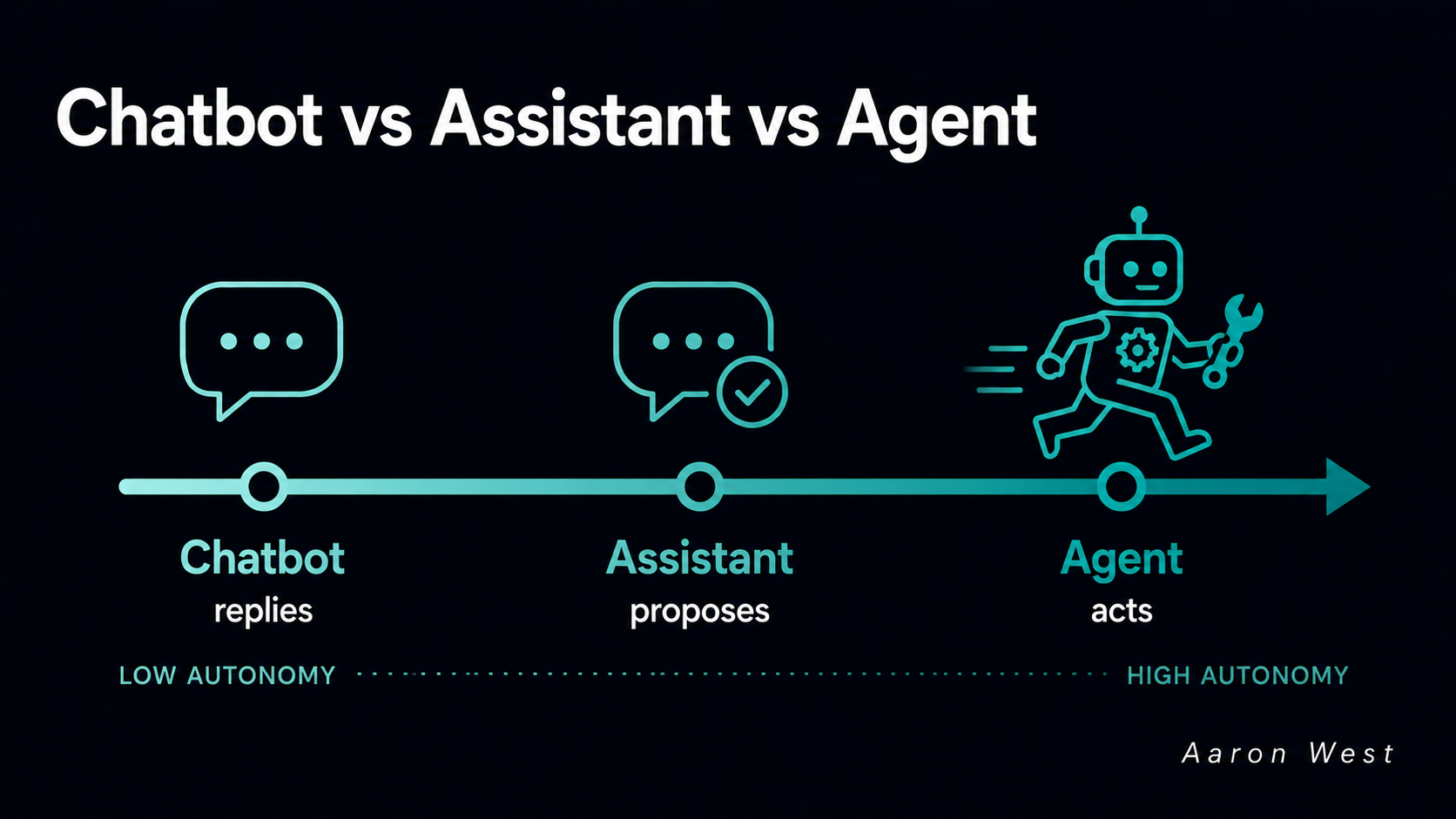
What Is an AI Agent? The Difference Between a Chatbot, an Assistant, and an Agent
An AI agent is a system that takes a goal, breaks it into steps, uses tools to carry those steps out, and decides on its own what to do next based on what just happened. That last part is the whole difference. A chatbot answers…
Continue reading...