What Is an AI Agent? The Difference Between a Chatbot, an Assistant, and an Agent

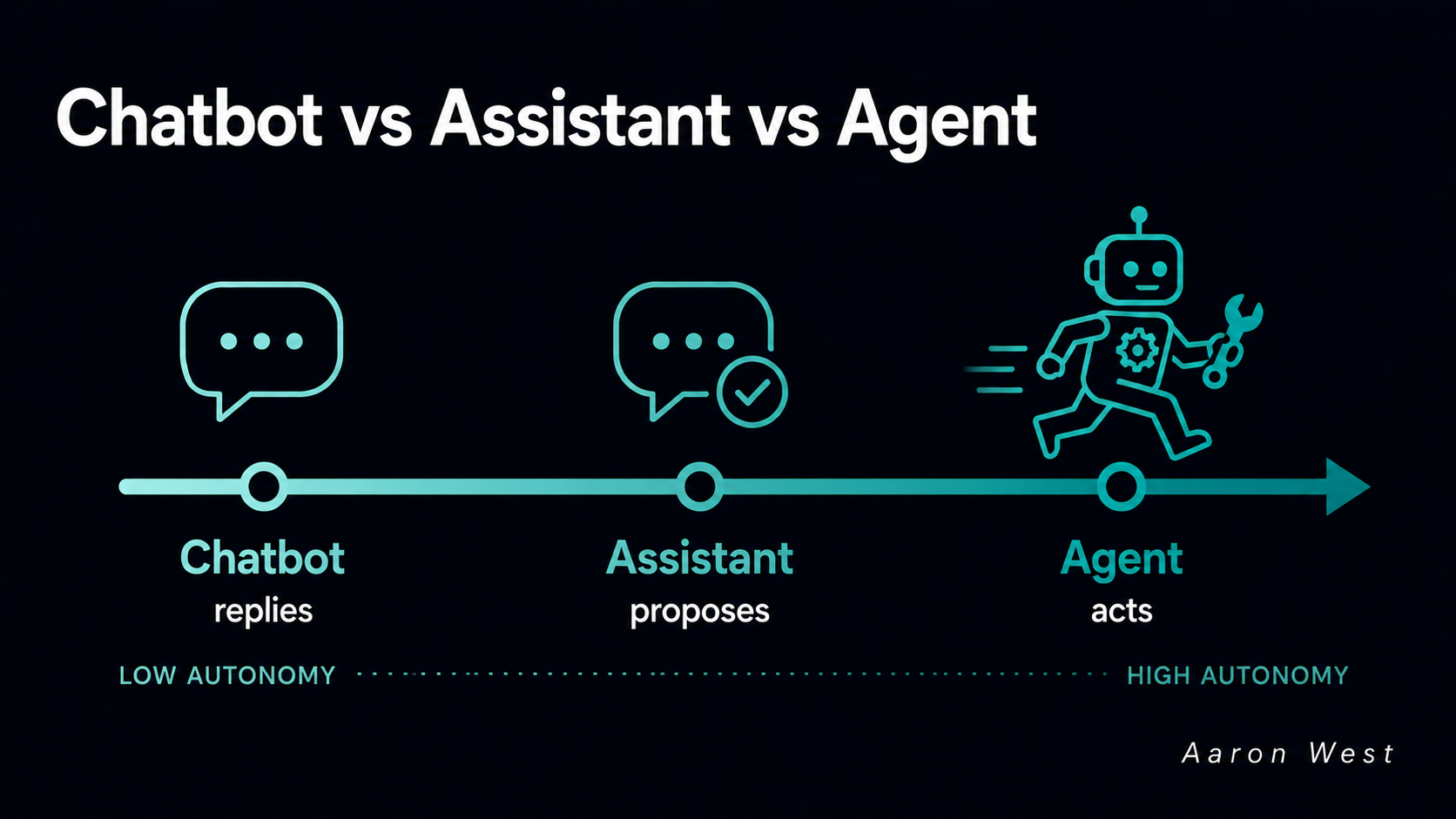
Table of Contents
An AI agent is a system that takes a goal, breaks it into steps, uses tools to carry those steps out, and decides on its own what to do next based on what just happened. That last part is the whole difference. A chatbot answers your question and waits. An agent is handed an objective and works toward it, acting in the world rather than just talking about it.
These words get used interchangeably in marketing, and the result is genuine confusion. "Chatbot," "assistant," "copilot," "agent," "agentic AI" all get sprayed across product pages as if they mean the same thing. They do not, and the difference matters, because it determines what the thing can actually do for you and how much you should trust it to act unsupervised. So here is the plain-language version, with no hype, that explains what each one really is and where the lines sit.
The one axis that separates them: autonomy
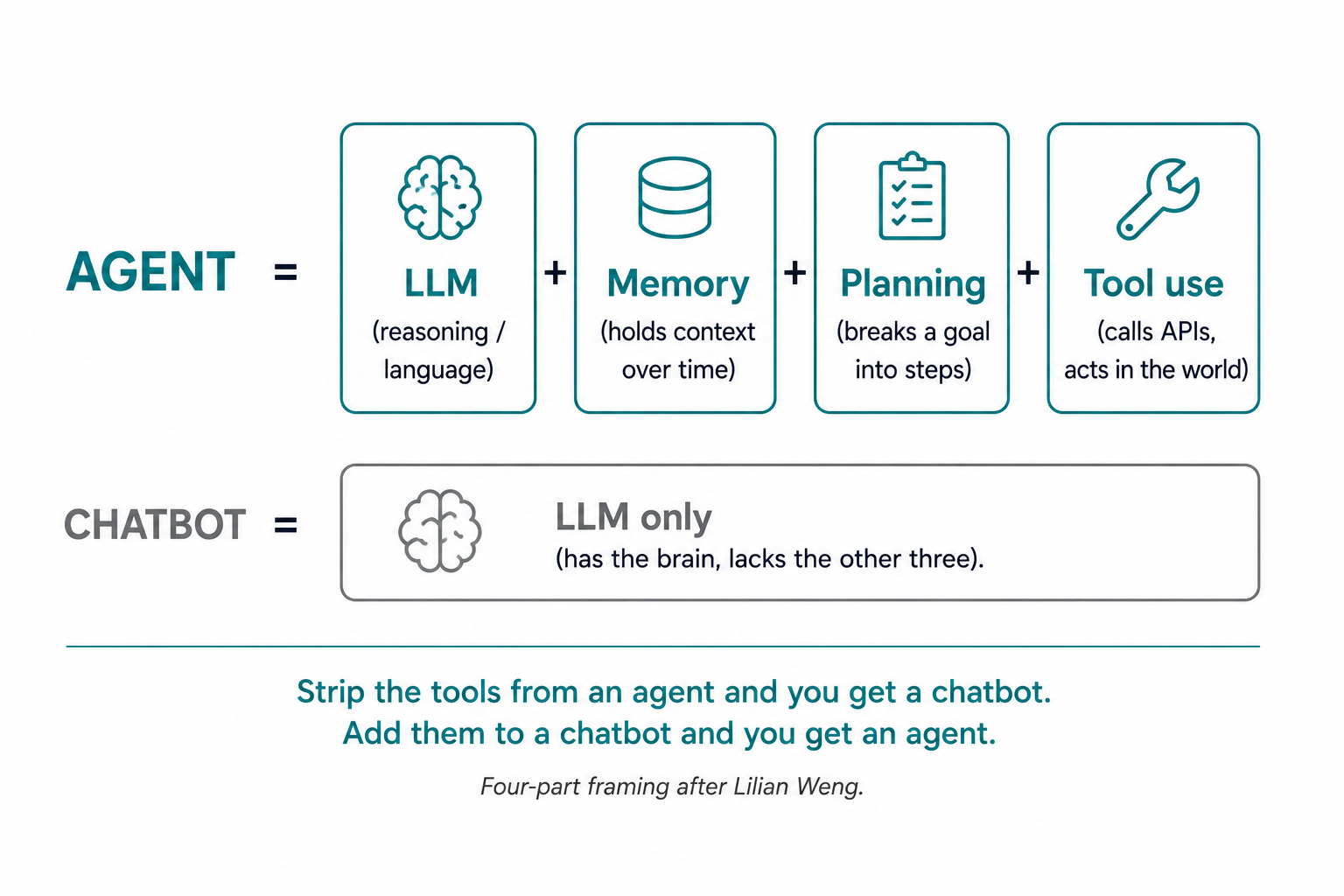
Forget the labels for a moment, because the cleanest way to understand all of this is a single spectrum: how much the system decides and does on its own. Everything else is a point on that line.
A chatbot answers a question and waits for your next message. It replies. It does not act.
An assistant or copilot goes a step further: it suggests an action, or drafts something for you, then waits for you to approve or use it. It proposes. You decide.
An agent is handed a goal and decides for itself what to do next, taking real actions through tools, until the job is done or it hits a point where it needs to stop or escalate. It acts.
That progression, replies, then proposes, then acts, is the entire concept. When you read about "agentic AI," all that word means is a system sitting at the acting end of the spectrum: one that plans, decides, uses tools, and adapts toward a goal without you directing every step. And it is genuinely a spectrum, not a switch. Most real systems sit somewhere in the middle, with some autonomy on some tasks and a human gate on others.
The formula that makes it click: Agent = LLM + memory + planning + tool use
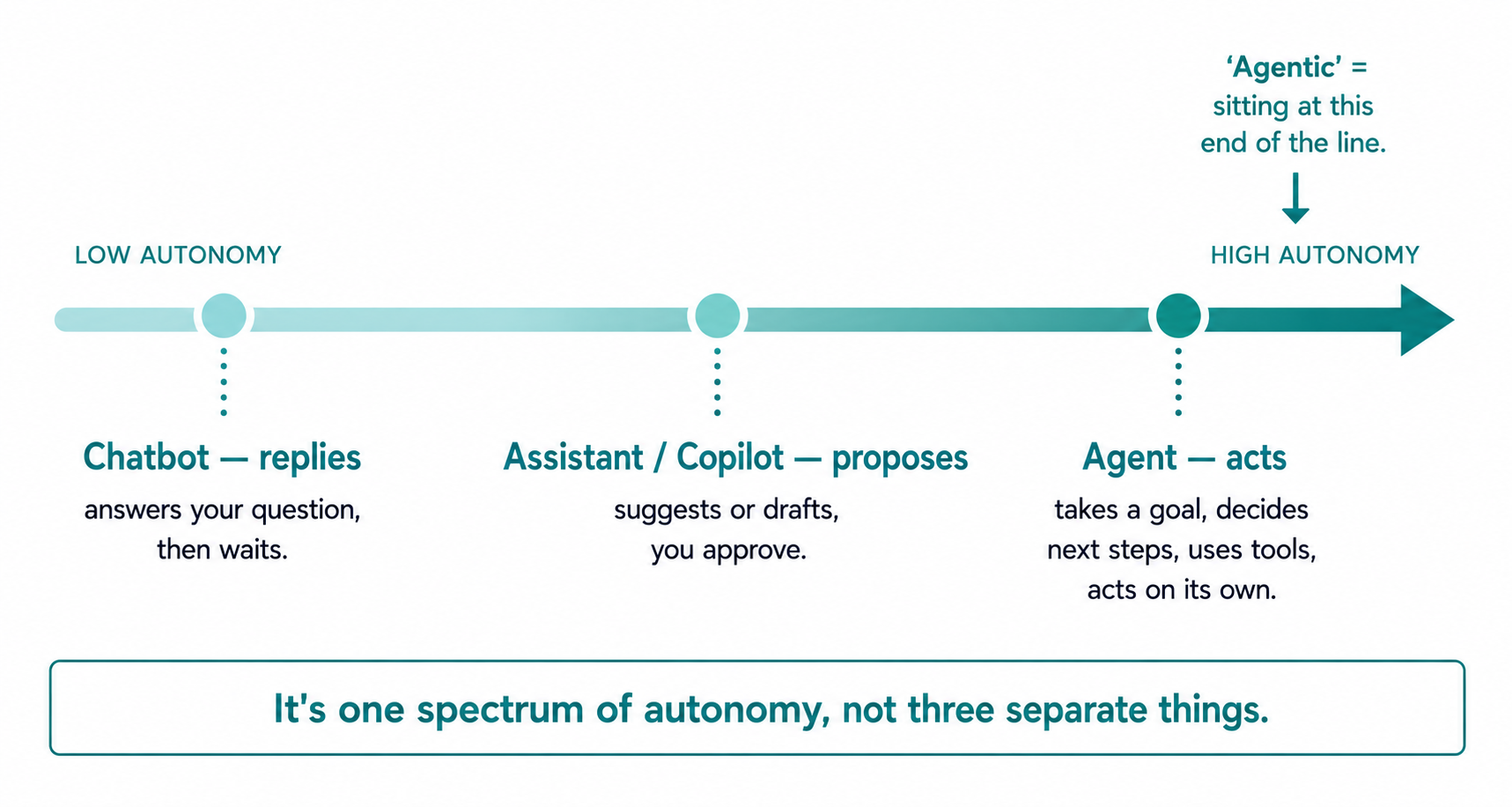
There is a well-known definition in the AI field, from researcher Lilian Weng, that captures an agent more cleanly than any marketing page: an agent is a large language model plus memory, plus planning, plus the ability to use tools. Four ingredients. A chatbot has the first one and lacks the other three, and that single fact explains almost everything about why they behave so differently.
Walk through the four, because each maps to something concrete.
The LLM is the reasoning engine, the part that understands language and works things out. Both a chatbot and an agent have this. On its own, it can talk. (If you want the deeper explanation of what an LLM actually is, that is its own foundation piece, but for now: it is the language-understanding brain.)
Memory is the ability to hold context over time, across many steps and even across past interactions. A basic chatbot largely lives in the moment, handling your current question. An agent remembers what it has already done, what the goal was, and what happened two steps ago, which is what lets it work through something multi-step without losing the thread.
Planning is the ability to take a goal and break it into an ordered sequence of steps. "Refund this customer" becomes: verify the customer, check the order, check the refund policy, check the payment method, execute the refund, send confirmation, log the action. Good planning is what makes an agent behave like a thoughtful junior employee rather than something that wanders off or gets stuck in a loop.
Tool use is the ability to actually do things: call an API, query a database, send an email, run code, browse the web. This is the part that lets an agent act in the world rather than just describe what it would do. Strip the tools away from an agent and you are left with a verbose chatbot. Give a chatbot memory, planning, and tools, and you have built an agent. That is the line, stated as plainly as it can be.
A worked example: the same request, three ways
Make it concrete. A customer writes in: "I want to return my order and get a refund."
A chatbot recognises this matches its "returns" topic and replies with the returns policy and a link to the returns form. Useful, but the customer still has to do everything. It answered.
An assistant might draft the whole refund for a support agent: it pulls up the order, pre-fills the refund amount, and presents it with a "send?" button. It did the legwork, but a human makes the call and clicks the button. It proposed.
An agent takes the goal "process this return" and works the plan itself: verifies the customer, checks the order against the refund policy, confirms the item was received, executes the refund through the payment API, sends the confirmation, and logs the action, escalating to a human only if something falls outside the rules. It acted.
Same request. Three very different levels of autonomy, and three very different levels of trust you are placing in the system. Which makes the obvious next question the important one.
Where agents genuinely work in 2026, and where the hype runs ahead
Here is the honest practitioner read, because this topic attracts more hype than almost any other. Agents genuinely cross the line from demo to useful in narrow, well-defined contexts, and that is exactly where the real production deployments are concentrated. A goal-bounded job with clear rules, like processing a standard return or triaging an incoming request, is where an agent earns its place. Within those boundaries, well-built agents are now resolving a large share of tasks end to end, far more than a scripted chatbot ever could.
What mostly does not work yet, despite the claims, is the open-ended, long-running, fully-autonomous agent that operates for hours without review or runs loose in a regulated, high-stakes process. The further a task drifts from "narrow and well-defined," the more an agent's non-determinism, the fact that it might do something slightly different each time, turns from a feature into a risk. This is the same reason I argued, in the context of running automation, that deterministic rule-based work should stay rule-based and agents earn their place on the messy, varying middle, with a human gate on anything sensitive or irreversible.
The practical filter: the credible agent systems shipping today all have guardrails, permission systems, dry-run modes, audit logs, and human approval on sensitive actions. If a vendor is pitching you a fully autonomous agent for a high-stakes process with none of those, they are, as one good 2026 write-up put it, usually selling you a chatbot with a rename. The capability is real and genuinely new. The discipline about where to trust it has not changed at all.
So: a chatbot replies, an assistant proposes, an agent acts. The difference is autonomy, the recipe is LLM plus memory plus planning plus tools, and the skill, as always, is knowing which level of autonomy a given job actually warrants.
A few common questions
What is an AI agent in simple terms? A system that takes a goal, breaks it into steps, uses tools to carry them out (calling APIs, sending emails, querying databases), and decides its own next move based on what just happened. Unlike a chatbot, which replies and waits, an agent acts toward a goal.
What is the difference between a chatbot and an AI agent? Autonomy. A chatbot answers a question and waits for your next message. An agent is given a goal and works toward it independently, taking real actions. A useful formula: an agent is an LLM plus memory, planning, and tool use; a chatbot is the LLM without the other three.
What does "agentic AI" mean? It describes any system that sits at the autonomous end of the spectrum: one that plans, decides, uses tools, and adapts toward a goal without step-by-step human direction. "Agentic" is a degree of autonomy, not a separate product category, and it is best understood as a spectrum.
Are AI agents reliable enough to use in 2026? In narrow, well-defined tasks with clear rules, yes, and they resolve far more than scripted bots. For open-ended, long-running, or high-stakes processes, they are not reliable enough to run unsupervised. Credible systems include guardrails: permissions, dry-run modes, audit logs, and human approval on sensitive actions.
You should also read:
What Is GEO (Generative Engine Optimization)?
Generative Engine Optimization (GEO) is the practice of structuring your content so that AI systems like ChatGPT, Perplexity, Google's AI Overviews, and Gemini cite, quote, or recommend it when they answer a user's question. Where traditional SEO optimises to rank in a list of links…
Continue reading...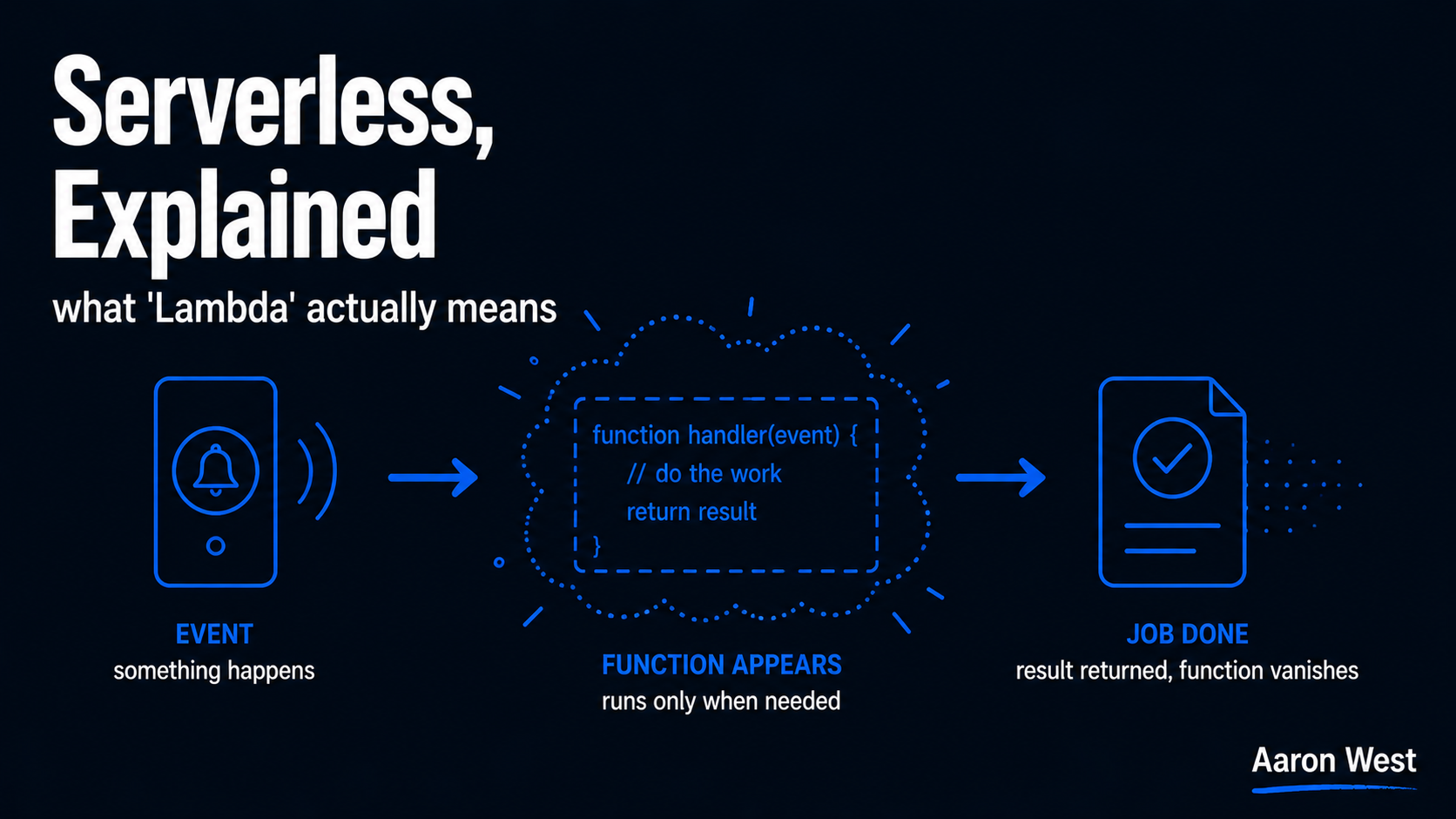
Serverless Explained for a Marketing Team (What "Lambda" Actually Means)
"Serverless" is one of the most misleading words in technology, because it does not mean there are no servers. It means you do not have to think about them. With serverless computing, you hand a small piece of code to a cloud provider, it runs…
Continue reading...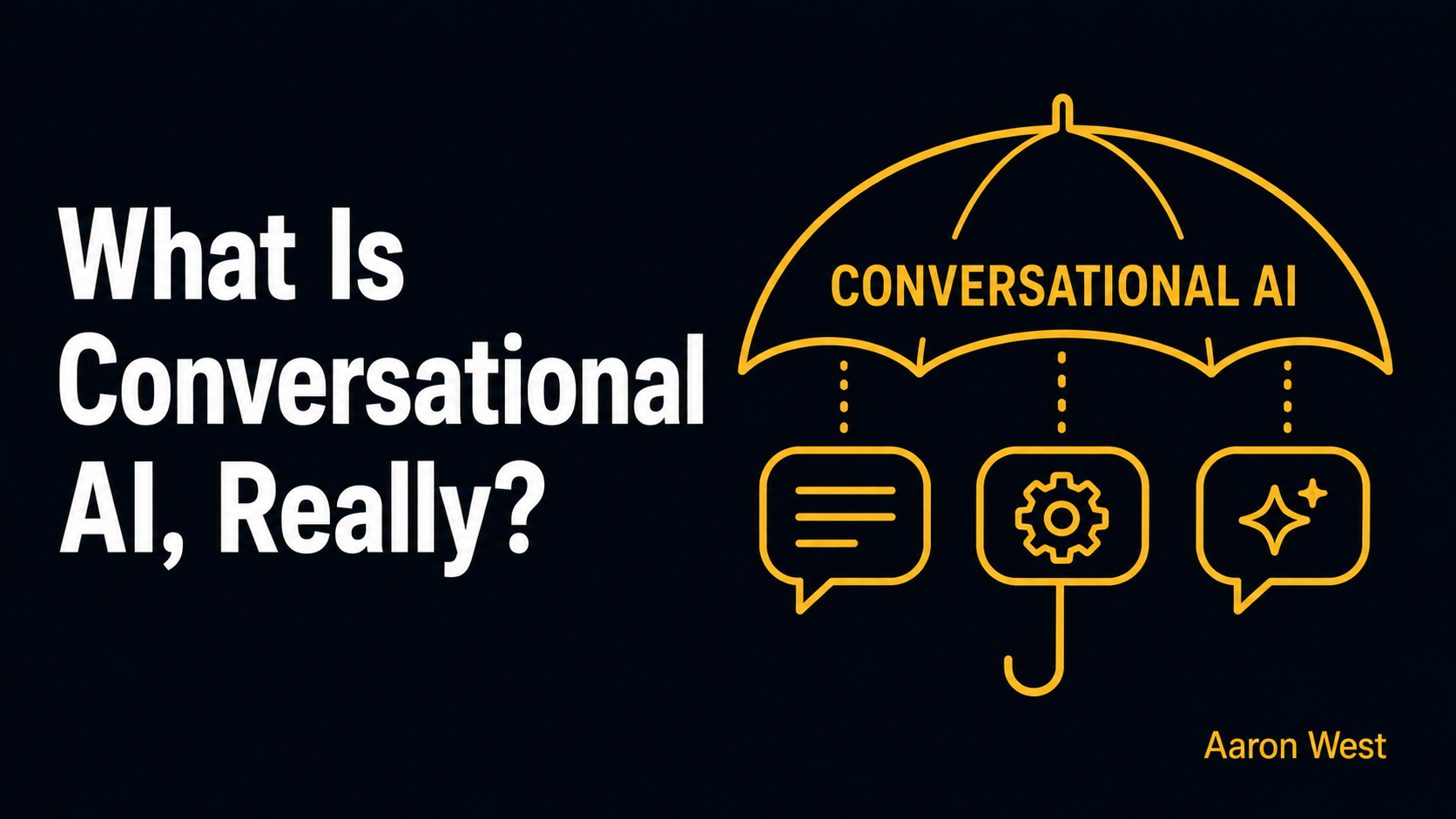
What Is Conversational AI, Really, and What It Still Can't Do
Conversational AI is the umbrella term for any technology that lets a machine understand, process, and respond to human language in something close to a natural conversation, by text or by voice. That is the whole definition. It is not one product or one technique.
Continue reading...