Serverless Explained for a Marketing Team (What "Lambda" Actually Means)

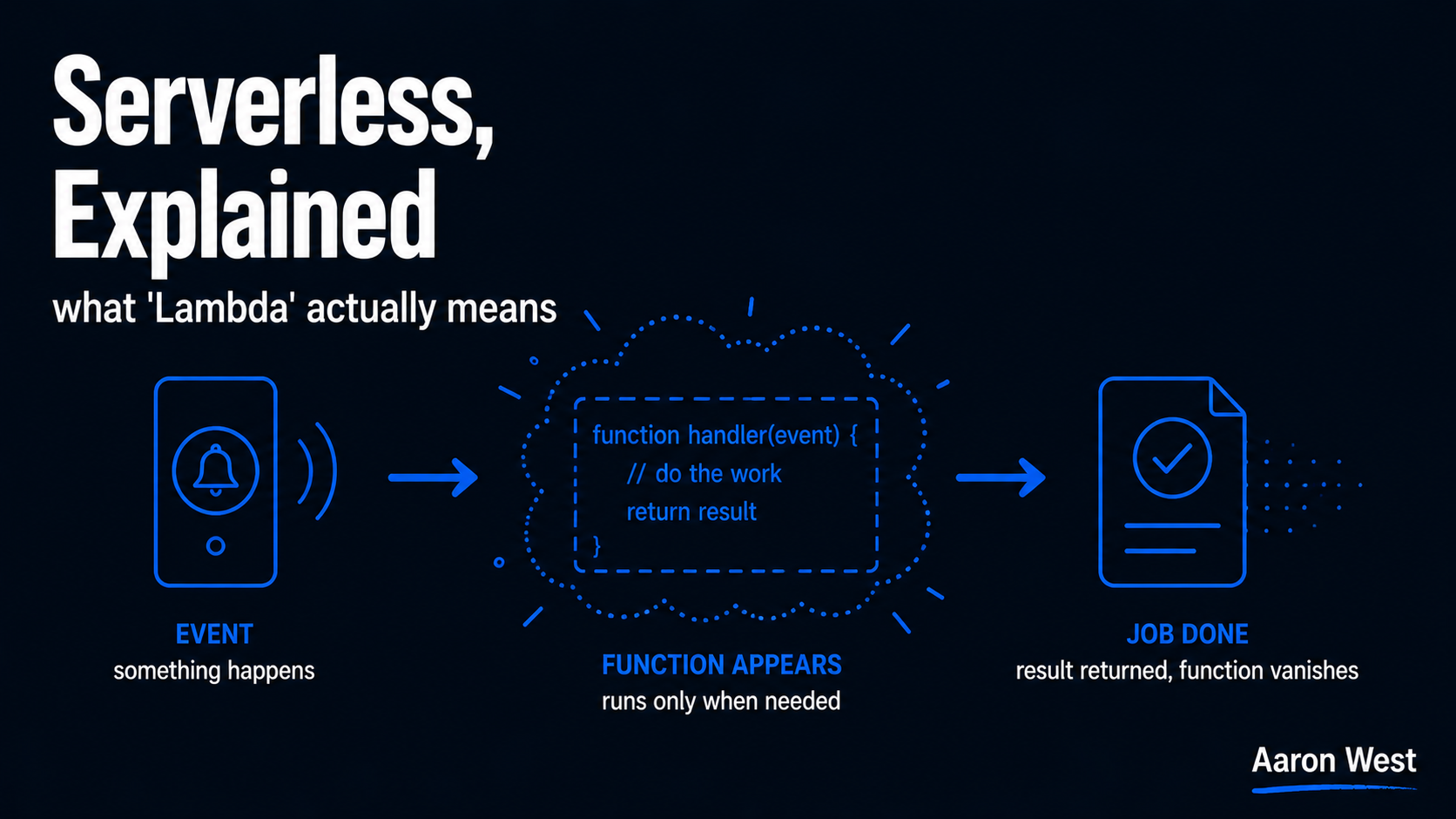
"Serverless" is one of the most misleading words in technology, because it does not mean there are no servers. It means you do not have to think about them. With serverless computing, you hand a small piece of code to a cloud provider, it runs only when something triggers it, and you pay only for the moments it actually runs, with the provider handling all the servers, scaling, and maintenance invisibly behind the scenes. On AWS, the service that does this is called Lambda, and that is the whole idea in one paragraph.
If you work in marketing rather than engineering, you do not need to write a line of Lambda code to benefit from understanding it, because it is the technology quietly running behind a lot of the automation and tools you already use, and because "do we need a server for this, or can it be serverless?" is a genuinely useful question to be able to follow. So here is what serverless actually means, the analogy that makes it click, and where it is the right tool, in plain language.
The misleading name, decoded
Let me kill the confusing word first. Of course there are still servers, the code has to run on a physical computer somewhere. "Serverless" describes your relationship to those servers, not their existence. In the traditional model, you rent a server (on AWS, that is EC2, the rentable computer from the AWS guide), and it is yours to run, configure, secure, patch, and pay for whether or not anyone is using it. It sits there, switched on, costing money, waiting.
Serverless flips that. You never see, rent, or manage a server at all. You just give the provider your code, and it takes care of everything needed to run it: finding a machine, running it, scaling it, patching it, all invisible to you. The "less" in serverless is not "no servers," it is "less for you to worry about." That reframing is the entire concept, and once you have it, the rest is just consequences of that one shift.
The analogy that makes it click
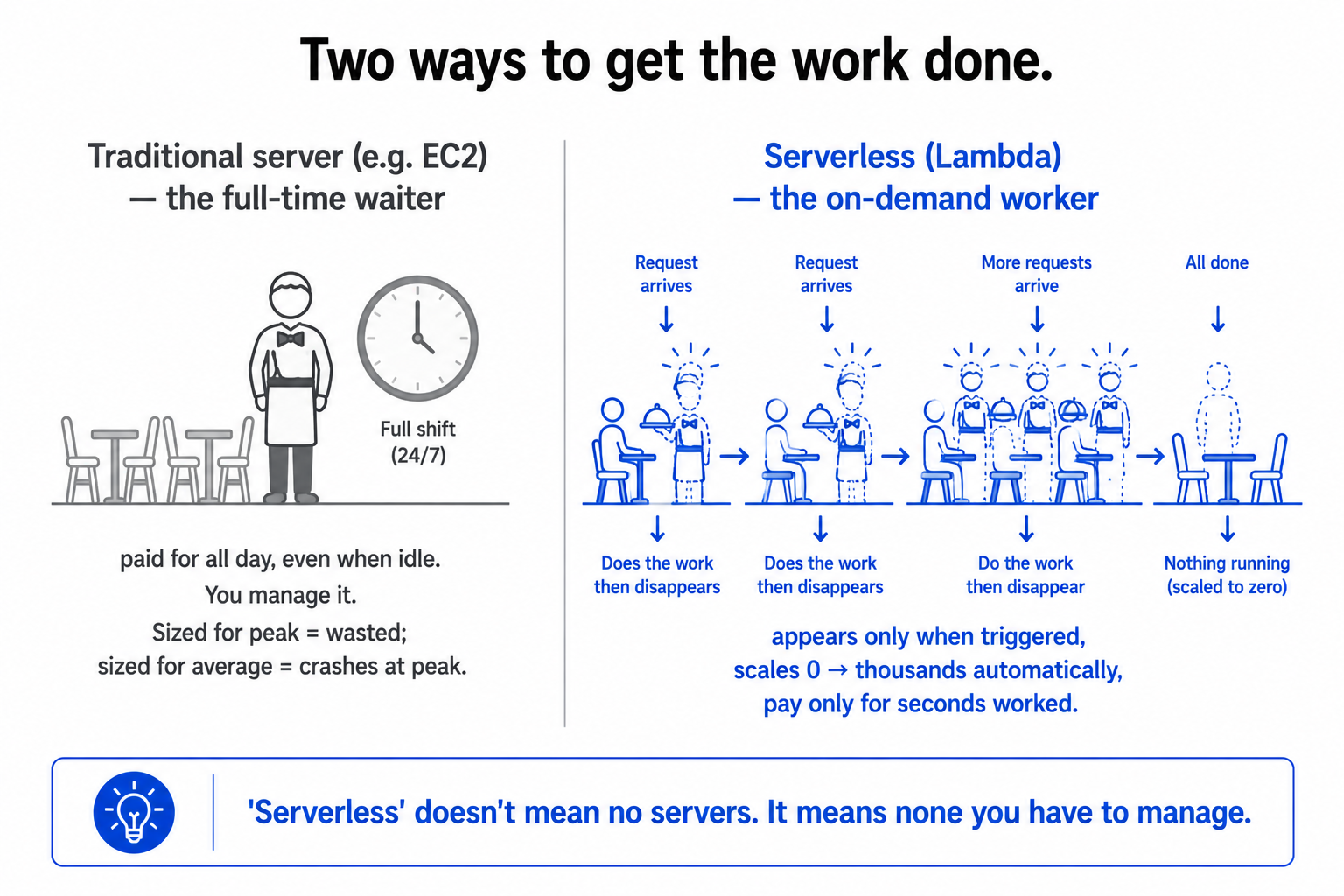
The cleanest way to feel the difference is two ways of getting work done. Think of a traditional server like hiring a full-time waiter. You pay them for the whole eight-hour shift even if only two customers come in. They are on the payroll all day, idle stretches included, and you also have to manage them, the uniform, the schedule, making sure they show up. That is a rented server: paid for around the clock, yours to look after, whether busy or not.
Serverless is like having a worker who materialises the instant a customer walks in, does exactly that one task, vanishes the moment it is done, and only charges you for the seconds they actually worked. No customers, no cost. A thousand customers at once, a thousand of them appear simultaneously, handle everyone, and disappear. You never hire, schedule, or manage them. They are simply there the instant they are needed and gone the instant they are not. That is Lambda. Code that appears when an event triggers it, runs, and disappears, and you pay only for the run, never for the waiting.
This is why serverless is so well suited to spiky, unpredictable, or occasional work. A traditional server sized for your busiest moment sits mostly idle the rest of the time, and one sized for your average moment falls over at the peak. Serverless sidesteps the whole dilemma: it scales from zero to thousands of simultaneous runs automatically and back to nothing, and you pay only for actual use. No capacity planning, no idle cost.
How it actually works, without the code
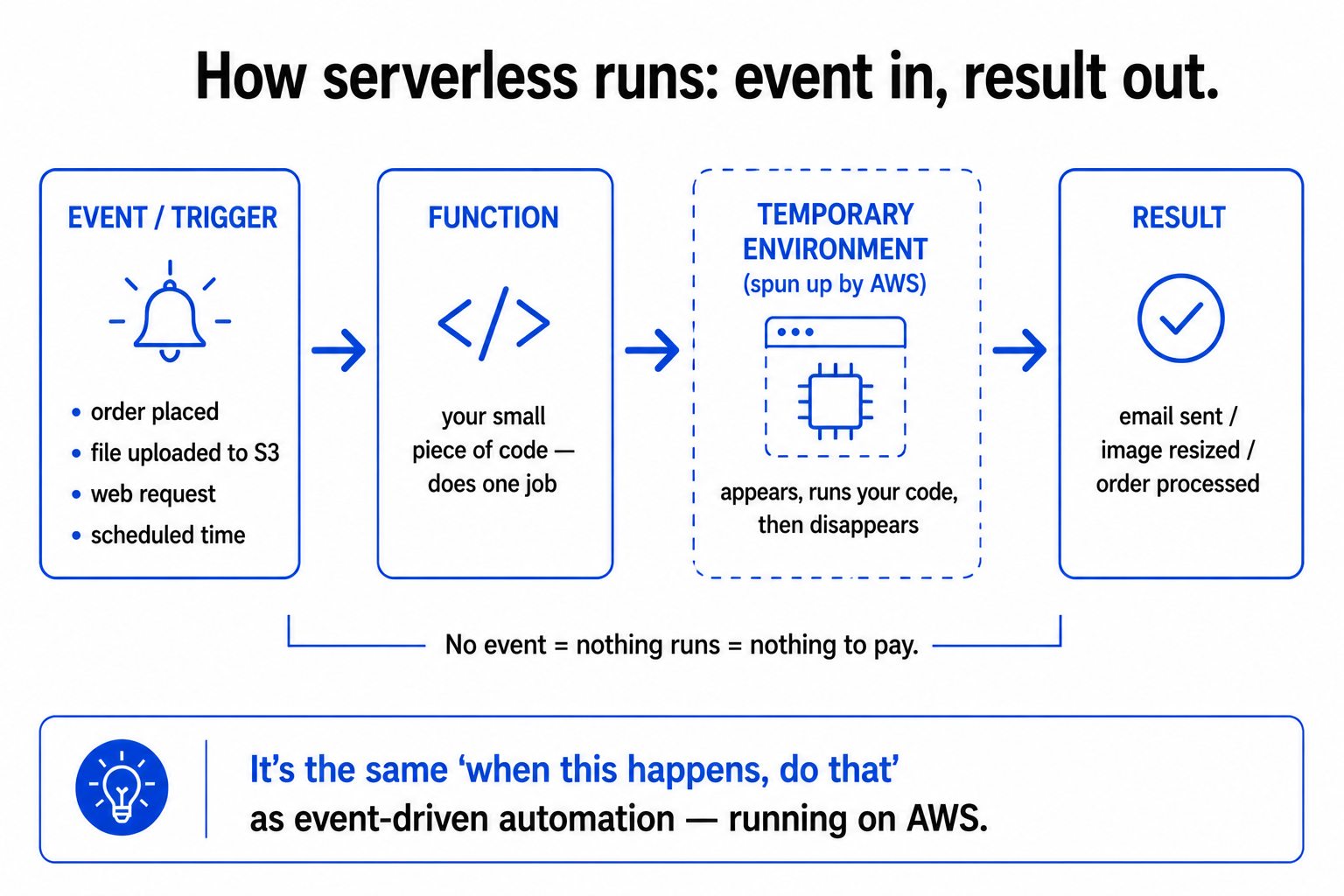
You do not need to program to follow the mechanics, and knowing them makes the trade-offs make sense. There are three moving parts.
First, a function: a small, self-contained piece of code that does one job, send a confirmation email, resize an uploaded image, process an order. Second, a trigger: the event that makes it run, a customer placing an order, a file being uploaded to S3, an incoming web request, a scheduled time. Third, the provider (AWS), which on a trigger conjures up a temporary environment, runs your function in it, returns the result, and tears the environment down. No event, no execution, no charge.
If that "runs in response to an event" structure sounds familiar, it should: serverless is the cloud-infrastructure expression of the same event-driven thinking I write about in automation. "When this happens, run that" is exactly the trigger-and-function model. Lambda is, in effect, event-driven automation running on Amazon's infrastructure, which is why it shows up so often as the engine behind the automations and integrations a marketing team relies on, even when nobody on the team ever sees it.
Where serverless fits, and where it doesn't
The honest part, because serverless is not a universal answer and pretending otherwise is how people misuse it. It shines in clear situations and is a poor fit in others, and knowing which is which is the useful judgment.
Serverless is a strong fit for short, event-triggered tasks, processing an upload, sending a notification, handling an occasional job, and for spiky or unpredictable traffic where paying for an always-on server would mostly buy idle time. It genuinely cuts cost and operational burden there, because you pay nothing when nothing is happening and it scales itself.
It is a poor fit in a few specific cases worth knowing. It is not built for long-running jobs: a function is meant to run briefly, with a hard ceiling (on Lambda, fifteen minutes), so heavy multi-hour processing belongs elsewhere. And it carries a quirk called a cold start: if a function has not run recently, the provider needs a moment to spin up a fresh environment, adding a small delay (often a fraction of a second, sometimes a touch more) to that first run. For most background tasks this is invisible and irrelevant. For something needing instant, guaranteed, every-single-time response with no tolerance for that occasional blink, an always-on server can be the better call. The pattern underneath: serverless trades a little control and the occasional cold-start delay for zero idle cost and zero server management, and that is a great trade for event-driven and bursty work, and a poor one for constant, latency-critical, or long-running work.
So that is serverless for a non-engineer. The name is a misnomer: the servers still exist, you just never manage them. You hand over a small piece of code, it runs only when an event triggers it, it scales itself from zero to thousands and back, and you pay only for the moments it actually runs. On AWS it is called Lambda, it is the same event-driven logic as good automation, and it is the right tool for short, spiky, triggered work, the wrong one for long or latency-critical jobs. You will likely never write a Lambda function. But the next time someone asks whether a task needs its own server or could just be serverless, you will know exactly what the question means and how to think about the answer, which is the whole point.
A few common questions
What does "serverless" actually mean? It does not mean there are no servers, it means you don't manage them. You give a cloud provider a piece of code; it runs that code only when triggered by an event, handles all the servers, scaling, and maintenance invisibly, and charges you only for the moments your code actually runs. On AWS, the serverless service is called Lambda.
What is AWS Lambda in simple terms? Lambda is AWS's serverless service: you upload a small function, set a trigger (like an order being placed or a file uploaded), and AWS runs it on demand, scaling automatically and billing only for the compute time used. Think of an on-demand worker who appears the instant they're needed, does the job, vanishes, and only charges for the seconds worked.
When should you use serverless instead of a server? Use serverless for short, event-triggered tasks and for spiky or unpredictable traffic, where an always-on server would mostly sit idle. Use a traditional server for long-running jobs (serverless functions have time limits) or for latency-critical work that can't tolerate the occasional "cold start" delay. The trade is zero idle cost and no server management, in exchange for a little less control.
What is a cold start? The small delay that happens when a serverless function runs after a period of inactivity and the provider has to spin up a fresh environment for it. It's often a fraction of a second and invisible for background tasks, but it matters for anything needing instant, guaranteed response every time.
You should also read:
AI vs Machine Learning vs Deep Learning: The Distinction That Actually Matters
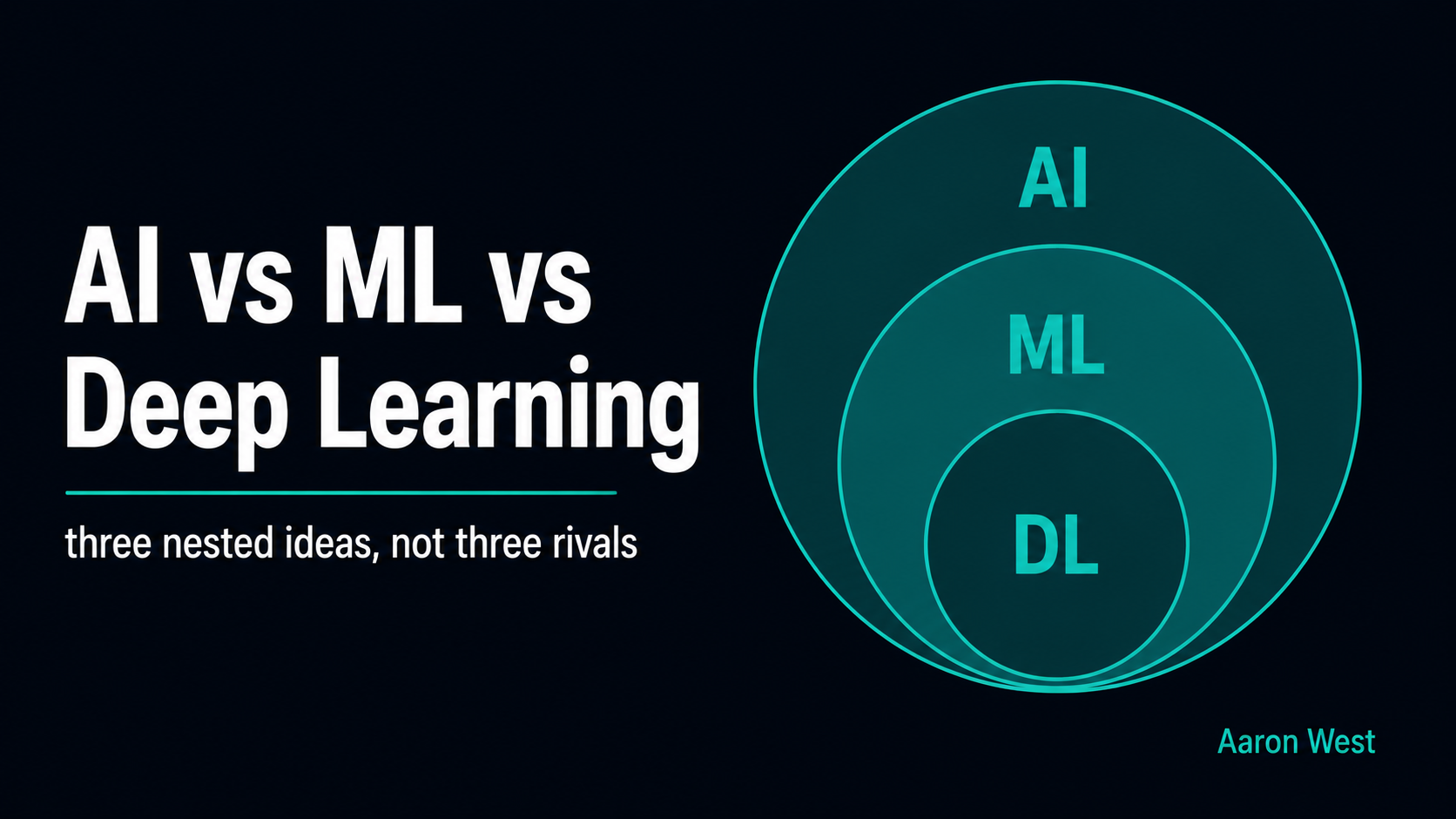
Artificial intelligence, machine learning, and deep learning are not three competing things you choose between. They are three nested ideas, each one a more specialised part of the one before it. AI is the big outer goal: machines doing things that would normally need human…
Continue reading...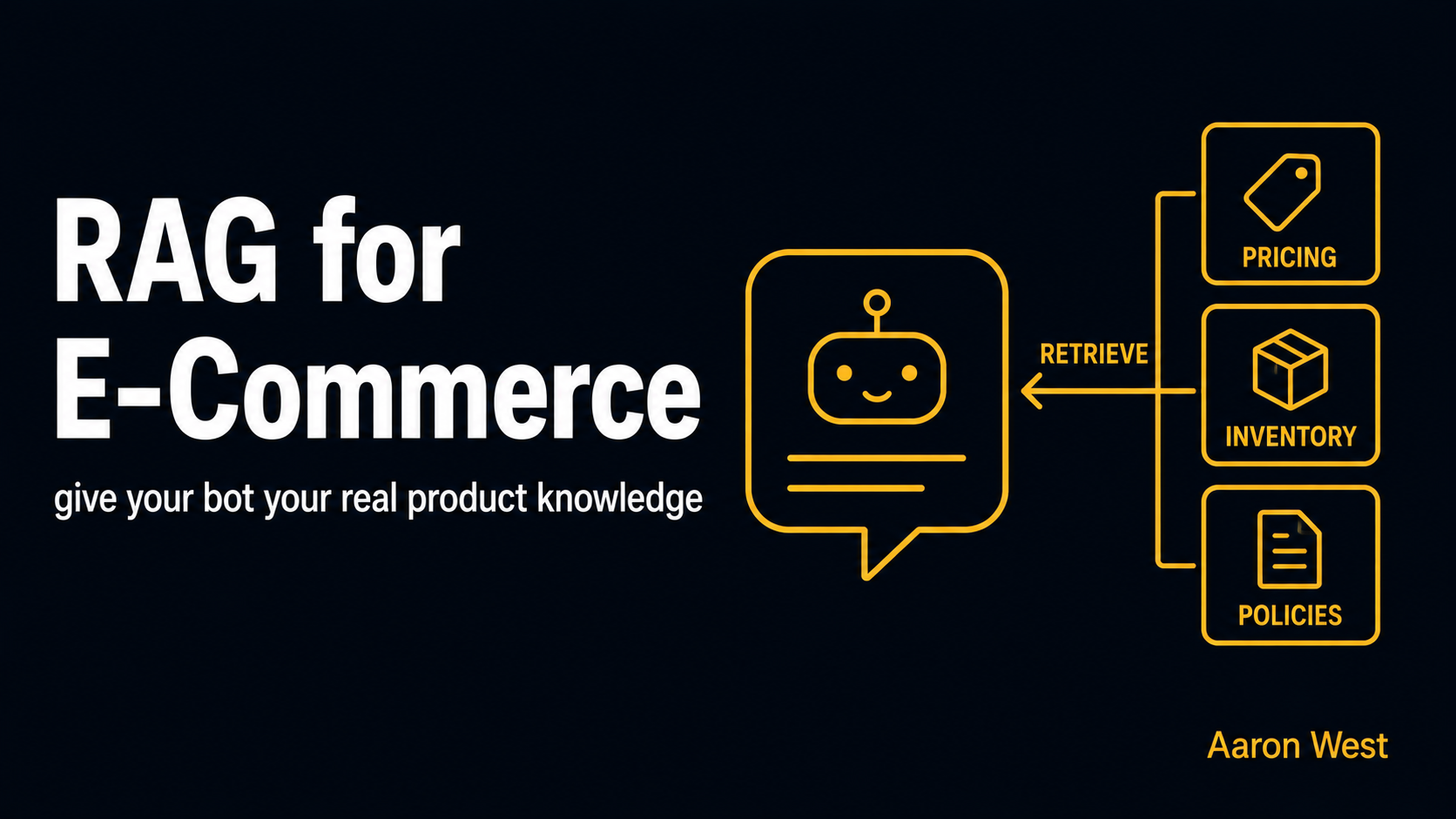
RAG Explained for E-Commerce: Giving a Bot Your Product Knowledge Without Retraining It
If you want an AI assistant that actually knows your store, your real products, your current prices, your live stock, your specific return policy, the technique you need is RAG, retrieval-augmented generation. It connects the AI to your live business data so it answers from…
Continue reading...
Everything I Know About Building Chatbots That Actually Work
The hard part of building a chatbot was never the technology. I learned this in 2019, building a natural-language chatbot from scratch for a large hotel group, across dozens of locations and several languages, back when "conversational AI" was a research term and not a…
Continue reading...