AI vs Machine Learning vs Deep Learning: The Distinction That Actually Matters

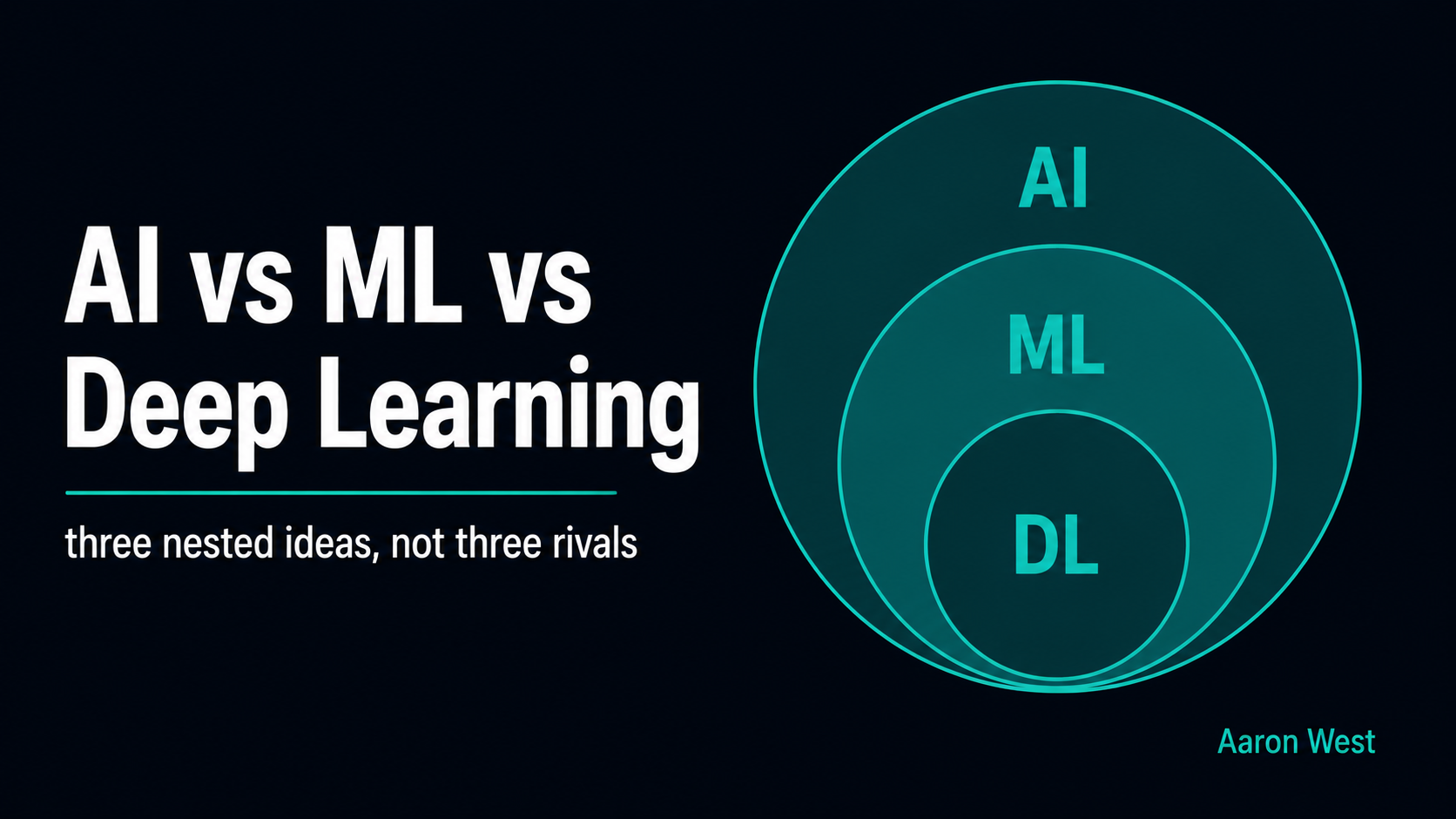
Table of Contents
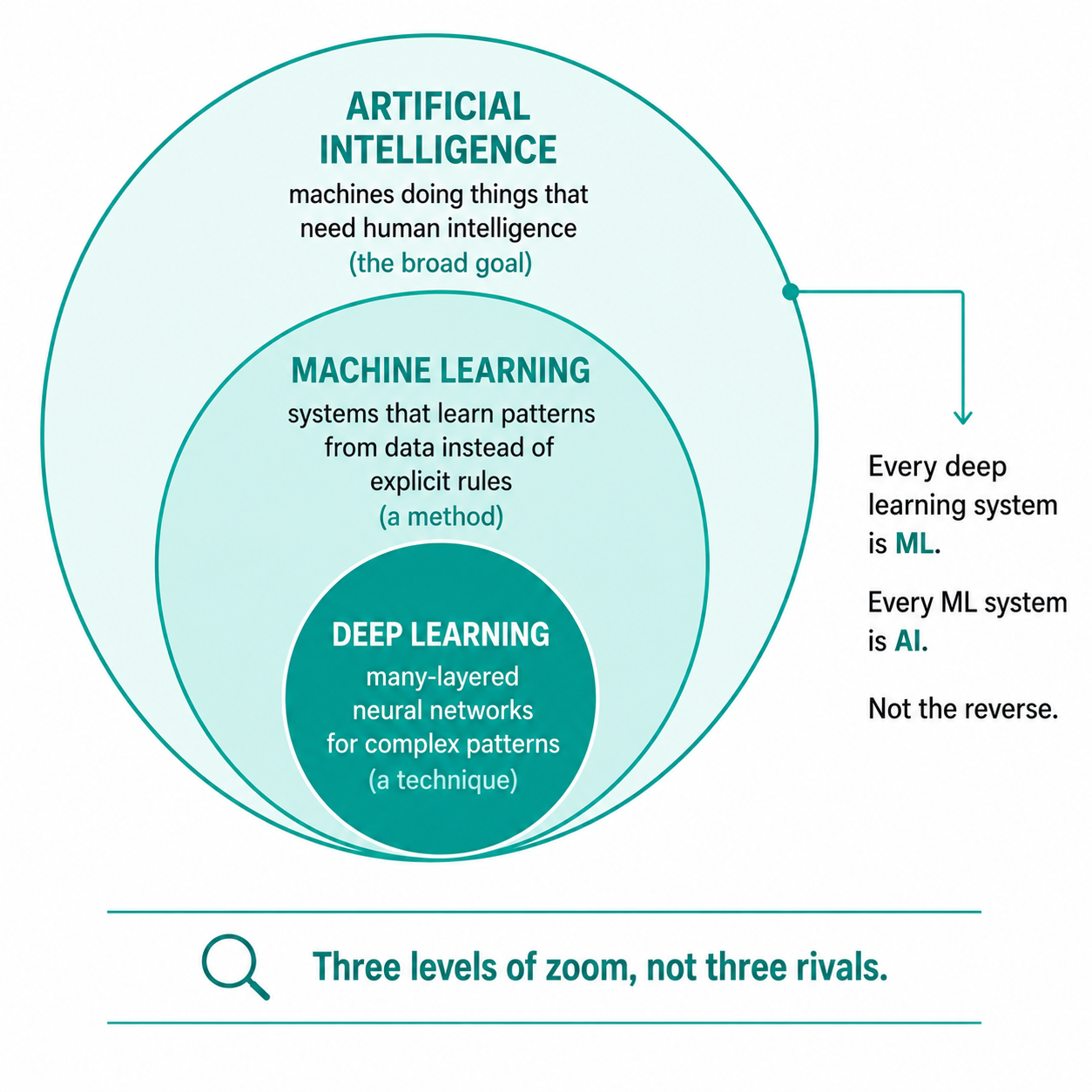
Artificial intelligence, machine learning, and deep learning are not three competing things you choose between. They are three nested ideas, each one a more specialised part of the one before it. AI is the big outer goal: machines doing things that would normally need human intelligence. Machine learning is a method inside AI: getting machines to learn patterns from data instead of being explicitly programmed. Deep learning is a technique inside machine learning: using many-layered neural networks to learn especially complex patterns. Three rings, one inside the next, not three rivals.
The reason this trips people up is that the terms get sprayed around interchangeably, in marketing, in job ads, in news articles, until they blur into one fuzzy concept called "AI stuff." That blur has a real cost: it makes it hard to tell what a product is actually doing, and easy for a vendor to dress up a simple rule-based system as cutting-edge "AI." So here is the clean version, with the relationship that actually matters made obvious, and then why a non-engineer should care.
The nested-dolls picture
The analogy everyone reaches for, because it is the right one, is the Russian nesting doll. The biggest doll contains a smaller one, which contains a smaller one again. That is exactly the relationship.
Every deep learning system is a machine learning system. Every machine learning system is a form of AI. But the reverse is not true: not all AI is machine learning, and not all machine learning is deep learning. They are layers of the same idea, each one narrower and more specialised than the one around it. Hold that picture and the whole thing stops being confusing. When you hear the three terms, you are not hearing three alternatives, you are hearing three levels of zoom on the same field.
Let me open each doll.
Doll 1: Artificial intelligence, the broad goal
AI is the outermost, broadest idea: a machine doing something that would normally require human intelligence. That is genuinely all it means at its core. Recognising a face, understanding a sentence, making a decision, playing chess, the unifying thread is "a task we associate with human smarts, done by a machine."
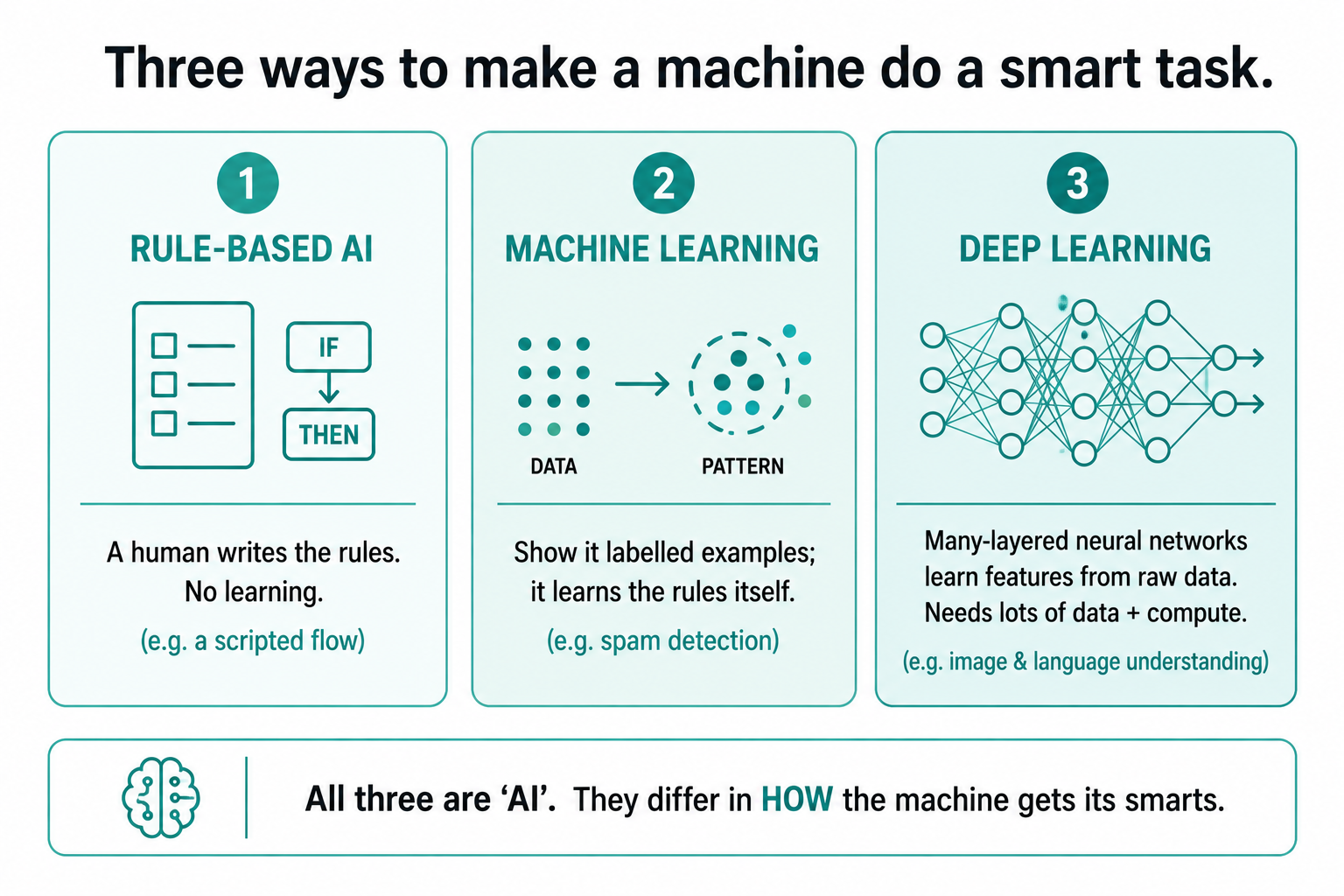
The thing people forget is that AI does not have to involve learning at all. The earliest AI systems were built on hand-written rules: long lists of "if this, then that" logic, painstakingly coded by humans. A chess program following programmed strategies, or a customer-service flow following a fixed script, is a form of AI without a shred of machine learning in it. It is doing an intelligence-like task by following rules a person wrote. This still matters in 2026, because plenty of things sold as "AI" are exactly this, rule-based systems, which is completely fine, but worth recognising for what they are. The reason AI became so much more powerful recently is that we mostly stopped hand-writing the rules and started letting machines learn them from data. Which is the next doll.
Doll 2: Machine learning, the method
Machine learning is the approach that powers almost everything people mean when they say "AI" today. The core idea is a genuine shift in how you get a computer to do something: instead of writing the rules yourself, you show the machine a large number of examples and let it work out the patterns on its own.
The difference is easiest to feel with an example. Suppose you want to detect spam email. The old, rule-based AI way: a human writes rules, "if it contains this phrase, flag it." Brittle, and spammers route around it the moment they learn the rules. The machine learning way: you show the system thousands of emails already labelled "spam" or "not spam," and it learns the patterns that distinguish them by itself, including subtle ones no human would think to write down. Then it applies what it learned to new emails it has never seen. Nobody wrote the rules. The system inferred them from the data, and it keeps improving as it sees more. That is machine learning, and it scales in a way hand-written rules never could, which is exactly why it took over. It is the engine behind recommendation systems, fraud detection, demand forecasting, and most of the practical "AI" running in businesses today.
Doll 3: Deep learning, the technique
Deep learning is a specialised, powerful kind of machine learning, inspired loosely by how the brain is wired. It uses neural networks, layers of simple interconnected units, and "deep" simply means there are many such layers stacked up. More layers let the system learn more complex, more abstract patterns, building understanding up in stages.
The practical distinction from ordinary machine learning is worth knowing. Classic machine learning often needs a human to tell it what features to pay attention to, you guide it toward what matters. Deep learning largely figures out the relevant features itself, directly from raw data, which is what makes it so powerful for genuinely hard problems like recognising images, understanding speech, and processing language. The trade-off is that it is hungrier: it needs much more data and far more computing power than simpler methods. Deep learning is the rocket engine, and data is the fuel, and you need a lot of fuel. This is the doll that matters most for current AI, because the tools dominating the conversation, the large language models behind ChatGPT and its peers, are deep learning systems. When you use one of those, you are using all three dolls at once: a deep learning technique, which is a machine learning method, in service of the broad goal of artificial intelligence.
Why a non-engineer should actually care
You might reasonably ask why any of this matters if you are not building the systems. Two practical reasons.
First, it is a marketing decoder. Once you understand the three layers, "powered by AI" stops being impressive on its own and becomes a question: which kind, and does it matter here? A simple, predictable task is often best served by old-fashioned rules, and a vendor charging a premium for "deep learning" to do something a rule could handle is selling you fuel you do not need. Conversely, a genuinely messy problem, understanding free-text customer questions, say, is exactly where deep learning earns its keep and a rule-based system would fail. Knowing the difference lets you match the tool to the problem instead of to the hype, which is the same discipline I bring to deciding what to automate in the first place.
Second, it tells you what a system needs to work. Machine learning and deep learning are only as good as the data you feed them, and deep learning needs a lot of it. If someone proposes a deep-learning solution and you have very little data, that is a red flag worth raising. Understanding the layers turns you from someone who nods along about "AI" into someone who can ask the question that matters: what is this actually doing, and is it the right tool for this job?
So, to keep it simple: AI is the goal of machines doing intelligent things. Machine learning is the dominant method, learning from data rather than hand-written rules. Deep learning is the most powerful technique within it, many-layered neural networks that learn from raw data and power today's most advanced systems. Three nested rings, not three rivals. Once you see the nesting, the entire field gets easier to read, and a lot harder to be sold a fuzzy story about.
A few common questions
What is the difference between AI, machine learning, and deep learning? They are nested, not separate. AI is the broad goal of machines doing tasks that need human intelligence. Machine learning is a method within AI: learning patterns from data instead of following hand-written rules. Deep learning is a technique within machine learning: using many-layered neural networks to learn complex patterns. Every deep learning system is machine learning; every machine learning system is AI; but not the reverse.
Is all AI machine learning? No. AI is the broader idea and includes systems that do not learn at all, such as rule-based programs that follow hand-written "if this, then that" logic. Machine learning is the subset of AI where the system learns from data. Much of today's AI is machine learning, but the terms are not interchangeable.
What is the difference between machine learning and deep learning? Deep learning is a specialised type of machine learning that uses many-layered neural networks. The key practical differences: classic machine learning often needs humans to specify which features matter, while deep learning learns features from raw data itself; and deep learning needs far more data and computing power. Deep learning excels at complex tasks like image, speech, and language understanding.
Why does the distinction matter if I'm not an engineer? It is a hype decoder. Knowing the layers lets you ask whether a product needs deep learning or whether a simple rule would do, so you match the tool to the problem instead of paying for buzzwords. It also tells you what a system requires: machine learning and especially deep learning depend heavily on having enough good data.
You should also read:
How Affiliate Marketing Actually Works: A Practitioner's Complete Guide
Affiliate marketing is a performance-based model where a business pays external partners (publishers) a commission for the sales or actions they drive, tracked through unique links so each partner gets credit for exactly what they brought in. The business only pays when it gets a…
Continue reading...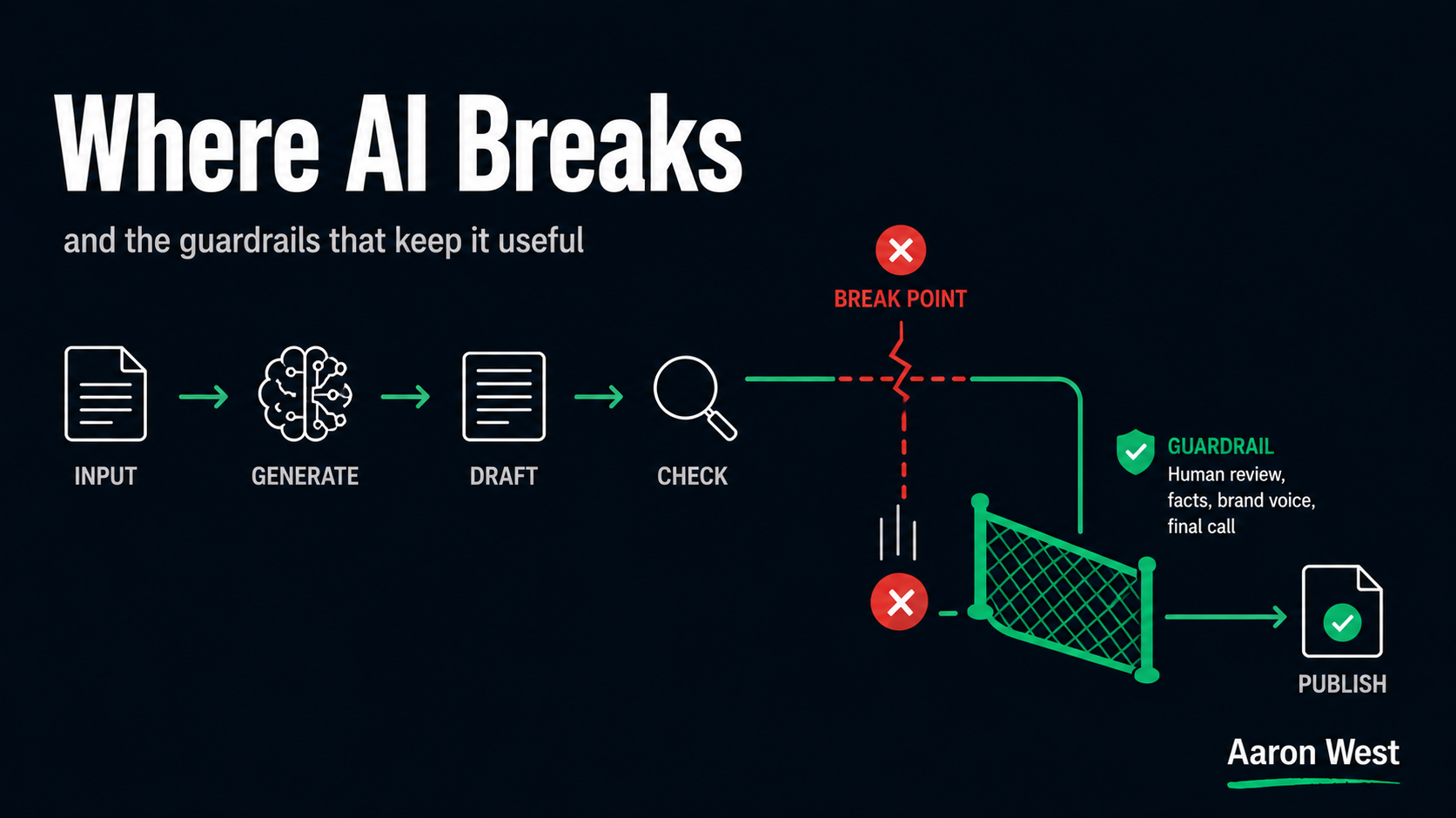
Where AI Breaks in E-Commerce Ops (and the Guardrails That Keep It Useful)
AI does not fail randomly in e-commerce operations. It fails in a handful of specific, predictable ways, and once you know them, you can build the guardrails that let you use AI confidently instead of nervously. The failures are not exotic. They are the same…
Continue reading...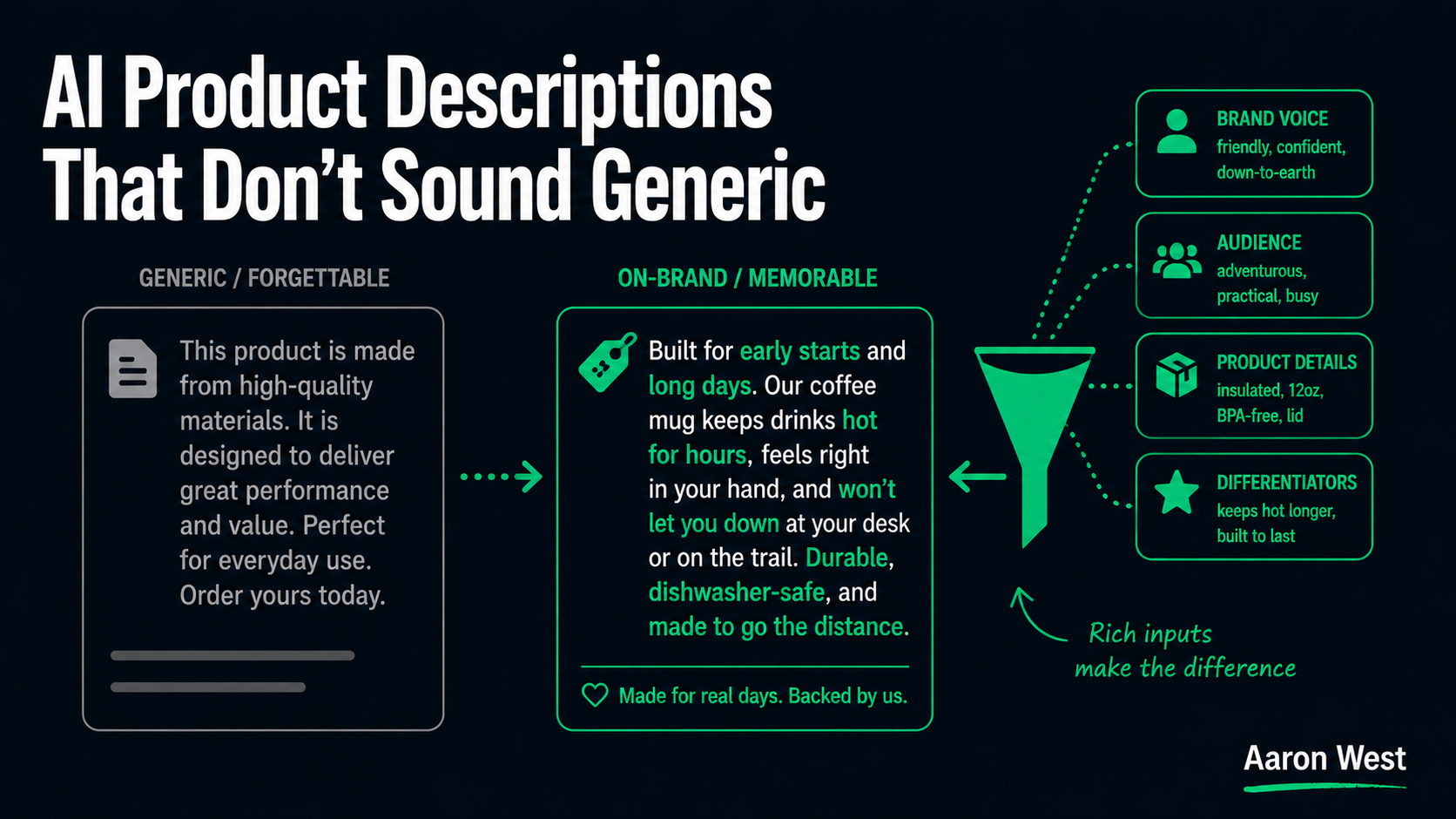
AI for Product Descriptions That Don't Sound Generic
The most common complaint about AI-written product descriptions is that they all sound the same, bland, interchangeable, like they could describe any product from any store. The complaint is fair, and here is the part nobody selling AI tools wants to say plainly: when AI…
Continue reading...