AI for Product Descriptions That Don't Sound Generic

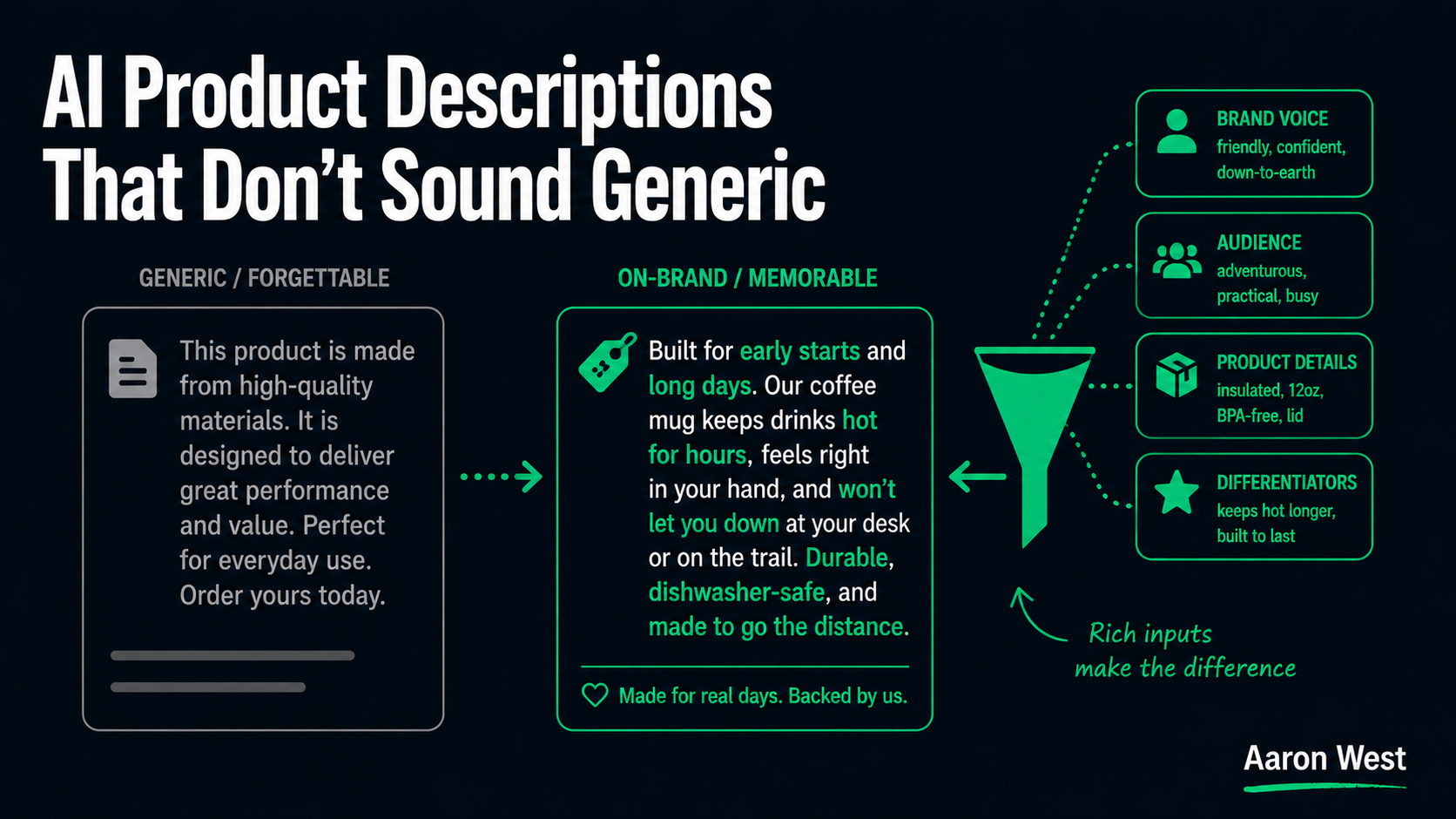
Table of Contents
The most common complaint about AI-written product descriptions is that they all sound the same, bland, interchangeable, like they could describe any product from any store. The complaint is fair, and here is the part nobody selling AI tools wants to say plainly: when AI writes generic descriptions, it is almost never the AI's fault. It is the inputs. Generic in, generic out. Feed a model a product name and the instruction "write a description," and of course you get fluff that could belong to anyone, because you gave it nothing that belongs to you. The difference between embarrassing AI copy and genuinely good, on-brand copy at scale lies almost entirely in what you put in, not which tool you use.
This matters because, as I argued in the cornerstone of this cluster, writing unique descriptions for a large catalogue is one of the single best uses of AI in all of e-commerce, a job that is otherwise effectively impossible becomes a manageable review queue. But only if you do it right. Done wrong, you flood your store with generic mush that actively cheapens the brand and does not even rank. So here is the actual method I use to get product descriptions that sound like a real store wrote them, not a machine: the inputs that matter, the brand-voice trick, and the mistakes that produce the generic sludge everyone rightly complains about.
Why generic happens: it is an input problem
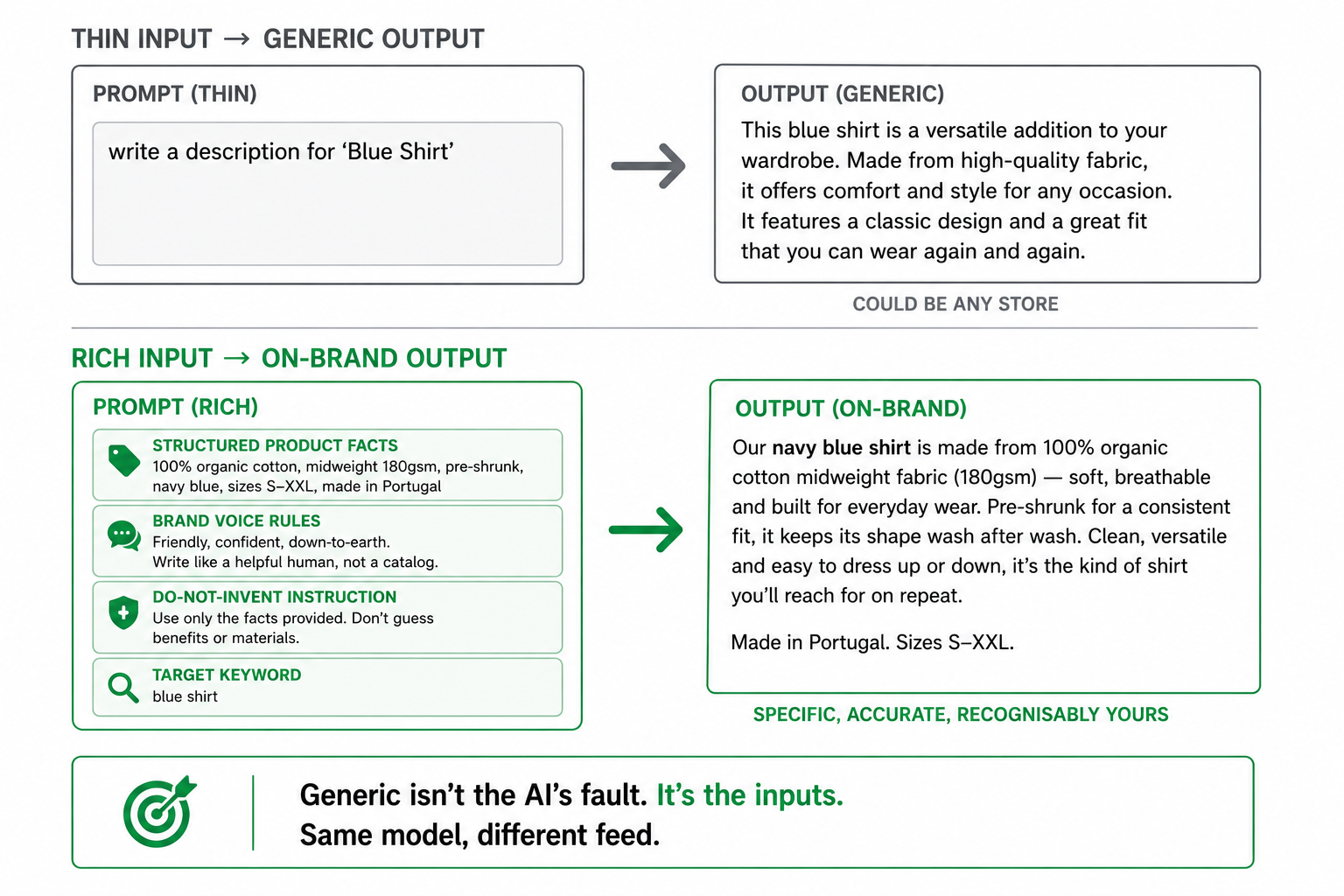
Start with the root cause, because once you see it, the fixes are obvious. A language model generates text based on what you give it plus the average of everything it learned in training. If you give it almost nothing specific, a bare product name, "write a product description", it has nothing to work from but the average, so it returns the most average, generic, seen-it-a-thousand-times text possible. That is not the model failing. That is the model doing exactly what a near-empty prompt asks: produce the statistically blandest plausible paragraph.
Generic output, in other words, is a symptom of starving the model of specifics. The reason this is good news is that it puts the quality entirely in your hands. You do not need a better AI, you need better inputs, and there are two that do almost all the work: the real facts about the product, and the real character of your brand. Get those two into the prompt properly and the same model that produced sludge a moment ago produces copy that is specific, accurate, and recognisably yours. Everything below is just how to supply those two things well.
Input one: structured facts (and an instruction not to invent)
The first input is the concrete, factual detail about the product, the more structured, the better. Material, dimensions, fit, use case, what makes it different, who it is for. If you have this in a tidy form already (a product data sheet, a well-maintained catalogue, or a PIM system), you are most of the way there, because you can feed the model a clean list of facts and ask it to write from those facts. This is also exactly why cleaning up your product data pays off twice: good structured data is the raw material that makes good descriptions possible at scale.
There is a critical instruction that rides along with the facts, and skipping it is how stores end up with invented specifications: explicitly tell the model to use only the facts you provide and not to make anything up. Left to fill gaps on its own, a model will cheerfully invent a plausible-sounding detail, a material it does not have, a feature it does not offer, because it generates fluent text, not verified truth. On a customer-facing product page, a hallucinated spec is not a small thing, it is a returns problem and a trust problem. So the rule is: give it the facts, and tell it those facts are all it gets. Then a human spot-checks, which on a large catalogue means reviewing a sample rather than every line, but never zero. Even very good models are wrong a small percentage of the time, and a small percentage of a big catalogue is still a real number of wrong pages.
Input two: brand voice, captured as rules not vibes
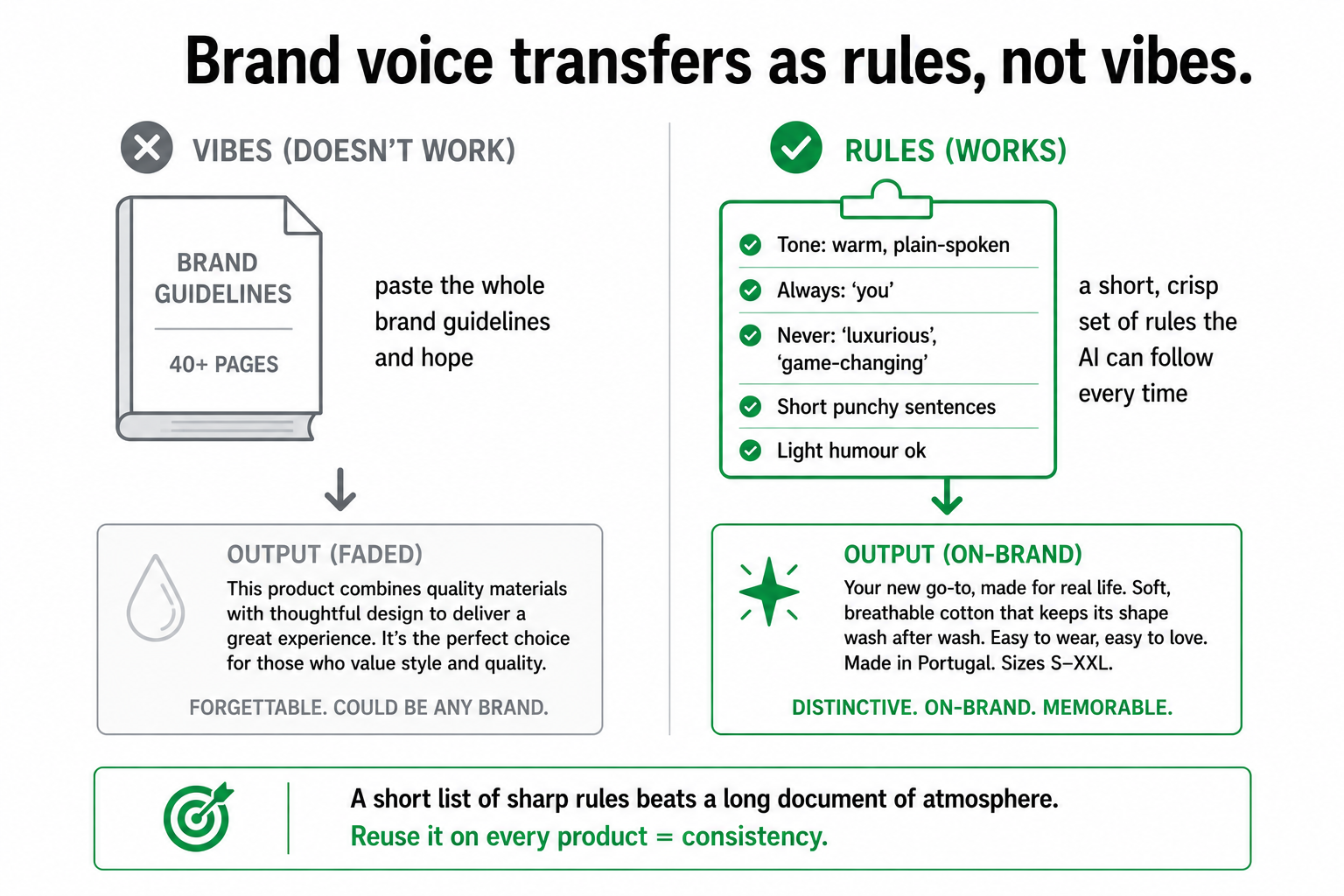
The second input is what stops the copy sounding like everyone else's: your brand's actual voice. The mistake here is trying to convey voice by feeling, pasting a long brand-guidelines document and hoping the model absorbs the spirit. It will summarise a forty-page PDF imperfectly and give you a watered-down average. Voice does not transfer as vibes. It transfers as rules.
Break your voice into concrete, explicit instructions the model can actually apply: the tone in a few specific adjectives (warm and plain-spoken, not "premium and aspirational"), words and phrases you always use, words you never use, sentence rhythm, whether you address the customer as "you," whether you use humour. A short list of sharp, specific rules beats a long document of atmosphere every time, because the model can follow a rule and cannot reliably absorb a mood. Keep that rule set in one place and reuse it on every product, and you get the thing that actually signals a real brand: consistency. The copy sounds like one store with a point of view, across the whole catalogue, instead of a different writer on every page. That repeatable, structured voice spec is the single highest-leverage thing you can build for AI content, and it compounds: refine it once, every future description improves.
The mistakes that produce generic sludge
Knowing the failure modes is half the craft, so here are the ones I see most, each the flip side of something above.
The thin prompt. Covered, but it is the number-one cause, so it earns repeating: "write a description for X" with no facts and no voice will always produce mush. If the output is generic, look first at how little you gave it.
The regenerate trap. This one wastes more time than any other. A description comes out bad, so the instinct is to hit "regenerate" and hope. The new one will be different. It will not be better, because the problem was never the dice roll, it was the input. A bad description almost always means a thin prompt or a missing fact. Fix the prompt or fix the data, do not re-roll. Re-rolling is gambling; fixing the input is engineering.
Voice drift across tools and time. A description written by one model on Tuesday and another on Wednesday will sound like two different companies, and even the same model drifts without a fixed voice spec. This is exactly why the reusable rule set from input two matters: it is what holds the voice steady across a catalogue built over weeks and across whichever tool you happen to use.
Translating after the fact. If you sell in multiple languages, do not write the English description and then machine-translate it, that regresses to flat, generic "translated e-commerce" prose. Generate each language from the same facts and the same brand-voice rules, so each reads like it was written natively, not laundered through a translator. This is the multilingual lesson applied to content: real fluency is built in, not bolted on.
Skipping the human review. The non-negotiable one. AI drafts; a human approves. On a large catalogue that means spot-checking a sensible sample and reviewing anything high-stakes, not rubber-stamping the lot and not checking every word either. The review step is what makes the whole thing safe to do at volume, and it is precisely the human-in-the-loop discipline the cornerstone insists on.
So that is how you get AI product descriptions that do not sound generic. Stop blaming the model and fix the inputs: feed it structured, real facts plus an explicit instruction not to invent; capture your brand voice as a short, reusable set of concrete rules rather than a vague document; avoid the regenerate trap and the post-hoc translation; and keep a human reviewing a sample. Do that, and the catalogue job that used to be impossible, thousands of unique, accurate, on-brand descriptions, becomes a fast, repeatable workflow that genuinely sounds like your store. Generic AI copy is not the technology's verdict on your brand. It is just a sign you have not fed it your brand yet.
A few common questions
Why do AI product descriptions sound so generic? Almost always because of thin inputs, not the AI itself. Given only a product name and "write a description," a model falls back on the blandest average text it knows. Feed it structured product facts and a clear set of brand-voice rules and the same model produces specific, on-brand copy. Generic in, generic out.
How do I keep my brand voice consistent in AI-written copy? Capture your voice as concrete rules rather than a long guidelines document: specific tone adjectives, words you always use, words you never use, sentence style, whether you address the reader as "you." Keep that rule set in one place and apply it to every product. A short list of sharp rules transfers far better than a 40-page PDF, and reusing it is what creates consistency across the catalogue.
How do I stop AI from inventing product details? Give it a structured list of the real facts and explicitly instruct it to use only those facts and not to invent anything. Models generate fluent text, not verified truth, so without this they'll fill gaps with plausible-but-false specs. Then have a human spot-check a sample of the output, since even good models are occasionally wrong, and a small error rate across a big catalogue is still many wrong pages.
Should I regenerate a bad AI description? No. Regenerating gives you a different result, not a better one, because the cause is usually a thin prompt or a missing input fact, not bad luck. Fix the prompt or fix the underlying data instead. Re-rolling is gambling; improving the input is the actual fix.
You should also read:
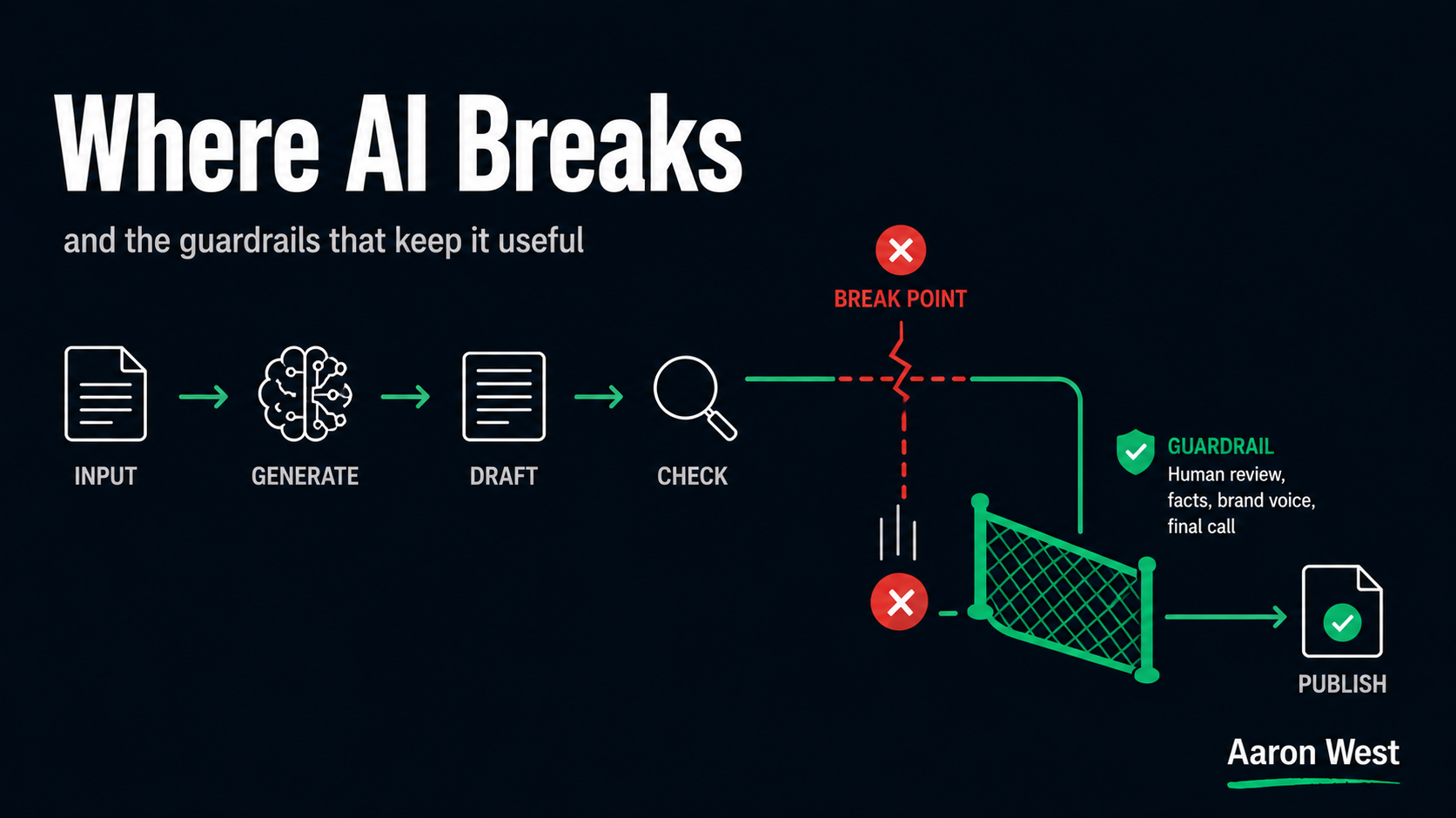
Where AI Breaks in E-Commerce Ops (and the Guardrails That Keep It Useful)
AI does not fail randomly in e-commerce operations. It fails in a handful of specific, predictable ways, and once you know them, you can build the guardrails that let you use AI confidently instead of nervously. The failures are not exotic. They are the same…
Continue reading...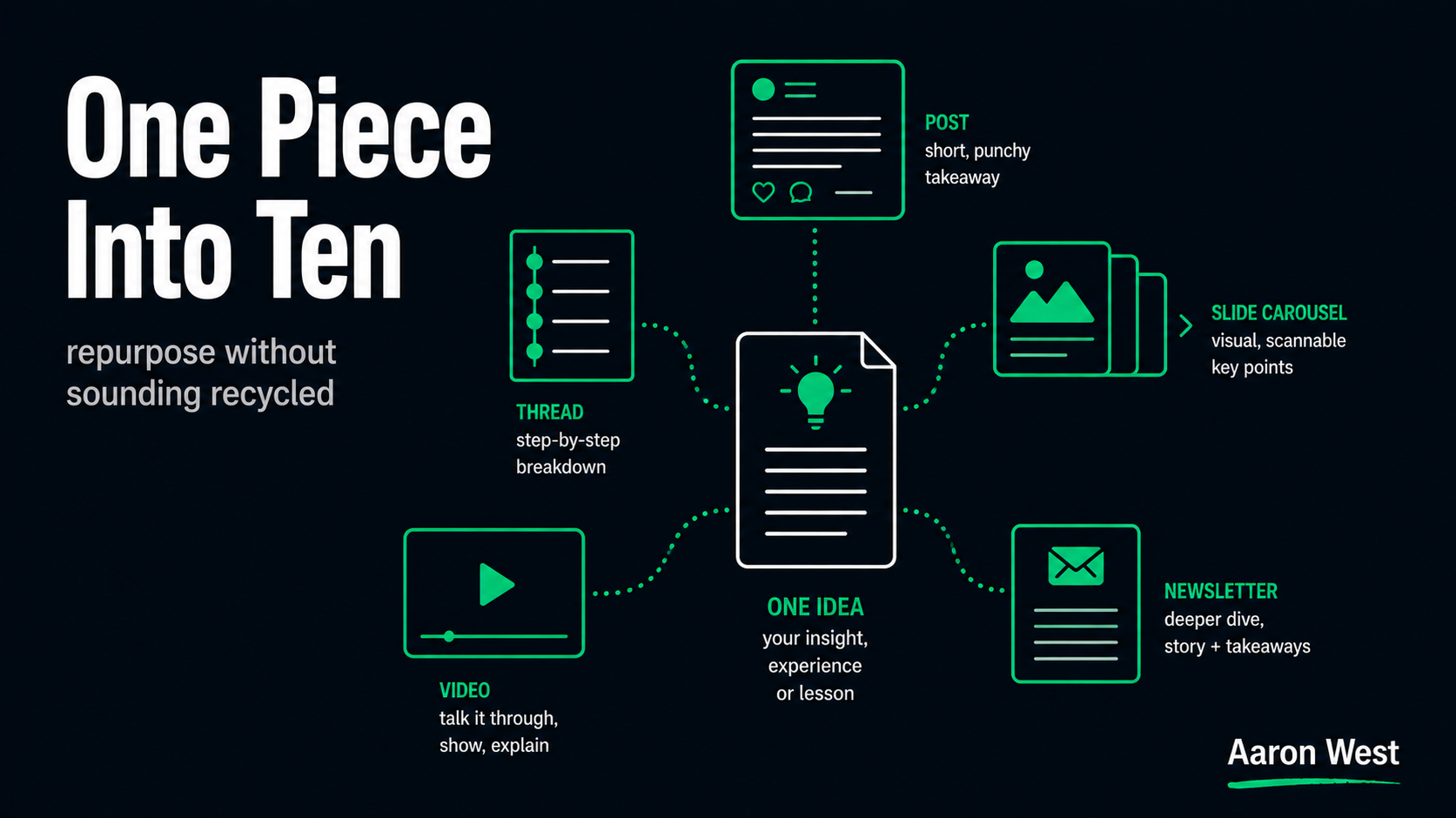
How I Use AI to Turn One Piece of Content Into Ten (Without It Sounding Recycled)
The promise of AI content repurposing is seductive: write one thing, turn it into ten, flood every channel. The reality is that most people do it badly, and badly here has a specific, recognisable shape, they take one post and paste a near-identical version onto…
Continue reading...
Why Your Product Images Are Slowing Down Your Conversion Rate
The single biggest thing slowing down your online store is almost certainly the very thing you put there to sell the product: the images. On a typical e-commerce page, images make up more than half of everything the browser has to download, and unoptimised product…
Continue reading...