What Is Conversational AI, Really, and What It Still Can't Do

Table of Contents
Conversational AI is the umbrella term for any technology that lets a machine understand, process, and respond to human language in something close to a natural conversation, by text or by voice. That is the whole definition. It is not one product or one technique. It is the category that contains the rigid scripted chatbot from 2015, the slick LLM-powered assistant of 2026, and everything in between. Which is exactly why the term causes so much confusion, it gets used as if it means one specific thing, when it actually covers a whole range of very different systems.
I want to clear that confusion up, because the vocabulary around this has become a mess. "Conversational AI," "chatbot," "generative AI," "AI agent" get used interchangeably in marketing, and they are not the same. Having built conversational systems myself, I have a strong interest in people knowing what they are actually buying or building. So here is what conversational AI really is, how the pieces fit together, and, the part the sales pages skip, what it still cannot do.
The umbrella, and what's under it
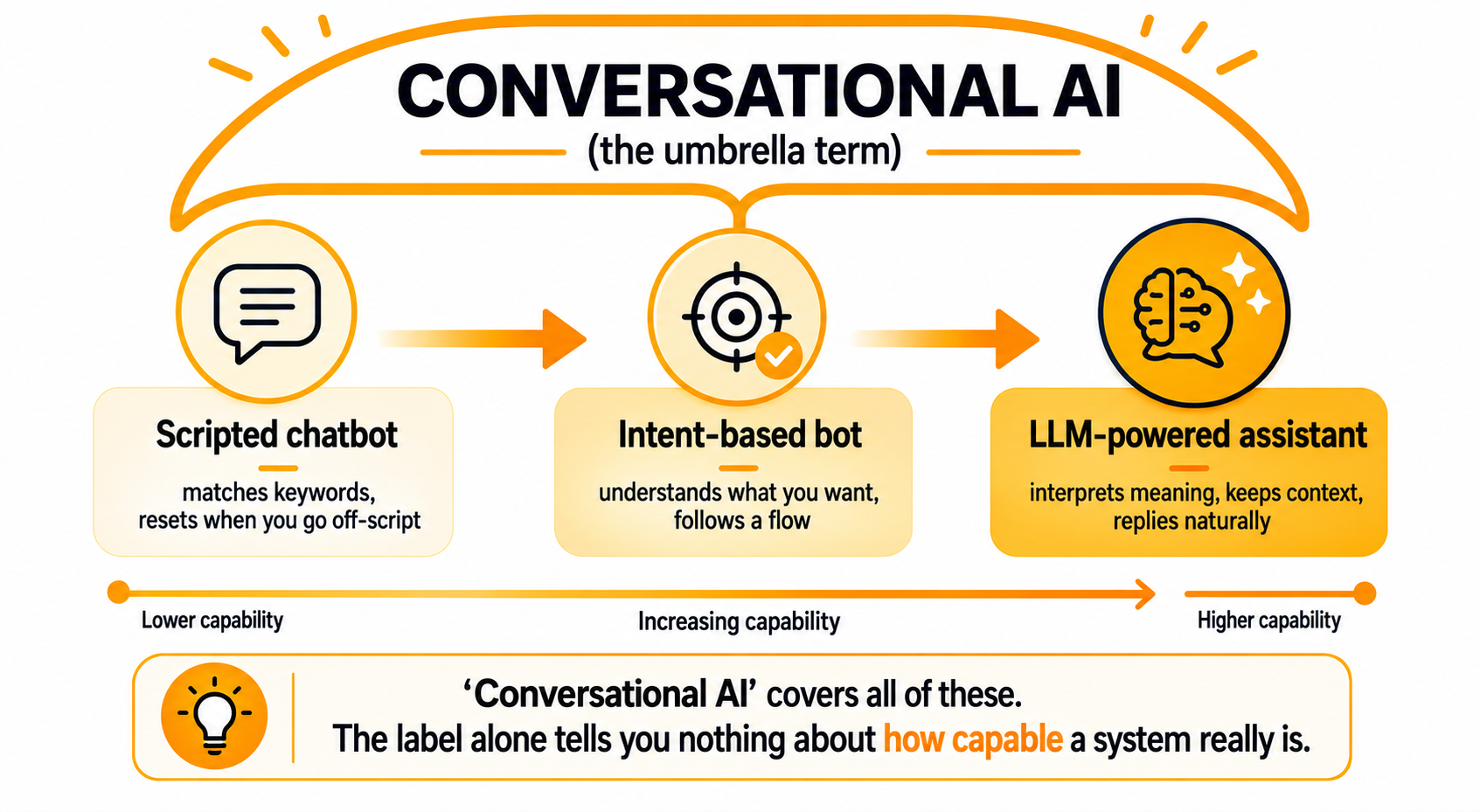
The most useful thing to understand first is that conversational AI is a category, not a capability level. A simple rule-based chatbot that recognises a keyword and returns a scripted answer is, technically, conversational AI. So is a sophisticated system that understands a vague question, remembers your last three interactions, and drafts a tailored reply. Both sit under the same umbrella, which is why "we use conversational AI" tells you almost nothing about how capable a system actually is.
What separates the simple end from the advanced end is not whether it is "conversational AI", they both are, but how it handles three things: understanding, context, and naturalness. A basic scripted chatbot matches keywords and treats each message as an isolated request, so it resets or breaks the moment you phrase something unexpectedly. A modern system interprets what you meant rather than just what you typed, connects your messages into a single ongoing conversation rather than isolated queries, and generates a natural-sounding reply rather than reciting a fixed one. Same umbrella, completely different experience. So when someone says "conversational AI," the useful follow-up question is always: how far up that scale, really?
How a modern conversational AI system actually works
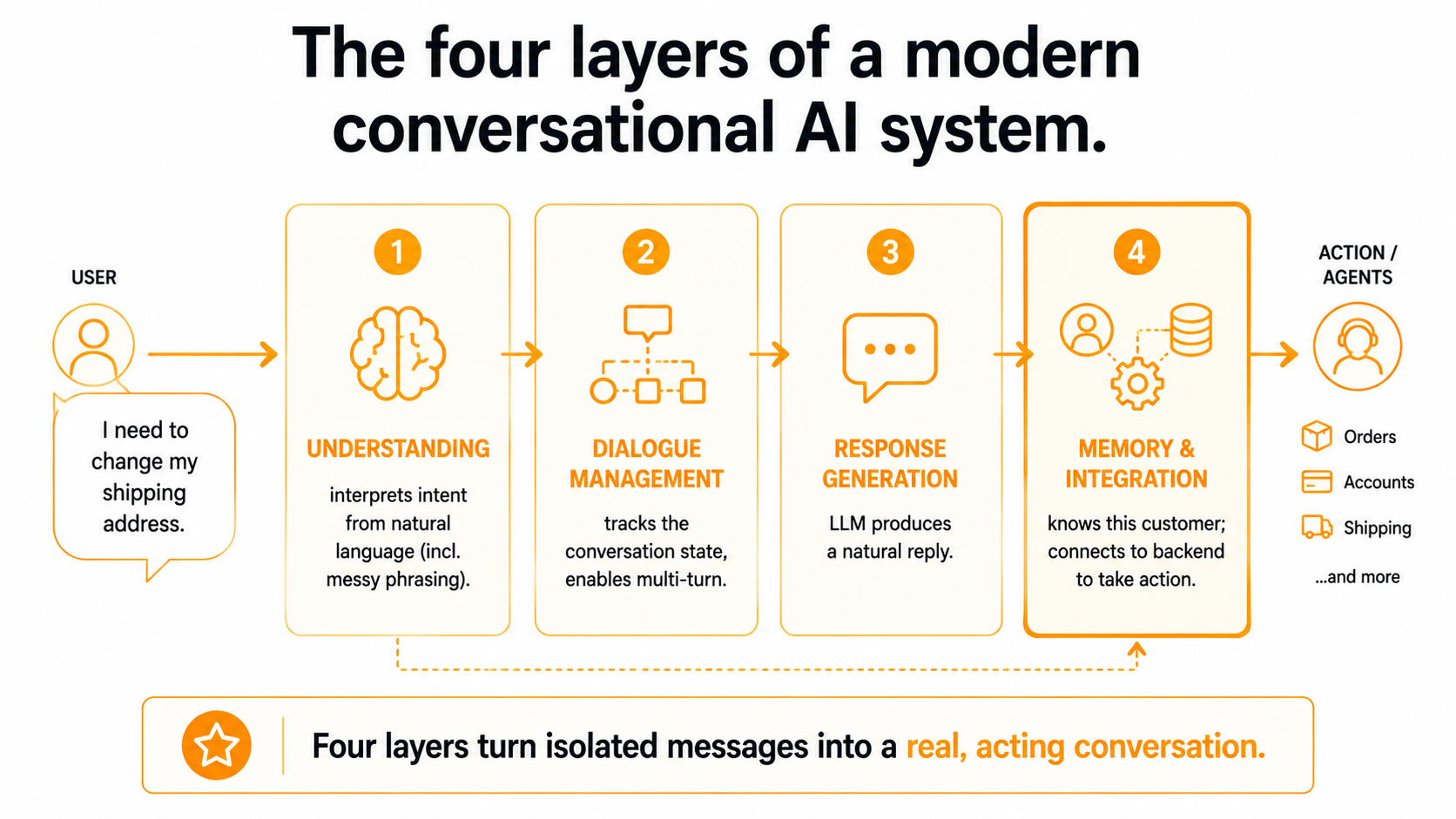
Strip a capable modern system into its parts and it stops looking like magic. Four layers do the work, and naming them makes the whole thing legible.
First, understanding the input. The system interprets what the user actually wants, the intent, from natural language, including messy phrasing, typos, and follow-ups. This is where modern systems pull far ahead of old ones, because large language models interpret meaning rather than matching keywords.
Second, dialogue management, which is the part people overlook and the part that makes it feel like a conversation rather than a series of disconnected questions. This layer tracks the state: what has been said, what still needs resolving, what the next step is. It is what lets the system handle a multi-turn exchange, ask a clarifying question, and remember that your "yes" two messages ago referred to the refund, not the exchange.
Third, generating the response. Modern systems use an LLM to produce the reply, which is why a 2026 assistant sounds so much more natural than the stilted scripted output of older bots. The language is generated, not retrieved from a fixed list.
Fourth, memory and integration. Memory is what lets the system know about this customer, from the current conversation and prior ones, so it does not make them start from scratch. Integration with your backend systems is what lets it actually do things, check an order, update an account, start a return, rather than only talk about them. This last layer is the bridge from a system that converses to one that acts, which is the doorway to AI agents.
Conversational AI, generative AI, agents: untangling the terms
Three terms get tangled together, so here is the clean separation.
Conversational AI is the umbrella, defined by its purpose: holding a conversation in natural language. Generative AI is defined by its technique: generating new content (text, images, code) rather than retrieving it. They overlap, a modern conversational system usually uses generative AI to produce its replies, but they are not the same thing. A generative model writing marketing copy is generative AI but not conversational AI. A simple scripted bot is conversational AI but not generative. The modern assistant is both. The terms describe different axes, what it is for versus how it produces output, and conflating them is the single most common confusion I see.
And AI agents are the next step beyond, defined by autonomy: a system that does not just converse but takes actions toward a goal, deciding its own next steps. The honest 2026 framing is that conversational AI is increasingly the interface to an agent underneath, you talk to it naturally (conversational AI), it generates its replies (generative AI), and it can actually execute tasks on your behalf (agentic). Three layers of capability, often stacked in one product, which is precisely why the marketing terms blur. Knowing which axis each word describes is how you cut through it.
What it still can't do
Here is the part the sales pages skip, and the part that matters most if you are deciding what to trust it with. Conversational AI in 2026 is genuinely impressive, and it has real, hard limits that are not going away soon.
It can still be confidently wrong. Because the generative layer produces plausible language rather than verified fact, a conversational system can state something false in a perfectly natural, authoritative tone. Fluency is not accuracy, and the better the system sounds, the more easily a wrong answer slips past. It also does not truly understand in the human sense, it models language patterns extremely well, which is not the same as comprehension, and it will miss genuine nuance, subtext, and the emotional weight of a situation that a person would catch instantly. It struggles with the genuinely novel and the high-stakes-but-rare, the edge cases that fall outside its training and its scope. And it has no real judgment about when it is out of its depth unless it has been deliberately designed to recognise that and escalate.
None of this makes it unusable. It makes it a specific tool with a specific shape. The systems that work in practice are the ones built around these limits rather than in denial of them: grounded in real data so they guess less, designed to surface uncertainty rather than bluff, and built to hand off to a human cleanly when they hit their edge. That is the same lesson as everything I know about building chatbots that work, and it is the difference between a conversational AI that earns trust and one that quietly erodes it.
So that is conversational AI, really: an umbrella term for machines that converse in natural language, spanning everything from a keyword script to an LLM-powered assistant, built from understanding, dialogue management, generation, and integration, distinct from generative AI and agents even though modern products fuse all three. Powerful, genuinely useful, and bounded by real limits that good design works around rather than pretends away.
A few common questions
What is conversational AI in simple terms? Technology that lets a machine understand, process, and respond to human language in a natural, conversational way, by text or voice. It is an umbrella term covering everything from simple scripted chatbots to advanced LLM-powered assistants, combining natural-language understanding, dialogue management, response generation, and integration with other systems.
What is the difference between conversational AI and a chatbot? A chatbot is one example of conversational AI, not a separate thing. "Conversational AI" is the broad category; a chatbot is a common application of it. The category spans from basic rule-based chatbots (keyword scripts) to sophisticated systems that interpret intent, hold context across turns, and respond naturally.
What is the difference between conversational AI and generative AI? They describe different things. Conversational AI is defined by its purpose (holding a natural-language conversation); generative AI is defined by its technique (creating new content rather than retrieving it). They overlap, modern conversational systems usually use generative AI to write replies, but a generative model writing marketing copy isn't conversational, and a simple scripted bot isn't generative.
What are the limits of conversational AI? It can be confidently wrong because it generates plausible language rather than verified fact; it models language rather than truly understanding, so it misses nuance and subtext; it struggles with novel, high-stakes edge cases; and it has poor judgment about when it's out of its depth unless deliberately designed to escalate. Good systems are built around these limits, not in denial of them.
You should also read:
Serverless Explained for a Marketing Team (What "Lambda" Actually Means)
"Serverless" is one of the most misleading words in technology, because it does not mean there are no servers. It means you do not have to think about them. With serverless computing, you hand a small piece of code to a cloud provider, it runs…
Continue reading...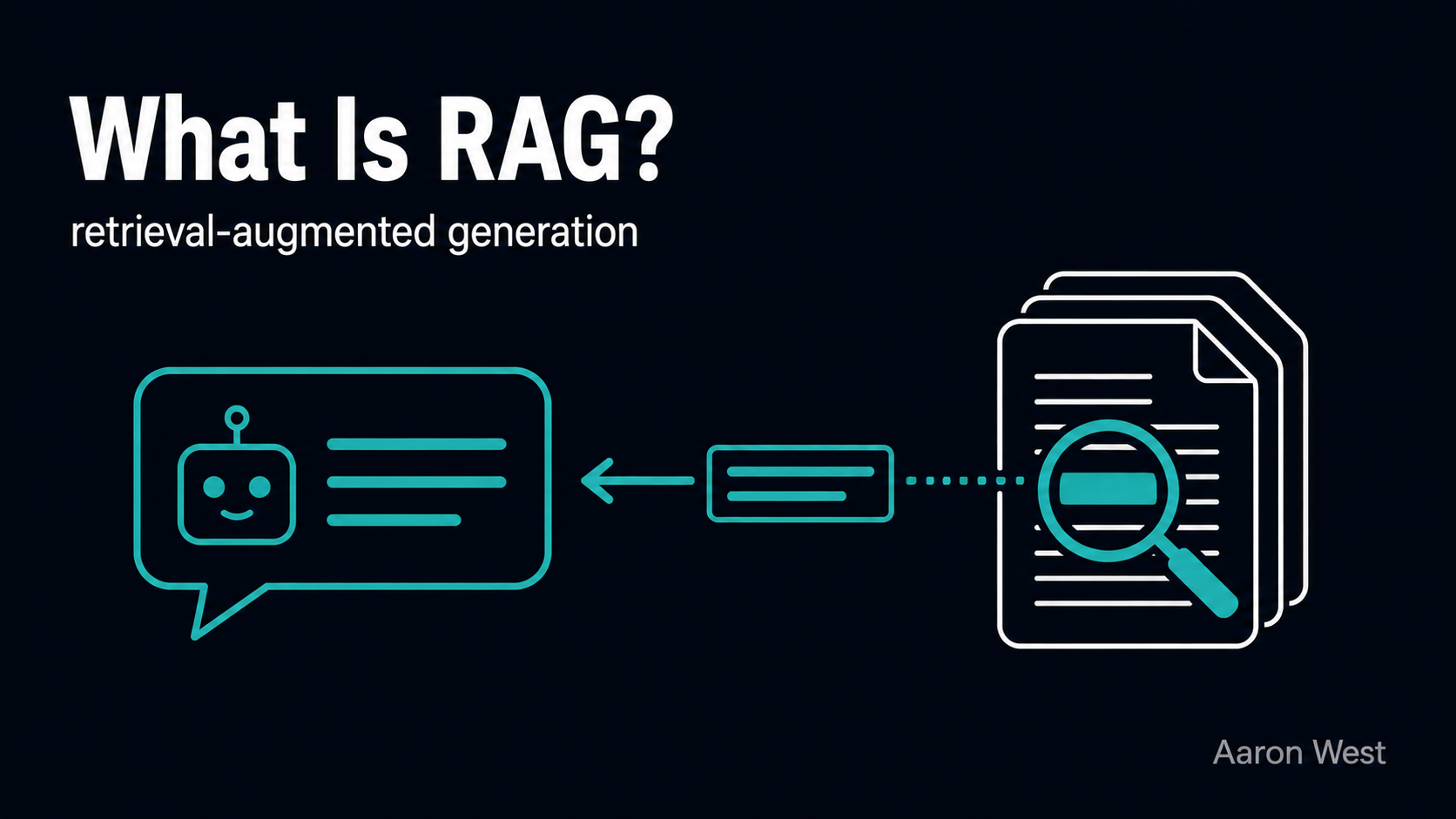
What Is RAG (Retrieval-Augmented Generation), and Why Everyone Is Using It
RAG, retrieval-augmented generation, is a way of making an AI model answer from a specific, trusted set of documents instead of relying only on what it absorbed during training. Before the model writes its answer, the system goes and fetches the most relevant material from…
Continue reading...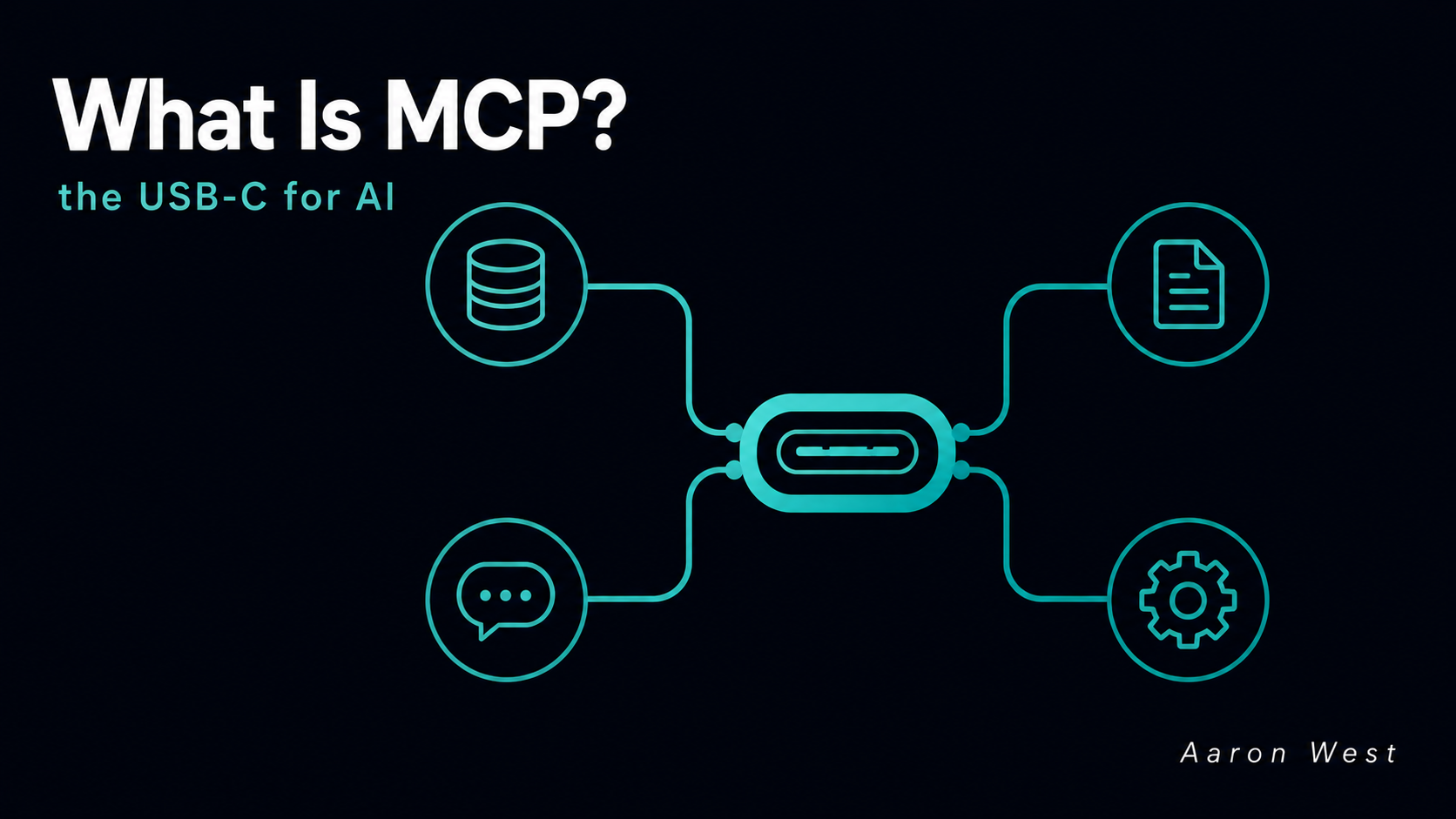
What Is MCP (Model Context Protocol), and Why It Matters
MCP, the Model Context Protocol, is an open standard that gives AI models a single, consistent way to connect to external tools and data. Instead of building a custom integration for every combination of AI model and service, you build one MCP connection and any…
Continue reading...