What Is MCP (Model Context Protocol), and Why It Matters

Table of Contents
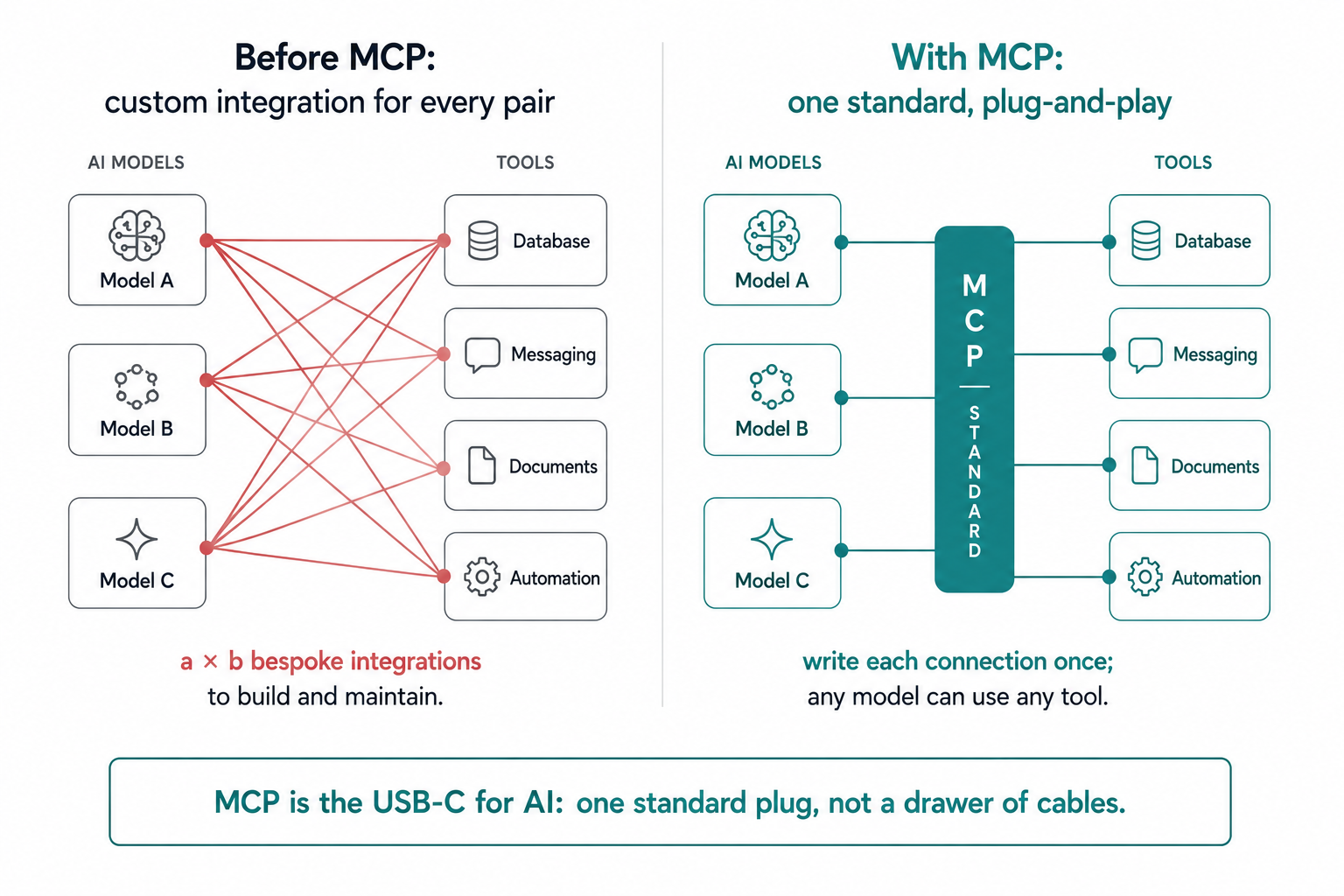
MCP, the Model Context Protocol, is an open standard that gives AI models a single, consistent way to connect to external tools and data. Instead of building a custom integration for every combination of AI model and service, you build one MCP connection and any MCP-compatible AI can use it. The analogy that has stuck, because it is accurate, is that MCP is doing for AI what USB-C did for devices: one standard plug instead of a drawer full of incompatible cables.
If that already makes sense, you have the core of it. But MCP is worth understanding a little more deeply, because it quietly explains a lot about where AI is heading in 2026, from "a thing that answers questions" to "a thing that actually does work in your real systems." It was introduced by Anthropic in late 2024, and within months it had been adopted by OpenAI, Google, and Microsoft, which is about as close to an industry agreeing on something as you ever see. Here is what it is and why that adoption happened so fast, in plain language.
The problem MCP solves: the integration mess
To understand why MCP matters, you have to see the problem it replaced, because the problem was genuinely painful.
An AI model on its own is, as one good description put it, a brain with no hands. It can reason and write, but it cannot see your CRM, read your database, or send a message in Slack unless you connect it to those things. And before MCP, every one of those connections was a bespoke piece of work. You wanted your AI to talk to your CRM? Custom integration. Also your database? Another custom integration. Also Slack, also your help desk, also your analytics? Each one its own project, its own code, its own authentication, its own thing to maintain and to break.
The maths of this gets ugly fast. Connect a tools to b models the old way and you are potentially building and maintaining a times b separate integrations. Every new model you adopt means re-wiring everything. Every tool that changes its API means hunting down and fixing the connections that depended on it. One practitioner described migrating a real product off this approach and going from 47 custom adapters down to 6 MCP servers. That is the scale of the mess MCP cleans up.
How MCP works: hosts, clients, and servers
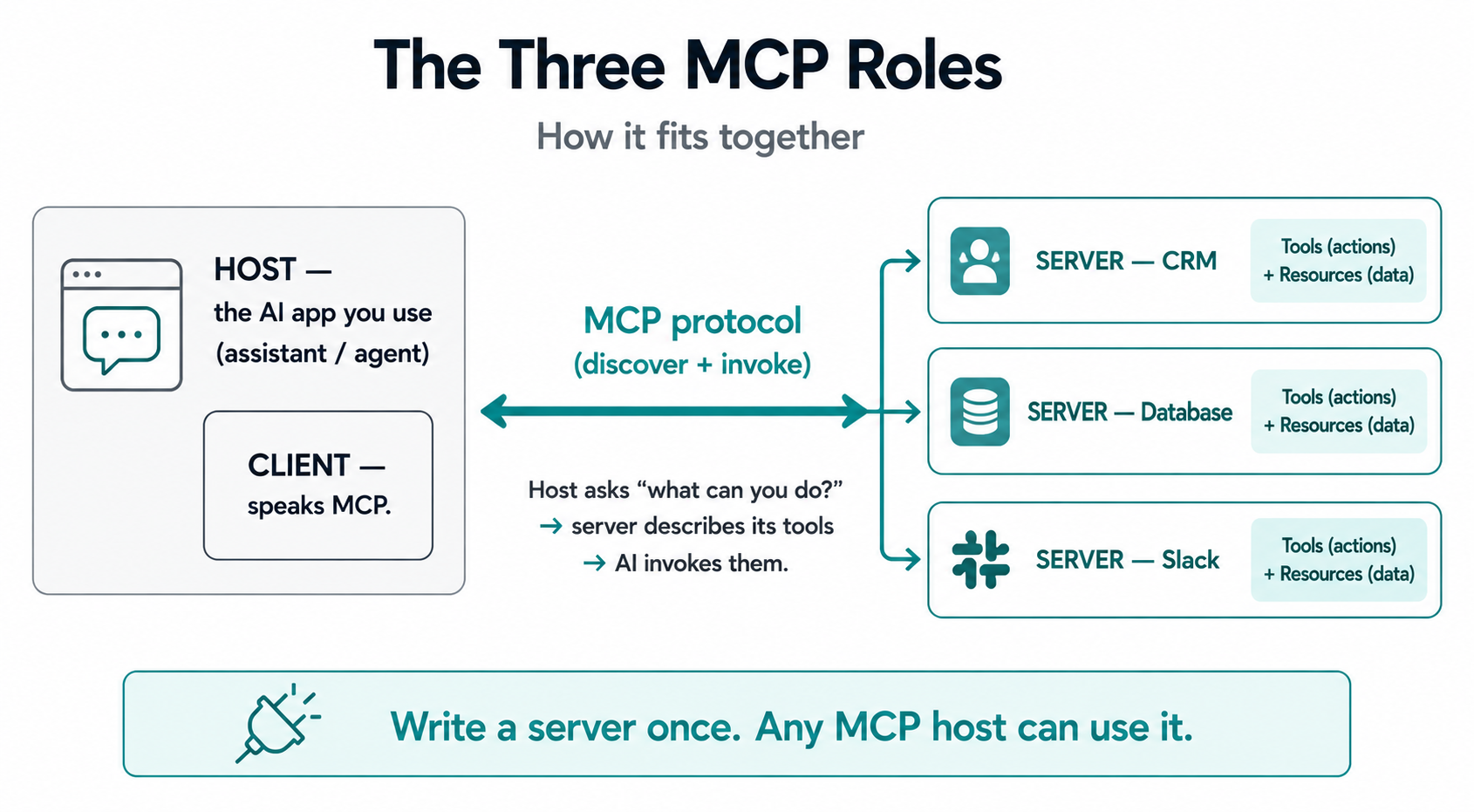
MCP uses a simple structure with three roles. You do not need to be technical to follow it, and knowing the three words makes everything written about MCP readable.
A host is the AI application you are actually using, the thing with the model inside it that wants access to tools. Your AI assistant, your agent, your chat app.
A server is a connector that exposes a particular tool or data source in the MCP standard. There might be an MCP server for your CRM, one for your database, one for Slack. The server is written once, by whoever wants that tool to be AI-accessible, and then it just works with anything that speaks MCP.
A client sits inside the host and is the piece that actually talks to a server in the MCP language. You can mostly think of host-and-client together as "the AI side" and server as "the tool side."
The flow is straightforward. The host connects to an MCP server, asks "what can you do?", and the server describes the tools and data it offers. From then on, when the AI decides it needs one of those tools, it invokes it through the protocol and gets the result back. The crucial part is that the AI did not need to be pre-programmed with that specific tool. It discovered what was available and used it through the shared standard. That is what "plug-and-play" actually means here.
MCP servers expose a few kinds of things, and the main two are worth knowing. Tools are actions the AI can take: query a database, send an email, create a ticket. The model decides when to use them based on what you have asked. Resources are data the AI can read: a document, a record, a file. Tools let the AI do; resources let it read. That distinction is most of what you need.
How this relates to APIs, agents, and function calling
If you have read my piece on webhooks, APIs and triggers, a fair question is: isn't an API already how software talks to software? Yes, and MCP does not replace APIs. It sits on top of them. Your CRM still has its normal API for human-built software to use. An MCP server wraps that API in the standard form that AI models understand, so the model can discover and use it without custom wiring. MCP will not replace REST APIs any more than USB-C replaced electricity. It is a layer that makes existing tools accessible to AI in a consistent way.
There is also a term you will hear alongside MCP: function calling, sometimes called tool use. That is the underlying ability of a model to call an external function. MCP does not compete with it; it standardises it. Before MCP, every model had its own format for describing the functions it could call, so you wrote model-specific plumbing for each one. MCP defines one shared format, so a tool described once works across any model that speaks the protocol.
And this is exactly where MCP connects to the bigger story. Remember that an AI agent is an LLM plus memory, planning, and tool use. MCP is rapidly becoming the standard way that tool-use layer gets wired up. It is the substrate that turns a model from something that talks into something that acts in your real systems, reliably and without a bespoke integration for every connection. That is why people describe the shift it enables as AI moving from answering questions to participating in your actual workflows.
Why it matters for an e-commerce operation
Strip away the protocol detail and here is the practical significance. The AI tools genuinely worth adopting in 2026 are not the ones that just chat. They are the ones that act on your real data: pull a customer record, update an order, prioritise outreach, feed a result back into your workflow. That only works if the AI can reliably connect to the real systems where your work lives, and connecting it the old bespoke way was expensive and fragile.
MCP changes the economics of that. An AI tool that speaks MCP can plug into your existing stack far more cleanly than one demanding custom integrations for everything. An agent connected to one CRM today can connect to a different one tomorrow, as long as both have MCP servers, without being rebuilt. For anyone running an operation rather than a lab, that is the difference between AI integrations being a constant maintenance burden and being something close to plug-and-play. It is also a useful buying signal: when you evaluate an AI tool now, "does it support MCP?" is a fair question to ask about how well it will fit your stack and survive your next tool change.
The protocol is still evolving, so the details will keep moving. But the core idea is stable and worth holding onto: MCP is the standard plug that lets AI connect to your tools without a custom cable for every one. It is unglamorous infrastructure, and unglamorous infrastructure that everyone agrees on is usually the kind that quietly changes everything.
A few common questions
What is MCP (Model Context Protocol) in simple terms? An open standard that gives AI models one consistent way to connect to external tools and data. Build the connection once as an MCP server, and any MCP-compatible AI can use it, instead of writing a custom integration for every model-and-tool combination. It is often called the USB-C for AI.
Who created MCP and who uses it? It was introduced by Anthropic in late 2024 and, within months, adopted by OpenAI, Google, and Microsoft, making it the de facto open standard for connecting AI to tools and data in 2026.
Does MCP replace APIs? No. APIs still serve human-built software. An MCP server wraps an existing API in a standard form that AI models can discover and use, so MCP sits on top of your APIs rather than replacing them.
How does MCP relate to AI agents? An AI agent needs tool use to act in the world. MCP is becoming the standard way that tool-use layer is wired up, letting an agent discover and use tools without a bespoke integration for each one. It is what turns a model that talks into one that acts in your real systems.
You should also read:
Serverless Explained for a Marketing Team (What "Lambda" Actually Means)
"Serverless" is one of the most misleading words in technology, because it does not mean there are no servers. It means you do not have to think about them. With serverless computing, you hand a small piece of code to a cloud provider, it runs…
Continue reading...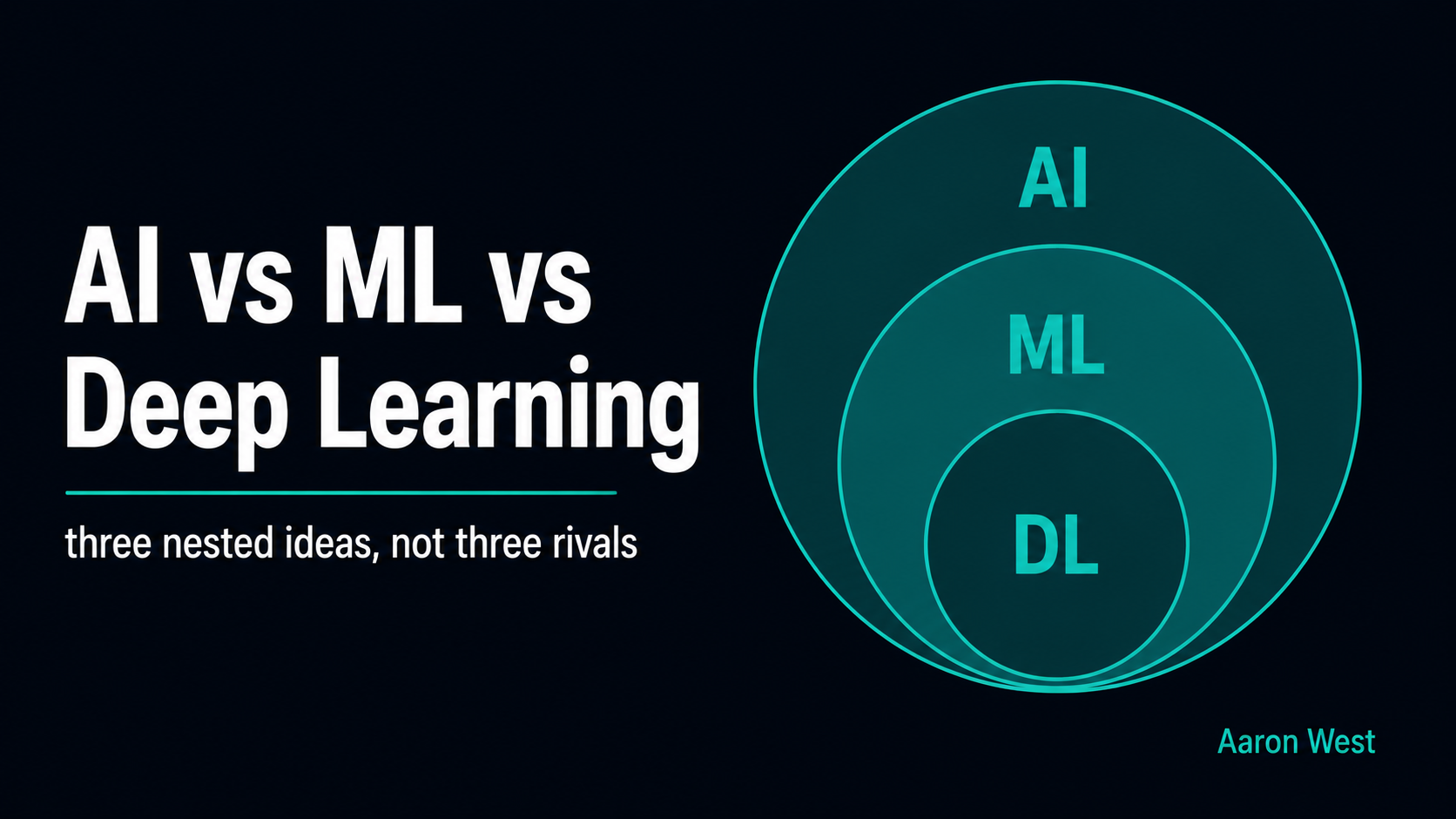
AI vs Machine Learning vs Deep Learning: The Distinction That Actually Matters
Artificial intelligence, machine learning, and deep learning are not three competing things you choose between. They are three nested ideas, each one a more specialised part of the one before it. AI is the big outer goal: machines doing things that would normally need human…
Continue reading...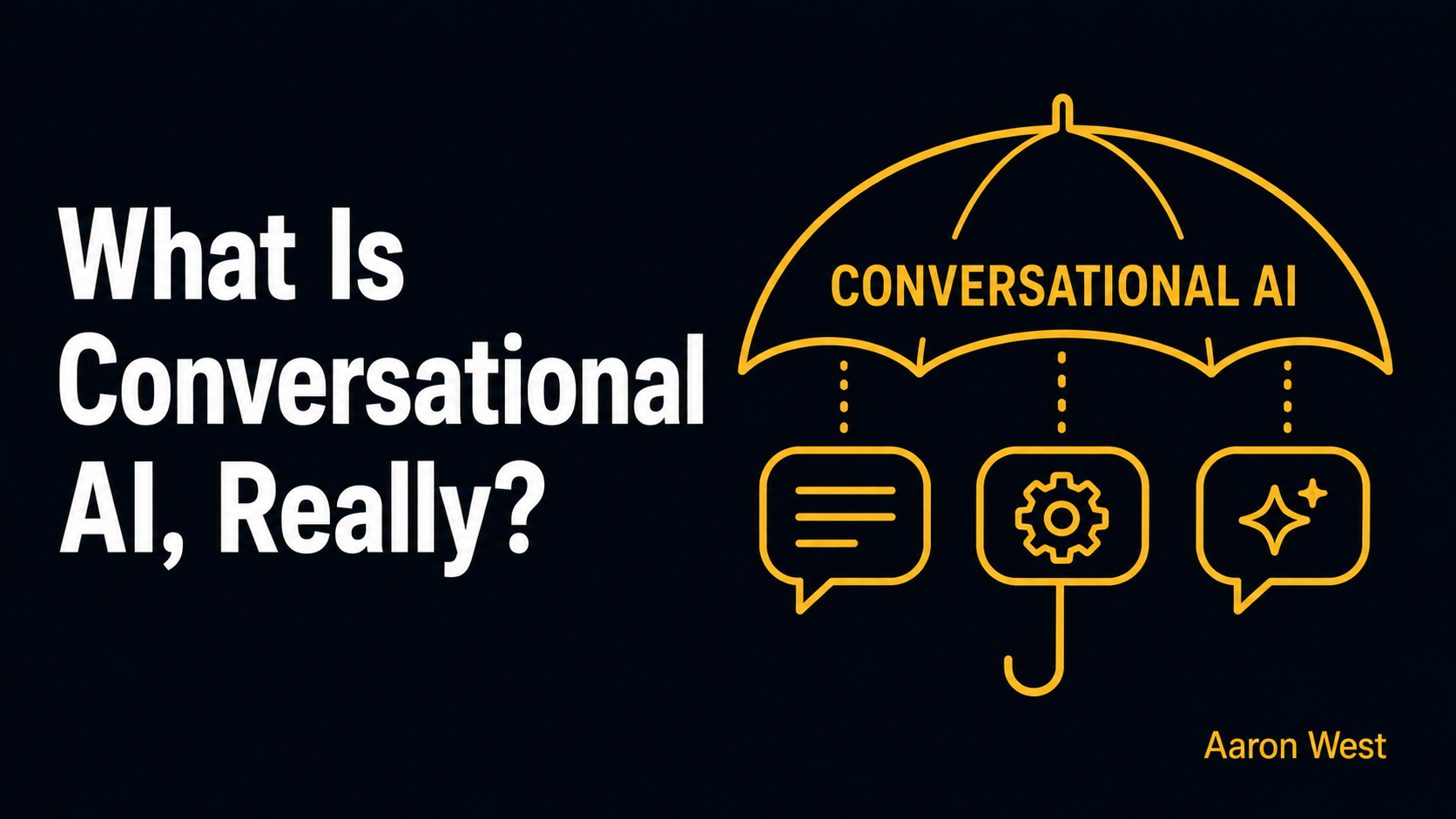
What Is Conversational AI, Really, and What It Still Can't Do
Conversational AI is the umbrella term for any technology that lets a machine understand, process, and respond to human language in something close to a natural conversation, by text or by voice. That is the whole definition. It is not one product or one technique.
Continue reading...