What Is RAG (Retrieval-Augmented Generation), and Why Everyone Is Using It

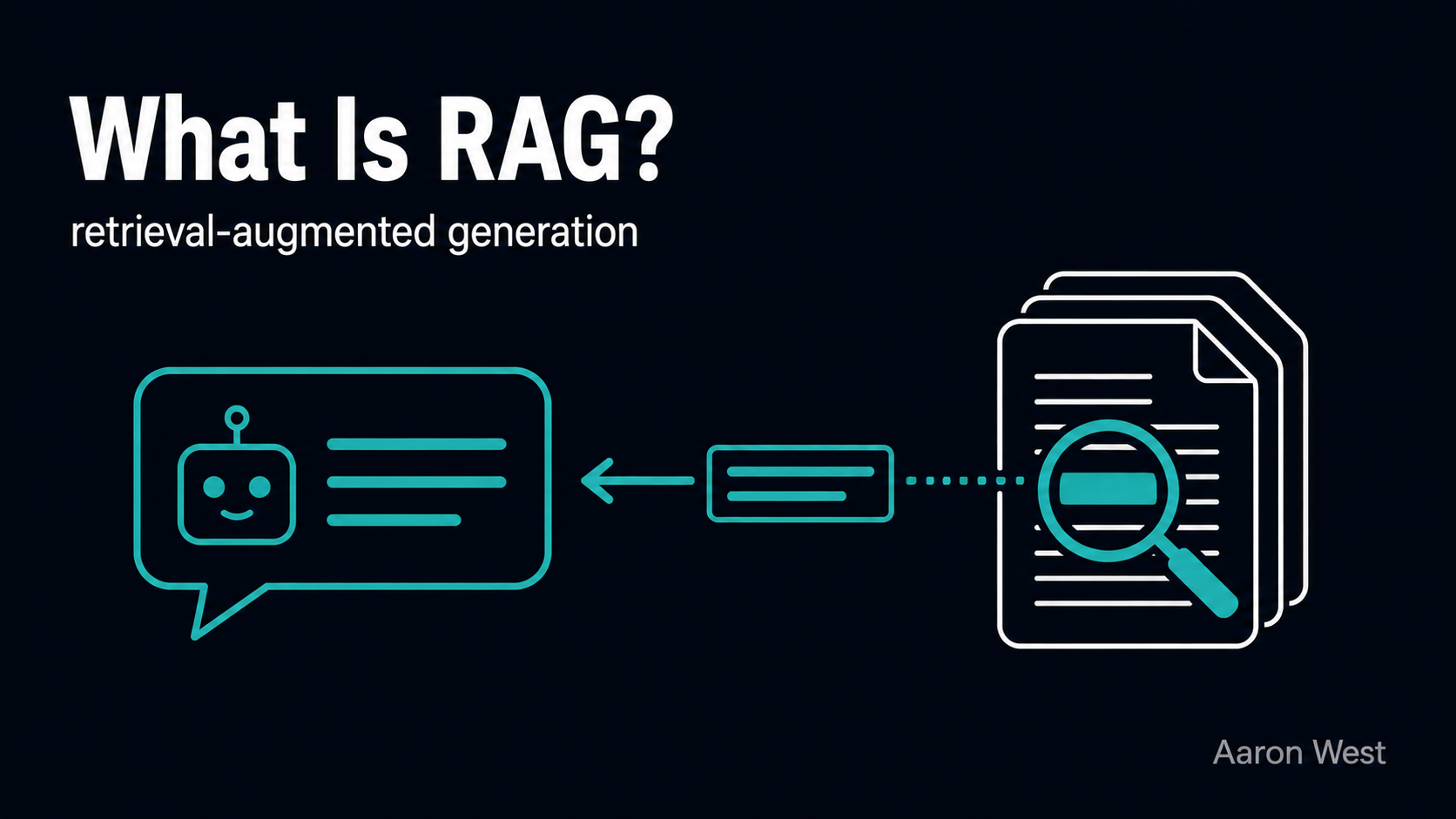
Table of Contents
RAG, retrieval-augmented generation, is a way of making an AI model answer from a specific, trusted set of documents instead of relying only on what it absorbed during training. Before the model writes its answer, the system goes and fetches the most relevant material from a knowledge base you control, and hands that to the model along with your question. The model then answers grounded in those real sources, rather than from memory alone.
If you have ever wanted an AI that can answer questions about your company's policies, your product catalogue, or your internal documents, accurately and with current information, you have wanted RAG, whether you knew the name or not. It is the single most common pattern for building useful AI applications on real business data, and once you understand why, you understand a lot about how serious AI tools are actually built. Here is the plain-language version.
The problem RAG solves: a brilliant graduate who stopped reading
A plain language model has two stubborn limitations, both of which I have written about elsewhere and both of which RAG directly targets.
First, its knowledge is frozen and general. A model knows what was in its training data up to a cut-off date, and nothing after. It has never seen your internal documents, your latest prices, or anything that happened since it was trained. Ask it about your refund policy and it will either admit it does not know or, worse, confidently invent one. Second, because it generates plausible text rather than retrieving facts, it can hallucinate, producing fluent answers that are simply wrong.
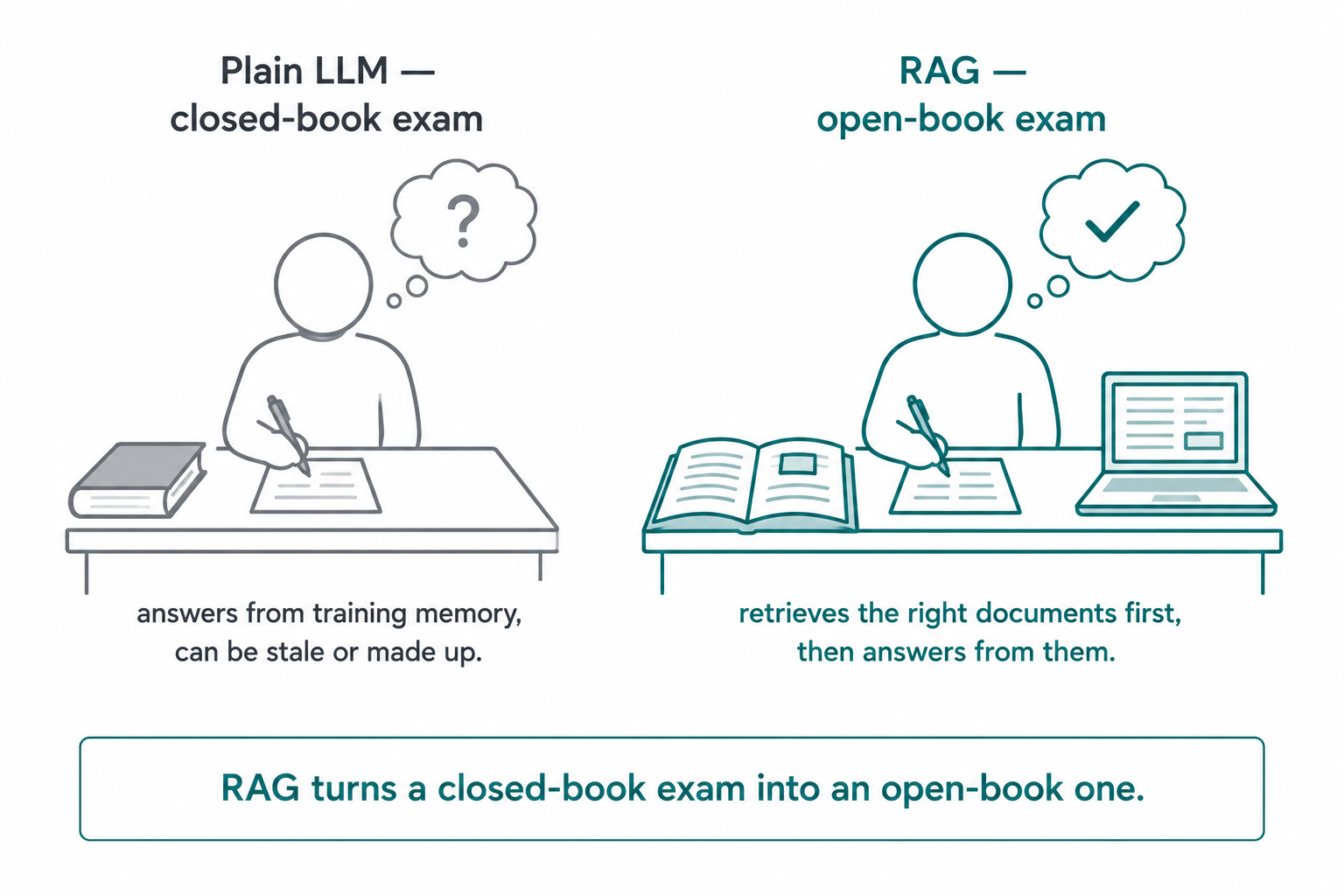
Picture a brilliant graduate who read an enormous library years ago and remembers the gist of all of it, but has read nothing since and cannot look anything up. They are articulate and broadly knowledgeable, and confidently wrong the moment you ask about something specific, recent, or internal to your business. That is a raw LLM. RAG is the equivalent of giving that graduate access to the exact reference documents they need, open on the desk in front of them, before you ask the question. Suddenly they are not answering from hazy memory. They are answering from the page.
How RAG works: retrieve, then generate
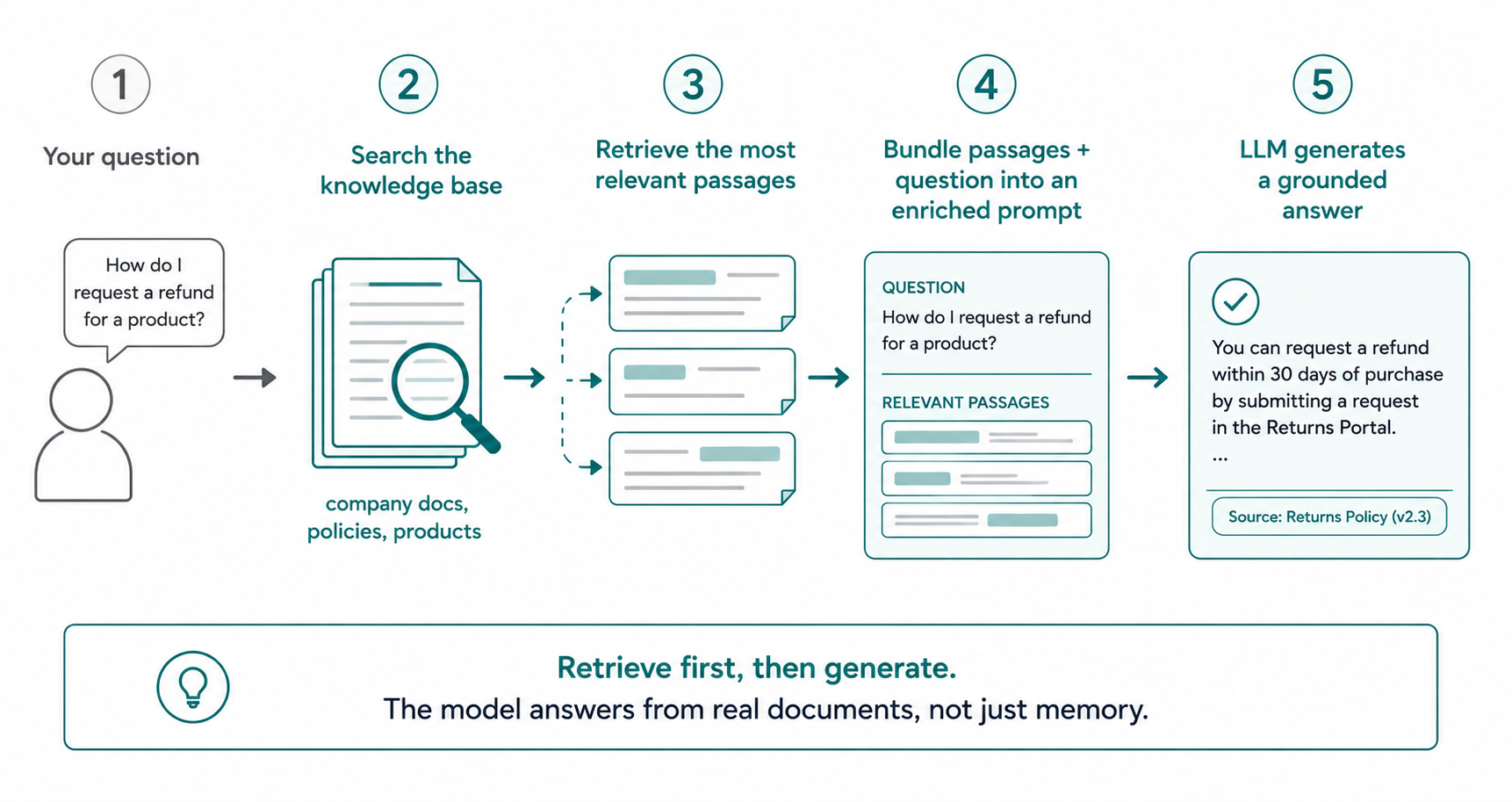
The name describes the two steps exactly: it retrieves, then it generates. Walk through what happens when you ask a RAG-powered system a question.
First, your question is used to search a knowledge base, a collection of documents someone has prepared in advance: company policies, product information, support articles, whatever the system is meant to know about. The retrieval step finds the handful of passages most relevant to what you asked. Then comes the clever part: instead of sending the model just your question, the system quietly bundles those retrieved passages together with your question into an enriched prompt, effectively saying to the model, "here is the question, and here is the relevant source material, now answer using this." The model generates its response grounded in that supplied material, and hands it back.
That is the whole pattern. The model is doing what it always does, predicting a good answer, but now it is doing it with the right reference material placed directly in front of it rather than reaching into general memory. The retrieval happens in a fraction of a second and you usually never see it. From your side it just looks like the AI happens to know your business well.
Behind the scenes, the documents are usually prepared by being broken into chunks and converted into a mathematical form that makes them searchable by meaning rather than just keywords, so a question about "time off" can find a document titled "holiday and leave policy" even with no shared words. That semantic-search machinery (vectors and embeddings, if you want the terms to look up) is the engineering detail. The concept you need is simpler and more durable: fetch the relevant real documents, then answer from them.
Why RAG beats the obvious alternatives
A fair question: if you want an AI that knows your business, why not just retrain the model on your data, or paste all your documents into the prompt every time? RAG wins over both, and the reasons are worth knowing because they explain why it became the default.
Retraining a model on your data is enormously expensive, slow, and has to be redone every time your information changes. Your prices change weekly; you cannot retrain a model weekly. RAG sidesteps this entirely. You update the knowledge base, a normal document store, and the next query immediately uses the new information. No retraining, no waiting, no cost of rebuilding the model. The knowledge stays current because it lives outside the model, where you can edit it freely.
Pasting everything into the prompt fails for a different reason, and it connects directly to the context window. The model can only hold so much at once, and even within that limit, burying the key fact inside a giant dump of documents makes the model more likely to miss it. RAG is the disciplined answer: rather than handing the model everything and hoping, it selects only the few most relevant passages for each specific question and feeds in just those. It treats the context window as the valuable, limited workspace it is. That is the same instinct as good tool design with standards like MCP: give the model clean, relevant, well-structured access to real information rather than a raw flood.
There is one more benefit that matters a lot in practice: because a RAG system knows which documents it used, it can cite them. The answer can come with its sources attached, so you can verify it rather than taking it on faith. For any business use where being wrong is costly, that traceability is often the whole reason to use RAG in the first place.
Why it matters for an e-commerce operation
Strip away the architecture and here is the practical payoff. RAG is what lets you point an AI at your own trusted information and get answers grounded in it. A support chatbot that answers from your actual return policy and current product details, not a plausible guess. An internal assistant that lets your team query hundreds of pages of supplier contracts or process documents in seconds. A product assistant that recommends from your real catalogue rather than inventing items.
It also directly addresses the trust problem that holds a lot of teams back from deploying AI at all. A raw model that might confidently hallucinate your refund terms is a liability on a customer-facing channel. The same model, grounded in your real policy documents through RAG and able to cite them, is something you can actually put in front of customers. RAG does not make hallucination impossible, and there is a catch worth stating plainly: a RAG system is only as good as the documents you feed it. Point it at outdated or messy source material and you simply get confident answers built on bad information. The model retrieves what you give it. Garbage in, garbage out still applies. But fed clean, current, well-organised sources, RAG is the difference between an AI that is a fun demo and one you can trust with real work.
So that is RAG: retrieve the relevant real documents first, then let the model generate its answer from them. It grounds a large language model in your actual knowledge, keeps it current without retraining, lets it cite its sources, and turns a brilliant-but-unreliable generalist into something that can answer accurately about your specific business. That is why, in 2026, it is behind so many of the AI applications that are actually worth using.
A few common questions
What is RAG (retrieval-augmented generation) in simple terms? A method where an AI system fetches relevant documents from a knowledge base you control and feeds them to the model along with your question, so the model answers from real, trusted sources instead of relying only on its training. Retrieve first, then generate.
How does RAG reduce hallucinations? By grounding the model's answer in actual retrieved documents rather than letting it generate from memory alone. It does not eliminate hallucination, and it is only as reliable as the sources you give it, but answering from supplied real material is far safer than answering from hazy training memory, and the system can cite its sources so you can verify.
Why use RAG instead of retraining the model on my data? Retraining is expensive, slow, and must be redone whenever your data changes. RAG keeps your knowledge in an ordinary document store outside the model, so you update the documents and the next query uses the new information immediately, no retraining, no cost, always current.
What is RAG used for in business? Common uses include customer support chatbots that answer from your real policies and product data, internal knowledge-search assistants over company documents, and product assistants grounded in your actual catalogue. Anywhere you want AI answers grounded in your own trusted, current information.
You should also read:
Using AI in Real E-Commerce Work: Where It Earns Its Place and Where It Wastes Your Time
After actually using AI across real e-commerce work rather than reading about it, here is the honest summary: AI is genuinely transformative for a specific, narrow band of tasks, and a confident waste of time for a surprising number of others. The skill in 2026…
Continue reading...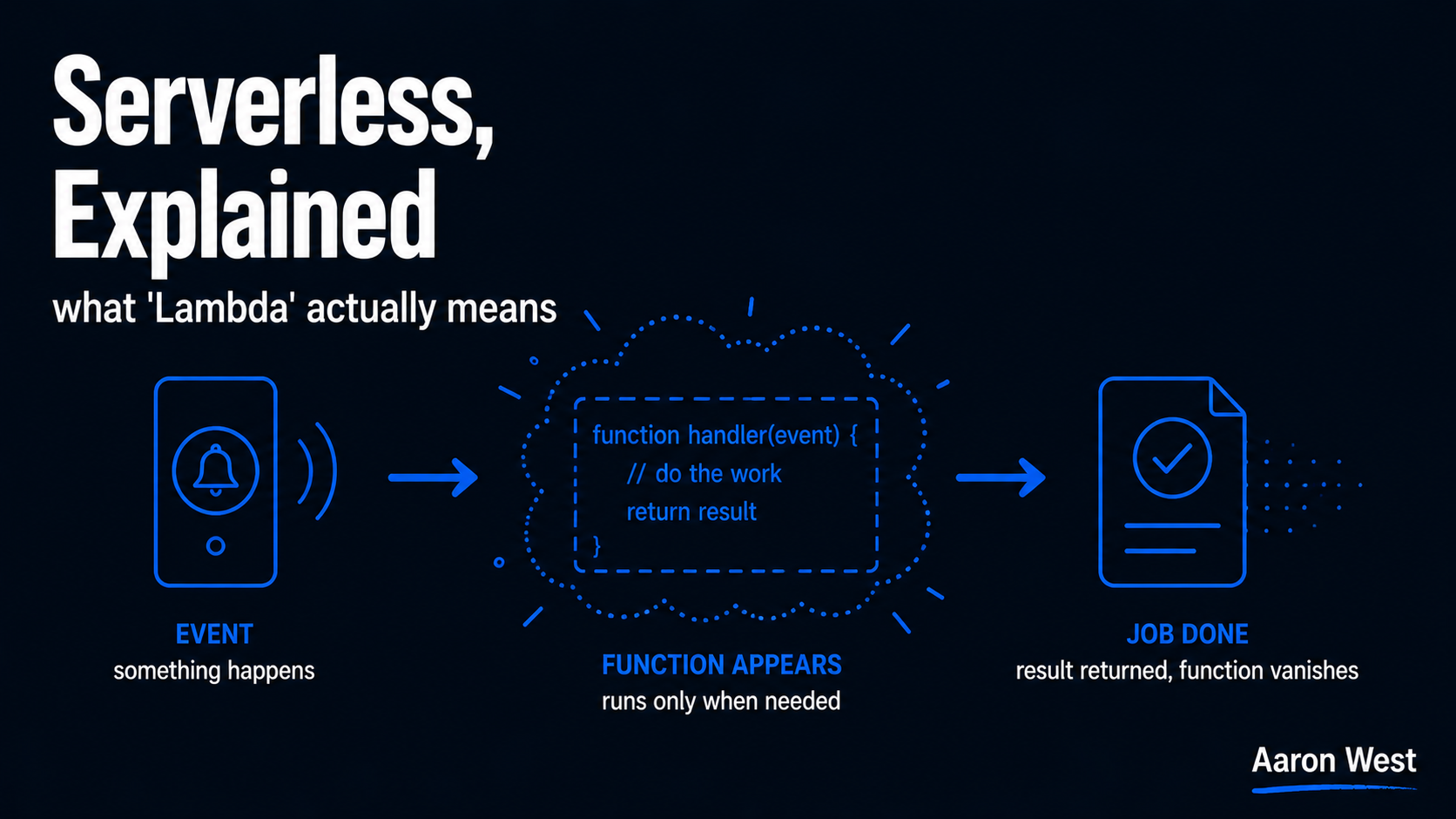
Serverless Explained for a Marketing Team (What "Lambda" Actually Means)
"Serverless" is one of the most misleading words in technology, because it does not mean there are no servers. It means you do not have to think about them. With serverless computing, you hand a small piece of code to a cloud provider, it runs…
Continue reading...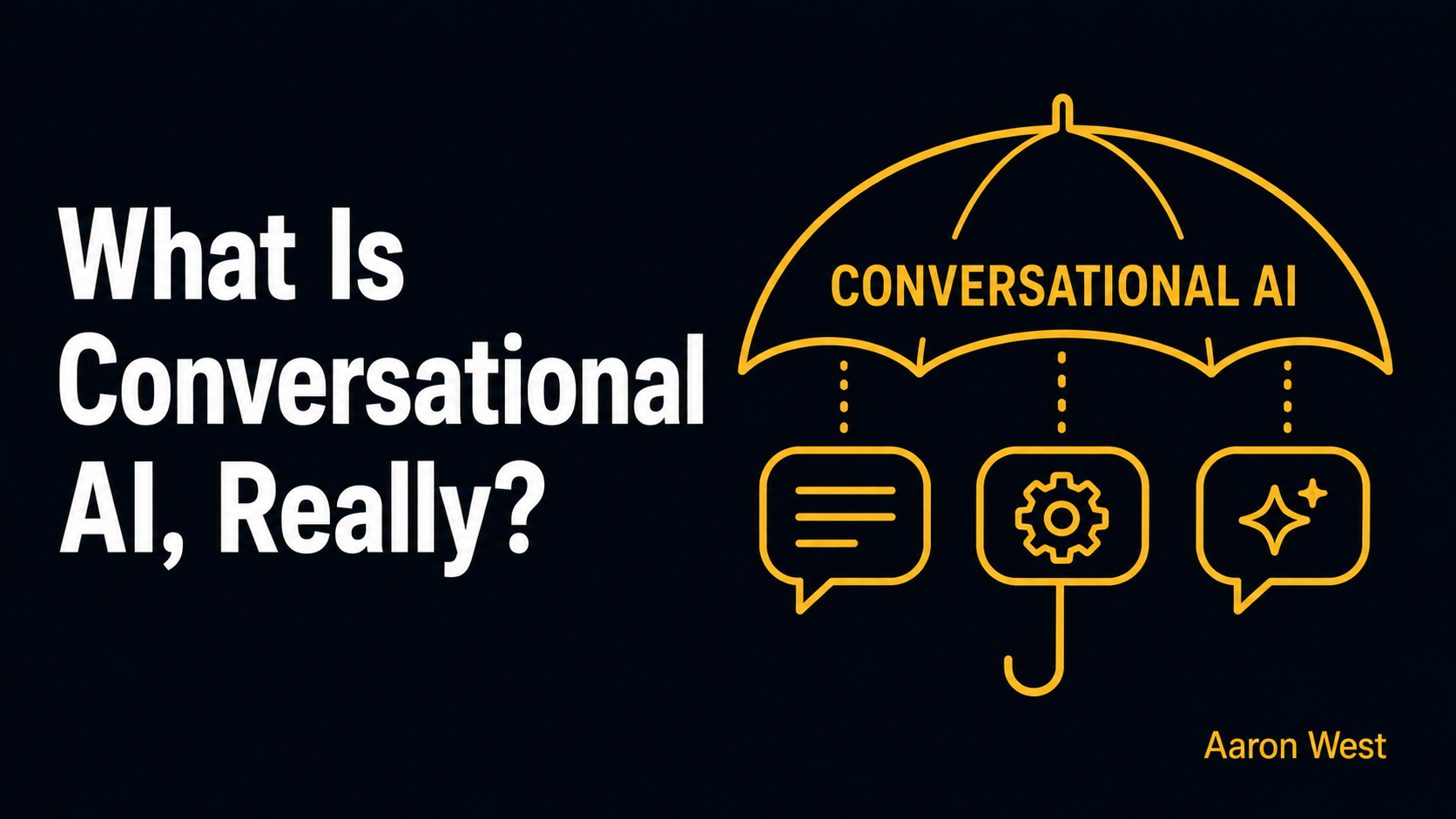
What Is Conversational AI, Really, and What It Still Can't Do
Conversational AI is the umbrella term for any technology that lets a machine understand, process, and respond to human language in something close to a natural conversation, by text or by voice. That is the whole definition. It is not one product or one technique.
Continue reading...