Intent-Based vs Generative Bots: Why the Best Systems Use Both

Table of Contents
The loudest take in 2026 is that the old rule-based chatbot is dead, that large language models have made the intent-based bot obsolete, and that you should rip out the scripts and let a generative model handle everything. It is a clean story, and it is wrong. The best conversational systems I see today are not generative instead of intent-based. They are both, deliberately combined, each doing the job it is actually good at.
I have a particular vantage point on this, because I built a classic intent-based bot for a hotel group back in 2019, before generative AI was an option at all, and I have watched the whole pendulum swing since. The short version of what I have learned: the two approaches fail in opposite ways, which is exactly why pairing them works. A rule-based system is reliable but rigid. A generative system is flexible but unpredictable. Put them together correctly and you get reliability where you need it and flexibility where you want it. Here is how to think about it, and where the dividing line actually goes.
What each approach actually is
Start with what these two things really are, in plain terms, because the labels get thrown around loosely.
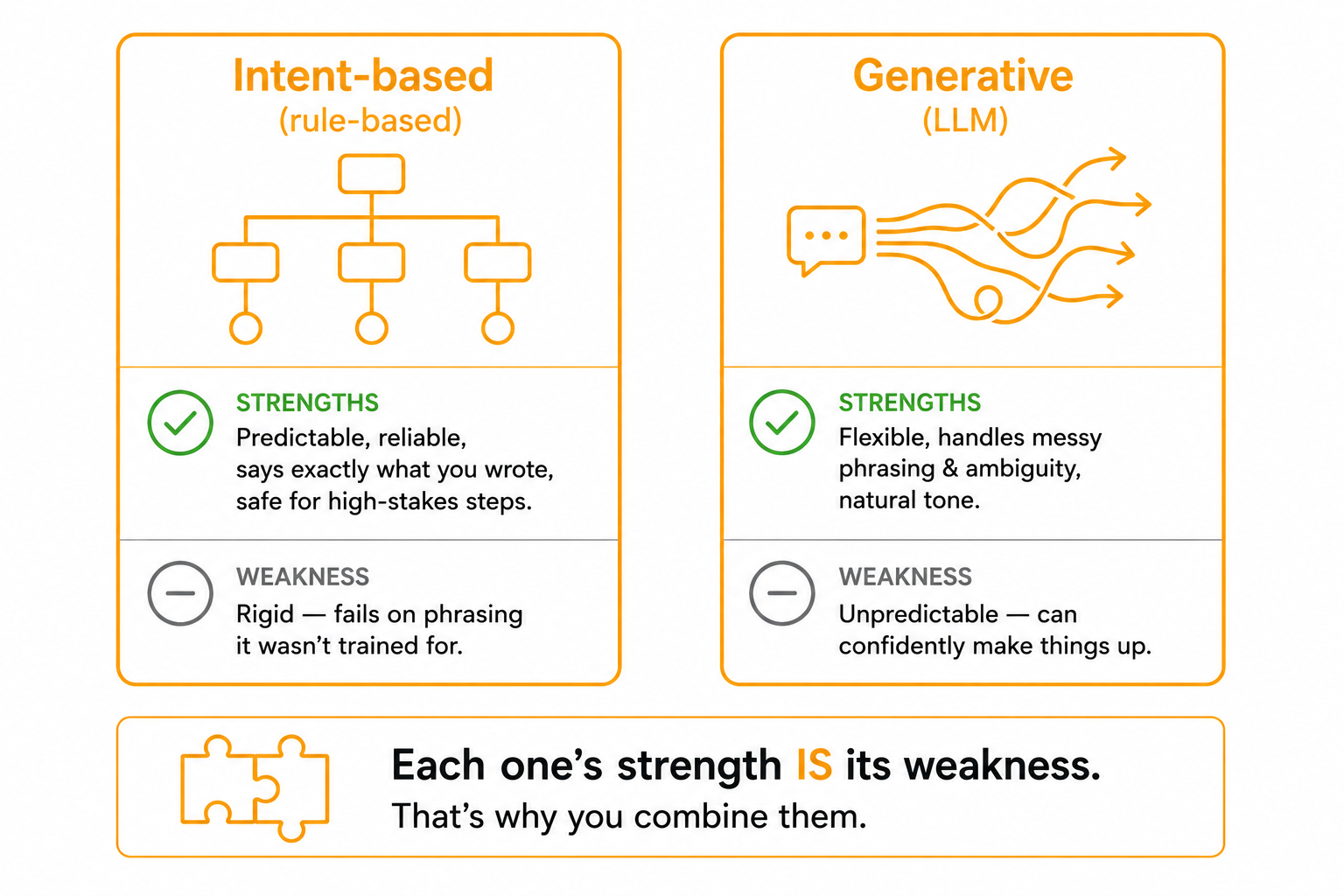
An intent-based bot (the older, rule-based approach) works by recognising what a user wants, the intent, and mapping it to a predefined response or flow. You define intents like "reset password" or "check order status," and the bot follows a script: it identifies the intent, then runs the path you wrote for it. Its defining quality is that it only ever does what you told it to. Predictable by design. It says exactly what you wrote, every time.
A generative bot works differently. Instead of retrieving a pre-written answer, it uses a large language model to generate a fresh, context-aware response on the spot. It reads the message, takes the conversation into account, and writes a reply in natural language. Its defining quality is flexibility: it handles messy phrasing, ambiguity, and questions you never explicitly scripted, because it is not matching against a fixed list, it is composing an answer.
Put like that, the generative bot sounds strictly better, and that is the trap. Flexibility cuts both ways. The same model that gracefully handles a question you never anticipated can also, just as gracefully, invent a confident wrong answer to a question where being wrong is expensive. The intent bot's rigidity is also its reliability. The generative bot's flexibility is also its unpredictability. Neither is a flaw you can engineer away, because in each case the strength and the weakness are the same property.
The dividing line: rules decide what, the model decides how
So where do you draw the line? The cleanest principle I have found, and the one current practice keeps converging on, is this: let rules decide what is allowed, and let the model decide how to say it.
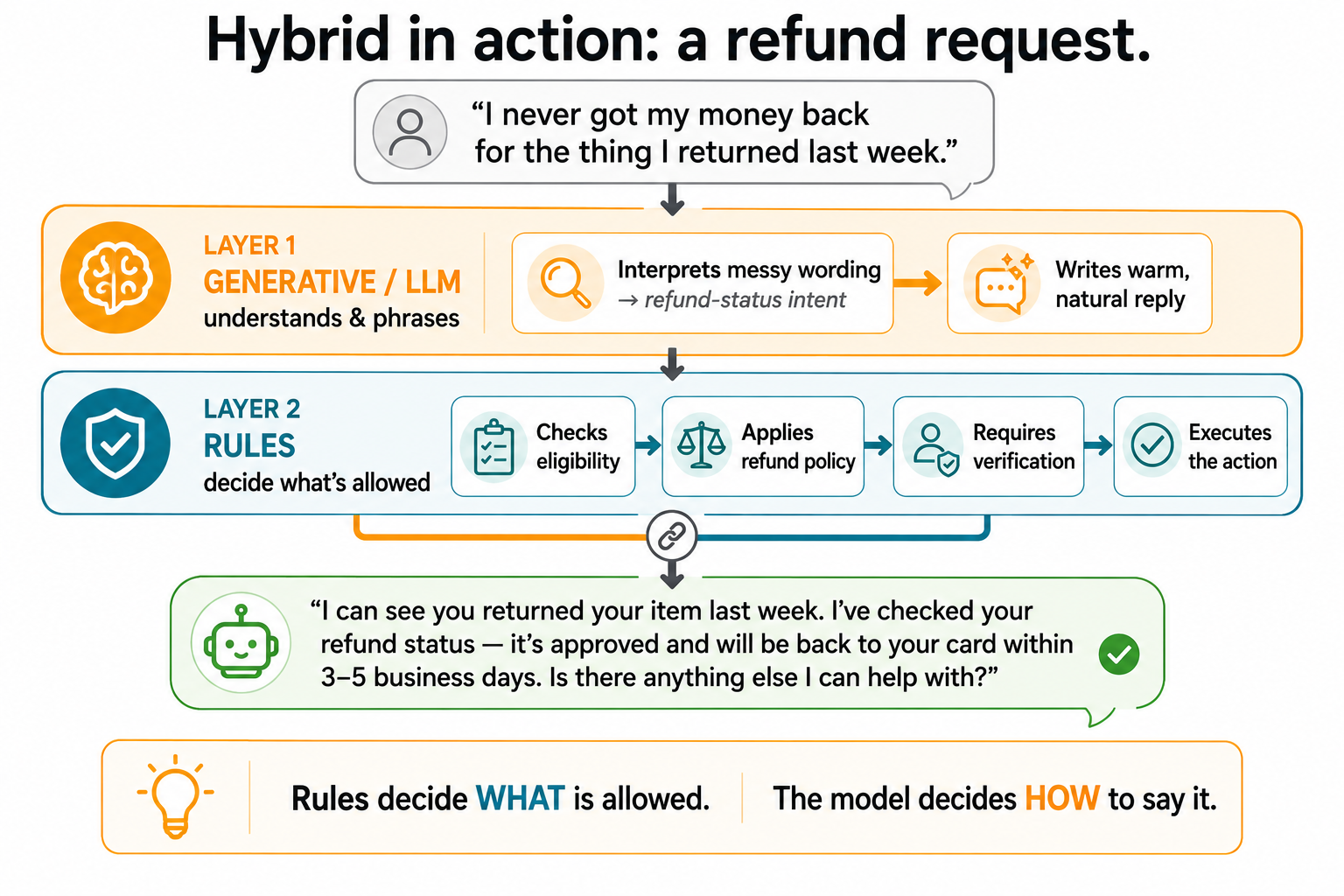
Think about a refund request. There are things about that interaction you absolutely do not want a generative model improvising: who is eligible, what the policy actually permits, what verification is required, the exact wording of a commitment. Those are rules. They must be the same every time, correct every time, and never invented. That is deterministic, high-stakes territory, and it belongs to the rule-based layer, for exactly the reason I argue some automation should never be handed to a non-deterministic system: when being wrong is expensive and the answer must be exact, you want predictability, not creativity.
But the how of that same interaction, understanding that "I never got my money back from the thing I sent back last week" means a refund-status query, and replying in warm, clear, natural language rather than a robotic script, is exactly what the generative model is brilliant at. So the model interprets the messy input and writes the human-sounding reply, while the rules govern the facts, the eligibility, and the actions. The customer experiences one smooth conversation. Underneath, two systems are each doing the half they are suited to.
This split resolves the false choice. You are not betting your refund logic on a model that might hallucinate, and you are not forcing customers through a rigid phone-tree script that breaks the moment they phrase something unexpectedly. Rules for the facts and the actions. The model for the understanding and the words. That is the architecture that actually works.
When you don't need both
Honesty matters here, because "use both" can become its own lazy default, and a hybrid system is more complex to build and maintain than either approach alone. So when can you skip the complexity?
If your needs are genuinely simple and predictable, a handful of structured questions like opening hours, store location, appointment confirmation, a plain rule-based bot is often the right call, full stop. It is cheaper, faster to deploy, completely predictable, and adding a generative layer would buy you flexibility you do not need while introducing unpredictability you do not want. Small operations with a narrow, stable set of questions should not over-engineer this. The rule-based bot is not obsolete; it is just no longer the answer to everything.
And at the other end, the picture is shifting again. The frontier is moving from generative bots that answer toward agents that act, and toward grounding the model in your real documents with retrieval so it answers from your actual policies instead of from training or invention. But notice that this does not abandon the hybrid principle, it deepens it. Retrieval is a way of feeding the generative layer trustworthy facts. Agentic action makes the "rules decide what is allowed" boundary more important, not less, because now a confident mistake can do something, not just say it. The newest architectures are more hybrid, not less.
How to actually decide
Strip it to a practical sequence. First, ask whether your use case is genuinely simple and stable. If it is, a rule-based bot may be all you need, and that is a perfectly good answer. If it is not, you are in hybrid territory, and the question becomes where to draw the line between the two layers.
Draw it by stakes and variability. Anything where being wrong is expensive or where the answer must be exact, eligibility, policy, money, verification, identity, goes to the deterministic rule-based layer. Anything that is about understanding what a human actually meant and responding naturally goes to the generative layer. When in doubt about a specific step, ask the question from the cornerstone of how I think about chatbots: what happens if this is wrong? If the answer is "an awkward sentence," let the model handle it. If the answer is "we issue a refund we shouldn't have," that is a rule, and it stays a rule.
The takeaway is the opposite of the hype. The arrival of powerful generative models did not kill the intent-based bot, it gave us a second tool with the opposite strengths, and the skill now is combining them deliberately. Rules where you need to be right. The model where you need to be understood. The best systems were never going to be one or the other. They were always going to be both, used on purpose.
A few common questions
What is the difference between an intent-based and a generative chatbot? An intent-based (rule-based) bot recognises what the user wants and follows a predefined script, so it is predictable but rigid. A generative bot uses a large language model to compose fresh, natural responses, so it is flexible but can be unpredictable and occasionally invent wrong answers. Their strengths and weaknesses are mirror images.
Should I use a rule-based or generative chatbot? For genuinely simple, stable needs (opening hours, appointment confirmation), a rule-based bot is often the best, cheapest, most predictable choice. For messy phrasing, ambiguity, and varied questions, you need the generative approach. For most real businesses, the answer is a hybrid that uses each where it fits.
What is a hybrid chatbot? A system that combines both approaches: rules handle the deterministic, high-stakes parts (eligibility, policy, verification, actions), while a generative model handles understanding messy input and producing natural replies. The principle: rules decide what is allowed, the model decides how to say it.
Did large language models make rule-based chatbots obsolete? No. They added a second tool with opposite strengths. Rule-based systems are still ideal for simple, predictable tasks and for any step where being wrong is costly and the answer must be exact. The best modern systems combine deterministic rules with generative flexibility rather than choosing one.
You should also read:
What Is GEO (Generative Engine Optimization)?
Generative Engine Optimization (GEO) is the practice of structuring your content so that AI systems like ChatGPT, Perplexity, Google's AI Overviews, and Gemini cite, quote, or recommend it when they answer a user's question. Where traditional SEO optimises to rank in a list of links…
Continue reading...
Conversational AI & Chatbots: Was Marketing-Profis 2025 wissen müssen
Conversational AI & Chatbots: Ein ehrlicher Leitfaden jenseits des Hypes – mit dem, was funktioniert, was schiefgeht, und was du wirklich beachten musst. Der Artikel bietet einen umfassenden, praxisnahen Überblick über den aktuellen Stand, die Einsatzmöglichkeiten, Risiken und strategischen Erfolgsfaktoren von Conversational AI und Chatbots…
Continue reading...